


TPO Roofing Membrane Manufacturer for Low-Slope Commercial Roofs, Industrial Waterproofing, and Custom OEM Supply
DERFLEX supplies TPO roofing membrane for buyers who need more than a generic roll good. We support roofing contractors, building material distributors, waterproofing brands, project developers, industrial procurement teams, and OEM buyers looking for a more reliable source of custom TPO roof membrane, reinforced TPO waterproof roofing membrane, and commercial single-ply systems that combine weather resistance, weldability, dimensional stability, reflectivity, and commercially realistic delivery.
Whether the requirement involves a large warehouse roof, an industrial plant upgrade, a logistics center, a retail building, a data facility, a municipal waterproofing program, or a private-label roofing membrane line, serious buyers usually evaluate the same fundamentals. They want membrane quality that stays consistent across batches, seams that can be welded with confidence, stable supply for repeat orders, widths and thicknesses suited to project design, lead times that match construction schedules, and a manufacturer that understands that roofing procurement is not only a material transaction. It is a system decision tied to project risk, installation speed, downstream warranty expectations, and long-term building performance.
This page is written for commercial decision-makers rather than casual readers. Instead of relying on vague brochure claims, it explains what TPO roofing membrane is, what technical variables buyers should review, where the material is commonly used, how it compares with alternative roofing membranes, and why OEM and export-oriented customers often prefer to work with a manufacturer capable of aligning product supply with project planning.
What Is TPO Roofing Membrane?
TPO roofing membrane is a thermoplastic polyolefin-based single-ply roofing sheet used as the exposed waterproofing layer in many low-slope commercial roofing systems. In practical procurement language, it is the membrane category buyers turn to when they need a roof covering that is lightweight compared with multi-layer built-up systems, workable for modern installation methods, compatible with heat-welded seams, and commercially adaptable across a wide range of industrial and commercial buildings.
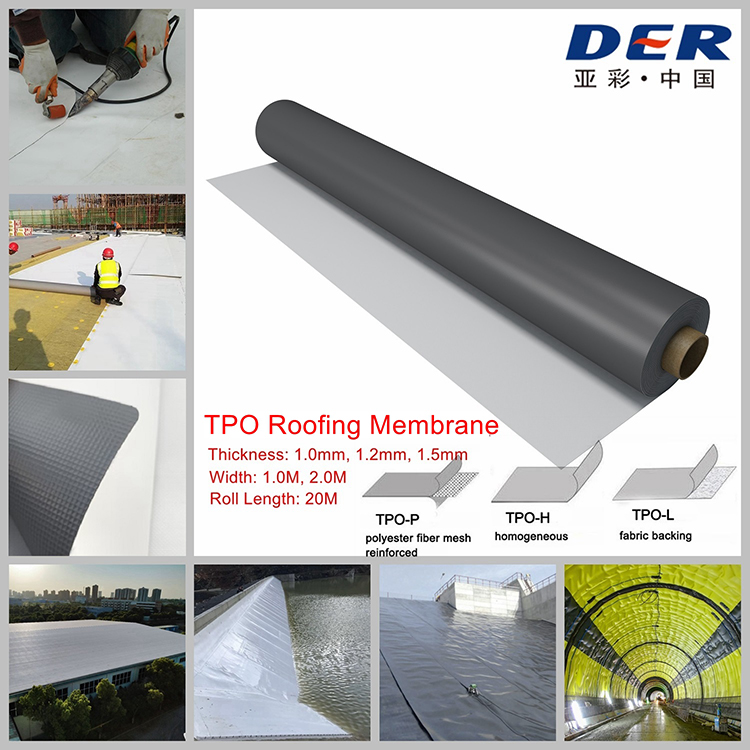
A TPO roof membrane is not simply “plastic sheet for roofs.” It is part of a complete assembly that may include deck, vapor management, insulation, cover board, fasteners or adhesives, perimeter detailing, drainage design, and flashing strategy. Because of that, professional buyers do not evaluate the membrane only by price per roll. They evaluate whether it can support the intended system pathway, whether it is suitable for the project climate and building use, whether it allows efficient installation, whether it supports light-color reflective design strategies, and whether the manufacturer can deliver stable material quality on the schedule required by the project.
In the broader market, TPO is widely recognized as one of the most important single-ply options for low-slope commercial roofing. The category is associated with heat-welded seams, weather resistance, UV resistance, and strong commercial practicality when correctly specified. That is why searches for phrases such as TPO roofing membrane manufacturer, TPO roof membrane supplier, reinforced TPO roofing membrane, or custom TPO membrane supplier are usually made by buyers who already understand the material’s importance and now need a dependable supply partner rather than a basic textbook definition.
DERFLEX approaches TPO roofing membrane as a professional building-material product rather than a commodity. That means membrane discussion is tied to installation method, project type, thickness logic, climate exposure, roll planning, export handling, OEM requirements, and documentation needs. For serious buyers, that is far more useful than generic product wording.
Need a TPO roofing membrane supplier for commercial, industrial, or OEM roofing projects?
Tell DERFLEX your target building type, assembly direction, thickness requirement, color preference, and project quantity. We can help align the membrane supply direction with your commercial roofing goals.
Key Features Buyers Expect from a Competitive TPO Roofing Membrane Manufacturer
Heat-Weldable Seam Performance
One of the defining commercial advantages of TPO roofing membrane is its compatibility with hot-air welded seams. Buyers value this because seam quality is central to roof waterproofing performance. A membrane that supports clean, controlled welding helps crews create more reliable joints and reduces uncertainty during installation.
Weather and UV Resistance
Low-slope roofs are continuously exposed to sunlight, thermal cycling, and environmental stress. Buyers therefore expect TPO membrane to support long-term outdoor exposure with a weather-resistant formulation appropriate for commercial roofing use.
Reflective Surface Options
Light-colored membranes such as white, tan, and gray are often selected when reflectivity matters for building design, climate response, or energy-focused project strategies. A capable TPO membrane supplier should be able to discuss this clearly and practically.
Dimensional Stability and Reinforced Construction
Roof membranes are judged not only by waterproofing but also by how they behave during handling, welding, and field exposure. Buyers typically want reinforced TPO roofing membrane options that support stable installation and durable service in demanding roof environments.
Commercial Thickness Options
In many markets, 45 mil, 60 mil, and 80 mil are familiar reference thicknesses for TPO roof systems. A supplier serving professional buyers should understand how membrane thickness interacts with project budget, durability targets, and roof traffic expectations.
OEM and Project Supply Flexibility
Many distributors, project contractors, and private-label roofing brands need more than a fixed catalog item. OEM-ready supply means the manufacturer can discuss width, thickness, color, packaging, logistics, and commercial documentation in a project-oriented way.
These features matter because roofing buyers do not purchase membrane in isolation. They purchase system confidence. The membrane must support installation efficiency, project scheduling, building exposure conditions, and repeat-order consistency. That is the level on which DERFLEX positions its TPO roofing membrane supply.
Technical Specifications for TPO Roofing Membrane
Exact values and assembly suitability depend on the selected product grade, reinforcement structure, and project specification. The table below shows the technical areas most buyers review when sourcing a TPO roof membrane manufacturer or TPO roofing membrane supplier.
| Item | Typical Option / Range | Why It Matters |
|---|---|---|
| Material Base | Thermoplastic Polyolefin (TPO) | Defines the membrane family and compatibility with single-ply roofing system design. |
| Membrane Construction | Reinforced or project-specific construction options | Affects handling, stability, tensile behavior, and field performance expectations. |
| Common Thickness References | 45 mil / 60 mil / 80 mil and project-custom directions | Thickness selection influences durability planning, budget logic, and installation pathway. |
| Color Options | White, gray, tan, custom planning subject to production | Color can affect visual design, heat management strategy, and market preference. |
| Roll Width | Project-based roll width planning | Wider rolls may improve installation efficiency depending on roof layout and logistics. |
| Surface Type | Smooth, reinforced, or selected backed constructions depending on system design | Surface construction should align with attachment method and application conditions. |
| Seam Method | Hot-air welded seams | Central to waterproofing integrity and one of the key commercial reasons buyers select TPO. |
| Installation Pathways | Mechanically attached, adhered, induction-welded, selected self-adhered directions depending on assembly | Membrane supply must match the intended roof system and local project practice. |
| Standard Reference | Project discussions may reference ASTM D6878-oriented requirements | Useful when buyers need clearer technical benchmarking or export-oriented product discussion. |
| Documentation Support | Quality files, export documents, and selected compliance support by project | Important for contractors, distributors, and international buyers managing approvals and logistics. |
Note: Final technical data, certifications, and system suitability should be confirmed through sample review, project specification, and roof assembly evaluation.
Need custom TPO membrane thickness, width, color, or private-label packaging?
DERFLEX can support OEM roofing membrane projects for distributors, waterproofing brands, and large-volume project procurement teams.
Applications of TPO Roofing Membrane
Commercial Low-Slope Roofs
TPO roofing membrane is widely used on low-slope and flat commercial roofs where builders need a single-ply system that can be installed efficiently and detailed with hot-air welded seams. Shopping centers, office buildings, schools, public facilities, and mixed-use buildings often fall into this category.
Industrial and Manufacturing Buildings
Factories, workshops, and industrial campuses typically need waterproofing systems that are practical, scalable, and compatible with large roof areas. Reinforced TPO roof membrane can be a strong commercial option when the building design calls for a single-ply exposed membrane system.
Warehouses and Logistics Centers
Large-span warehouse roofs and logistics hubs often prioritize installation rhythm, membrane consistency, and long-term exposure performance. Buyers in this segment usually focus on width efficiency, seam reliability, and supply continuity for phased construction schedules.
Retail, Data, and Institutional Facilities
Modern roof design for retail facilities, data-related infrastructure, and public institutions often favors membrane systems that balance project budget, roof assembly design, and material performance. TPO membrane is frequently evaluated within this decision framework.
New Construction and Selected Re-Roof Projects
TPO waterproof roofing membrane is commonly considered for both new construction and selected recover or retrofit pathways, provided the substrate condition, insulation arrangement, attachment method, and code pathway are suitable for that project.
Distributor and Private-Label Programs
Not all buyers are end contractors. Many are distributors or regional brands building roofing product portfolios. In these cases, custom TPO membrane supply may need to align with OEM packaging, market positioning, documentation requirements, and ongoing order planning.
The key point is that TPO roof membrane is not limited to one narrow building type. It is a flexible commercial roofing category that can serve different markets when the membrane supply is matched correctly to the roof assembly, climate, and installation method.
Why Choose DERFLEX as Your TPO Roofing Membrane Supplier?
Commercial Roofing Focus, Not Just Roll Trading
Serious buyers want a manufacturer that understands what the membrane has to do after shipment. DERFLEX discusses TPO roof membrane in relation to building type, installation pathway, project stage, and procurement reality rather than treating it as a generic commodity roll.
OEM and Custom Production Capability
Many buyers need custom TPO roofing membrane options for color, roll planning, brand labeling, packaging, or regional product strategy. DERFLEX supports project-oriented and distributor-oriented customization rather than forcing every customer into the same offer structure.
Quality Consistency for Repeat Orders
Roofing projects and distribution programs rarely stop with one shipment. Buyers evaluate whether the same membrane performance can be reproduced across batches and reorder cycles. Consistency matters because field crews, project engineers, and distributors all depend on predictable product behavior.
Lead Time Awareness and Delivery Control
Roof construction is schedule-sensitive. If membrane delivery slips, installation sequencing and labor planning can be disrupted. DERFLEX treats lead time as part of commercial performance and supports clearer planning for project-based orders.
Export-Ready Communication and Documentation Support
International buyers often need a supplier that can work with shipment planning, technical documents, commercial packing, and product discussion in a clear and efficient way. This is especially important when buyers compare multiple membrane manufacturers across borders.
Broader Membrane Material Knowledge
A supplier active across roofing and waterproofing membranes can often give more practical recommendations than a narrow trader. DERFLEX’s broader membrane experience helps support customers comparing TPO with PVC membrane or other project alternatives.
When buyers search terms such as TPO roofing membrane manufacturer, TPO waterproof roofing membrane supplier, OEM TPO membrane manufacturer, or reinforced TPO roof membrane factory, they are rarely seeking only the lowest visible quote. They are searching for a supplier profile that reduces project risk, supports commercial clarity, and makes repeat sourcing more manageable. That is the position DERFLEX aims to serve.
TPO Roofing Membrane Compared with Other Roofing Membrane Options
No roofing membrane should be chosen through oversimplified “best material” language. Professional specification depends on roof design, building use, climate, budget, code pathway, installation preference, maintenance expectations, and owner priorities. The comparison below is intended to help buyers think commercially and technically at the same time.
| Factor | TPO Roofing Membrane | PVC Roofing Membrane | EPDM / Other Alternatives |
|---|---|---|---|
| Seam Strategy | Hot-air welded seams are a major selling point | Also heat-weldable in many system designs | Often uses different seam and joining pathways |
| Market Position | Very important in low-slope commercial roofing | Often selected where chemical exposure or other project needs influence choice | May suit different roof priorities, climates, or budget frameworks |
| Reflective Light Colors | Common in white, tan, and gray commercial offerings | Also available in reflective options | Varies depending on membrane family |
| Commercial Thickness Logic | Often discussed in 45, 60, and 80 mil references | Also offered in multiple thickness pathways | Depends on material family and assembly design |
| Buyer Selection Logic | Chosen for weldability, practical system design, and commercial roof use | Chosen when a project has reasons to favor PVC system characteristics | Chosen when project design points to another membrane family |
| OEM / Supply Consideration | Suitable for distributors, project supply, and private-label strategies | Also possible in OEM channels | Varies by product line and manufacturer capability |
For many projects, the question is not “Is TPO always better?” The real question is “Does TPO best fit this building, this assembly, this climate, and this commercial objective?” That is the correct way to specify a roof membrane and the correct way to evaluate suppliers.
Buying insight: The best TPO roofing membrane manufacturer is rarely the one with the shortest product description. It is the one that can turn roof design intent, installation method, thickness logic, delivery timing, and documentation needs into a supply program that works in the field and in procurement.
How Serious Buyers Evaluate a TPO Roofing Membrane Manufacturer
Roofing procurement teams, distributors, and contractors often begin with price comparisons, but the decision quickly becomes more complex. A membrane may look competitive on a quotation sheet and still be commercially weak if it creates uncertainty in welding, installation rhythm, lot consistency, or project timing. That is why experienced buyers assess the supplier profile as carefully as the membrane itself.
1. Technical Relevance to the Roof System
A capable manufacturer should be able to discuss membrane construction in relation to mechanically attached, adhered, induction-welded, or other system directions. That does not mean doing the designer’s job, but it does mean understanding how the membrane will be used.
2. Seam Weld Confidence
Because hot-air welded seams are central to TPO system value, buyers assess whether the product is described and supplied in a way that supports welding consistency rather than creating avoidable site uncertainty.
3. Thickness and Roll Planning
A supplier should not treat every project the same. Thickness logic, roll width, and handling preferences can affect field efficiency, roof traffic durability expectations, and phased jobsite planning.
4. Repeatability Across Orders
Commercial roofing projects and distribution channels both depend on consistency. Buyers want to reduce the gap between approved sample expectations and later production shipments.
5. OEM and Distributor Support
For brands and regional distributors, custom packaging, label strategy, market-specific color planning, and communication speed are important. The supplier needs to support the business model, not just the material itself.
6. Documentation and Compliance Pathway
Different markets may ask for different technical references or project files. A useful supplier should be able to discuss documentation clearly and honestly, including where system-level approvals and local code decisions affect final suitability.
This is why high-intent search phrases such as custom TPO roofing membrane manufacturer, TPO roof membrane supplier for warehouse roofing, or OEM TPO waterproof membrane factory have real commercial value. They reflect buyer intent to find a capable partner, not just a catalog page.
Looking for a TPO roofing membrane supplier that can support project planning, OEM requests, and repeat-order stability?
Share your roof type, target market, specification references, installation pathway, and estimated quantity. DERFLEX can review the supply direction before quotation is finalized.
Case Study: Building a More Commercially Stable TPO Roofing Membrane Supply Program
Project Background
A regional waterproofing distributor serving contractors in industrial parks and logistics development needed a TPO roofing membrane manufacturer that could support both stock business and project-based orders. Their previous challenge was familiar: some suppliers could quote low, but communication was slow, production detail was unclear, and repeat-order confidence was weak. On active projects, this created tension around delivery timing, roof schedule coordination, and customer confidence when contractors asked technical questions.
The buyer was not only comparing membrane price. They were trying to build a product line that their own customers could trust across multiple low-slope roofing jobs with varying quantities and schedules.
What the Buyer Needed
- A more reliable supply path for standard commercial TPO roofing membrane
- Clearer discussion of thickness logic and roll planning
- Consistent communication on lead time and shipment readiness
- OEM labeling and packaging flexibility for regional distribution
- Commercial documents prepared in a more organized way for export and sales use
- A supplier able to discuss TPO versus PVC direction when contractors raised comparison questions
DERFLEX Solution Logic
Rather than treating the request as a single transaction, the supply discussion was structured around application mix, reorder rhythm, contractor expectations, and distributor sales logic. Standard membrane directions were organized alongside custom packaging and communication requirements. This helped the buyer avoid the common problem of purchasing technically acceptable membrane that still performs poorly as a distribution product.
Because the customer also sold related waterproofing materials, it was important that the TPO membrane program fit a broader commercial story rather than existing as a disconnected item. DERFLEX therefore supported the project as a portfolio-oriented supply discussion, not just a one-off quote.
Commercial Outcome
The value of the program was not based on one technical number alone. It came from more coherent procurement, improved planning confidence, smoother customer communication, and a better foundation for repeat business. This is a useful reminder for buyers: the right TPO roofing membrane supplier does more than ship rolls. It helps reduce friction between product choice, project execution, and market-facing sales activity.
Related Roofing and Waterproof Membrane Resources
To strengthen internal relevance and help buyers compare adjacent membrane categories, the following related pages can be linked from this page as part of a stronger roofing materials content structure.
- TPO membrane — a broader TPO category page that reinforces product-family relevance.
- TPO roofing membrane thickness roll — useful supporting content for buyers comparing common thickness directions and roll planning.
- TPO waterproof roofing membrane rolls — relevant for waterproofing-focused and export-oriented membrane search intent.
- Types of TPO coated roofing membrane — a supporting comparison page for buyers researching membrane options.
- PVC roofing membrane — useful adjacent product page for buyers comparing TPO with PVC roof systems.
- Waterproof membrane manufacturer — broader membrane authority page connecting roofing and waterproofing use cases.
Frequently Asked Questions About TPO Roofing Membrane
What is TPO roofing membrane used for?
TPO roofing membrane is used as the exposed waterproofing layer in many low-slope and flat commercial roof systems, including warehouses, factories, commercial buildings, public facilities, and selected re-roof applications. Final suitability depends on the complete roof assembly and project requirements.
Why do buyers choose TPO roof membrane?
Buyers often choose TPO because it offers heat-weldable seams, practical installation options, weather resistance, UV resistance, and reflective light-color options in a widely used commercial roofing format. The best choice still depends on the building and specification pathway.
What thicknesses are common for TPO roofing membrane?
In the commercial roofing market, 45 mil, 60 mil, and 80 mil are common thickness references. Which thickness is appropriate depends on project design, traffic expectations, local conditions, owner priorities, and the full roof assembly.
Can DERFLEX provide custom TPO roofing membrane?
Yes. DERFLEX can discuss custom and OEM pathways including color, width, thickness direction, labeling, packaging, and commercial shipment planning for distributor, contractor, or project supply programs.
Is TPO roofing membrane suitable for new construction and retrofit?
TPO roof membrane is commonly used in both new construction and selected retrofit or recover systems. However, final design suitability depends on substrate condition, insulation design, fastening or adhesive method, roof drainage, and local code requirements.
What should buyers check when choosing a TPO membrane supplier?
Key checkpoints include membrane consistency, reinforcement quality, seam weld behavior, dimensional stability, documentation support, OEM capability, communication speed, lead time reliability, and the supplier’s understanding of real project constraints.
Ready to source TPO roofing membrane from a manufacturer focused on project fit, quality consistency, and dependable delivery?
Tell us your building type, membrane thickness target, installation direction, regional market, quantity, and OEM needs. DERFLEX will help you evaluate a more suitable TPO roofing membrane supply option.