



Suspended Tank Cover Membrane for Wastewater, Clarifiers, Sludge Tanks and Process Water Systems
DERFLEX suspended tank cover membrane is engineered for projects that need a lightweight, tensioned and highly customizable cover above wastewater or process liquid surfaces. It helps support odor containment, algae control, debris prevention, rainwater exclusion, condensation reduction and safer tank operation while allowing access hatches, sampling ports, pipe penetrations, vents and duct connections to be integrated into the cover design.
Built Around Suspended Cover Logic
- Tensioned flexible membrane positioned above the tank surface
- Suitable for metal, concrete, circular and rectangular tanks
- Custom support by center column, cables, frame or perimeter anchoring
- UV-resistant reinforced membrane options for outdoor exposure
- Optional access hatches, sampling ports, vents and duct interfaces
- Designed for odor, algae, condensation and weather protection goals
What Is a Suspended Tank Cover Membrane?
A suspended tank cover membrane is a reinforced flexible membrane system installed above a tank, basin or clarifier opening. Unlike floating covers that rise and fall directly with the liquid level, suspended covers are tensioned or supported by perimeter anchors, center supports, cables, frames or structural hardware. This configuration is often selected when operators need odor control, algae control, rainwater protection, inspection access, equipment clearance or low-profile enclosure without installing a heavy rigid roof.
Why Suspended Covers Are Used
Open tanks can release odors, grow algae, collect debris, lose heat, allow rainwater dilution and expose equipment to corrosive moisture. A suspended membrane cover provides a practical cover layer while preserving design flexibility around mixers, piping, launders, weirs, aeration equipment and access zones.
- Reduce sunlight penetration to support algae control.
- Contain odors and support off-gas routing to treatment equipment.
- Keep rainwater, dust, leaves and wind-blown debris out of tanks.
- Allow inspection hatches, removable panels and sampling ports.
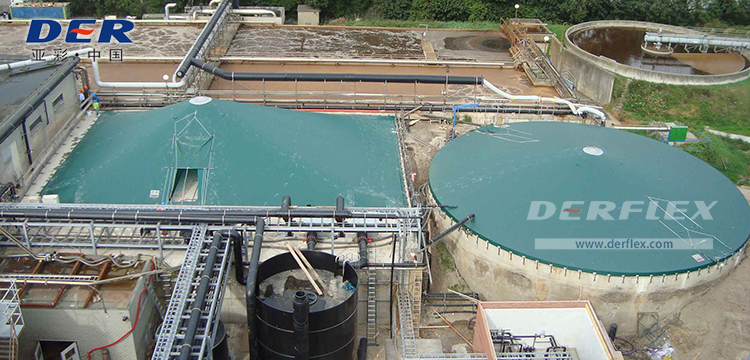
DERFLEX Suspended Tank Cover Membrane Technical Options
DERFLEX supports project-based suspended tank cover membrane selection for fabricators, contractors, water treatment equipment suppliers, municipal wastewater plants and industrial process facilities.
| Product Name | Suspended Tank Cover Membrane / Tensioned Tank Cover Membrane / Suspended Wastewater Cover Material |
|---|---|
| Material Platform | Reinforced flexible membrane, coated industrial textile, geomembrane-style cover material or customized composite structure according to project requirements. |
| Cover Configuration | Suspended cover, tensioned cover, center-column supported cover, cable-supported membrane, frame-supported cover, segmented removable cover and hybrid cover system. |
| Tank Compatibility | Metal tanks, concrete tanks, circular tanks, rectangular tanks, square basins, clarifiers, equalization tanks, sludge tanks, process tanks and treatment basins. |
| Functional Goals | Odor containment, algae control, rainwater exclusion, debris prevention, condensation reduction, heat retention, splash control, evaporation reduction and equipment protection. |
| Performance Options | UV resistance, weather resistance, tear resistance, tensile strength, dimensional stability, chemical resistance, waterproofing and weldable seam performance. |
| Hardware Compatibility | Stainless steel hardware, aluminum frames, cable systems, center support columns, perimeter anchors, FRP components and project-specific attachment systems. |
| Custom Details | Access hatches, sampling ports, lockable doors, inspection openings, pipe boots, vents, duct connections, drains, reinforced edges and removable panels. |
| Fabrication Support | Panel layout, thermal welding direction, reinforced perimeter design, connection zones, roll material supply and OEM support for prefabricated membrane systems. |
| Required Project Data | Tank drawings, tank diameter/length/width, cover span, liquid level, equipment layout, access points, chemical exposure, wind/snow/rain load and target service life. |
Why Choose a Suspended Tank Cover Membrane?
Odor Control Support
Suspended covers help enclose odor-generating surfaces and can be designed with duct connections for scrubbers, filters or gas treatment systems.
Algae Control
Opaque membrane materials can block sunlight from reaching clarifier launders, basins and storage tanks, reducing algae-related operational issues.
Rain & Debris Protection
A properly designed cover helps prevent rain dilution, leaves, dust, birds and wind-blown debris from entering the tank.
Low-Profile Enclosure
Compared with high internal-volume roof systems, a tensioned cover can reduce enclosed air volume and improve odor treatment efficiency.
Better Access Planning
Hatches, removable panels, sampling ports and lockable access details can be integrated where operators need inspection or maintenance access.
Lower Structural Weight
Membrane systems are often lighter than rigid metal, fiberglass or concrete roofs, making them attractive for retrofits and existing tanks.
Suspended Tank Cover Membrane System Options
Suspended tank covers are not one-size-fits-all. The membrane, support concept and attachment details must match the tank geometry, process environment and maintenance requirements.
Center-Column Supported Membrane
A central support raises and tensions the membrane, encouraging water shedding and reducing sagging on circular tanks or clarifiers.
Circular Tank FriendlyCable-Supported Suspended Cover
Cable systems can help support larger spans while keeping the membrane lightweight and adaptable to rectangular or irregular basins.
Large Span SupportFrame-Supported Low-Profile Cover
Aluminum, stainless steel or FRP frame concepts can support low-profile membrane covers and allow removable access sections.
Access-FocusedSuspended Baffle & Cover Hybrid
For treatment tanks requiring flow guidance, membrane covers can be coordinated with suspended baffle curtains to improve hydraulic performance.
Flow Control OptionApplications of Suspended Tank Cover Membrane
Wastewater Treatment Tanks
Used in municipal and industrial wastewater plants for odor control, debris prevention and weather protection.
Clarifiers & Launder Areas
Helps block sunlight, reduce algae growth and protect clarifier channels, launders and treatment surfaces.
Sludge Tanks
Suitable for tanks that require stronger odor containment, corrosive moisture control and operator access planning.
EQ Tanks
Equalization tanks benefit from rainwater exclusion, debris protection, odor control and reduced exposure to external conditions.
Process Water Tanks
Industrial process tanks can use suspended membrane covers for liquid protection, vapor control and environmental compliance support.
Clearwell & Baffle Systems
Suspended membrane materials can support water treatment baffle curtains and flow path management where applicable.
How to Choose the Right Suspended Cover Membrane
Buyers should not select a tank cover membrane by thickness alone. The correct material depends on tank geometry, cover span, environmental load, chemical exposure, gas/odor conditions, maintenance access and installation method.
| Project Requirement | What to Check | DERFLEX Material Direction |
|---|---|---|
| Outdoor Exposure | UV, rain, wind, temperature, snow load and long-term weathering. | UV-resistant reinforced membrane with stable coating and weldable surface. |
| Odor Containment | Gas generation, duct connection, sealing perimeter and internal cover volume. | Low-profile suspended membrane with reinforced openings and sealing details. |
| Algae Control | Sunlight penetration, clarifier exposure, effluent channels and TSS-related operation concerns. | Opaque light-blocking membrane cover with custom tank geometry fit. |
| Maintenance Access | Sampling, inspection, mixers, valves, ladders, weirs, piping and equipment clearance. | Access hatches, removable panels, pipe boots and reinforced penetration zones. |
| Hydraulic Performance | Short circuiting, contact time, flow path, mixing, baffle curtain or suspended curtain requirements. | Cover material can be coordinated with suspended baffle curtain or flow-control membrane systems. |
Suspended Membrane Cover vs Floating Cover vs Rigid Roof
Each cover type has its own application logic. DERFLEX helps buyers evaluate whether a suspended membrane design is appropriate before material specification.
Suspended Membrane Cover
- Positioned above the liquid surface
- Good for odor, algae, rain and debris control
- Supports hatches, vents, pipe boots and ducts
- Useful for retrofits and low-profile enclosures
- Requires proper support and anchoring design
Floating Tank Cover
- Moves with liquid level
- Good for evaporation and gas collection in selected tanks
- May need floats, drains and gas collection details
- Less suitable when equipment clearance is critical
- Depends strongly on liquid level movement
Rigid Metal or FRP Roof
- High structural stiffness
- Often heavier and more expensive to retrofit
- May require more complex installation equipment
- Can be strong for large engineered spans
- Less flexible for irregular penetrations
Project Data Needed for Suspended Tank Cover Design
A reliable suspended cover begins with correct project information. Send these details to DERFLEX for a more accurate material recommendation and quotation.
Tank Geometry
Diameter, length, width, tank wall type, span, freeboard, existing rim and anchoring conditions.
Process Environment
Wastewater type, gas, pH range, chemicals, operating temperature and liquid level changes.
Support Concept
Center column, cable system, frame, perimeter anchor, removable section or hybrid support structure.
Access Details
Hatches, sampling ports, lockable doors, vents, pipes, ducts, drains, ladders and maintenance zones.
Why DERFLEX for Suspended Tank Cover Membrane Materials?
Industrial Flexible Membrane Manufacturing Focus
DERFLEX provides industrial flexible materials for demanding outdoor and environmental applications. Our membrane material direction supports reinforced structure, coating stability, weldability, weather resistance and project customization for tank cover fabricators and engineering contractors.
- Reinforced membrane and coated fabric material options.
- Support for suspended, tensioned, supported and hybrid cover concepts.
- Custom color, reinforcement, coating and fabrication direction.
- OEM support for international wastewater and process tank projects.
Built for Real Procurement Decisions
A high-quality suspended tank cover page must help buyers evaluate actual system performance, not only describe generic tank covers. DERFLEX content and technical support focus on geometry, access, anchoring, weather loads, chemical exposure and service goals.
- Clear selection logic for suspended vs floating vs rigid covers.
- Material guidance for odor, algae, rainwater and debris control.
- Compatibility with hatches, vents, pipes and duct connections.
- Project-based quotation for municipalities, EPCs and industrial users.
Example: Suspended Membrane Cover for an Existing Clarifier
Project Challenge
A wastewater treatment facility operates an existing circular clarifier with algae growth, odor release, wind-blown debris and difficult maintenance access. A traditional rigid roof is too heavy and costly for the retrofit, and the operator needs a lower-profile solution with sampling access and equipment clearance.
DERFLEX Material Direction
A suspended reinforced membrane cover can be designed with perimeter anchoring, optional center support, access hatches, sampling ports and reinforced penetration details. The membrane can be specified for UV resistance, weldability, outdoor exposure and long-term dimensional stability.
Related DERFLEX Membrane Materials & Tank Cover Solutions
Explore more DERFLEX materials and solutions related to wastewater covers, biogas membranes, geomembranes and reinforced industrial fabrics.
Request a Suspended Tank Cover Membrane Recommendation
Send DERFLEX your tank drawings, span, support concept, process environment, access requirements and target function. Our team will help recommend a suitable suspended membrane material and project direction for your wastewater, clarifier, sludge tank or process water cover system.
Suspended Tank Cover Membrane FAQ
What is a suspended tank cover membrane?
A suspended tank cover membrane is a reinforced flexible membrane installed above a tank or basin opening using perimeter anchoring, supports, cables, frames or a center column. It is used for odor control, algae control, rain protection, debris prevention and low-profile tank enclosure.
How is a suspended cover different from a floating cover?
A floating cover rests on or near the liquid surface and moves with the liquid level. A suspended cover is positioned above the liquid surface and is supported or tensioned by structural elements, making it useful where equipment clearance, access and low-profile enclosure are important.
Can suspended membrane covers be used on existing tanks?
Yes. Suspended membrane covers are often suitable for retrofits because they can be customized to the existing tank rim, wall, support structure, equipment layout, hatches and pipe penetrations.
Can DERFLEX membrane materials help with algae control?
Yes. Opaque light-blocking membrane options can reduce sunlight penetration into clarifiers, launders and wastewater basins, helping limit algae growth.
Can the membrane include hatches, vents and pipe boots?
Yes. Suspended tank cover systems can be designed with reinforced access hatches, sampling ports, vents, lockable doors, pipe boots, drains and duct connections according to project requirements.
What information is needed for quotation?
Please provide tank drawings, tank shape, span, wall type, support concept, wastewater or process liquid conditions, chemical exposure, environmental loads, access points and target function such as odor control, algae control or rainwater exclusion.
Does DERFLEX provide complete installation?
DERFLEX focuses on engineered flexible membrane materials and OEM support. Depending on the project, DERFLEX can support material selection, roll supply, panel fabrication direction and custom membrane supply for fabricators, contractors and equipment companies.