



Low-Wick Architectural Membrane
A project-oriented PVC/PVDF tensile membrane direction focused on reducing capillary moisture migration into the polyester reinforcement—especially at cut edges, fabrication interfaces and other locations where the base fabric may become exposed.
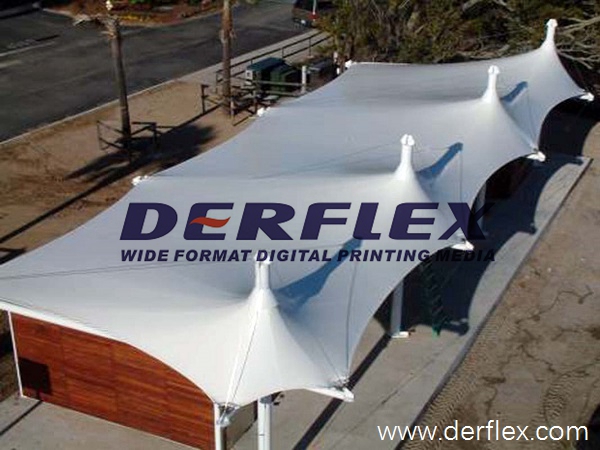
Waterproof Surface and Low-Wick Reinforcement Solve Different Problems
In PVC-coated polyester architectural membrane, the outer polymer coating provides the principal barrier against rain. Low-wick or anti-wick treatment addresses a second route: water moving between or along filaments in the woven polyester base fabric by capillary action.
That distinction matters in tensile architecture because membrane panels are cut, welded, tensioned, reinforced and installed as part of a larger structural system. If the reinforcement is exposed at an edge or compromised interface, moisture can migrate beyond the local contact point. Over time, this can contribute to staining around seams and edges, microbial growth in damp conditions, and deterioration of appearance. In severe long-term exposure, moisture inside the reinforcement may also become a durability concern.
Why this page is different from a generic architectural membrane page
The selection question here is not simply “PVC or PVDF?” It is whether the membrane construction controls moisture at the reinforcement level and whether the anti-capillary requirement is verified before bulk production. For humid, rainy, coastal or frequently washed structures, that can be a meaningful specification item.
Primarily concerns water passing through the coated membrane surface under exposure or pressure.
Concerns water migrating internally through exposed yarn pathways within the textile reinforcement.
A Low-Wick Membrane Is a System, Not a Single Surface Coating
Long-term performance depends on the interaction between reinforcement, adhesion / primer system, PVC coating, surface lacquer, fabrication method and edge detailing.
Where Low-Wick Treatment Adds Value
Anti-capillary performance is particularly relevant where the project includes repeated rain exposure, high ambient humidity, a large number of welded panels, perimeter cut edges, complex reinforcement details or long maintenance intervals.
It should not be used as a substitute for correct membrane detailing. Fabricators still need suitable seam geometry, edge sealing, reinforcement design, welding parameters and protection against mechanical damage. The most reliable approach is to combine moisture-resistant material construction with fabrication details that minimize direct access to the yarn structure.
For procurement, the practical question is simple: how will the supplier demonstrate the low-wick requirement on the actual production grade? The answer should be agreed before the order is released.
Six Design Priorities for Low-Wick Architectural Membrane
Low-wick performance belongs inside a broader architectural membrane specification. These six priorities help keep material selection connected to real structural and fabrication needs.
Capillary Moisture Control
Specify anti-wick treatment for the reinforcement or bonding system and agree how cut-edge wicking will be evaluated on the approved grade.
Structural Textile Strength
Match yarn size, weave density, tensile strength, tear resistance and elongation behavior to the engineer’s load model rather than selecting by GSM alone.
Coating Adhesion
The bond between PVC and reinforcement is critical because tensile loads, welded seams, heat exposure and moisture all act on the composite material over time.
Surface Weathering
PVDF or other architectural lacquer directions may improve cleanability, dirt resistance and appearance retention for exposed roof and canopy surfaces.
Weldability
Confirm whether the selected topcoat is directly weldable or needs preparation, and qualify hot-air or HF welding parameters using the production membrane.
Fire & Code Route
State the required regional fire standard at RFQ stage. Any rating should be confirmed on the exact membrane construction and supported by applicable documentation.
DERFLEX Low-Wick Architectural Membrane: RFQ Specification Framework
The table below is intended for project scoping. Final values should be confirmed against the exact grade, drawings, local code and test reports before purchase.
| Specification Item | DERFLEX Project Direction | Why the Buyer Should Confirm It |
|---|---|---|
| Base reinforcement | High-tenacity polyester architectural base fabric; low-wick / anti-capillary treatment to be specified for the project grade | The textile reinforcement controls tensile behavior and is the pathway where capillary moisture migration can occur. |
| Coating system | PVC architectural coating with optional PVDF or acrylic surface direction | Influences waterproofing, weldability, dirt pickup, weathering and surface maintenance. |
| Weight range | Approx. 650–1350 g/m2 architectural membrane direction | Weight alone does not define strength; match the grade to span, pretension and structural calculations. |
| Width | Project-dependent; selected DERFLEX knife-coated membrane directions are available around 3.2 m, with other widths dependent on grade | Wider rolls can reduce seam count, but width must be balanced with production stability and fabrication layout. |
| Surface | White, light architectural colors or custom direction; translucent / blockout options according to construction | Color and translucency affect daylight, visual comfort, heat gain and project aesthetics. |
| Fabrication | Hot-air and HF welding direction depending on selected membrane and topcoat | Welding compatibility must be confirmed on the actual coated surface before panel fabrication. |
| Flame-retardant route | B1 / M2 / NFPA 701 and other project directions may be discussed depending on grade and testing needs | Building-code acceptance depends on jurisdiction, exact construction and valid test documentation. |
| Low-wick verification | Agree a cut-edge / immersion evaluation method and acceptance criterion before bulk order | “Low-wick” should be measurable on the approved production structure rather than treated as a marketing label. |
| Quality confirmation | Tensile, tear, coating adhesion, weld trial, surface review and project-specific documentation | Architecture-grade membrane is a composite structural textile; multiple properties should be approved together. |
Note: stated ranges are selection directions based on DERFLEX architectural membrane categories, not universal guarantees for every construction. Final technical datasheet values and certificates should govern the purchase order.
When Is a Low-Wick Grade Worth Specifying?
The decision depends on moisture exposure, service expectation, fabrication complexity and the consequences of edge staining or reinforcement wetting.
General PVC Architectural Membrane
- Suitable for many covered, moderate-exposure or budget-controlled membrane projects.
- Primary focus may be waterproof surface, mechanical strength, FR direction, UV stability and weldability.
- Anti-capillary treatment may not be the first procurement question unless the specification requires it.
- Good detailing and edge protection remain essential.
Low-Wick / Anti-Capillary Membrane Direction
- Useful where exposed edges or high humidity create a higher probability of moisture reaching the textile reinforcement.
- Supports a cleaner long-term appearance around seams and edges when used with correct fabrication and maintenance.
- Relevant for coastal, humid, rainy or frequently washed structures.
- Should be validated through an agreed sample evaluation rather than assumed from coating waterproofness.
How to Buy Low-Wick Membrane Without Leaving the Key Requirement Undefined
The most common procurement mistake is writing “low-wick” into an RFQ without defining the actual exposure, fabrication route or acceptance evidence.
Architectural Projects Where Moisture Migration Deserves Extra Attention
Low-wick treatment is most relevant when membrane exposure and fabrication details create repeated opportunities for moisture to contact the textile reinforcement.
Transport Hub Walkways
Long seam networks, open edges and repeated wet-dry cycles make edge detailing and anti-capillary specification useful discussion points.
Commercial Canopies
White or light-colored membrane often places a premium on clean seam appearance, especially at entrances, plazas and retail environments.
Stadium & Arena Shade
Large fabricated panel areas can involve extensive welding and perimeter reinforcement, increasing the value of clear moisture-control specifications.
Coastal Structures
High ambient humidity and salt-laden air can increase maintenance pressure; membrane grade, hardware and detailing should be selected as a complete system.
Public-Space Roofs
Projects with long inspection cycles benefit from material choices that consider cleanability, capillary moisture control and repair access from the start.
Permanent Tensile Buildings
Where service expectations are longer, anti-wick treatment can be specified alongside higher surface protection, structural strength and documented fabrication controls.
Example RFQ: Humid-Climate Tensile Walkway Canopy
This is an illustrative specification route—not a published DERFLEX project case—to show how buyers can translate “low-wick” into procurement language.
Project Inputs
- Outdoor covered walkway with frequent wind-driven rain.
- White or light-color architectural finish.
- Multiple welded panels and reinforced perimeter edges.
- High humidity for a substantial part of the year.
- Local flame requirement to be confirmed by the project team.
- Fabricator intends to use hot-air or HF welding after sample trials.
Recommended RFQ Language
Request a PVC/PVDF architectural membrane built on high-tenacity polyester reinforcement with a specified low-wick / anti-capillary treatment. Ask the supplier to identify the exact membrane construction and provide an agreed cut-edge wicking evaluation on the approved sample.
- State target weight and minimum mechanical properties from the structural engineer.
- Request PVDF or appropriate architectural surface direction for cleaning and outdoor appearance.
- Confirm direct weldability or required surface preparation.
- Approve color, translucency, weld sample and seam appearance together.
- Attach the accepted sample / construction reference to the bulk order.
A Practical Material-Supply Approach for Fabricators, Contractors and Project Buyers
DERFLEX’s architectural membrane pages emphasize coated-fabric formulation, coating uniformity, base-fabric strength, surface treatment, roll stability, project customization and export-oriented supply.
Specification Matching
Share structure type, climate, color, topcoat, low-wick requirement, FR direction, roll width and quantity so the material route can be narrowed before sampling.
Custom Membrane Direction
Weight, width, surface finish, color, translucency and coating structure can be discussed according to production feasibility and order requirements.
Sample & Fabrication Review
For low-wick projects, include the anti-capillary evaluation together with weld trials, surface review and mechanical-data confirmation before bulk production.
Continue Your Architectural Membrane Selection
These six related pages help buyers compare membrane systems, fabrication directions and broader architectural material options.
Low-Wick Architectural Membrane FAQ
Short answers for architects, tensile fabricators, contractors, distributors and technical procurement teams.
What is a low-wick architectural membrane?
It is an architectural coated fabric designed to reduce capillary water migration into the textile reinforcement. In PVC-coated polyester membranes, the low-wick or anti-capillary treatment is associated with the base fabric and/or bonding system rather than simply the outer waterproof coating.
Is low-wick the same as waterproof?
No. Waterproofing concerns water passing through the coated surface, while low-wick performance concerns water travelling along exposed fibers or filaments inside the reinforcement. A project-grade membrane may need both.
Where can wicking start in a tensile membrane?
Typical risk points include cut edges, damaged coating, fabrication interfaces, repair areas and locations where the textile core becomes directly exposed to persistent moisture.
How should low-wick performance be checked before ordering?
Ask the supplier to agree on a sample evaluation using exposed cut edges and a defined immersion period or comparable anti-capillary procedure. The acceptance criterion should be written into the approval process instead of relying only on the product name.
Does low-wick treatment replace edge sealing and correct welding?
No. Low-wick treatment is an additional material control. Membrane detailing, seam design, welding parameters, edge protection and installation quality remain important parts of the system.
Can DERFLEX discuss custom low-wick PVC/PVDF membrane specifications?
DERFLEX supports project-oriented architectural membrane development and specification matching. Include your low-wick requirement, structure type, climate exposure, target weight, surface finish, color, FR direction, roll width and quantity in the RFQ so feasibility and testing can be confirmed for the selected grade.
Specify the Moisture-Control Requirement Before the Membrane Goes Into Production
Send DERFLEX your drawing or application, climate, target weight, low-wick requirement, color, PVDF / surface direction, fire requirement, roll width and quantity. The team can review a suitable architectural membrane route and coordinate sample confirmation before bulk supply.