News
Company News

Emergency Shelter Tarp Manufacturer & Bulk Supplier | DERFLEX

Update:2026/8/10 16:48:53 Views:
Emergency Response Material Program

Emergency Shelter Tarp

Temporary shelter tarpaulins developed around deployment speed, packed logistics, fixing strength and the conditions people will actually face in the field.

DERFLEX supports emergency shelter tarp procurement for aid suppliers, disaster-response contractors, government tenders, distributors, shelter-kit assemblers and OEM brands. PE-based lightweight routes and reusable PVC coated polyester routes can be discussed according to the required service period, climate, packing plan and tender specification.

Field-First Product Definition

An Emergency Shelter Tarp Is a Deployment Component, Not Just a Sheet

An emergency shelter tarp is a flexible weather barrier used to create temporary roofing, walling, privacy zones, ground protection or rapid cover after storms, floods, earthquakes, conflict displacement and infrastructure damage. In B2B procurement, the term can refer to anything from lightweight folded PE sheets for rapid household distribution to reinforced humanitarian tarpaulin and heavy duty PVC covers for repeated emergency-response use.

The procurement problem is therefore broader than selecting “waterproof tarpaulin.” A usable shelter tarp must be practical to transport, distribute, unfold, anchor, repair and identify. Its edge construction must tolerate installation loads. Its packed format must fit the logistics plan. Its material must match the expected exposure period and climate. If the tarp is part of a shelter kit, the sheet dimensions and fixing layout also need to coordinate with poles, rope, tools or locally sourced framing.

DERFLEX approaches emergency shelter tarp manufacturing from this full deployment chain: material selection, coating or lamination, reinforcement, panel fabrication, printing, unit packing and repeat-order control.

Structural note for shelter buyers

A tarp is the flexible cover component of a shelter. Wind resistance, snow resistance and overall structural safety depend on the complete shelter system, including frame geometry, poles or rigid supports, anchoring, connections, installation and site conditions. Where a tender requires structural ratings, use the responsible shelter-system engineer or supplier for verification.

Material Strategy

Three Emergency Shelter Tarp Routes for Different Response Models

The lightest tarp is not automatically the most economical, and the heaviest tarp is not automatically the most useful. Select the construction according to deployment volume, expected use cycle and field handling.

01

Rapid-Issue PE Shelter Tarp

For high-volume distribution where packed weight, handling speed and accessible installation are important.

  • Woven PE with laminated surfaces
  • Folded sheet or roll supply
  • Reinforced perimeter options
  • Printing and kit packing available by project
02

Specification-Led Humanitarian Sheet

For NGO, institutional or government procurement where dimensions, reinforcement, marking, test methods and packing are controlled by a current technical document.

  • Project-defined PE / reinforced sheeting construction
  • Fixation bands, reinforced zones or holes as specified
  • Controlled print, label and batch identification
  • Pre-production review against the supplied tender
03

Reusable PVC Emergency Tarp

For contractors, utilities, emergency stock programs and shelter operators that need welded panels, stronger reinforcement and repeated handling.

  • PVC coated polyester construction
  • Typical heavy duty discussion range: 450–900 gsm
  • Heat-welded seams and reinforced edges
  • Roll goods, panels or finished covers
Procurement Priorities

What Makes a Shelter Tarp Practical During an Emergency?

Search results often reduce emergency tarps to “waterproof + UV resistant.” Professional procurement usually requires a wider set of decisions.

Logistics

Packed Weight & Volume

Air freight, truck capacity, warehouse racking and last-mile distribution can make packed efficiency as important as the tarp’s surface performance.

Deployment

Fixing System

Eyelets, reinforced bands, webbing, rope hems or project-specific fixing points should be selected for the installation method rather than added as an afterthought.

Weather

Rain, UV & Climate Exposure

Expected sunlight, rainfall, temperature and service duration should guide resin, coating, lamination and reinforcement choices.

Human Factors

Color, Light & Privacy

White, blue, green, orange or other colors may serve different visibility, heat-management, identification or program needs. Opacity should be discussed where privacy matters.

Identification

Printing & Traceability

Organization marks, instructions, batch codes, SKU labels, warning text and orientation graphics can be incorporated according to the purchasing specification.

Distribution

Unit Packing

Individual bags, cartons, bales, rolls, pallets and kit combinations can be planned around handling conditions and distribution points.

Specification Framework

Emergency Shelter Tarp Specification Options

Use this table as an RFQ framework. Final values should come from the buyer’s application, current tender, approved sample or agreed test protocol.

Specification Item Configurable Direction Why It Matters in Emergency Use
Material PE woven / laminated tarpaulin, reinforced humanitarian sheeting, PVC coated polyester Determines packed weight, fabrication method, handling life, repair approach and cost structure.
Finished Size Standard project sizes or fully customized dimensions; roll supply can also be discussed Finished size—not only nominal cut size—should match shelter geometry, distribution kit and coverage plan.
Weight / Thickness Project-defined PE grades; PVC coated polyester commonly discussed from about 450–900 gsm for heavier-duty programs Higher weight may improve robustness but increases transport, lifting and storage burden.
Water Protection Waterproof coated or laminated surface; welded seam options for PVC fabricated panels Finished shelter water performance also depends on seam design, roof slope, drainage, fixing and installation.
UV Direction UV-stabilized formulations can be developed according to exposure target Outdoor exposure can degrade polymer strength and surface flexibility if the material is not matched to duration and climate.
Reinforcement Reinforced hems, bands, webbing, corner patches, rope-in-hem, doubled layers Most installation stress concentrates at edges, corners and fixing points rather than in the center of the sheet.
Fixing Points Eyelets, holes through reinforced bands, loops, straps or drawing-defined interfaces Fixing design should be coordinated with rope, frame and intended tensioning method.
Color & Opacity White, blue, green, orange, black, grey or custom colors subject to project and MOQ Color can affect identification, visibility, heat behavior, privacy and program consistency.
Flame Performance Flame-retardant formulation can be discussed when a named test method is supplied “Flame retardant” is not “fireproof.” The exact standard, class, sample conditioning and acceptance rule should be documented.
Marking Logo, instruction print, orientation marks, warnings, batch code, SKU or barcode Clear identification can simplify warehousing, field issue and program traceability.
Packing Individual fold pack, bale, carton, roll, pallet or shelter-kit configuration Packing affects storage density, manual handling, distribution speed and shipping economics.
Compliance note: terms such as “UNHCR-style,” “NGO standard,” “government relief tarp” or a named fire standard should not be treated as automatic certification. Send the current technical specification, revision, drawing, test method and marking rules for review before sampling or production.
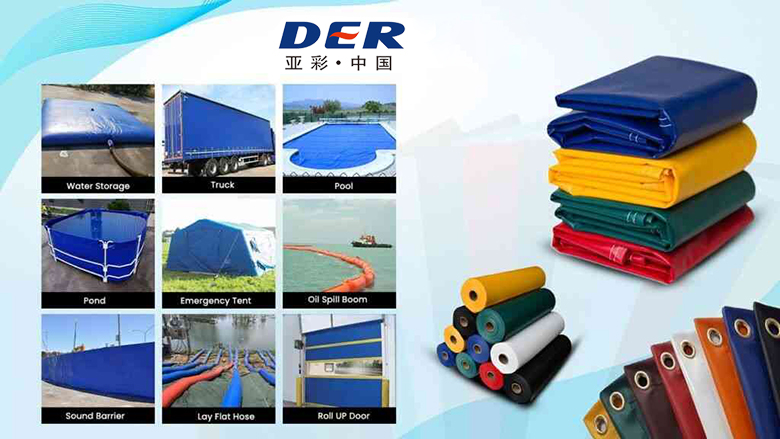
DERFLEX emergency shelter tarp and tarpaulin product display
DERFLEX Tarpaulin Product Reference Representative DERFLEX tarp and emergency tent application image. Final shelter tarp construction is selected by project specification.
Product Image & Material Context

From Roll Material to Finished Shelter Sheet

Emergency shelter procurement may require different levels of fabrication. Some buyers need roll goods for regional converting. Others need finished sheets with reinforced fixing zones. Shelter-kit suppliers may require a precisely folded unit with ropes, instructions and program labels. Contractor programs may use welded PVC panels with heavy edge reinforcement.

DERFLEX can discuss the supply format before material selection so the construction is compatible with the buyer’s own cutting, welding, packing or field-deployment workflow.

Useful approval sequence

Technical specification → sample material → reinforcement / fixing detail → print artwork → unit packing → pre-production or first-article confirmation → bulk production.

60,000㎡Integrated production area stated in DERFLEX company materials
450+Full-time employees stated in DERFLEX company materials
25+Senior engineers stated in DERFLEX company materials
120+Countries and regions served stated in DERFLEX company materials
Deployment Scenarios

Where Emergency Shelter Tarps Are Commonly Specified

The same material may serve several tasks during a response, but the reinforcement, packing and service-life target should be adjusted to the mission.

Shelter

Temporary Household Roofing

Flexible roof and wall coverage for rapid shelters assembled with local poles, framing materials or pre-designed kit components.

Recovery

Storm-Damaged Roof Cover

Temporary weather protection for exposed structures while permanent repair materials, labor or insurance processes are pending.

Camp

Privacy & Partitioning

Visual screening and temporary internal or external divisions for relief camps, intake zones, clinics and support facilities.

Ground

Ground Sheet & Base Layer

Temporary separation from wet, dusty or dirty ground for shelter floors, material sorting and protected staging areas.

Medical

Field Aid & Support Zones

Weather cover, partitions or equipment protection around temporary medical, WASH, distribution and logistics spaces.

Logistics

Relief Supply Protection

Coverage for cartons, food, water-system components, generators, tools and other weather-sensitive response inventory.

Failure-Aware Specification

Specify the Failure Mode Before You Specify the Tarp

Emergency material often fails where design decisions meet field reality. A clearer RFQ can reduce preventable problems.

Tearing at Eyelets or Bands

Typical cause: concentrated load, poor spacing, insufficient reinforcement or movement in wind.

Specification response: reinforce the load path, not only the metal eyelet.

Surface Degradation in Sun

Typical cause: exposure period exceeds the UV package assumed for the material.

Specification response: state climate, storage condition and expected outdoor duration.

Leakage at Joined Panels

Typical cause: seam method is not matched to material or seam positioning.

Specification response: confirm joining method and sample performance before bulk production.

Difficult Last-Mile Handling

Typical cause: single-unit weight, bale size or carton format exceeds realistic manual handling limits.

Specification response: design packing together with the response logistics team.

Insufficient Privacy

Typical cause: color and opacity were treated as cosmetic rather than functional requirements.

Specification response: approve color and light transmission on a physical sample where privacy is relevant.

Wrong Product for the Use Cycle

Typical cause: an economy tarp is repeatedly reused, or an unnecessarily heavy tarp is selected for one-time rapid issue.

Specification response: define the intended service and replacement cycle before selecting material.

Manufacturing & Quality Path

Built for Repeatable Emergency Supply Programs

For institutional and distributor procurement, repeatability matters across materials, fabrication, marking and packing—not only the first sample.

Requirement Review

Application, current tender, material route, quantity, destination and delivery priorities.

Material Match

PE, reinforced sheeting or PVC coated polyester selected around use cycle and handling.

Detail Approval

Finished dimensions, reinforcement, fixing points, print artwork and packing layout.

QC Checkpoints

Agreed checks may include weight, dimensions, appearance, strength direction, fabrication and packing.

Repeat Supply

Approved reference, documented specification, label and packing logic retained for future orders where agreed.

Buyer Guide

How to Write an Emergency Shelter Tarp RFQ

A complete RFQ lets the supplier compare like with like and reduces hidden assumptions around finished size, fixing, packing and compliance.

  1. 1
    Define the mission.
    Household shelter, roof repair, ground sheet, partition, relief-stock cover or reusable contractor tarp.
  2. 2
    Attach the current specification.
    Include revision number, drawing, test methods and any program-specific marking rules.
  3. 3
    State finished dimensions.
    Separate cut size from finished size and define size tolerance where procurement requires it.
  4. 4
    Map reinforcement and fixing.
    Band position, eyelet spacing, webbing, patches, loops, ropes or other attachment interfaces.
  5. 5
    Define logistics.
    Quantity, unit fold, bag/carton/bale, pallet, container plan, destination and delivery window.
  6. 6
    Approve before bulk.
    Use a material sample, print proof, packing sample or first article according to project risk.
Emergency Shelter Tarp FAQ

Questions from Relief Suppliers, Distributors & Project Buyers

What material is commonly used for an emergency shelter tarp?
PE woven or laminated tarpaulin is commonly selected when low packed weight and fast high-volume distribution are priorities. Reinforced humanitarian sheeting can be developed around a tender specification. PVC coated polyester is often considered for heavier-duty, welded and reusable emergency covers. The correct material depends on expected service period, climate, transport limits, fixing method and procurement budget.
Can DERFLEX make custom emergency shelter tarps for NGOs or government tenders?
DERFLEX can review buyer-provided specifications, drawings and tender documents and discuss a corresponding material, reinforcement, printing and packing plan. A program name by itself does not establish compliance; the current specification, sample, test requirements and purchasing-authority acceptance should be confirmed for each project.
What size should an emergency shelter tarp be?
There is no universal size for every response. 4 × 5 m, 4 × 6 m and other formats are frequently encountered in humanitarian and shelter procurement, but the correct finished size should come from the current project design or tender. DERFLEX can also discuss custom sizes and roll supply.
Are emergency shelter tarps waterproof?
Emergency shelter tarp materials can be supplied with waterproof laminated or coated surfaces. Finished shelter water protection also depends on seams, overlap, roof slope, penetrations, anchoring and installation. For fabricated PVC panels, welded seams can be considered where the project requires a stronger water barrier at panel joints.
Can logos, instructions and batch codes be printed on relief tarps?
Yes, project-based printing can include organization marks, warning text, installation guidance, orientation marks, batch codes, SKU labels and other identification. Artwork, print position, color and durability expectations should be approved before bulk production.
What information is needed for a bulk emergency shelter tarp quotation?
Provide the application, current technical specification or material target, finished size, quantity, color, weight or thickness, reinforcement and fixing details, UV or flame-test requirement, print artwork, unit packing, pallet plan, destination and required delivery window. If the tarp is part of a shelter kit, include the kit BOM or interface drawing where possible.

Build the Emergency Tarp Specification Before the Next Shipment

Send DERFLEX your target application, current tender or reference sample, finished size, quantity, reinforce, ment layout, packing plan and destination. The team can review an appropriate PE, reinforced sheeting or PVC coated polyester supply route for quotation and sampling.

DERFLEX logo
DERFLEX · PVC coated fabrics, tarpaulins and custom flexible material solutions. Product ranges, test methods, tolerances, packing and compliance requirements are subject to project confirmation. Shelter structural performance must be verified at complete-system level.
Consulting Services
+86-021-54361792 / 54361798
Email
sales@derflex.com