Record the Maximum Envelope
Measure loaded length, top width, maximum height, side drop and front/rear coverage.



 Custom Industrial Tarp Engineering
Oversized cargo rarely fails a tarp because the sheet is simply “too light.” More often, the problem begins with a rectangular cover forced over a stepped, curved or projecting load. DERFLEX develops custom cargo tarp constructions around the actual load envelope, contact points, wind exposure and driver handling method.
A tall transformer, fabricated machine, agricultural attachment or modular skid creates a different stress pattern from a uniform lumber stack. High points attract tension. Hard edges concentrate abrasion. Recesses trap loose fabric. Unsupported spans can flutter. The tarp must therefore be planned as a fitted protection system rather than a larger version of a stock flat sheet.
The design objective is not to pull every surface drum-tight. It is to establish controlled coverage, useful overlap, practical tensioning paths and replaceable protection at predictable contact areas. This reduces unnecessary material, improves handling and makes the construction easier to reproduce for fleet or OEM orders.
DERFLEX can discuss roll material, cut panels, semi-finished assemblies or completed custom load tarps, depending on the buyer’s local fabrication capability and supply model.
The design sequence below helps procurement teams move from cargo photos to a clear specification without assuming that one standard tarp shape can cover every project.
Measure loaded length, top width, maximum height, side drop and front/rear coverage.
Identify corners, brackets, exhausts, flanges, lifting lugs and other hard contact points.
Choose a flat drape, shaped cover, bag-style form or overlapping multi-piece set.
Place sacrificial patches, webbing and extra layers only where the load creates risk.
Keep primary joins away from high-curvature corners and repeated rubbing where practical.
D-rings and grommets should follow usable anchor points and realistic tension directions.
Confirm the drawing, sample or first article before locking bulk-order documentation.
A custom pattern should reduce uncontrolled folds and wind pockets while remaining practical to install, tension, inspect, fold and store.
Suitable when the load changes frequently but remains within a predictable maximum envelope.
Useful for repeated machinery, transformers or equipment with a recognizable non-rectangular silhouette.
Recommended when one very large tarp would be difficult to lift, position or repair in the field.
Use appropriate corner guards, padding or dunnage between the hard load and the tarp.
Local wear pads or replaceable sleeves absorb repeated rubbing before the main tarp body is damaged.
Webbing, double-layer patches and reinforced hems distribute tension around hardware and high-stress zones.
Useful hardware rows and proper overlap reduce repetitive movement that can turn a small contact point into a tear.
A sharp flange or unfinished steel corner can damage heavy fabric if vibration repeatedly presses the same point into the coating and scrim. Increasing fabric weight may slow the process, but it does not remove the concentrated contact. The better approach is layered: isolate the edge, strengthen the tarp locally and control movement around the load.
Puncture zones need padding or rigid edge protection. Broad rubbing zones may need large sacrificial panels. Hardware zones need reinforcement that follows the pulling direction. Treating all three with one continuous heavy panel can add weight without addressing the actual failure mechanism.
Welded or sewn joins should not be routed directly over a high corner merely because it is convenient for panel nesting. On a repeat product, a small pattern change can move a seam into a flatter, more stable area and make the reinforcement easier to inspect.
Buyers comparing tarp materials can also review DERFLEX guidance on steel tarps and custom flatbed tarps for related reinforcement and handling considerations.
Use the table as a discussion framework. Final materials, dimensions, tests and workmanship should be confirmed against the real application and approved sample or drawing.
| Specification Area | DERFLEX Direction | Why It Matters for Sharp or Irregular Loads |
|---|---|---|
| Body Material | PVC coated polyester, vinyl-coated polyester, selected laminated structures or mesh for ventilated applications. | Balance weather protection, abrasion, flexibility, weldability, handling weight and airflow. |
| Weight Range | Approximately 550–1100gsm as a common heavy-duty discussion range; project-specific structures can be reviewed. | Higher weight can increase robustness but also increases lift effort, folded volume and transport cost. |
| Panel Architecture | Flat drape, shaped pattern, stepped cover, bag-style form, split panel or overlapping multi-piece set. | Pattern architecture controls loose fabric, fit around projections and field handling. |
| Top / Side Construction | One uniform body or a heavier top and lighter side-panel combination where suitable. | Hybrid construction can place robustness on exposed top zones while reducing side-panel handling weight. |
| Reinforcement | Webbing hems, double layers, D-ring patches, corner patches, abrasion strips and replaceable wear panels. | Localized protection is more efficient when risk zones are known in advance. |
| Seam Construction | Hot-air welding, hot-wedge welding, high-frequency welding, sewing or combined construction. | The process must match the material, hardware attachment, seam route and required finished performance. |
| Hardware Layout | D-rings, grommets, webbing loops, straps, buckles, sleeves and buyer-specified components. | Rows should align with usable anchor points and the intended pull direction rather than fixed catalog spacing alone. |
| Flaps & Access | Front or rear flaps, side closures, inspection openings, overlap zones and detachable modules. | Access design can reduce the need to remove a large cover during inspection or partial unloading. |
| Environmental Options | UV-resistant, cold-flexible, anti-mildew, flame-retardant, anti-static or selected chemical-resistance directions subject to confirmation. | Required standards and acceptance values should be stated before sampling; claims depend on the agreed formulation and test method. |
| OEM Details | Custom color, logo, labels, barcodes, instructions, carton marks, palletization and private-label packing. | Supports distributors, fleets and repeat product programs with controlled identification. |
| Supply Format | Coated fabric rolls, cut panels, semi-finished assemblies, replacement sections or completed tarp sets. | Lets buyers select the most practical balance of local labor, freight cost and after-sales replacement. |
Note: finished weather protection depends on the complete construction, including seams, openings, overlap, installation and maintenance—not only the waterproofness of the base fabric.
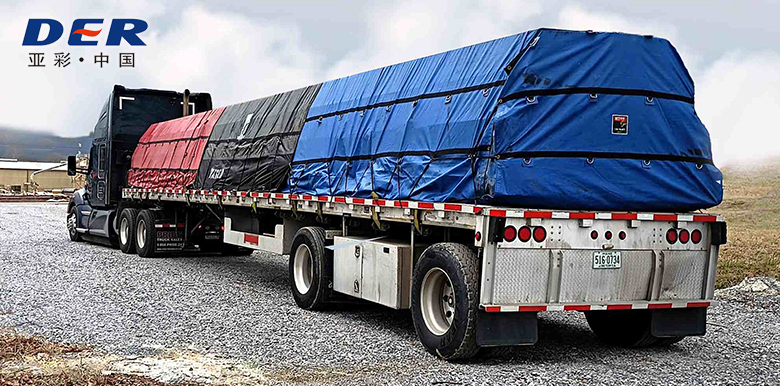
These DERFLEX images show deep-drop, shaped, long-trailer and multi-piece tarp directions. Final cargo-specific construction is developed from the approved specification.
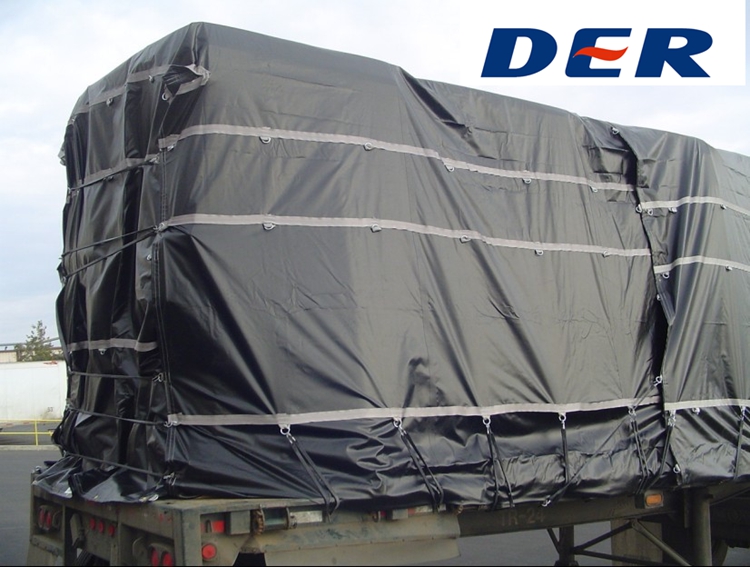
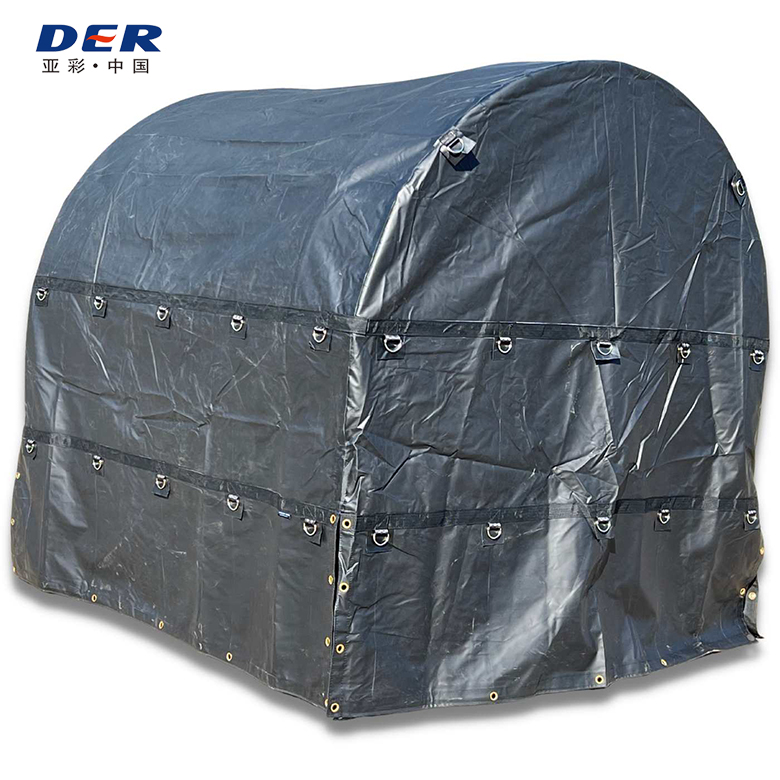
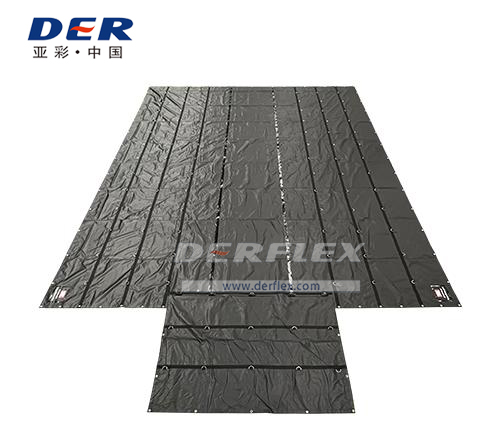
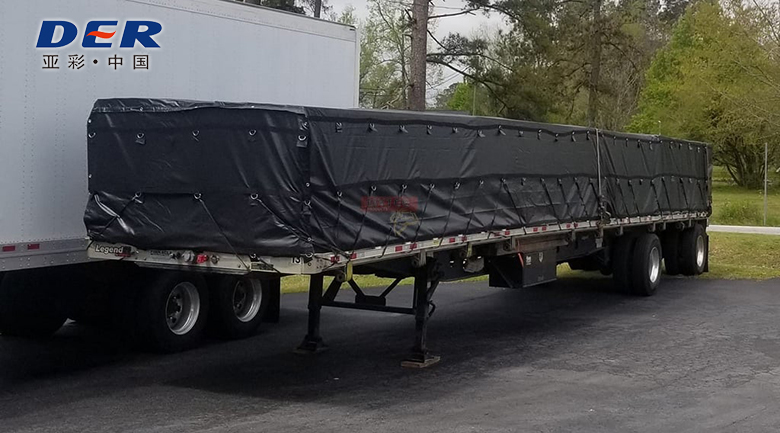
The following cargo groups often require more than a standard rectangular sheet because projections, asymmetric profiles or unusual dimensions change the wear and tension pattern.
Stepped housings, radiators, bushings and inspection needs can require shaped top sections, protected contact zones and controlled access.
Frames, brackets, lifting points and exposed components benefit from a mapped reinforcement plan and reduced loose material.
Sharp plate edges, flanges and asymmetric bundles require separate edge protection plus abrasion-resistant tarp zones.
Attachments, guards, wheels and changing profiles may suit modular panels or a repeat shaped cover for the same equipment family.
Skids, packaged process systems and prefabricated modules can be covered with hardware rows coordinated to known frame levels.
Curved components, corrosive environments and long-distance exposure may require special surface, reinforcement and packing discussions.
A stock tarp may still be the right commercial choice for variable or one-time loads. A custom program becomes more valuable when the same cargo profile repeats or when excess fabric creates recurring damage and handling problems.
A clear brief reduces assumptions and helps the construction proposal reflect the load, vehicle and operating method.
These six related pages connect oversized-load design with truck tarp systems, material choice, flatbed coverage and cargo-specific constructions.
Practical answers for fleets, distributors, tarp converters, equipment manufacturers and heavy-haul procurement teams.
The suitable design depends on whether the cargo profile changes or repeats. A controlled flat drape can suit variable loads, while a shaped, stepped or multi-piece tarp is often more practical for repeated machinery or project cargo. Final selection should consider projections, wear zones, anchor points, handling weight and overlap.
Heavy material may improve general abrasion resistance, but it should not be relied on as the only protection against a cutting edge. Use suitable edge protectors or padding on the cargo, then add sacrificial tarp patches and localized reinforcement where contact is expected.
A single piece reduces overlap joins but can become difficult to lift, position, dry and repair. Multi-piece sets divide the handling weight and allow individual sections to be replaced. The overlaps should be designed around airflow, drainage and the installation sequence.
Hardware should be placed according to usable trailer anchors, load height and the direction in which the tarp will be tensioned. A fixed catalog spacing may be inadequate for asymmetric cargo. A hardware map is normally included in the approved drawing or sample.
Provide loaded dimensions, photos or drawings, projection and wear-zone locations, trailer type, anchor positions, preferred material direction, flap or access needs, quantity, destination and any required test standards. Dimensioned drawings are especially useful for stepped, curved or repeat cargo.
A tarp covers and protects the load but does not replace rated tiedowns, chains, binders, blocking, bracing, chocks or other securement devices. The carrier remains responsible for selecting and using compliant securement for the cargo and jurisdiction.
DERFLEX can discuss PVC coated fabric rolls, cut panels, semi-finished assemblies, replacement sections or completed tarp sets. The practical supply format depends on local fabrication capability, freight economics, quality-control needs and the buyer’s after-sales model.
Send DERFLEX the load photos or drawing, loaded dimensions, known sharp edges, trailer anchors, material direction and order quantity. The team can review a practical construction route for roll material, panels or finished custom tarp sets.