News
Company News

Tunnel Ventilation Duct for Underground Airflow | DERFLEX

Update:2026/8/13 16:37:37 Views:
DERFLEX logo Flexible underground airflow systems

Tunnel Ventilation Duct Built Around Airflow, Pressure & Tunnel Geometry

Project-configured tunnel ventilation duct for fresh-air supply, local exhaust and changing underground routes—specified as a working air path rather than a generic fabric tube.

DERFLEX supplies flexible tunnel ventilation ducting with selectable duct structure, diameter, section length, suspension, couplings and project-defined performance options. The configuration can be reviewed against fan data, route length, pressure direction, bends, clearances and the installation sequence before production.

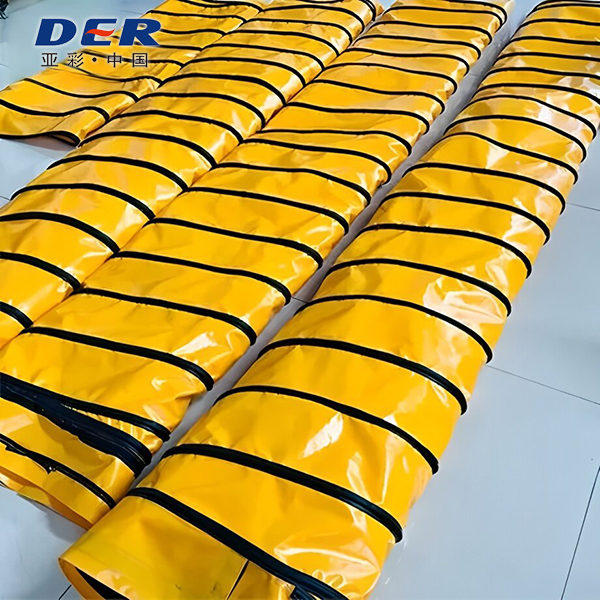
DERFLEX flexible tunnel ventilation ducting product
DERFLEX flexible PVC tunnel air duct sections. Final diameter, reinforcement, connection and performance options are confirmed by project specification.
Positive-pressure supply
Negative-pressure extraction
PVC-coated textile body
Custom coupling & suspension
Airflow mode first Forcing, exhausting or combined ventilation
Approx. ?300–3000 mm Reference project range; final size by airflow review
Layflat / reinforced / low-profile Structure selected by pressure and clearance
Project-defined interfaces Zipper, ring, cuff, clamp or custom connection
Product definition

A Tunnel Air Duct Is Part of the Ventilation Route, Not an Isolated Component

During excavation, the work face moves while duct length, hanging points and local restrictions change. A useful product specification therefore begins with the planned air route and operating mode.

01

Fresh-Air Forcing

A fan pushes fresh air through the tunnel ventilation duct toward the active heading. Collapsible layflat construction is commonly evaluated because internal pressure keeps the air passage open during operation and the duct can be packed compactly between moves.

View positive-pressure ducting →
02

Local Exhaust & Suction

Where contaminated air, dust, fumes or heat must be drawn through the duct, the air passage needs structural support. Rings or a continuous wire helix help the duct resist collapse under negative pressure and through bends.

Review spiral-reinforced duct →
03

Restricted Clearance

In narrow drifts, utility tunnels or equipment-dense headings, a full round section may interfere with vehicles, services or the crown. Oval or twin-chamber layouts can be considered where preserving vertical clearance is part of the installation plan.

01

Fan airflow and static pressure

Fan model, operating airflow and pressure are more useful than fan power alone. They help determine whether the planned duct diameter and line length are practical.

02

Duct diameter and total run length

Diameter affects air velocity, friction and space occupation. Route length adds cumulative resistance and makes leakage control at each section connection more important.

03

Joints, leakage and inner surface

Welded body seams, coupling overlap and connection count influence how much fan output reaches the working zone. A smooth internal air path also helps limit unnecessary flow resistance.

04

Bends, branches and equipment transitions

Elbows, reducers, Y-pieces and fan interfaces should be included in the route review. Repeated tight bends can require a shape-retaining duct section rather than a fully layflat tube.

05

Suspension geometry and site handling

Hanging fins, eyelets, reinforced patches and section weight influence installation speed and local stress. The suspension layout should suit tunnel crown conditions and planned duct relocation.

06

Fire, static and compliance requirements

Flame-retardant or antistatic performance should be specified with the required standard, test method and acceptance value. Category labels alone do not define final compliance.

Material & fabrication

How Flexible Tunnel Ventilation Ducting Is Built

The finished duct is a coordinated assembly of coated textile, welded seams, reinforcement, suspension and end connections. Performance depends on how these parts work together.

Outer PVC surface Moisture, handling and abrasion-oriented surface protection; formulation selected by project.
High-tenacity polyester reinforcement Load-bearing textile structure supporting tensile and tear performance.
Inner PVC surface Weldable air-containment layer with a smooth internal flow path.
Optional shape support Steel rings or continuous helix for suction duty, bends or route stability.

Coated textile and duct fabrication should be specified together

DERFLEX uses PVC-coated polyester technical textile as a common construction platform for flexible tunnel air duct assemblies. Material weight, yarn structure and coating formulation can be matched to pressure, handling, abrasion and safety requirements.

Buyers that fabricate locally can also review the dedicated PVC fabric for tunnel ventilation duct page. Finished-duct buyers can specify welded sections with suspension details and selected end interfaces.

  • Hot-air or high-frequency welded body construction, subject to material and geometry
  • Reinforced suspension zones, cuffs, zipper areas and contact points where required
  • Wear strips or extra layers available for repeated wall or ground contact
  • Custom color, identification marks and section labeling subject to order confirmation
Specification framework

Reference Tunnel Ventilation Duct Specifications for Quotation

Use this table as an RFQ framework. Final values depend on the completed duct construction, fan duty, route layout and the approved project datasheet.

Specification Item Typical Project Options Why It Matters
Product form Layflat duct, ring-supported duct, spiral-wire duct, low-profile duct or custom transition Selected mainly by positive/negative pressure, bends, handling and tunnel clearance.
Duct body PVC-coated polyester technical textile Fabric structure and coating are matched to air containment, welding, wear and project treatments.
Reference fabric weight Approx. 400–900 g/m2 or project-specific Weight alone does not define duct pressure capability; yarn, seam, reinforcement and diameter also matter.
Diameter Approx. 300–3000 mm; custom review available Chosen from airflow requirement, pressure loss, fan curve and available headroom.
Section length Project-defined; common fabricated sections may be 1–100 m, with longer options reviewed by design Longer sections reduce joint count but increase handling weight and installation difficulty.
Connections Zipper, steel ring, clamp, drawstring cuff, hook-and-loop or drawing-based interface Connection choice affects extension speed, compatibility, sealing and field replacement.
Suspension Reinforced fin, eyelets, D-rings, patches or custom hanger layout Correct load distribution helps reduce concentrated stress during inflation, movement and relocation.
Reinforcement None, periodic rings, continuous spring-steel helix, wear strip or custom reinforcement Shape support is usually required when suction, tight bends or repeated contact can collapse or damage the duct.
Performance options Flame-retardant, antistatic, cold-resistant, abrasion-oriented or high-visibility formulations Any safety or performance claim should be linked to the named project test method and acceptance criteria.

Reference values are intended for quotation planning and product comparison, not as a universal performance guarantee. Confirm the final construction, tolerances and test requirements on the approved technical document before ordering.

Duct type comparison

Layflat, Spiral-Reinforced or Low-Profile Tunnel Ventilation Duct?

The practical choice depends on whether the fan pushes or pulls air, how the line must bend, and how much space is available above the tunnel traffic envelope.

Positive pressure

Layflat Duct

Commonly selected for forced fresh-air delivery to advancing headings.

  • Collapses compactly when airflow stops
  • Efficient for long, extendable supply lines
  • Lower storage volume than helix-reinforced formats
  • Requires internal pressure to hold its operating shape
Positive / negative pressure

Spiral-Reinforced Duct

Shape-retaining flexible construction for suction, extraction and difficult routing.

  • Helix helps resist collapse under suction
  • Useful at equipment interfaces and curved routes
  • Wear strip and reinforced cuff options available
  • Bulkier to store than fully layflat sections
Restricted headroom

Oval / Twin Configuration

Alternative profile where a round tunnel air duct conflicts with equipment or services.

  • Reduces vertical space demand
  • Can preserve clearance for vehicles and machinery
  • Requires coordinated suspension and section geometry
  • Should be reviewed against actual tunnel dimensions
Underground applications

Where Tunnel Ventilation Ducting Is Commonly Specified

Flexible ducting is particularly useful where the air route must extend, relocate or pass through confined construction space while the project progresses.

Road & Highway Tunnels

Temporary fresh-air delivery and extraction during drilling, blasting, lining, equipment operation and staged underground work.

Railway Tunnels

Extendable ventilation lines for long underground alignments where the face and work zones continue to move.

Metro & Subway Construction

Flexible routing for station boxes, cross passages, shafts and tunnel headings where clearance is shared with equipment and services.

Hydropower & Water Tunnels

Project-configured air supply or extraction for access tunnels, diversion tunnels, underground chambers and maintenance zones.

Utility & Service Tunnels

Temporary ventilation in cable, pipeline and civil utility corridors where rigid duct installation may be impractical during construction.

Fan & Ventilation Equipment OEMs

Custom duct diameter, cuffs, connectors, labeling and packaging can be coordinated around blower or auxiliary fan packages.

Procurement guidance

What to Send Before Requesting a Tunnel Ventilation Duct Quote

A complete brief helps the quotation reflect airflow duty, installation effort and project documentation—not just a price per meter.

Recommended RFQ data

  • Tunnel type and project stage
  • Fresh-air supply, exhaust or combined duty
  • Fan model or fan curve
  • Operating airflow and static pressure
  • Required duct diameter
  • Total route length
  • Preferred section length
  • Bend count and approximate bend radius
  • Branches, reducers and fan transitions
  • Available crown / sidewall clearance
  • Suspension and hanger preference
  • Connection / coupling preference
  • Temperature and chemical exposure
  • Flame-retardant test requirement
  • Antistatic or surface-resistance target
  • Quantity, packing and destination
Project safety options

Specify Flame-Retardant and Antistatic Requirements by Test Method

Underground projects may require specific fire behavior or surface-resistance limits. These should be stated in the RFQ so material formulation, finished-duct construction and documentation can be reviewed against the same requirement.

Avoid treating “FR” or “antistatic” as a generic label

Requirements differ by market, project owner and application. DERFLEX can discuss optional flame-retardant and antistatic configurations, but the requested standard, test method and acceptance value should be confirmed before production.

For underground projects with a documented safety specification, review the antistatic flame-retardant ventilation duct configuration and provide the applicable project requirement with the RFQ.

Define the named standard Do not rely on a general product category or marketing term.
Define the acceptance value State the required classification, resistance limit or project threshold.
Define required documentation Identify whether internal records, batch documents or third-party testing are required.
Approve before production Confirm final construction and test scope on the order specification.
DERFLEX supply model

From PVC Coated Fabric to a Finished Tunnel Duct Assembly

DERFLEX can support buyers that need complete fabricated duct sections as well as customers that purchase coated ventilation fabric for local conversion.

Finished Duct Sections

Welded body, cuffs, suspension details, selected couplings and optional reinforcement can be quoted as one fabricated product.

Material Matching

PVC-coated textile construction can be reviewed against pressure direction, abrasion, handling and project-specific treatment requirements.

Custom Interfaces

Reducers, bends, branch pieces, fan connections and drawing-based end interfaces can be discussed for route compatibility.

Project Identification

Sections can be labeled by diameter, length, route or installation sequence to support site handling and staged installation.

FAQ

Tunnel Ventilation Duct Purchasing Questions

Practical answers for contractors, ventilation equipment suppliers, tunnel project buyers and distributors preparing a duct specification.

What is a tunnel ventilation duct used for?

A tunnel ventilation duct creates a controlled air path between a fan and an underground work zone. Depending on the system, it can carry fresh air toward an advancing heading or extract contaminated air, dust, fumes and heat from a localized area.

What is the difference between tunnel ventilation duct and tunnel ventilation ducting?

The terms are commonly used for the same product category. “Tunnel ventilation duct” often refers to one duct section or product, while “tunnel ventilation ducting” may describe the full run, multiple connected sections or the overall flexible air-distribution system.

When should a tunnel air duct be layflat instead of spiral reinforced?

Layflat construction is commonly evaluated for positive-pressure fresh-air supply because fan pressure inflates the tube. Spiral or ring-reinforced construction is normally considered when the duct must remain open under suction, negotiate repeated bends or maintain shape at equipment connections.

How is tunnel ventilation duct diameter selected?

Diameter should be reviewed against the required airflow, target air velocity, fan curve, static pressure, total route length, bends, leakage allowance and available tunnel clearance. Selecting only from fan power can miss important pressure-loss and installation factors.

Can DERFLEX customize diameter, section length and couplings?

Yes. DERFLEX can review project-specific diameter, fabricated section length, suspension, end cuffs, zipper/ring/clamp interfaces, reinforcement, branches, reducers and other connection details. Final availability depends on the confirmed duct structure and order specification.

Can tunnel ventilation ducting be supplied with flame-retardant or antistatic properties?

Project-specific flame-retardant and antistatic configurations can be discussed. The required standard, test method, acceptance value and documentation should be included in the RFQ so the proposed construction can be reviewed against the actual project requirement.

Send the Fan Data and Tunnel Route—Not Just the Diameter

Share airflow mode, fan data, total line length, tunnel clearance, preferred section length, coupling method and any named safety test. DERFLEX can review a tunnel ventilation duct configuration around the actual installation conditions.

Consulting Services
+86-021-54361792 / 54361798
Email
sales@derflex.com