News
Industry News

Box Shaped Tarps & Fitted PVC Box Covers | Custom OEM | DERFLEX

Update:2026/10/13 19:12:04 Views:
Custom PVC cover manufacturing · B2B / OEM

Box Shaped Tarps & Fitted PVC Box Covers

Flat tarps leave excess folds around rectangular equipment and loads. A box shaped tarp follows the actual length, width and height of the object, with planned corners, side drops, openings and fastening points. DERFLEX supports drawing-based PVC coated polyester covers for industrial storage, palletized goods, machinery and repeat OEM supply.

4 / 5 / 6-sided configurationsCustom L × W × HReinforced PVC constructionOEM & bulk projects
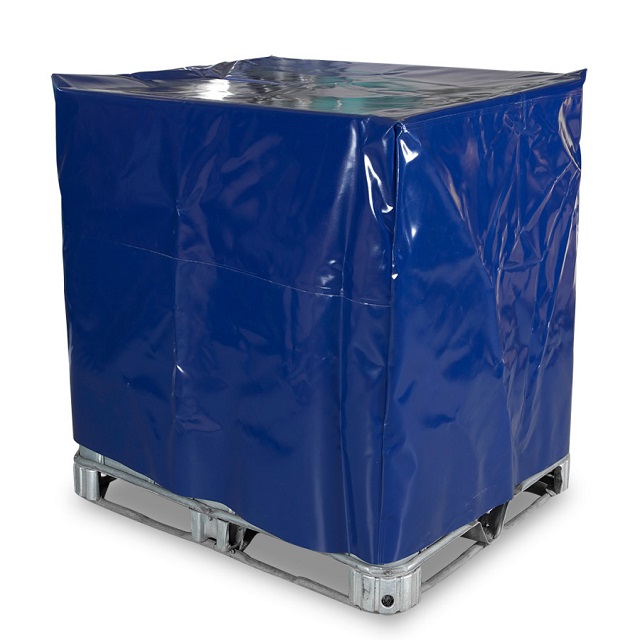
Blue fitted waterproof PVC box cover over a rectangular palletized load with tailored corners and straight side panels
Three-dimensional fitted coverageDERFLEX PRODUCT REFERENCE
The short answer

What Is a Box Shaped Tarp?

A box shaped tarp is a made-to-measure, three-dimensional protective cover that follows a rectangular object's top and vertical faces rather than draping as a flat sheet. The pattern is defined by its panel count, finished dimensions, corner construction, openings and fixing method.

For repeatable rectangular assets, a fitted PVC box cover can reduce loose fabric, improve handling and place reinforcement where the cover sees real stress. Water shedding, ventilation and restraint still need to be engineered for the application.

For irregular shapes and other custom sheet patterns, visit DERFLEX's custom tarps manufacturing overview. This page concentrates on the box geometry itself: deciding which faces to cover, translating measurements into a pattern and preparing a repeatable fabrication specification.

Structure first

4-, 5- and 6-Sided Box Tarp Designs

The number of covered faces affects access, fastening, water paths and fabrication cost. These examples use common panel-count conventions; some suppliers count faces differently. The approved drawing—not the style name—is the final definition.

Format 01 / selective access

Four-Sided Box Tarp

In a common layout, one top panel and three vertical walls leave the rear end and bottom open. The open end supports loading, inspection or access without completely removing the cover.

  • Good for fixed front-and-side protection
  • Specify rear opening and flap direction
  • Check the open end for driven rain
Format 02 / most familiar hood

Five-Sided Fitted Cover

A top with four descending sides forms a box-shaped hood with an open bottom. It is often the simplest format for repeat rectangular equipment, cabinets, storage boxes and pallet loads.

  • Designed around the maximum outside profile
  • Choose a controlled skirt/drop length
  • Plan lower hems and anchor locations
Format 03 / added enclosure

Six-Sided / Closure Cover

Adds a sixth face or a closing base/flap to the five-sided envelope. Use where improved containment or access closure is needed, after reviewing handling, ventilation and how the cover will be fitted.

  • Define the removable or opening face
  • Choose zipper, overlap or hook-and-loop
  • Check water paths at all closures

Important: “six-sided” does not automatically mean airtight or watertight. A closing panel is not the same as a certified sealed enclosure. Describe exposed faces, sealing requirements and opening layout explicitly.

Original buyer worksheet

How to Measure a Box Tarp Correctly

Measure the object at its largest real working profile, not merely its nominal catalog footprint.

  1. Length (L): outside front-to-back footprint including guards, pallet overhang and protrusions.
  2. Width (W): maximum left-to-right footprint, including handles or brackets.
  3. Height (H): from the intended lower edge or support surface to the highest point.
  4. Coverage: identify every closed side and the access/open side.
  5. Clearance: agree a fit allowance for installation, movement and any internal padding; do not assume an arbitrary addition.
  6. Skirt & fastening: draw the intended bottom-edge position and all safe anchor points.

A drawing-based made-to-measure tarpaulin specification should distinguish the object dimensions from the required finished cover dimensions. Seam allowance, weld overlap, shrink behavior and hem width belong to the production pattern and should not be guessed by the buyer.

WLHHem lineConfirm finished cover sizeObject envelope ≠ cutting dimensions

Conceptual geometry for discussion. Final panel count, seam allowances and fastening details require an approved fabrication drawing.

01

Photograph

Front, rear, left, right, top and fixing points—with a clear scale reference.

02

Dimension

Note the maximum dimensions and identify protrusions or handles.

03

Design

Approve opening direction, vents, skirt, pads and closure points.

04

Validate

Where appropriate, trial fit a sample before repeat production.

Selection & specifications

Material and Construction Options

PVC coated polyester fabric is commonly chosen for reusable fitted industrial covers because its reinforced textile carries mechanical loads while the coating provides a waterproof outer surface and fabrication compatibility. The selected grade must match exposure and handling—not merely a target fabric weight.

Custom box shaped tarp specification options
SpecificationAvailable directionWhat the buyer should confirm
Cover formatFour-, five- or six-sided enclosure; optional shaped panelsFaces covered, open faces, access orientation, bottom design
Cover materialPVC coated polyester; selected laminated PVC options subject to fabrication reviewReusable outdoor duty, flex, abrasion, weld compatibility
Weight directionApprox. 450–1100 gsm can be discussed for industrial cover programs; not a universal prescriptionBase-fabric construction, thickness, handling frequency, strength and total cover weight
DimensionsMade to drawings; rectangular and adapted shapesObject vs finished dimensions, fit clearance, tolerances and seam positioning
SurfaceColor, gloss/matte, selected UV-oriented or cleaning-friendly finishesOutdoor exposure, rubbing, color consistency, printing requirements
JoineryHeat-welded seams where compatible; sewn or mixed assemblies for certain detailsSeam location, overlap direction, exposure, sample approval and test needs
ReinforcementHem folds, webbing, corner patches, wear strips, protected edgesRepeated rubbing points and the actual tie-down load path
HardwareGrommets, D-rings, buckles, straps, drawcords, hook-and-loop or zippersAnchor locations, position, corrosion environment, access workflow
Special requirementsSelected UV, low-temperature, flame behavior or anti-static directions after technical reviewExact requested test method, acceptance level and documentation
DeliveryFinished fitted covers, components or related roll goods; OEM branding and packingQuantity, approved sample, labeling, folded/rolled method and destination
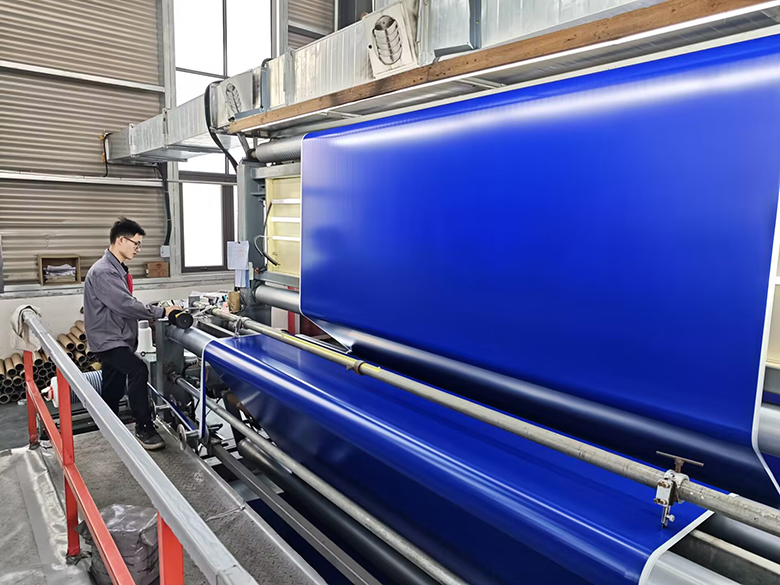
DERFLEX blue PVC coated polyester material on a manufacturing and winding line for custom industrial tarp fabrication

Choose fabric by the failure mode.

Outdoor storage often makes UV exposure and rain-shedding details critical. Repeated installation increases the importance of flexibility, abrasion protection and reinforced hems. Transport-related use may require stronger restraint engineering and verified wind-load review.

Find the wider material family in DERFLEX's PVC tarpaulin material guide.

Do not infer finished-cover waterproof performance from GSM or a roll-fabric test alone.

Engineering notes

Details That Determine a Box Cover's Working Life

The corners and bottom edge frequently matter more than a small increase in fabric weight. A fitted shape reduces loose drape, but only if the seam pattern, wear zones and securement match the object.

01 / seam placement

Keep water away from vulnerable joins

Favor seam arrangements and overlap direction that shed water instead of facing it into an opening. Welded seams can improve water resistance when the PVC grade and process are compatible; stitched seams should not be assumed watertight.

02 / corner loading

Build protection where corners rub

Rigid corners, bolts, banding and pallet edges can abrade the PVC face. Specify a wear patch or protective buffer, consider corner shaping and avoid concentrating the whole tie-down force into an unreinforced seam.

03 / anchoring

Connect straps to real fixing points

Grommet spacing should follow actual anchor geometry, not a universal number. Webbing, buckles and D-rings may be preferable at defined load points; field installation must not create unsafe loose straps or snagging zones.

04 / opening access

Plan how people remove the cover

Rear flaps, zipper panels, hook-and-loop closures and handles reduce unnecessary pulling across the top. Repeated-access panels need their own seam and wear design; clear openings must not conflict with rain protection.

05 / moisture control

Prevent condensation and standing water

A flat fabric top may pool water. Use the underlying object, a supported pitch or a specified drainage approach. Moisture-sensitive contents may need a separate humidity-control plan and properly positioned vents.

06 / repeatability

Record an approved finished pattern

For OEM programs, agree seam route, color reference, cut orientation, finished dimensions, closure positions, tolerance method and packing. A material swatch alone cannot approve a multi-panel fitted cover.

Real-world use cases

Where Fitted PVC Box Covers Make Sense

APPLICATION / 01

Outdoor Equipment & Cabinets

Useful for fixed rectangular machinery, pumps, control enclosures and idle assets. Prioritize access doors, ventilation clearances, corner padding and tie-downs. For larger or irregular assets, see custom industrial equipment covers.

APPLICATION / 02

Loaded Pallets & Returnable Packaging

A repeatable five-sided hood helps organize protection around standardized loads and warehouse handling. The loaded dimensions—not the empty pallet—set the pattern. Explore reusable pallet cover design.

APPLICATION / 03

Industrial Storage Boxes

For crates, metal storage boxes, stacking bins and reusable equipment containers. A simple hood may suffice, while frequent opening favors a defined access flap and identifiable closure side.

APPLICATION / 04

OEM Accessory Covers

Equipment manufacturers may need matching fitted covers shipped alongside the primary product. Drawing control, printed branding, labels, folded size and standardized kits become purchasing priorities.

APPLICATION / 05

Factory Shutdown Protection

Custom covers shield selected idle machinery from dust, splashes and handling contamination. Material suitability, safe isolation of hot or moving components and necessary ventilation must be checked on site.

APPLICATION / 06

Staging & Transport Preparation

Fitted geometry can reduce unsecured fabric during staging and loading. For use on moving vehicles or exposed loads, a separate transport restraint and aerodynamic safety review is essential.

Safety & exposure note: These covers are not a substitute for certified load restraints, fire barriers or engineered weatherproof housings. Do not cover operating generators, live exhausts, hot equipment or critical cooling/ventilation openings without an equipment-specific safety design.
Product & production imagery

See the Shape. Understand the Material.

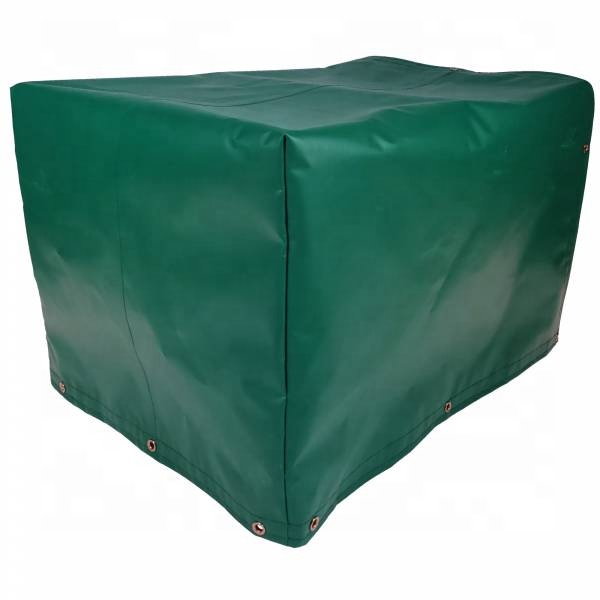
Images below are hosted on DERFLEX's website. They illustrate fitted-cover geometry and coated-fabric manufacturing; the exact product specification is established through the project drawing and approved sample.

Manufacturer collaboration

From Technical Drawing to Repeatable OEM Supply

A box-shaped tarp is a fabricated assembly rather than a plain rectangular roll cut. DERFLEX can review the covered object, select an appropriate PVC textile, work through joining and reinforcement, then confirm the final supply format with the buyer.

01 · Technical review

Send object dimensions, six-sided photos, drawings, exposure and required faces. Identify roof slope, access, hardware and installation sequence.

Output: agreed geometry & critical requirements.

02 · Material and build

Review PVC grade, panel direction, seam location, corner protection, fasteners, finish and logo needs. Trial critical details before a repeat program as applicable.

Output: approved sample / fabrication specification.

03 · Bulk / OEM planning

Align quantity, tolerance acceptance, labelling, packing, shipping and order consistency. For converters requiring semi-finished components, discuss tarpaulin fabrication support.

Output: quotation-ready production scope.
DERFLEX's published product pages discuss PVC roll material, finished custom tarps, OEM branding and fabrication options. Specific finishing feasibility, production minimums, certifications and delivery windows must be confirmed for each design; none are assumed here.
Procurement readiness

What to Send for a Box Cover Quotation

Accurate pricing starts with a drawable, buildable specification. A photograph and “box tarp, heavy duty” are rarely enough.

Object photos or dimensioned drawing
Maximum external L × W × H
4 / 5 / 6-face coverage plan
Indoor, outdoor or transport exposure
Desired material, GSM or duty level
Fastening / access / vent positions
Quantity, destination and packaging
Logo, tolerance and required tests

Avoid these common ordering mistakes

Five ways a “simple” box cover goes wrong

  1. Ordering to nominal equipment dimensions instead of measured protrusions.
  2. Leaving the opening direction out of a six-sided or flap design.
  3. Specifying grommet spacing without checking actual anchor locations.
  4. Choosing the highest GSM without checking flexibility, total hood weight and removal ergonomics.
  5. Approving a fabric swatch without verifying finished seams, closures and fit.

Request a fit trial or first-article approval for high-volume programs when practical. It can save far more than changing material weight after production.

Answers for specifiers & buyers

Frequently Asked Questions

Useful answers to common questions about custom fitted vinyl covers and box-shaped tarp fabrication.

What is a box shaped tarp?

It is a three-dimensional fitted protective tarp made to follow the length, width and height of an object. Unlike a flat tarp, it uses preplanned top and side panels, corner seams, a defined lower edge and optional closures or fastening points. PVC coated polyester is one practical material for reusable industrial versions.

What is the difference between four-sided, five-sided and six-sided box tarps?

Under one common convention, four-sided covers protect the top and three walls, five-sided covers protect the top and all four walls while leaving the base open, and six-sided covers include a sixth face or closing panel. Supplier naming can vary. Always agree which faces are closed, which are open and how the cover is installed.

Are fitted PVC box covers waterproof?

PVC coated polyester fabric has a waterproof material surface. However, completed-cover performance depends on seam construction, water runoff, closure overlaps, openings and installation. For water-sensitive assets, specify the seam and leak-resistance criteria you require, and do not assume a zipper or vent is watertight.

How do I measure for a custom box tarp?

Measure the maximum outside length, width and height including handles, brackets and load overhang. Mark the desired skirt/bottom-edge location, open faces, access points and any protrusions. Tell the manufacturer whether the numbers describe the object itself or the required finished cover. Agree clearance and tolerance separately.

Should I use grommets, straps, buckles or a drawcord?

Use the fixing method that connects safely to real anchor points. Grommets work for supported perimeter ties; reinforced webbing and buckles are helpful where tension needs to be spread to defined locations. A drawcord or elastic edge can help retention on suitable small covers, but is not a universal high-wind anchoring method.

What GSM is suitable for a heavy-duty fitted box cover?

The answer depends on the polyester reinforcement, coating, expected abrasion, outdoor exposure, handling frequency and cover size. DERFLEX publishes industrial PVC material options across multiple GSM categories, but the cover should be selected as a complete assembly with seams and reinforcement. Have the final grade approved against the intended use.

Can a PVC box cover have a zipper, flap, vent or printed logo?

Such features can be reviewed as part of the design. Their locations and compatibility with the chosen fabric, water protection and handling workflow need confirmation. Vents, acces, s openings and closures should not conflict with safety-critical exhaust or cooling requirements.

Does DERFLEX supply bulk or OEM box-shaped tarps?

DERFLEX can discuss drawing-based PVC cover projects, custom materials, finishing, branding and export packing. Send the specification and requested quantity for a feasibility review, sample plan and quotation. Minimum order quantities and production schedules are confirmed during the commercial process.

Ready to define the fit?

Make the Cover Fit the Equipment — Not the Other Way Around.

Share a sketch, dimensions, use environment, desired coverage and annual or batch quantity. DERFLEX can review the material and construction route before preparing a custom fitted PVC box-cover quotation.

Request A Quote

Include these in your first message:

01 / Object L × W × H and site photographs
02 / 4-, 5- or 6-sided coverage, closures and vents
03 / PVC grade preference, color and surface duty
04 / Grommets, straps, reinforcements and logo
05 / Requested volume, destination and timeline

No nonfunctional submission form is embedded on this page. The button opens DERFLEX's existing quotation channel.

Consulting Services
+86-021-54361792 / 54361798
Email
sales@derflex.com