Outer Overlap Flap
Direct runoff over the joint rather than toward its open edge. Specify overlap orientation for vertical panels, roofs and wind-driven rain.



Custom tarps with hook and loop fastening give maintenance teams, enclosure installers and equipment operators a practical way to open, reclose or remove a section without dismantling an entire cover. DERFLEX supports project-defined PVC fabric, overlapping flaps, reinforced fastening zones and OEM manufacturing.
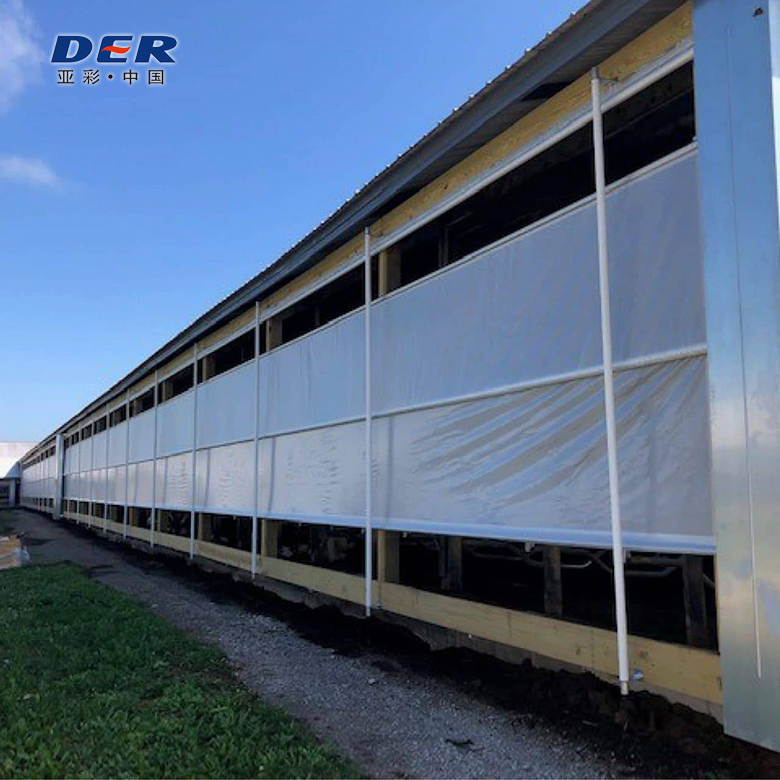
A hook-and-loop tarp uses two mating textile surfaces—one with small hooks and one with loops—to join fabric sections or secure an access flap. Unlike a permanently welded seam, the joint can be opened and engaged again by hand.
That makes this construction useful for periodic equipment inspection, temporary cable openings, maintenance access, modular partitions and fitted covers where a conventional single-piece tarp is inconvenient. For a broader view of made-to-measure coverings, see DERFLEX custom tarpaulin manufacturing options.
The most important decision is what the closure is expected to do: locate a flap, reduce drafts, hold an overlap in position or withstand a defined mechanical load. Those functions require different construction and validation.
Choose it when frequent access, variable fit and rapid panel removal matter more than an uninterrupted permanent seam. Use reinforced attachment zones and position the closure so water sheds over the overlap. In windy or tensioned installations, provide separate load-bearing fixing points.
The failure point in a repeatedly opened cover is often the transition between the closure tape, its supporting patch and the loaded tarp body. Plan these layers together rather than selecting fastener width alone.
Direct runoff over the joint rather than toward its open edge. Specify overlap orientation for vertical panels, roofs and wind-driven rain.
Match hook/loop orientation, tape width, substrate compatibility and backing reinforcement. Keep strips out of high-abrasion or dirt-collection paths.
Use hemmed anchors, straps, rail systems or other evaluated retention where the curtain takes wind, pull or hanging loads. Hook-and-loop is not an automatic substitute.
The fastening layout is selected from how operators will approach, open, secure and reclose the cover during normal work.
A hinged panel opens to a valve, control box or inspection point while the main tarp stays secured. Specify opening hand, hinge side, flap reach and closure clearance.
A replaceable section engages against a reinforced surrounding border. Helpful when access is less frequent but full panel removal must be quick and tool-free.
Hook-and-loop strips connect two flexible curtain panels or fasten a flap to a frame interface. Useful for adjustable joins, with weather and load limits assessed separately.
There is no universal tape width or tarp GSM for every hook-and-loop installation. The practical starting point is the duty cycle, the direction of load and the environment around the joint.
| Application / exposure | Recommended design direction | Key risk to control | Sample evaluation focus |
|---|---|---|---|
| Indoor machine access | Reinforced local flap with full mating contact and easy grip edge | Oil, abrasion, snagging or accidental peeling | Repeat access, operator handling and residue cleaning |
| Warehouse partition | Vertical overlapping connection; separate top suspension and restraints | Draft pressure, forklift contact and misaligned edges | Panel alignment, reclosure and repeated traffic |
| Outdoor weather enclosure | Weather-facing overlap with water-shedding orientation and secondary anchors | Wind-driven rain entering the joint; UV and grit exposure | Joint leakage, pull direction and weather aging |
| Custom equipment cover | Fitted wrap or tail flap; reinforced joining patch at service side | Corner strain, poor fit and fastener abrasion | Real fit test and ease of removal with gloves |
| OEM replacement curtain | Controlled panel size, mating side, color, closure location and packaging | Batch mismatch and reversed tape orientation | Golden sample, labeling and repeat-lot compatibility |
These are design recommendations, not certified performance ratings. Final construction is confirmed by drawing, application review and approved samples.
Think of the tarp body, attachment zone and closure as a single product. The parameters below are intentionally project-defined where no approved model data has been supplied.
| Specification item | Available direction / quotation requirement | Why it matters |
|---|---|---|
| Base tarp material | PVC coated polyester fabric, or flexible clear PVC where visibility is required | Determines drape, tear resistance, weather protection and fabrication approach |
| Fabric weight / thickness | Choose to installation duty and expected wear; confirm GSM or thickness after technical review | Higher mass can improve robustness but also adds handling weight and opening force |
| Hook / loop selection | Mating sides, weave or molded type, width, color, texture and any named brand requirement to be specified | Different systems vary in engagement, cycling, contamination tolerance and compatibility |
| Panel / flap geometry | Finished width × height; opening position; hinge or removal direction; overlap | Controls fit, usability, runoff and closure engagement |
| Attachment method | Stitching, validated welding-compatible tape or combined fabrication after sample review | Prevents assuming all adhesive tapes or fastener backings can be welded to every PVC grade |
| Reinforcement / hardware | Webbing, perimeter hems, patches, grommets, D-rings, support tracks or straps as required | Transfers installation loads away from an access closure |
| Performance requirements | Water ingress expectation, UV exposure, cold flex, fire-performance test, peel/shear and cycle targets if relevant | Enables validation against an agreed method rather than unsupported generic claims |
| Supply mode / OEM | Roll material, cut panels, finished tarp sets, labels, packaging and repeat specifications, subject to review | Aligns product format with downstream assembly and inventory needs |
Often appropriate where tear resistance, abrasion and dimensional support matter. DERFLEX supplies PVC coated polyester fabric for tarp and industrial curtain conversion.
Useful for visibility around access points, but requires close review of bonding, patch support and panel distortion. Explore transparent PVC tarp materials.
Each closure works for a different job. Combining them is often better than expecting one fastener to solve both frequent access and structural restraint.
| Solution | Most useful for | Advantages | Watch-outs |
|---|---|---|---|
| Hook & loop | Flaps, removable panels, alignment-tolerant joints | Tool-free reopening and adjustable engagement | Debris buildup, peeling under load, incomplete closure |
| Zipper | Defined access doors and regular track-style openings | Positive continuous closure path and predictable alignment | Slider wear, grit and snagging; separate weather-flap design may be needed |
| Grommets / D-rings | Anchoring and tie-down zones | Defined load transfer into reinforced perimeter | Not quick-access seals; require suitable support and spacing |
| Straps / buckles | Adjustable restraint, larger cover tensioning | Can take defined holding loads when properly engineered | Slower repetitive opening and projecting hardware |
For loads that demand dedicated tie-down points, see DERFLEX D-ring tarp reinforcement and fastening.
The practical value is not the hook-and-loop tape by itself. It is how quickly users can reach machinery, pass through a partition or remove a panel while leaving the surrounding protection in place.
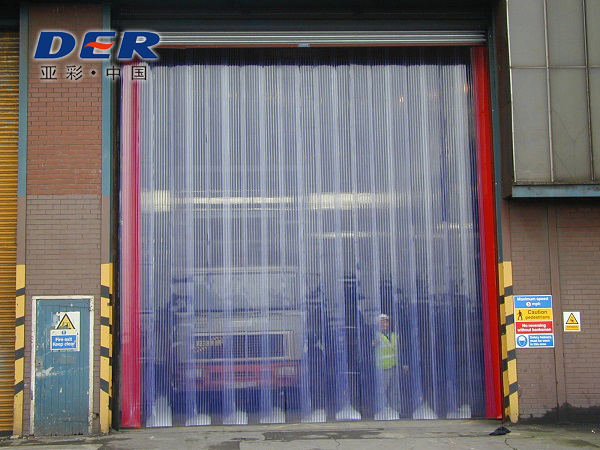
Removable edge joins and service flaps help divide work areas while preserving access. Permanent suspension and safe traffic clearance still require a dedicated design. Explore warehouse divider tarp systems.
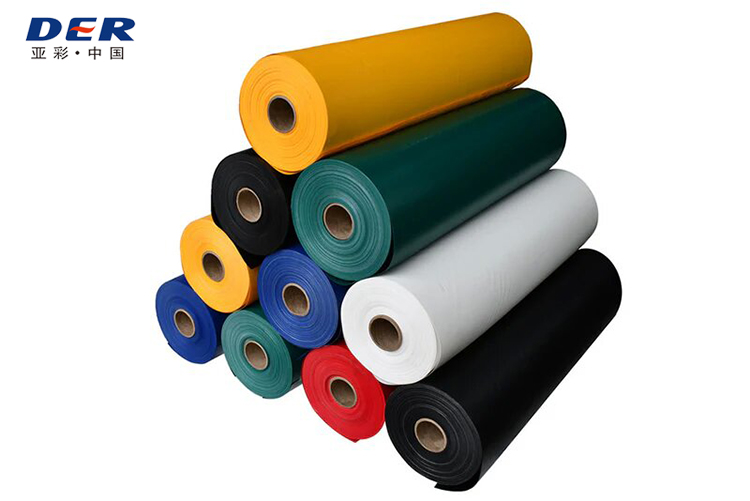
Access to gauges, controls and fittings can be placed at a known location instead of requiring removal of the full fitted cover. Reinforce corners and abrasion points near the opening.
Use defined mating edges between curtain sections for reconfiguration, site work or equipment replacement. A clear window can preserve line-of-sight without converting the entire barrier to transparent sheet. DERFLEX's industrial PVC curtain range also describes hook-and-loop joining options.
Lock the finished drawing, exact hook/loop side, matching tape construction, fabric code and packaging instructions before bulk supply. A "similar" replacement tape can fail to mate with existing stock.
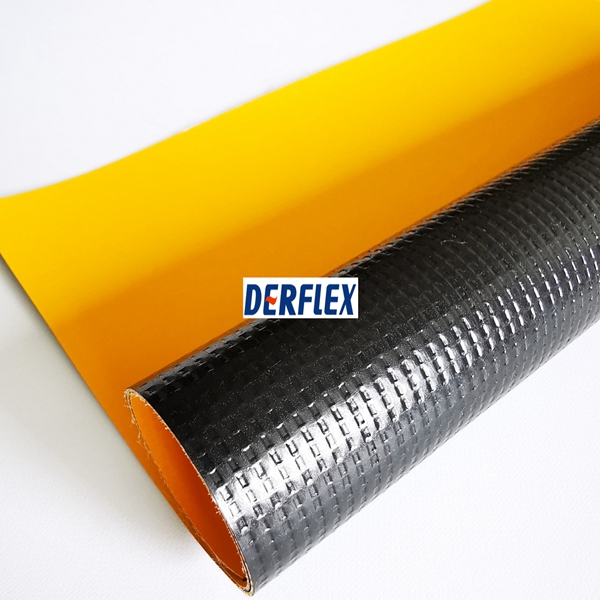
These are authentic DERFLEX material / application reference photographs. They do not claim to depict a completed hook-and-loop assembly; the precise closure is engineered to your drawing.
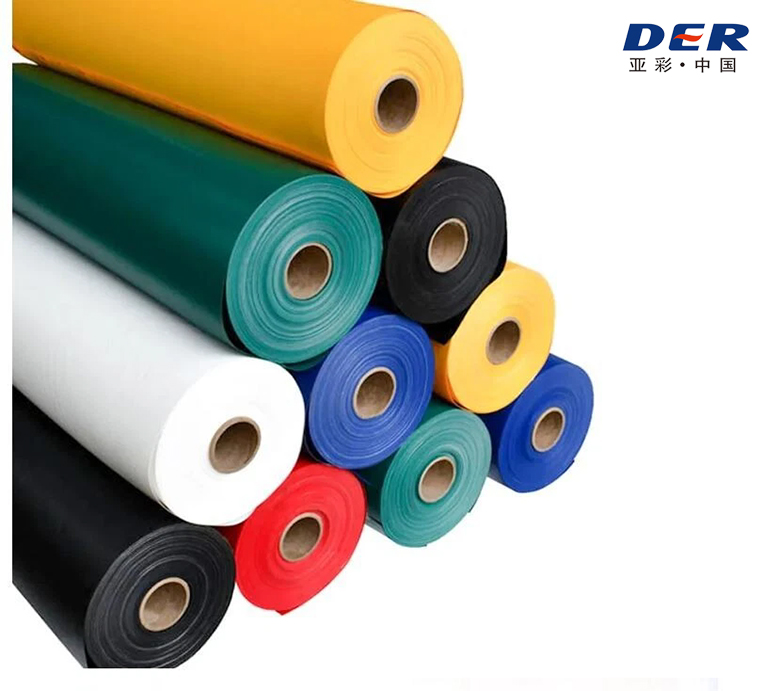
A controlled approval route matters more than a generic claim that a closure will survive a certain number of cycles. Testing should use the selected material, fastener backing, attachment method and real access direction.
Mark every opening on an annotated drawing. Record which hand or edge opens, clearance, frequency, access with gloves and available anchoring points.
Agree tarp substrate, hook/loop grade, tape orientation, reinforcement, finishing method, overlaps and separate load-bearing connections.
Check peel and shear paths, reopening cycles, contamination, rain run-off and mating compatibility. Ask for reports against named methods when evidence is required.
Approve a reference sample, dimensional tolerance, panel marking, hook versus loop side, packing and any inspection criteria before recurring supply.
DERFLEX works with custom PVC tarpaulin and industrial fabric requirements, including roll supply and downstream cover fabrication. For a repeatedly opened tarp, the supply conversation should begin with where the operator interacts with the fabric—not simply the overall rectangle size.
Material structure, welded or sewn seams, edge reinforcement and accessory placement can be considered together. Fastener attachment may need a trial on the final PVC substrate, especially when the buyer specifies an exact tape brand, flame-performance requirement or environmental condition.
For larger or critical projects, design approval should include the complete cover system, installation structure and performance acceptance criteria, not an unsupported guarantee attached to the textile alone.
Direct answers to selection, performance, installation and maintenance questions.
Ask DERFLEX a Question ↗They are tarp or enclosure panels with mating hook-and-loop textile fastening strips at defined openings, seams or perimeter zones. They allow access or removal without undoing the whole cover.
The PVC coated fabric may be waterproof, but the hook-and-loop joint alone is not a watertight seam. Rain-exposed designs need sufficient overlap, suitable orientation, drainage and additional sealing where required.
Not automatically. Grommets, tracks, straps or other load-bearing restraints should handle structural loads, especially in wind. Hook-and-loop is primarily an access or joining feature unless the complete assembly is engineered and tested otherwise.
Hook-and-loop works well for adjustable, quick-opening flaps and irregular shapes; zippers create a more defined continuous opening and can offer better closure alignment. Choose based on access frequency, weather exposure, contamination and required security.
Fastener strips may be sewn to reinforced PVC tarp zones or attached by a validated compatible welding or hybrid process. Fastener backing, PVC compatibility, seam position and sample peel/shear perfor, mance must be checked before production.
Keep fastening surfaces free of dust, grit and loose fibers; avoid dragging or overstressing strips; engage the full mating area; and inspect seams and patches. Service life depends on product design and actual duty cycles.
Provide application, finished dimensions, quantity, opening drawing, access frequency, hook/loop side orientation, exposure conditions, base material, reinforcement, required testing, OEM packaging and destination.
These verified DERFLEX product groups explain the material, fabrication and installation context for an access-ready enclosure.
Additional contextual links are integrated within the selection, application and fastening sections above.
Send your drawing, size, service-access frequency, environmental conditions, material choice, closure orientation and quantity. DERFLEX can review a practical material and fabrication direction and prepare a project-specific quotation.