


Industrial loading bay / engineered coated textile
PVC Coated Fabric for Dock Shelters
Durable dock shelter fabric and loading dock fabric for side curtains, head curtains and reinforcement zones where trailer movement, abrasion and weather meet.
DERFLEX supplies PVC coated polyester rolls and custom material structures to dock equipment manufacturers, curtain converters and industrial OEM buyers.
Custom weights & widthsUV & cold-flex optionsOEM roll supply
Dock shelter / functional cross-sectionIllustrative diagram · not to scale
Material specification should follow the actual dock system, contact pattern and vehicle mix.
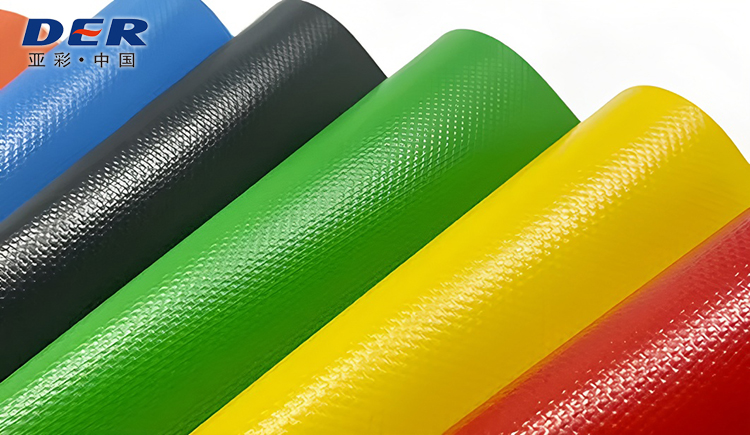
ROLL GOODS · OEM
The direct answer
What is dock shelter fabric?
Dock shelter fabric is a reinforced, flexible material used to form the top and side curtains around a loading-bay entrance. PVC coated polyester is commonly selected because it combines weather protection, tensile and tear strength, cleanability and fabrication versatility. The right grade depends on trailer contact, dock geometry, temperature and duty cycle.
A loading dock shelter does not work like a fixed tarp. Its side flaps rub against trailer bodies, its header moves over varied vehicle heights, and its joining or mounting points can concentrate stress. A material suitable for a stationary enclosure may fail prematurely at a trailer contact edge. DERFLEX supports buyers choosing loading bay shelter curtain material by real wear conditions and production needs.
Design by contact zone
One loading dock. Three different fabric demands.
Dock shelters are systems. Separate the visible outer canopy from curtains that move against trucks and the localized points that take the hardest abrasion.
Side curtains
PVC coated dock shelter side curtains follow vehicle walls as trucks enter and exit. Prioritize abrasion resistance, tear performance, repeat folding and smooth contact behavior.
Abrasion + flexible recoveryHead curtains & hoods
Top flaps and weather hoods must handle trailer-height variation, rainfall exposure and repeated movement. Balance fabric stiffness, UV stability and low-temperature flex.
Weather barrier + movementWear strips & reinforcement
Contact edges, mounting tabs and corners need heavier protection than the rest of the shelter. Consider extra overlays or abrasion-resistant patches rather than adding weight everywhere.
Reinforce the failure pointMaterial engineering
Strength comes from the entire construction.
PVC coating provides the water-shedding surface; woven polyester carries much of the tensile load. Coating adhesion, yarn architecture and finishing become critical where a curtain repeatedly bends or rubs.
- Polyester scrim: warp and weft construction selected for strength, flexibility and dimensional stability.
- PVC surface: weather resistance, cleanability, appearance and weldability.
- Optional top finish: lacquer or abrasion-oriented surface treatment, qualified for actual contact and cleaning conditions.
- Reinforced joints: welding or stitched seams, hems and mounting interfaces tested as a finished assembly.
Coated textile / layer concept
OUTER PVC COATING Weather / abrasion-facing surface
WOVEN POLYESTER SCRIM Tensile / tear reinforcement
INNER PVC COATING Barrier / processing surface
Schematic only. Exact layer thickness, finish and yarn construction are project-dependent. A heavier coating does not automatically guarantee better tear or flex endurance.
Practical material selection
Which GSM should you specify?
Start from contact severity rather than treating weight as a performance rating. These are indicative sourcing bands, not fixed DERFLEX stock SKUs or certified shelter-specific test results.
| Use / material direction | Discussion range | Engineering focus | Procurement note |
|---|---|---|---|
| Flexible head / general curtain | 650–900 g/m² | Flexibility, waterproofing, weathering, tear resistance | Check trailer contact, geometry and cold conditions first. |
| Repeated-contact side curtain | 900–1200 g/m² | Abrasion, coating adhesion, tear resistance and fold life | Confirm panel recovery and selected surface finish on a sample. |
| Wear overlay / reinforced zone | 1200–1500 g/m² or multi-layer buildup | Contact wear, attachment integrity and repairability | Use selective reinforcement where practical; verify final assembly. |
*Reference ranges reflect commonly used PVC coated polyester construction families and dock-system examples; exact grade availability, roll width, performance and compliance must be confirmed by DERFLEX for the order. GSM alone does not describe abrasion life.
Quick material-direction selector
Choose the most demanding operating situation to see a starting discussion point. This is not a final specification.
Start with a flexible curtain grade.
Discuss 650–900 g/m² PVC coated polyester, the required header deflection, outdoor UV exposure and the mounting method. Sample the selected coating at actual working temperature.
RFQ-ready technical reference
PVC coated loading dock fabric specifications
A useful quote ties the roll fabric to the shelter type, fabrication process and measurable acceptance criteria. Supply values below describe customizable options, not a single guaranteed material grade.
| Parameter | Available direction / what to define | Why the buyer should care |
|---|---|---|
| Material | Woven high-tenacity polyester with PVC coating on both sides | Combines textile reinforcement with a weatherproof, workable surface. |
| Finished weight | Project discussion: approximately 650–1500 g/m²; other structures by review | Affects handling, drape, wear protection and shipping weight. |
| Base textile | Yarn denier and weave density matched to required tensile/tear targets | Controls load-bearing and tear-growth behavior. |
| Roll width & length | Common industrial widths approx. 1.02–3.20 m; wider structures on feasibility review | Defines panel yield, seams, production efficiency and freight. |
| Coating / finish | Knife coating or qualified lamination; matte, glossy or optional lacquer / wear finish | Influences abrasion behavior, adhesion, cleanability and fabrication. |
| Color | Black, grey, blue, high-visibility colors and project-specific matching | Matches facility aesthetic, visibility and replacement orders. |
| Weather and cold flex | UV stabilizers / cold-resistant PVC formulation by climate and test requirement | Reduces risk of hardening, cracking or premature weathering. |
| Fire performance | Optional fire-retardant formulation subject to named standard and test report | Compliance depends on jurisdiction and exact material assembly. |
| Fabrication | Sample qualification for hot-air / HF welding, sewing and edge reinforcement | Prevents seam failures, leaks and weak mounting points. |
| Documentation | Approved sample, data sheet, batch label and agreed test records | Helps control repeat orders and customer quality review. |
Technical test values such as tensile strength, tear strength, abrasion cycles, cold-crack temperature, coating adhesion and flame rating are deliberately not invented. Request a signed specification / test report for the exact construction and lot.
Performance verification
Qualification that matters at the dock.
For working curtains, a spec sheet should measure the risks that cause replacement: rubbing, tear propagation, coating separation, cold stiffness and weak joined edges.
Abrasion
Agree a suitable coated-textile abrasion method and document contact pressure, medium and pass/fail criterion. Compare after-sample appearance, not just cycles.
Tensile & tear
Specify warp and weft values and a consistent method such as ISO 1421 for tensile and ISO 4674-1 for tear where appropriate.
Adhesion & flex
Consider ISO 2411 coating adhesion and ISO 7854 flex testing, with conditioning that represents your service temperature.
Weld / seam check
Trial-weld or stitch the actual construction, then inspect joint strength, edge stability and damage after repeated flexing.
Methods listed are potential evaluation routes, not claims that every DERFLEX dock-shelter grade has passed them. Applicable test editions, procedures and acceptance limits must be agreed with the buyer.
Genuine DERFLEX material imagery
Inspect the fabric before choosing the shelter.
Actual DERFLEX coated-fabric product photos. These show color, surface and roll presentation—not installed dock-shelter projects or evidence of a particular performance grade.
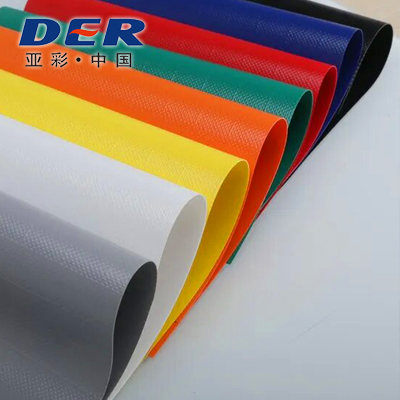
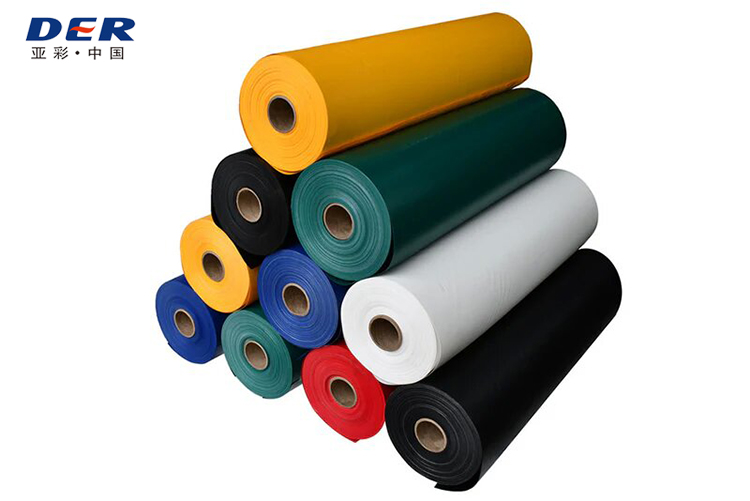
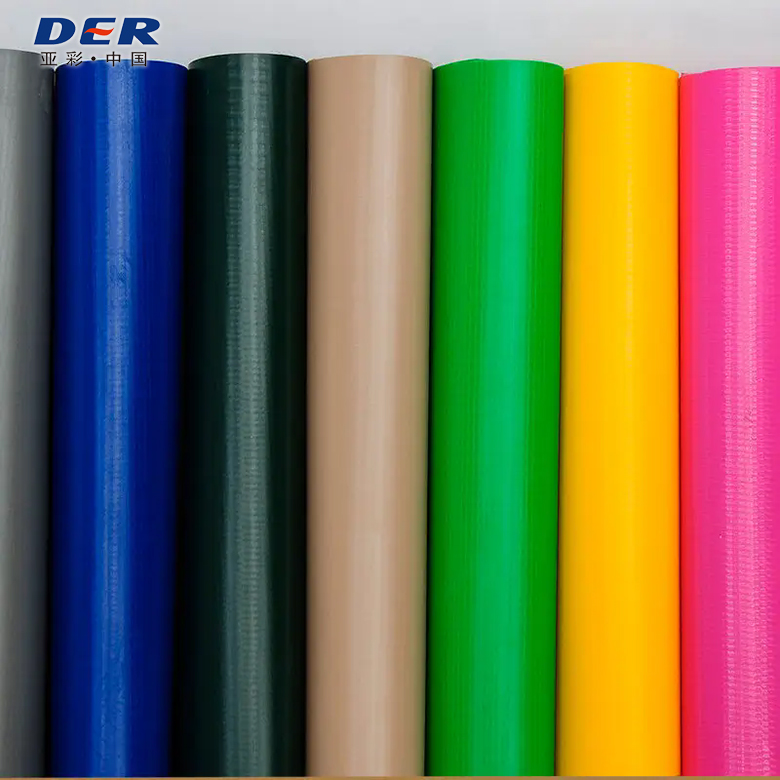
Choose the correct material system
PVC coated fabric vs alternative dock coverings
Different materials can all be valid. Select around finished shelter behavior and maintenance economics rather than treating one coating type as universally superior.
| Material option | Good fit | Watch points |
|---|---|---|
| Reinforced PVC coated polyester | Custom curtains, weather hoods, OEM roll conversion, welded or stitched assemblies | Confirm contact wear, cold flex and surface finish for the duty cycle. |
| Rubber / specialty coated fabric | Projects seeking specialized abrasion, chemical or temperature behavior | Different joining methods, cost and material-specific qualification. |
| Lightweight PE sheeting | Short-lived temporary weather covers away from repeated contact | Usually unsuitable as a long-cycle trailer-contact curtain. |
| Multi-layer reinforced impact zone | Localized points with aggressive rub, buckling or collision-adjacent stresses | Validate stitching, mounting clearance, weight and movement. |
A completed loading dock shelter is not made from fabric alone. Curtain tension, mounting frame, bumpers, trailer approach, wear strips and operator practices affect sealing and life.
Factory-to-converter supply
A smoother way to source custom dock curtain fabric.
DERFLEX supports manufacturers and converters of truck dock shelters, warehouse entrance curtains and weather-protection assemblies. The project starts with an application review and a qualifying sample instead of a generic one-size-fits-all claim.
- Define contact pattern: header, side flap, canopy or localized reinforcement.
- Share truck and dock data: opening size, trailer range, daily cycles, slope, bumper projection and working temperatures.
- Confirm material: basis weight, color, available width, finish, yarn strength, FR and environmental needs.
- Qualify conversion: sewing, hot-air welding or HF welding, seam reinforcement and attachment points.
- Approve repeat production: sample, QC criteria, label, roll length, order quantity and packaging.
Buyer questions
Dock shelter fabric FAQ
Short, practical answers for OEMs, installers, converters and technical purchasing teams.
What fabric is used for loading dock shelters?
Dock shelter side and head curtains commonly use reinforced coated textiles such as PVC coated polyester. The coating helps repel weather while the woven reinforcement supplies tear and tensile strength. Exact fabric choice depends on trailer abrasion, required flex, climate and assembly construction.
What GSM is best for loading dock curtain fabric?
There is no single best GSM. Around 650–900 g/m² may be a starting point for flexible panels; repeated-contact zones may require 900–1200 g/m² or localized heavier reinforcement. Verify abrasion, tear, cold flex and the actual curtain assembly before approval.
Is PVC coated dock shelter fabric waterproof?
A continuous, suitable PVC coating is water-resistant or waterproof as a sheet material, but the finished dock shelter can still admit rain through edges, movement gaps or poorly designed seams. Water tightness of the whole opening must be evaluated as a system.
Can loading dock shelter fabric be welded or sewn?
Many PVC coated polyester fabrics can be hot-air welded, high-frequency welded or sewn. The chosen material and process must be trialed together because coating formulation, thickness, reinforcement and seam configuration affect joint performance.
How can I reduce premature side-curtain wear?
Measure the trailer contact location, inspect bumpers and docking alignment, and then choose an abrasion-qualified fabric or add replaceable reinforcement in the high-wear zone. A heavier sheet alone cannot correct a misaligned dock or poor fit.
Does DERFLEX supply custom loading dock fabric rolls?
DERFLEX supports OEM PVC coated fabric orders with specification matching for weight, roll width, color, finish, cold flexibility, optional FR requirements and packaging. Send the intended application and acceptance criteria to confirm grade feasibility, sampling and quotation.
Build the right material specification
Ready to develop a better dock shelter curtain?
Tell us your curtain position, approximate GSM or existing sample, roll width, color, wear issue, weather conditions, quantity and destination. We'll use these details to discuss a suitable PVC coated fabric direction.