Fewer assembly steps
Eliminating a separate rigid support frame reduces components to move and assemble. Ground preparation and controlled filling remain essential.



Frameless, collapsible onion tanks for rapid-access water reserves. Built around the realities of field deployment: available footprint, self-rising collar geometry, coated-fabric integrity, fill-and-drain connections, and repeatable OEM specifications.
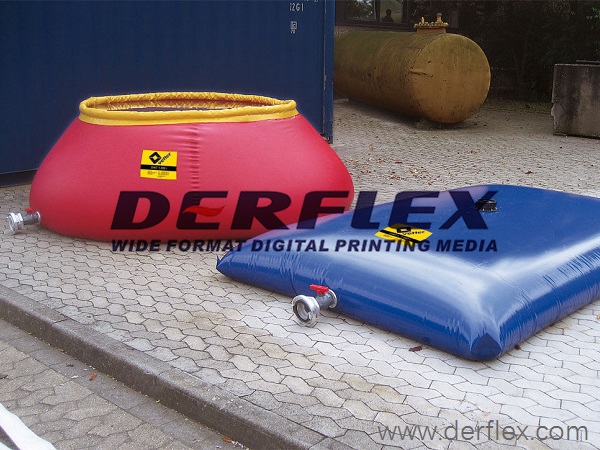
Both are collapsible systems. Their operating geometry, exposure to contamination and access requirements are different.
A self-supporting water tank is a frameless, flexible water reservoir, commonly called an onion tank, pumpkin tank or self-rising water tank. Reinforced coated-fabric walls and a buoyant top collar rise as the tank fills, forming an open, accessible reservoir without a rigid external support frame.
It is particularly useful when field crews need quick access to stored non-potable water without erecting a steel or tubular frame. Empty, the tank folds for transport; full, it must remain on a prepared, load-bearing surface and within the approved usable fill level. A cover may reduce debris entry but does not by itself create a certified potable-water system.
The distinguishing component is a buoyant rim or collar integrated around the opening. As water is introduced, the collar follows the water surface, helping the sidewall rise. Tank geometry, reinforcement and fill limit must work together to prevent excessive deformation or loss of freeboard.
The benefit is not only that a tank folds. It is that temporary water capacity can be moved, deployed, used and recovered as a complete field system.
Eliminating a separate rigid support frame reduces components to move and assemble. Ground preparation and controlled filling remain essential.
Allows direct hose filling, visual water-level checks and project-specific drafting or pumping arrangements.
Folded coated fabric occupies less empty-return space than a rigid reservoir of comparable installed capacity.
Reinforcement, coating adhesion, seam overlap, edge construction and valve reinforcement can be evaluated as a system.
Discuss color, product marking, packing, spare accessories, fitting layout and repeat-order technical documentation.
Match tank type to stored liquid, pumping requirements, contamination risk, exposure and the available site footprint.
Use the parameters below to prepare an RFQ. They are material and design directions, not a universal performance datasheet for every onion tank size.
| Specification | DERFLEX project direction | What the buyer should confirm |
|---|---|---|
| Tank architecture | Frameless, open-top onion / self-rising geometry; covered concepts can be discussed. | High- or low-side profile, permitted filling method and required access. |
| Capacity | Custom capacity subject to approved onion tank geometry and engineering review. | Nominal versus usable volume; do not assume the full flexible-tank family range applies to an onion design. |
| Liquid-contact material | Reinforced PVC coated polyester; TPU coated textile can be evaluated where appropriate. | Water type, liquid temperature, storage duration and relevant compliance. |
| Coated-fabric thickness | DERFLEX flexible-tank material references include approximately 0.75–1.20 mm; final onion tank specification requires confirmation. | Approved fabric construction, reinforcement, thickness, strength and welding behavior. |
| Reinforcement | Polyester woven substrate; 1000D-class constructions exist in DERFLEX water-containment material references. | Warp/weft strength, tear resistance, load paths, coating adhesion. |
| Collar / top rim | Buoyant self-rising collar design and optional project-specific rim details. | Collar section, joining, handling points, maintenance and fill-limit markings. |
| Panels and seams | HF / RF or other compatible thermal welding, selected by material and tank geometry. | Sample weld validation, seam map, panel layout and fitting reinforcement. |
| Connections | Outlet, drain, flange, threaded or quick-coupling options according to drawing. | Hose size, thread/flange standard, pump flow, outlet location and support. |
| Accessories | Optional cover, groundsheet, marking, carrying/packing bag and repair-kit discussion. | Accessory compatibility, contents and packing specification. |
| Environment & compliance | Outdoor formulation and contact requirements assessed for each order. | UV exposure, site temperature, potable-water restrictions and destination standards. |
Coating chemistry alone does not prove tank performance. The substrate, double-side construction, weld compatibility and intended liquid must be reviewed together.
A practical construction for many general-service, non-potable outdoor reservoirs where reinforced fabric, weldability and commercial cost are key purchasing considerations.
Worth evaluating when repeated folding, flexibility or a particular water-contact formulation is a priority. Material selection must not be equated with automatic food- or drinking-water approval.
If the stored medium is fertilizer solution, industrial liquid, wastewater or anything other than ordinary water, provide the exact composition and exposure conditions before seeking material approval. Fuel and aggressive chemicals are not automatically compatible with this product.
The hero image above shows DERFLEX’s self-supporting onion shape. The following different images illustrate related tank structures and a coated-fabric detail for comparison; they are not presented as onion-tank models.
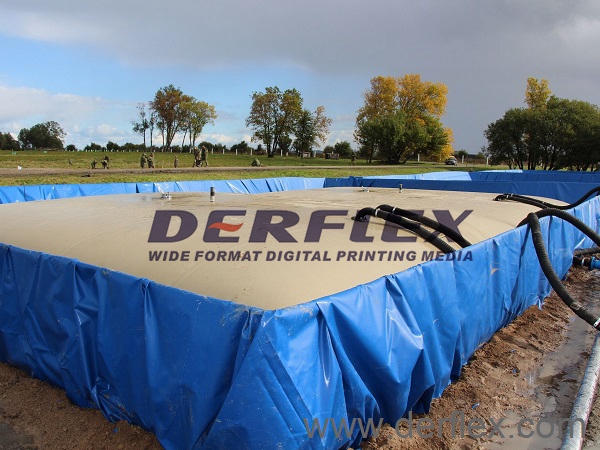
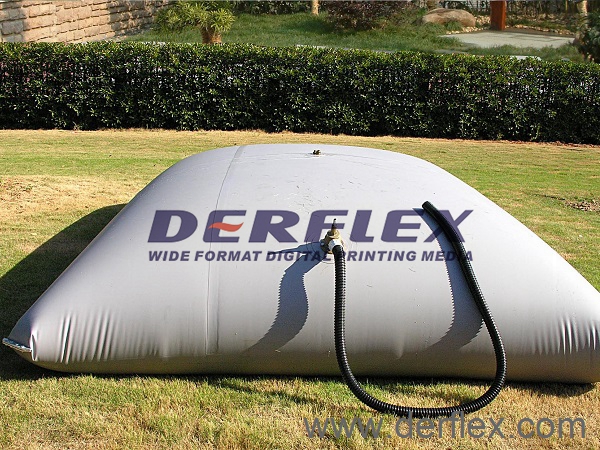

The right tank format is determined first by access, water quality controls and site conditions, not by a preferred marketing name.
| Buyer requirement | Self-supporting onion | Closed pillow / bladder | Frame-supported liner |
|---|---|---|---|
| Open top access | Yes; key advantage | No; sealed/port access | Yes |
| Rigid assembly frame | Not required for designed self-rising configuration | Not required for typical ground-supported bladder | Required |
| Contamination protection | Requires cover and a hygiene plan; open reservoir limitations remain | Enclosed configuration is generally preferable | Requires cover and site controls |
| Installation geometry | Flexible footprint and side height vary with fill | Low-profile expansion as filled | Frame defines supported shape |
| Typical procurement priority | Field reserve, fast access, temporary firefighting water | Enclosed temporary storage and compact logistics | Stable open working tank and repeated access |
Each setting has a different balance of water quality, site loading, hydraulic connection and turnaround requirements.
Temporary water supply at rural or remote staging areas. Confirm pump coupling, usable volume, safe access and local emergency-service requirements; not every configuration is suitable for aerial dipping.
Seasonal reserve for irrigation crews and farms. Evaluate turbidity, debris, hose connections, weather exposure and storage period.
Short-term process or dust-control water where access, site footprint and ground protection are planned in advance.
Rapidly deployable non-potable water reserves at field camps, relief sites or temporary works. Hygiene and user access controls are project-specific.
Temporary clean-up or service-water buffer systems where the liquid is verified as compatible and discharge is controlled.
Repeated product ranges with specified colors, markings, connection standards, accessory kits and export packing.
A 10,000 L water reserve holds approximately 10 metric tonnes of water, before adding fabric or equipment weight. A flexible tank also changes profile during filling. That is why a capacity-only quotation is not enough.
Ask for a project drawing showing base diameter, top opening diameter, expected filled height, maximum usable water level, discharge point and packed dimensions. Confirm that the substrate can accommodate the resulting filled footprint and total load. Never estimate dimensions from a simple cylinder formula when the tank has a curved onion profile.
Use the approved product manual and local site procedures. These principles help procurement teams decide what instructions, accessories and risk controls to ask for.
DERFLEX supplies reinforced coated fabrics and finished flexible tank directions. For a self-supporting tank, the buyer should ask to review the complete fabric–collar–seam–fitting system before repeat orders.
Confirm weight, thickness, strength directions, coating adhesion and weather suitability on the chosen construction.
Review buoyancy, sleeve seams, joining and the relationship between collar geometry and the approved water level.
Use compatible joining methods with meaningful seam and fitting sample checks; do not approve by fabric GSM alone.
Check outlets, flanges and hose interface layout where concentrated loads and pump forces may occur.
Define visual checks, dimensional inspection and project-appropriate leak or water-holding acceptance criteria.
Document approved color, collar, fabric, seam map, fittings, accessory kit, markings and packing for future orders.
Send your intended operating conditions, not only a requested price per liter. DERFLEX can discuss an appropriate tank construction and suitable material direction for your project.
For repeat-order programs, request a drawing and technical confirmation before approving bulk fabrication. A quotation does not replace site engineering or a required potable-water / fire-service compliance review.
Explore the other tank architectures and coated-fabric material routes before locking your project specification.
Clear technical answers before purchasing and deployment.
A self-supporting water tank is a collapsible, frameless flexible tank whose sidewall and buoyant collar rise as water is introduced. Also called an onion or pumpkin tank, it is typically an open-top reservoir for temporary field storage.
No rigid metal frame is needed for a properly designed self-supporting onion tank. The coated-fabric wall, buoyant collar, geometry and contained water work together. It still needs a suitable prepared site and operation within the approved water level and ground limits.
An onion tank is normally an open-top, self-rising tank with direct field access. A pillow water bladder is enclosed and expands into a low-profile shape during filling. Choose the onion style for rapid open access; choose a closed bladder when enclosed storage is a priority.
Yes, the design is used for temporary fire-water staging and field reserve systems. However, the selected tank must meet the project’s required capacity, access height, pump suction or outlet dimensions, safe deployment conditions and applicable local fire-service specifications. Never assume every tank supports helicopter dipping.
Reinforced PVC coated polyester is a common material for weldable outdoor flexible tanks. TPU coated fabric can also be evaluated for specific projects. Suitability depends on filled height, tensile and tear properties, seam quality, folding cycles, water type, climate and any required testing.
Do not assume ordinary open-top PVC or TPU field tanks are approved for drinking water. Potable use needs suitable hygienic containment, water-contact materials, valves and finished-system documentation for the destination market. An open-top cover alone is not proof of potability.
Provide target usable capacity, available footprint, water type, operating temperatures, pumping and filling method, connection requirements, preferred material, deployment frequency, quantity, destination and required tests or certifications. If possible, attach a site or product drawing.