Firefighting Water Reserve
Useful as a receiving or temporary supply point during water shuttle operations. Specify hose couplings, access clearance, refill cycle and site-approved operating procedures.



Self-supporting, collapsible open-top water tanks for firefighting reserve, emergency water staging, irrigation and temporary field supply. DERFLEX can match reinforced PVC or project-selected TPU coated fabric, floating collar, outlet fittings, tank dimensions and OEM packaging to the way your team actually deploys and drains water.
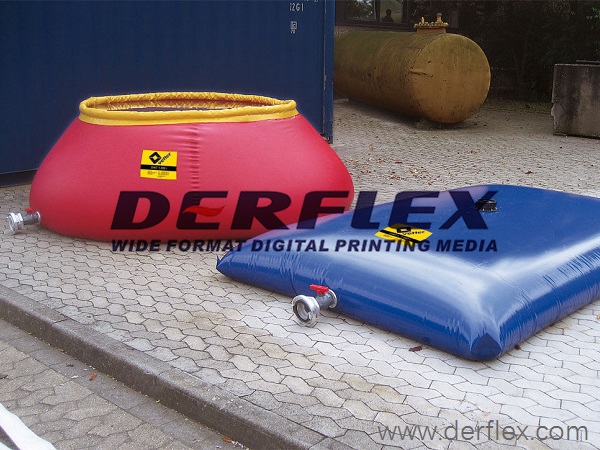 DERFLEX product archive
An onion tank is a collapsible, self-supporting liquid-storage tank with a broad circular base, sloping flexible sidewalls and a large open top. A buoyant collar helps the opening rise as the tank fills, allowing temporary storage without installing a rigid external frame.
Also called an onion water tank, self-rising tank or self-supporting firefighting water tank, this format is useful where fast top filling, visual access and compact empty-state transport matter. An optional cover can reduce debris ingress, but an open-top tank should not automatically be treated as hygienically sealed.
For the wider product family—including closed bladders and frame-supported options—see DERFLEX's flexible water tank manufacturing overview.
Capacity alone cannot describe a field tank. The purchase specification should define the filled footprint, operating liquid, water-access method, structural fabric, collar geometry, connections and the intended deployment cycle.
| Specification | DERFLEX sourcing direction | What to confirm before ordering |
|---|---|---|
| Tank type | Open-top, self-supporting onion-shaped flexible tank; optional cover subject to design. | Open access vs contamination control; top opening and collar dimensions. |
| Capacity | Project-sized; existing DERFLEX flexible-tank family references cover approx. 500–500,000 L, not an onion-specific guaranteed range. | Required usable liters or US gallons; fill height, footprint and stability review for this particular onion design. |
| Coated fabric | Reinforced PVC coated polyester; selected TPU coated fabric alternatives can be reviewed. | Stored liquid, UV exposure, folding cycle, service temperature, chemical or potable-water requirements. |
| Weight / thickness | Specified by project. Existing DERFLEX flexible-tank directions include approx. 0.75–1.20 mm for selected products, with other grades possible. | Approved TDS, tensile / tear strength, coated-fabric adhesion, weld trials and target performance. |
| Floating collar | Self-rising collar concept; buoyancy, collar material and optional hose support to be agreed. | Opening diameter, collar construction, fill-hose loading and folding method. |
| Seams & edges | Compatible HF / RF or thermal welding route, reinforced high-stress areas where needed. | Panel layout, seam validation, base transitions, fitting reinforcement and workmanship checks. |
| Outlet / drain | Custom valve, adapter, coupling and discharge positioning available for review. | Thread / camlock standard, nominal bore, pump suction, discharge rate, hose restraint and closure. |
| Color / accessories | Project color, printed mark, groundsheet, cover, storage bag and repair accessories by agreed scope. | Color sample, print location, packing method, spare fittings and field repair plan. |
| Production & commercial | OEM / wholesale / engineered projects; samples and order terms discussed after review. | Quantity, drawing, destination, required documents, sample plan and target schedule. |
Specifications are a procurement framework, not a certified datasheet for a stock model. Do not apply material references from other tank geometries as automatic performance guarantees for a finished onion tank. For related fabric and system design, see heavy-duty tarpaulin tank engineering considerations.
Authentic images from DERFLEX's existing website show how flexible tank formats differ. The onion tank is the primary subject of this page; adjacent formats below are for technical comparison, not mislabeled as onion tanks.
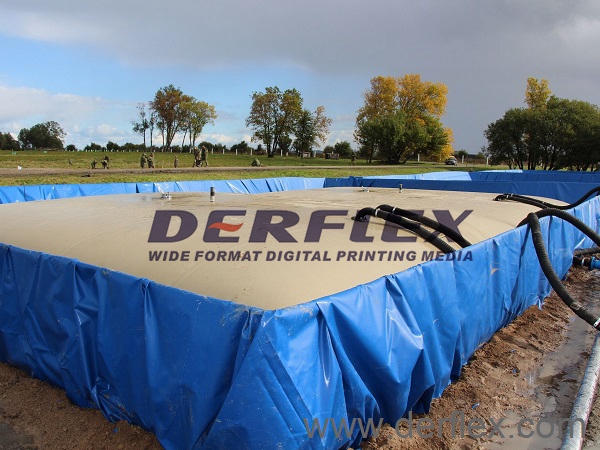
Open-top containment may use a floating rim, a rigid support frame or another support mechanism. Procurement documents must state exactly which design is required.
DERFLEX product photography · comparative tank type
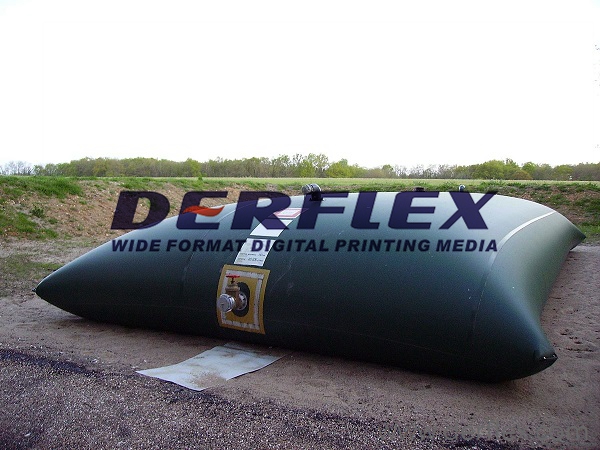

All images above are hosted on derflex.com. Historical photographs may carry original brand watermarks; finished product details should be confirmed with the current quotation and approved sample.
Instead of treating “heavy duty” as a single fabric grade, decide which parts of the operation place the greatest demand on the finished tank.
State water shuttle volume, the pump or tanker connection, target fill rate, outlet size and crew access around the rim. Review hose restraint and emergency drain procedure.
Define expected folding frequency, abrasive ground conditions, protective sheet, seam design and the spare fitting / field repair policy before selecting coated fabric.
Review UV, soil or gravel substrate, seasonal storage, outlet elevation and the required flow to irrigation equipment. Confirm cover needs for debris control.
Define water purpose, contact duration, destination-market requirements and cleaning plan. A general-purpose open PVC tank is not automatically drinking-water approved.
The self-supporting geometry changes with the water level. Tank behavior depends on more than material thickness: the collar, seam transitions, outlet load and ground contact must work together.
Agree target volume, opening diameter, base footprint, maximum working height and clearance before pattern making.
Review PVC / TPU chemistry, reinforcement, flex performance and approved welding parameters for the actual liquid.
Specify buoyancy, protective finish, top access and the effect of filling hose position on the floating rim.
Match discharge interface, patch geometry and hose restraint to expected hydraulic and handling loads.
Agree dimensions, weld appearance, fitting integrity, tank leak check and traceable approval criteria.
For a polyurethane-coated material route and welding considerations, review DERFLEX TPU flexible water tank fabric. The selected construction must be qualified for the planned use.
The correct tank style follows the water-handling workflow. If an operation requires frequent open access, a closed bladder is not a direct substitute. If clean enclosed storage is essential, an open onion tank may be the wrong default.
| Decision point | Onion / self-supporting | Pillow / closed bladder | Frame-supported tank |
|---|---|---|---|
| Top access | Large open top; optional cover subject to design | Sealed; access through designated ports | Open top commonly available |
| Field setup | Deploy on prepared ground; self-rises with filling | Unfold and connect filling / venting lines | Install or verify frame + liner first |
| Containment priority | Fast receiving, inspection and water transfer | Enclosed temporary storage | Stable open tank geometry / process access |
| Empty-state logistics | Collapsible; collar influences pack size | Collapsible and compact | Liner folds; frame ships separately |
| Key buyer risk | Spillage, debris, flotation rim / hose loads | Valve / seam issues and inaccessible interior | Frame stability, liner abrasion and setup time |
These applications share a need for portable water capacity, but they should not share an unexamined material specification. Access, storage duration, water quality and field hazards change the purchasing decision.
Useful as a receiving or temporary supply point during water shuttle operations. Specify hose couplings, access clearance, refill cycle and site-approved operating procedures.
Compact transport supports field deployment when utilities are disrupted. Confirm intended water quality, hygienic precautions, handling personnel and local response requirements.
Temporary water buffers for seasonal irrigation and remote field work. Review soil preparation, outdoor exposure and outlet interface; also see agricultural water storage designs.
Portable supply for washing, site maintenance and selected dust-control operations. Keep equipment traffic away from the filled tank and protect the base from debris.
Interim receiving capacity between tanker, pump and point of use. Define available pumping head, inlet placement, drain speed and isolation of the work area.
Suitable only when the actual water chemistry, temperature, cleaning method and any containment obligations are checked. Do not assume chemical compatibility.
These practical requirements should be part of field instructions and procurement review—not discovered after the tank arrives on site.
Water volume translates into substantial ground load. Tank volume, actual filled dimensions and ground condition must be reviewed together.
Enter the planned liters and sustained fill rate. This simple estimate excludes hose, pump and site losses; it does not calculate tank dimensions or validate site stability.
A complete RFQ helps determine whether a self-supporting open-top onion tank is the correct form and which material, fittings, footprint and accessories should be evaluated. DERFLEX can discuss color, marking, packaging, repeat-order scope and material-to-fabrication details.
Request a Custom QuoteNo fake online price, minimum order quantity or delivery promise: terms are confirmed against the approved project specification.
Direct answers for engineers, emergency water planners, distributors and international procurement teams.
An onion tank is generally an open-top, self-supporting field reservoir that rises as water is added. A pillow tank is a closed flexible bladder that expands during filling. Onion tanks favor rapid top access; pillow tanks favor enclosed storage.
A self-supporting onion design does not normally require an external metal support frame. Its buoyant collar helps keep the top opening raised as it fills. Specific collar construction varies; confirm whether the selected version uses foam, an air-filled element or another approved arrangement.
DERFLEX supports project-based flexible tank sizing, coated-fabric selection, valve and connection layouts, color, branding and accessories. Exact onion tank capacity, footprint, dimensions and operating limits require engineering review before confirmation.
Reinforced PVC coated polyester is a common construction for collapsible water tanks. TPU coated technical fabric can also be reviewed when folding behavior, liquid-contact requirements or operating conditions call for a different material. Material names alone do not establish final suitability.
Not automatically. Drinking-water suitability depends on the exact liquid-contact materials, the finished assembly, required destination-market standards, cleaning practices and verified supporting documentation. Request a project-specific compliance review before specifying potable-water use.
Choose a stable, level, clean area that can support the fully filled water load. Remove stones, sharp debris and exposed edges, and use a protective groundsheet where necessary. Permitted slope and filled footprint must be confirmed for the specific tank model.
Only after reviewing the exact liquid composition, concentration, temperature, contact time, cleaning chemicals and secondary-containment requirements. A standard water-storage tank should not be assumed compatible with fuels or industrial chemicals.
Provide target usable capacity, intended liquid, installation surface, available footprint, fill and drain rates, hose / valve connection standard, deployment frequency, operating climate, accessories, quantity, destination and any OEM documentation.