Pile Geometry & Runoff
Define diameter or footprint, crown height, slope and low points. The cover should support deliberate water shedding instead of creating pockets where water can accumulate.



DERFLEX develops grain pile cover programs for farms, grain elevators, cooperatives, storage-system integrators and agricultural distributors. The focus is not only on a waterproof sheet: pile geometry, panel layout, welded seams, perimeter reinforcement, anchoring, drainage, aeration and deployment method are reviewed together so the finished cover matches the storage plan.
A grain pile cover is a large flexible weather barrier placed over temporary or overflow grain storage. Its job is to shed rain, reduce direct solar and weather exposure, and create a controllable outer barrier around the pile. For commercial storage, performance depends on the cover and on pile shape, site drainage, anchoring, aeration and inspection.
That distinction matters when comparing a grain pile cover supplier. A heavier fabric alone cannot correct a low spot that holds water, a loose perimeter that allows wind entry, sharp contact points, or warm grain with no moisture-management plan. DERFLEX therefore approaches custom grain covers as engineered fabricated panels rather than generic oversized tarps.
Start with wind uplift, water runoff, seams, perimeter fixing, access points, abrasion zones and repeated handling. Then select the material weight and reinforcement needed for those conditions. This usually produces a more practical specification than buying by thickness alone.
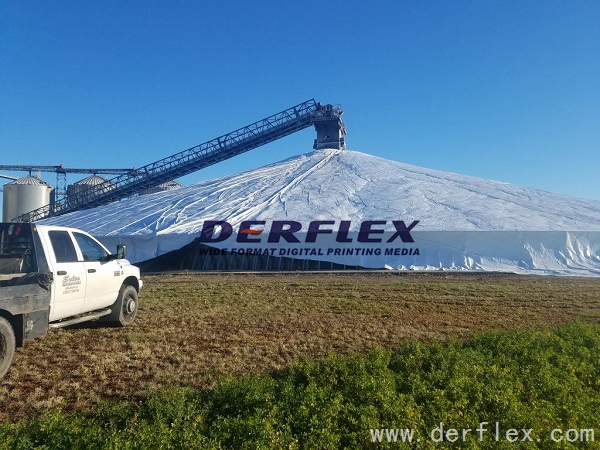
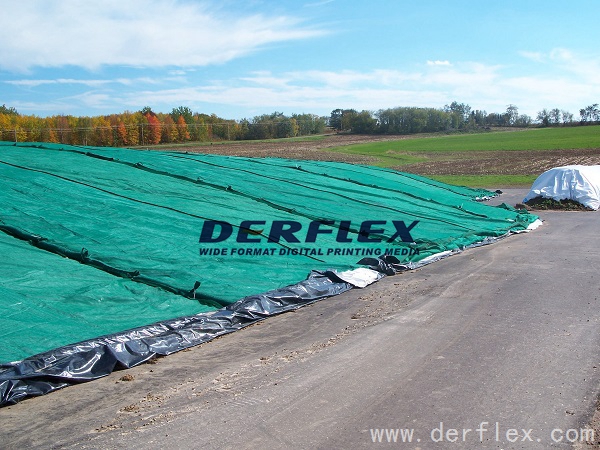
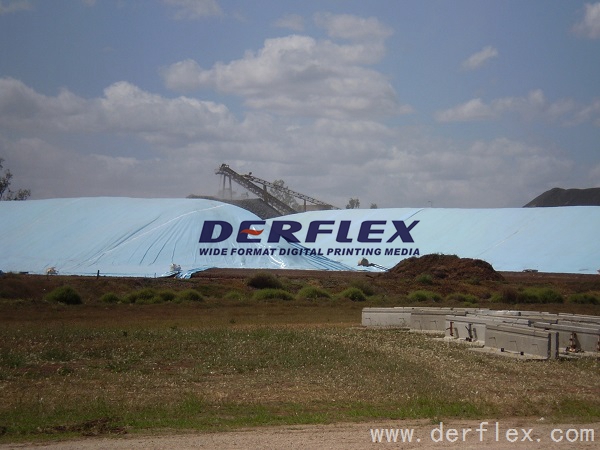
The examples below show the scale and geometry involved in open-air grain storage. Final color, panel arrangement, reinforcement, vents, chutes and anchoring details are confirmed against the buyer's approved drawing or sample.
Commercial grain storage covers often fail first at transitions, edges or installation details. These five decisions should be made before the finished cover is released for production.
Define diameter or footprint, crown height, slope and low points. The cover should support deliberate water shedding instead of creating pockets where water can accumulate.
Very large covers are fabricated from multiple widths. Seam direction, overlap logic and welding quality should be planned around runoff and installation—not placed arbitrarily.
Wind can enter under a loose edge and load the entire sheet. Reinforced hems, webbing, D-rings, eyelets, sleeves or project-specific fixing details should match the anchoring method.
A waterproof cover blocks external rain but does not remove moisture already inside the grain mass. Vent or aeration interfaces should be coordinated with the operator's grain-management plan.
Large panels can be heavy and wind-sensitive during installation. Folding pattern, lifting points, labeling and panel sequence can be specified to support faster, more controlled deployment.
Sharp aggregate, exposed steel, wall corners and repeated dragging can damage a cover. Ground sheets or sacrificial reinforcement should be considered where contact risk is high.
DERFLEX can discuss roll material, welded panels and finished-cover configurations. The ranges below are procurement directions based on the company's published grain-cover and agricultural-tarpaulin information; final values should be confirmed on the approved technical sheet and sample.
| Specification Item | Typical Project Direction | Why It Matters |
|---|---|---|
| Material family | PVC coated polyester fabric; selected reinforced/laminated constructions can also be reviewed | Determines welding behavior, weight, flexibility, surface durability and handling |
| Fabric weight | Approx. 380–850 gsm directions for agricultural PVC tarp projects | Should be matched to wind, abrasion, repeated handling and required service duty |
| Base textile | 500D × 500D, 1000D × 1000D and other project structures | Influences tensile, tear and dimensional performance |
| Color | White, silver, green, grey, blue, black or custom color discussion | Reflectivity, appearance, identification and market requirements can differ |
| Panel fabrication | Hot-air / high-frequency welded panel assemblies as appropriate | Large grain pile covers usually require controlled multi-panel fabrication |
| Edge reinforcement | Webbing, reinforced hems, rope-in-hem, D-rings, eyelets, sleeves or custom hardware | Perimeter loads can govern finished-cover durability |
| Functional details | Vents, filling chute, access flap, identification marking, repair patches, lifting/folding labels | Improves compatibility with the storage and handling procedure |
| Supply format | Custom finished cover, sectioned cover, fabricated panels or roll goods | Lets converters, installers, integrators and distributors choose the right supply level |
The market uses both reinforced polyethylene and PVC-coated textile constructions. Neither should be chosen only by headline weight or price; the better fit depends on handling, service duration, fabrication method and reuse expectations.
A custom grain pile cover project can be configured around one site, while a grain pile cover wholesale program may need repeatable SKUs, labeling, packed dimensions and batch consistency across multiple customers. DERFLEX supports both procurement paths.
This is a planning example rather than a claimed customer case. It shows the type of information a buyer can organize before asking a grain pile cover manufacturer for pricing.
DERFLEX's published company profile describes a 60,000㎡ integrated production area, 450+ employees, 25+ senior engineers and service to 120+ countries and regions. The company also publishes calendering, coating and lamination capability for industrial coated materials.
For grain pile projects, the practical value of that manufacturing base is the ability to discuss material structure and finished-cover fabrication in one supply workflow. Order-specific capacity, lead time, test documentation, MOQ and production route should be confirmed in the quotation.
These six internal resources cover adjacent material, crop-storage and farm-tarp decisions without turning this page into a keyword list.
PVC-coated polyester is a practical direction when a buyer needs robust welded panels, reinforced edges and a reusable heavy-duty construction. Reinforced PE is also widely used where lower weight and seasonal handling efficiency are important. The material should be selected from pile size, wind, UV exposure, storage period, abrasion and handling method.
Custom sizing can be discussed from a dimensioned drawing, pile geometry, photos or an existing cover sample. For very large covers, the key is not only overall size but also panel direction, seam placement, reinforcement, openings and how the cover will be deployed and anchored.
A waterproof outer cover helps block rain, but the complete storage system still needs suitable grain condition, site drainage, runoff slope, anchoring, aeration or ventilation where required, and regular inspection. Condensation under an intact cover can come from moisture and temperature conditions inside the stored grain.
The restraint method should be engineered for the pile and site. Common concepts include reinforced perimeter hems, webbing, eyelets, D-rings, ballast, straps, anchors, retaining walls or suction created by a compatible aeration system. The exact arrangement should be reviewed by the storage-system designer or operator.
Yes, DERFLEX can discuss wholesale and OEM programs covering custom dimensions, material weight, color, finishing, labels, markings and packing. MOQ, production timing and commercial terms depend on the final specification and should be confirmed in the quotation.
Provide pile dimensions and shape, crown height, grain type, storage duration, climate conditions, desired material or duty level, anchoring method, vents or chutes, quantity, packing preference and destination. A drawing or photos of the existing storage system can make the review more accurate.
Send the pile geometry, expected storage period, local weather conditions, material direction, anchoring details and quantity. DERFLEX can review the cover construction and supply format before preparing a quotation.