



COATED FABRICS · INDUSTRIAL COVERS
BUYING GUIDE · RETAIL TO REPEAT ORDERS
Harbor Freight Heavy Duty Tarps: Choose by the Job
Choosing Harbor Freight heavy duty tarps starts with the exact item, finished dimensions and working conditions. A duty label is a starting point; the cover still needs the right fabric, seams and fixing details. This guide helps contractors, distributors and equipment buyers compare retail options and prepare a specification when repeated use or custom geometry calls for another approach. DERFLEX supplies its own PVC tarpaulin materials and custom cover programs for commercial sourcing.
Independent DERFLEX guide. Harbor Freight is a separate brand; no affiliation or authorized supply relationship is claimed.
01
What do Harbor Freight heavy duty tarp labels tell you?
The official heavy-duty category reviewed for this guide included reflective 9 mil heavy-duty and silver/black 12 mil extreme-duty listings. Those are examples from that retailer’s range, not industry-wide definitions. Other materials and product families may use different descriptions.
Use the official Harbor Freight heavy-duty tarp category for current item specifications, prices and purchase options. Match the item number to its instructions rather than relying on a category heading or a familiar color.
For a one-off purchase
A standard retail item can be a practical route when its finished size, attachment layout and stated use match the job. Check local availability directly with the retailer, particularly when the cover is needed immediately.
For a repeat purchasing program
“Same heavy-duty tarp as last time” leaves room for changes in material and fabrication. Build a written reference that another buyer or supplier can reproduce. DERFLEX’s industrial heavy duty tarpaulin overview explains the material and fabrication decisions behind that reference.
02
9 mil vs 12 mil: compare thickness without guessing strength
A mil is one thousandth of an inch. It measures thickness, while GSM and oz/yd² measure mass per unit area. A heavier fabric is not automatically a thicker fabric, and neither number alone tells you how an eyelet or seam will perform.
On small screens, scroll within the table to compare all columns.
| Label or unit | Exact relationship | Still needed for a purchasing decision |
|---|---|---|
| 9 mil | 0.2286 mm | Material construction, measurement method and tolerance |
| 12 mil | 0.3048 mm | Comparable strength, seams and perimeter details |
| GSM | Grams per square metre | Coating, base fabric and finished mass tolerance |
| oz/yd² | 1 oz/yd² ≈ 33.906 g/m² | Whether the figure covers the finished coated fabric |
These conversions are arithmetic, not DERFLEX product specifications. Do not convert GSM directly to mil without the material structure and density information. Do not use a double folded hem as the measurement point for the body sheet.
A 12 mil value is one-third greater than 9 mil as a nominal thickness. It does not establish one-third more strength or service life. For a commercial comparison, ask for the same test method, direction, specimen preparation and conditioning. Use the heavy-duty tarp thickness guide to keep thickness in the context of the complete cover.
03
Start with where the last cover failed
Describe the observed damage before increasing the material weight. The location often tells you which detail needs investigation.
| What you observe | Review before reordering | What to check on the sample |
|---|---|---|
| Eyelet pulled through the edge | Hem build, backing reinforcement, attachment positions and tension | Hardware seating, local reinforcement and an agreed attachment test |
| Tear beside a sharp corner | Contact geometry, protective padding and patch position | Fit over the actual object; inspect the contact zone |
| Water enters along a seam | Seam construction, overlap, placement and sealing | Agreed seam-water check on a representative assembly |
| Damage develops along fold lines | Handling frequency, storage conditions and low-temperature flexibility | Representative folding at the expected handling conditions |
| Cover flaps or pools water | Finished dimensions, support, drainage and fixing layout | Trial fit with the intended support and attachment arrangement |
A new sheet can be thicker while its attachment zone remains the weakest part. Closely spaced eyelets are not a substitute for adequate edge construction or suitable anchors. Likewise, tightening a poorly fitted cover can concentrate stress at a corner instead of correcting the fit.
Write five parts into the order
- Body: base fabric, coating, nominal mass and thickness where relevant.
- Joints: panel layout, seam type and the required water-resistance check.
- Perimeter: hem, reinforcement, corner treatment and edge finish.
- Interfaces: hardware type, position and the intended method of attachment.
- Acceptance: drawing revision, approved sample and agreed inspection criteria.
For site-use details, the contractor tarp guide connects these specifications to handling and jobsite conditions. General-purpose cover hardware should not be treated as lifting points.
04
Measure the finished coverage, then confirm the pattern
Measure the object or protected envelope and record the required drop on each side. Identify projections, corners, openings and access points. Write finished dimensions on the drawing separately from the fabric cutting dimensions; hems and seams are fabrication allowances, not extra usable coverage.
ILLUSTRATIVE FLAT-COVER GEOMETRY
A 12 × 20 ft top with 2 ft side drops
Required geometric width: 12 + 2 + 2 = 16 ft.
Required geometric length: 20 + 2 + 2 = 24 ft.
That is approximately 4.88 × 7.32 m before any fit or attachment allowance.
What this example excludes
The calculation assumes a rectangular horizontal top with a uniform drop. It does not determine slack, corner folding, fitted-box construction, anchor reach, drainage support or manufacturing tolerance.
For a shaped cover, send a sketch of the object and openings. For a flat tarp, confirm the usable finished sheet dimensions after edge finishing. Avoid ordering only by a rounded size family.
Before a bulk order, lay the sample out without stretching it and check the agreed measurement points. Photograph the trial fit. Record whether fastening tension is needed just to reach the anchors; that can indicate a size or attachment-layout problem.
05
Decide whether to stay with poly or evaluate coated PVC
The appropriate material depends on exposure, handling and the cost of interruptions. A standard retail cover may meet an occasional covering task. Repeated fitting, custom openings or controlled seams can make a specified coated-fabric cover worth evaluating. A material change still needs a sample trial; the word “vinyl” does not establish equivalence to a particular retail product.
Standard poly-tarp route
Compare the exact product’s finished size, construction, edging and stated use. This route can suit buyers who need an available standard item and can accept the supplied pattern. Keep the packaging or item reference if the same product needs to be identified later.
PVC coated-fabric route
A PVC coated polyester program lets the discussion focus on the body fabric and fabricated details together. DERFLEX’s PVC tarpaulin material page provides the starting point for roll material, while finished covers need their own drawing and acceptance criteria.
For repeated outdoor exposure, ask what evidence applies to the proposed grade and conditions. For cold handling, describe the temperature during unfolding. For chemical splash, identify the substance and contact conditions before making a material choice. A cover selected for rain protection should not be assumed suitable for liquid containment.
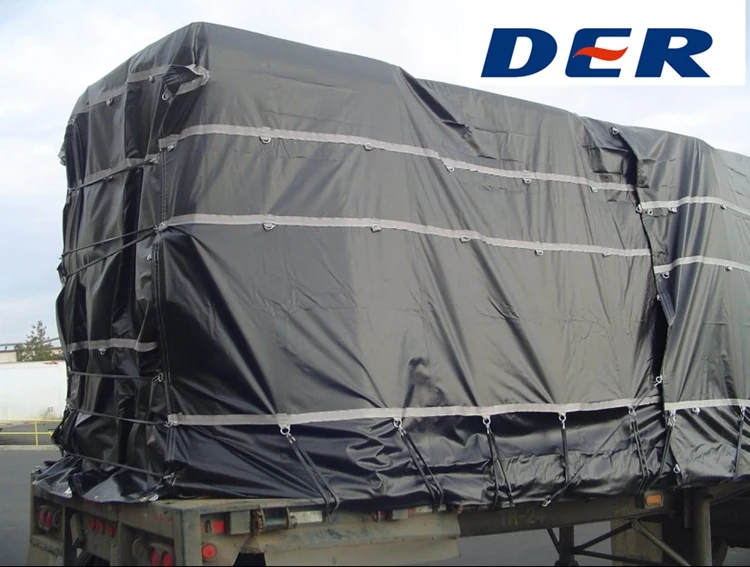
Images above are from DERFLEX website materials and product displays. They are not Harbor Freight merchandise photographs, certified test specimens or customer case studies.
06
Choose the supply format that fits your operation
Fabric rolls for your own workshop
State the required usable width, roll length, color and processing method. Review how the material behaves on your actual cutting and welding equipment before approving a large lot. Agree identification and packing so rolls remain traceable during conversion.
See the industrial tarp supply overview for the distinction between material and fabricated cover programs.
Fabricated tarps for direct deployment
Provide the finished-size drawing, seam and hardware positions, reinforcement needs and quantity by size. Request a sample that represents the proposed production build, including the perimeter. Confirm which accessories are included and which will be sourced separately.
A fabricated sheet does not automatically include anchors, support structures, installation or an engineered wind rating.
Compare quotations on the same scope. Material use, panel layout, edge length, reinforcement, hardware, printing, packing and delivery terms can all change the quote. A lower price per sheet is not a complete comparison when sizes or construction differ. Evaluate replacement frequency from your own use records rather than assuming a guaranteed lifespan or payback.
Have a failed sample or an existing drawing?
Send photographs of the whole cover and damaged area, actual dimensions, quantity and destination. Describe what must change on the next order.
Discuss Your Drawing07
Keep an acceptance record that works on the next batch
Approve both the material reference and a representative finished sample. A small body-fabric swatch cannot show whether a large cover fits, where a seam will sit or how the edge is finished. Agree the inspection method and tolerances before production so a later delivery is judged against the same reference.
| Record | Keep with the approved sample | Check on delivery |
|---|---|---|
| Identity | Material reference, sample ID and drawing revision | Lot identification and approved change notices |
| Finished dimensions | Measurement points, tolerance and hardware coordinates | Laid-flat measurements without stretching |
| Seams and perimeter | Panel layout, edge build and corner details | Visible gaps, missed operations and hardware seating |
| Performance evidence | Applicable grade, method, conditions and acceptance limit | Documents or agreed sample checks for that order |
| Packing | Size labels, fold or roll method and unit packing | Quantity by size and clear product identification |
Visual inspection does not replace an agreed leak, seam or strength test. For waterproof covers, evaluate the fabricated assembly rather than inferring its performance from a coated-fabric sample. The waterproof heavy duty tarp guide separates body material, seams and installed water paths.
When a material or fabrication change is proposed, identify the change in writing and decide whether the previous sample approval still applies. Keep the retained sample and drawing together so future purchasing does not depend on the memory of one buyer.
08
Before you order: exposure, handling and the enquiry
Review the working conditions
- Provide support and a drainage path; avoid persistent pooling.
- Review rubbing points and sharp edges before the cover is fitted.
- Use suitable anchors and tensioning arrangements for the installation.
- Inspect the perimeter and seams after handling or severe exposure.
- Follow grade-specific cleaning guidance and dry the cover before storage.
A tarp is not a lifting sling or cargo-restraint system. A duty label does not establish flame resistance, a wind rating or compatibility with hot equipment.
Send a focused RFQ
Include the application, exposure conditions, finished-size drawing or sketch, quantity by size, material reference if known, fixing details, packing, destination and required date.
If the cause of failure is unclear, start with photographs and a description of use. Separate essential acceptance requirements from preferences. Confirm MOQ, sample arrangements, lead time and delivery terms for the actual order.
Download the RFQ checklist (.txt)09
Heavy duty tarp buying questions
Does “heavy duty” always mean at least 10 mil?
No. Duty labels are product-family descriptions, not a universal thickness standard. The Harbor Freight category reviewed for this guide included 9 mil heavy-duty and 12 mil extreme-duty listings. Check the exact item specification, construction and intended use.
Is 12 mil automatically better than 9 mil?
A 12 mil sheet has greater nominal thickness, but thickness alone does not establish tear strength, edge strength or outdoor life. Compare the base fabric, seams, reinforcement and relevant test results under equivalent conditions.
Can I replace a retail tarp with a custom PVC cover of the same size?
Use the actual finished dimensions and fixing layout as a starting point, then review material flexibility, cover weight, seam position and compatibility with the application. A shared size or color does not establish equivalent performance.
Can a thicker tarp stop water collecting on top?
Thickness does not create drainage. The installed cover needs an appropriate shape and support to shed water, with seams, openings and edges reviewed for leakage. Persistent pooling calls for a layout change, not simply a thicker sheet.
What should a distributor keep for repeat orders?
Keep the approved sample reference, material specification, finished-size drawing, edge and hardware layout, color reference, packing instructions and agreed inspection record. Identify changes before accepting a substitute material or a new production batch.
Does DERFLEX sell Harbor Freight branded tarps?
DERFLEX is an independent brand. This guide does not represent a Harbor Freight sales, warranty or authorized supply relationship. Contact Harbor Freight for its branded products; contact DERFLEX to discuss its own PVC materials and custom tarp requirements.
FROM A DUTY LABEL TO AN APPROVED COVER
Make the next order easier to specify.
Tell DERFLEX what the cover protects, where the current tarp fails and how many units you need. Discuss PVC material or fabricated cover options around a clear drawing and a reviewable sample.
Request a QuotePublished by DERFLEX. Substantially updated . Retail product examples were checked against the official category on that date; specifications and availability can change.
This guide concerns selection and purchasing. Harbor Freight branded product support and warranty questions should be directed to Harbor Freight.