


 Industrial textiles · Material & OEM enquiries
Harbor Freight Mesh Tarp:
From Retail Sizes to OEM Specifications
Looking for a Harbor Freight mesh tarp for shade, ventilation or a trailer cover? Start by checking the finished size and the job the open fabric must do. This guide helps you compare a ready-made retail tarp with a drawing-based procurement brief. For importers, distributors and fabricators planning repeat orders, DERFLEX offers a route to discuss PVC coated polyester mesh, material rolls and custom finished tarps around the required construction and attachment details.
Published by DERFLEX · Updated October 31, 2026
Independent guide: DERFLEX is not presented as a Harbor Freight affiliate or the manufacturer of its branded tarps. Retail purchases, stock checks and warranty requests belong with Harbor Freight.
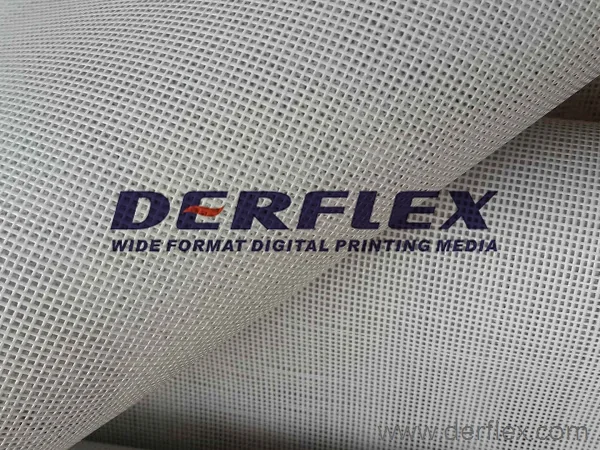
What does the Harbor Freight mesh tarp listing tell you?
Harbor Freight’s mesh collection, checked on October 31, 2026, lists 8 × 10 ft, 8 × 16 ft, 10 × 12 ft and 12 × 20 ft sizes. Its 12 × 20 ft reference, SKU 60584, identifies polyethylene material, a web-reinforced perimeter and grommets at 2 ft intervals. It also states 60–70% sun blocking. Verify the current item before buying; these are retailer details, not DERFLEX specifications.
Source: Harbor Freight mesh collection and SKU 60584 product listing. Prices and availability are omitted because they can change.
For a single standard-size purchase
A retail listing is a practical starting point when its actual dimensions, material and attachment layout suit the intended installation. Check the current product label and instructions, rather than assuming that every mesh tarp in the range has identical details.
For repeated or drawing-based orders
A procurement specification becomes useful when you need a different fit, defined edge construction, multiple sizes, roll supply or repeatable packaging. Compare an approved sample and drawing with the quotation so that the ordered item can be identified again.
Read units carefully. The retailer uses “4 oz.” in the listing. Do not convert that label into thickness or fabric GSM without a confirmed area basis. If a supplier specifically states oz/yd², multiply by approximately 33.906 to obtain g/m². GSM cannot be converted directly into mil.
Is mesh the right cover for the job?
Choose mesh when passage through the fabric is part of the purpose. Choose a suitable solid material when the primary task is to exclude rain or fine contamination. An open mesh cannot provide a sealed weather barrier, even if its coated yarns resist wetting. Use the mesh versus solid tarp guide when those requirements compete.
| Your application | What to establish | Decision before ordering |
|---|---|---|
| Patio or garden shade | Desired light level, ventilation, orientation and attachment locations. | Review a physical swatch in the intended setting; a shade claim alone does not establish UV protection. |
| Truck or trailer covering | Load type, particle size, tarping-system fit and transport requirements. | Check containment and equipment compatibility; a cover does not replace the required load securement. |
| Fence or temporary screening | Visibility, panel dimensions, support spacing and exposure. | Evaluate fabric and attachments together. Openness is not an installed wind rating. |
| Rain-sensitive equipment | Water entry, seams, overlaps and access points. | Start with a suitable solid cover and its finished construction. |
For a hauling project, review dump truck tarp material and replacement-cover options before treating a general-purpose rectangle as a direct system replacement. Compare roller interfaces, pockets and the deployed shape.
Shade, open area and UV are different
Open area describes the geometric gaps in the textile. Shade or light-blocking describes a measured optical effect. UV protection describes behavior over a specified wavelength range. These values cannot be substituted for one another. Ask which property was measured and whether the evidence matches the proposed color and construction.
More weight does not answer every question
Yarn construction, coating, aperture size and perimeter finishing all affect the finished cover. A heavier sample may add handling effort without resolving a poor fit or a weak connection. Request results for the selected material and evaluate the edge assembly separately when attachment strength matters.
Measure a replacement mesh tarp from its finished edges
Record the installed opening and the existing cover separately. An old tarp may have stretched, shrunk, torn or been modified. Measuring only that damaged item can carry the same fit problem into the replacement. State whether every dimension refers to the finished outer edge, the clear opening or the fixing centers.
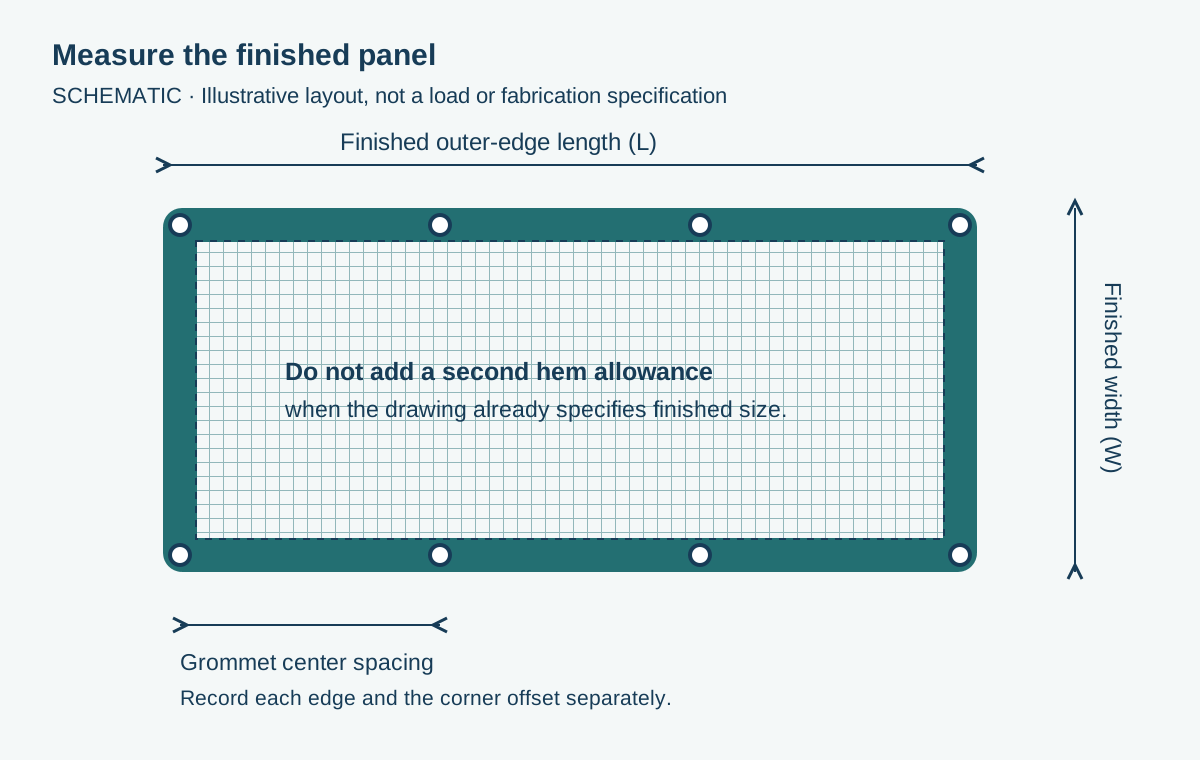
- Measure the opening. Note its length, width, shape and any obstruction or surface the fabric may rub against.
- Define the finished panel. Include the required coverage and connection method. Let the fabricator calculate processing allowances from the agreed finished dimensions.
- Map every attachment. Record the center spacing on each side, the corner offset and any connection that differs from the regular pattern.
- Identify interfaces. Show pocket openings, roller attachments and orientation on the drawing. Label the face and direction if the assembly requires them.
- Approve the first article. Check fit and operation before releasing a repeat-order specification.
Worked example — not an installation recommendation: a drawing calling for a finished 3.0 × 4.0 m rectangle specifies 12.0 m² of finished panel area. That is not the raw-fabric quantity or the installed clear opening. Hems, seams, pockets, material width and fabrication waste change the production requirement.
Turn a retail reference into a usable mesh tarp specification
A retailer’s SKU can communicate the general idea, but it cannot replace an approved specification for a different supplier. Describe the required function, then identify the material and finished details. Consult the tarp material guide if you are still deciding between PE, coated polyester and solid constructions.
| Specification field | Put in the enquiry | Use for acceptance |
|---|---|---|
| Material identity | Base textile, coating and sample reference. | Agreed material code and retained swatch. |
| Fabric mass | g/m² or an explicitly defined oz/yd² value. | Nominal value, tolerance and measurement basis. |
| Mesh structure | Required aperture, openness or screening objective. | Approved appearance plus relevant measured property. |
| Finished dimensions | Outer-edge dimensions, orientation and drawing revision. | Agreed tolerance and measurement condition. |
| Perimeter and hardware | Hem construction, webbing, corner details and fixing map. | Sample assembly and hardware details in the quotation. |
| Outdoor requirements | Exposure, cleaning and any required test documentation. | Evidence tied to the exact proposed material; no assumed service life. |
| Packing and reorders | Size identification, labels, folding or rolling and destination. | Approved packing instructions and order reference. |
For mechanical data, request the method, specimen direction, units and report reference. Compare like with like: an unqualified strength number cannot establish which finished tarp will last longer. Where the edge is critical, discuss testing of the actual hem and fixing assembly rather than relying only on a base-fabric value.
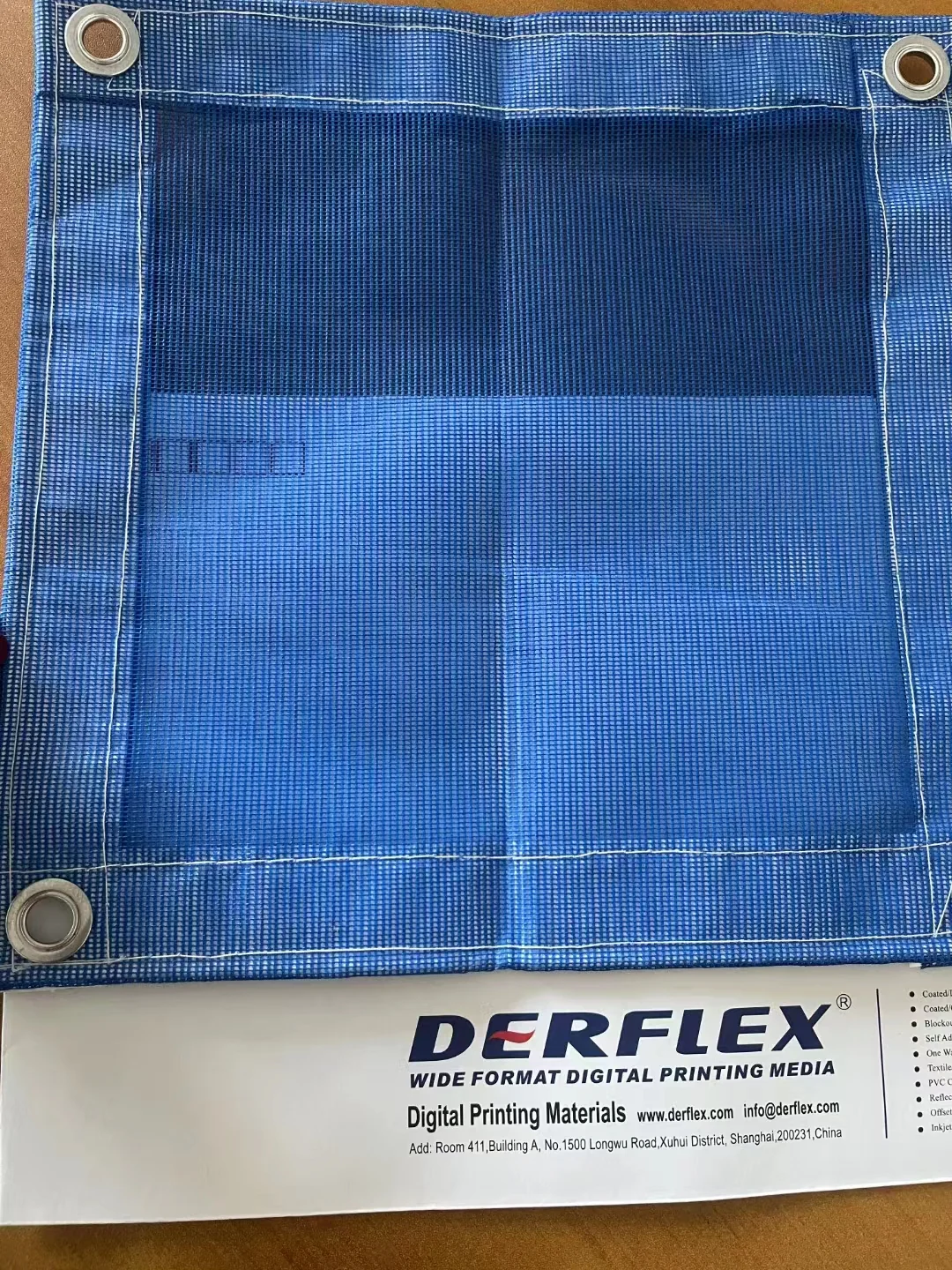
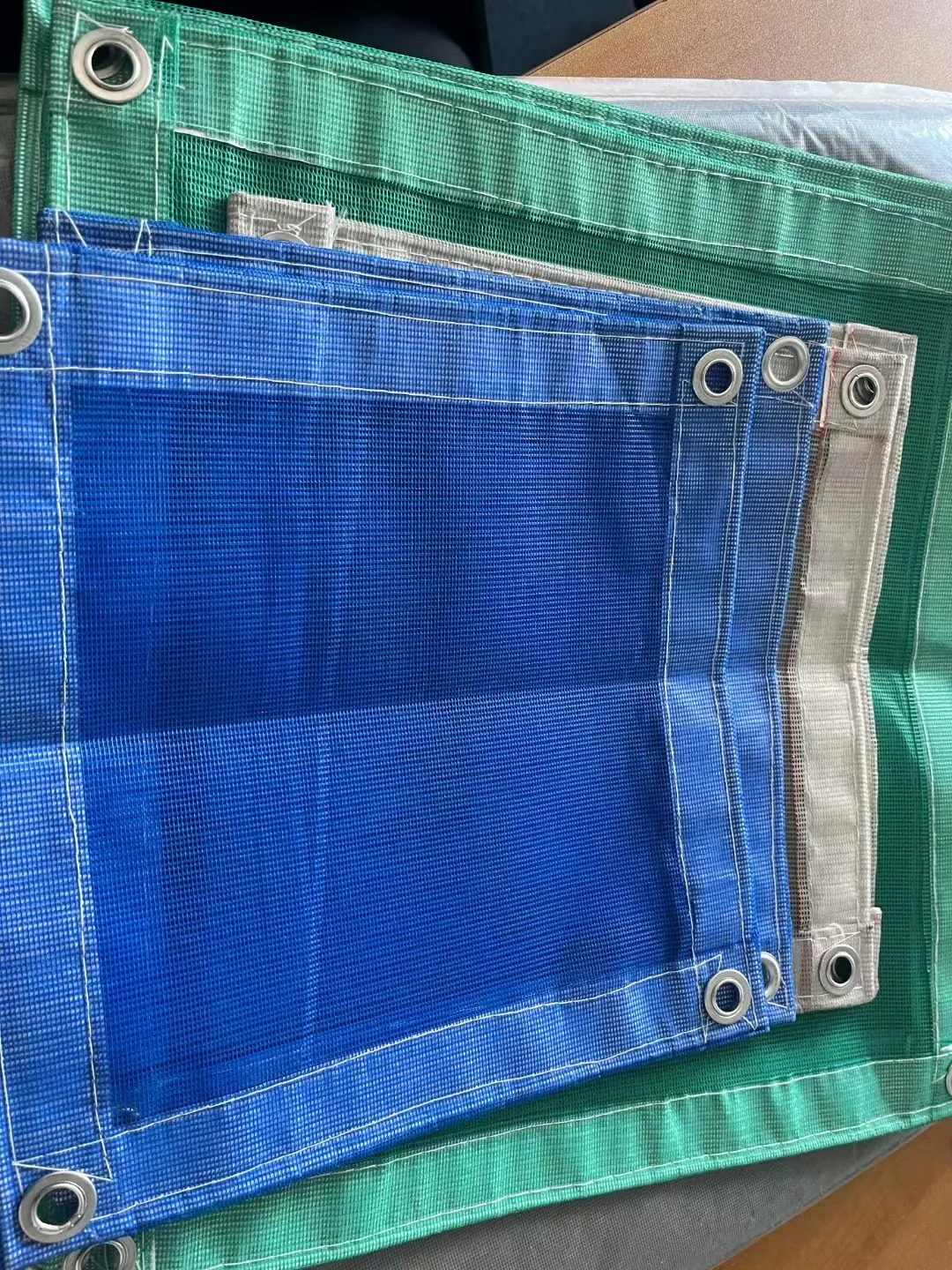
See the weave, the hem and the fixing detail
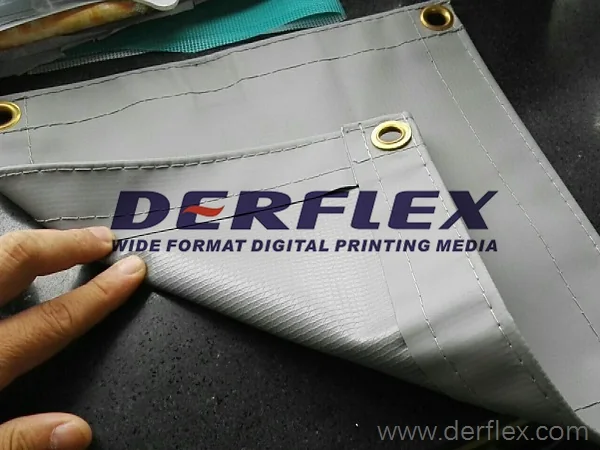
The following photographs are existing DERFLEX samples. They help explain details to review and are not photographs of Harbor Freight merchandise, a completed customer project or a certified performance test.
Specify how the edges connect
Closely spaced eyelets do not automatically produce a stronger installation. Their spacing must suit the support positions and the load distribution. Reinforcement, stitching or welding compatibility, hardware dimensions and edge distances belong in the approved construction.
Start with DERFLEX mesh tarp materials and finishing options, then discuss the specific detail your drawing requires.
What can you discuss with DERFLEX?
DERFLEX’s published mesh range includes PVC coated polyester material, roll supply and conversion into finished tarps, with custom size, color and edge-finishing discussions. Treat the confirmed quotation as the supply boundary. A tarp enquiry does not automatically include a frame, roller system, installation or engineering design.
Material rolls for fabricators
Provide the useful roll width, planned panel layout, cutting method and downstream finishing route. Request an identified material sample and check fabrication compatibility before committing to a roll program.
Finished covers for repeat orders
Provide a finished-size drawing, attachment map, approved color and packing instructions. For a broader fabricated-cover project, review custom heavy duty tarp supply alongside the mesh brief.
If the brief calls for a continuous weather barrier, discuss solid PVC tarpaulin material instead of selecting an open mesh merely because its weight looks similar.
Resolve fit, exposure and repeatability before price
Send a compact enquiry
- Application, environment and the reason for replacing the existing cover.
- Finished dimensions, drawing revision and installation photographs.
- Preferred material or a sample to evaluate.
- Attachment layout, pockets and reinforcement locations.
- Quantity by size and color, packaging, destination and required date.
- Any required documentation and sample-approval criteria.
Understand what changes the quotation
Material construction, useful roll width, seam layout, edge-processing time, hardware count and packaging can change the price. For a landed-cost comparison, ask which delivery terms and freight items are included. A different layout may change conversion cost even when the finished panel area is unchanged.
Ask for the proposed sample process, minimum order and production schedule with your actual brief. This guide does not assume a standard price, universal MOQ or fixed delivery time.
During use, inspect torn openings, worn hems, loose hardware and contact with sharp edges. Clean using instructions appropriate to the selected coating and let the cover dry before packing. Review a cover that has become brittle, distorted or damaged before reusing it. Material maintenance does not establish a wind or structural rating.
Ready to turn a reference tarp into an orderable specification?
Send an application photo, rough sketch and quantity if you do not yet have a technical drawing. Identify whether you need material rolls or finished covers so the quotation starts with the right supply scope.
Mesh tarp buying questions
Is a Harbor Freight mesh tarp waterproof?
An open mesh tarp is not a sealed rain barrier. Air and water can pass through the openings, even when the yarn surface resists wetting. Choose a suitable solid cover when keeping contents dry is the primary requirement.
Does a 60–70% shade claim mean 60–70% UV protection?
Do not treat those measurements as interchangeable. Shade or solar-blocking language does not establish a UV protection rating. Ask for the measured property, test method and exact material reference when UV exposure is part of the buying decision.
What should I check before replacing a retail mesh tarp?
Record the finished outside dimensions, attachment-point positions, corner offsets and any pockets or roller connections. Photograph the existing installation and identify why the old tarp failed. Match the function and fit before comparing material weight.
Can mesh replace a solid tarp on a truck or trailer?
Only when the load, required containment, tarping equipment and applicable transport requirements allow it. Mesh permits airflow but does not seal rain or reliably retain every fine particle. Hot loads require a separately suitable material and system.
Can DERFLEX quote custom mesh tarps or material rolls?
DERFLEX’s published mesh range includes PVC coated polyester material and custom finishing options. Send your intended use, dimensions, quantity, color and attachment drawing. The quotation should identify whether it covers rolls, panels or finished tarps, and which details are included.
Does DERFLEX manufacture or sell Harbor Freight branded tarps?
This page does not claim a supply relationship with Harbor Freight. It is an independent buying guide from DERFLEX. Harbor Freight product orders, store availability, returns and warranties should be handled through Harbor Freight.
References and related reading
Retail details were reviewed on October 31, 2026. Recheck the retailer’s current listing for product changes. DERFLEX supply discussions should use the approved material and finished drawing.