
Stationary or Sliding?
Sliding curtains need compatible roller spacing, panel weight control and track-friendly top reinforcement; fixed panels can use eyelets, straps or framed attachment.



DERFLEX manufactures factory curtain tarp systems for production zoning, dust containment, wash areas, temperature separation, privacy and flexible industrial partitions. Choose reinforced PVC coated polyester, clear viewing sections, insulated constructions, sliding tracks, fixed hanging, zipper access or project-specific reinforcement according to the actual factory environment.
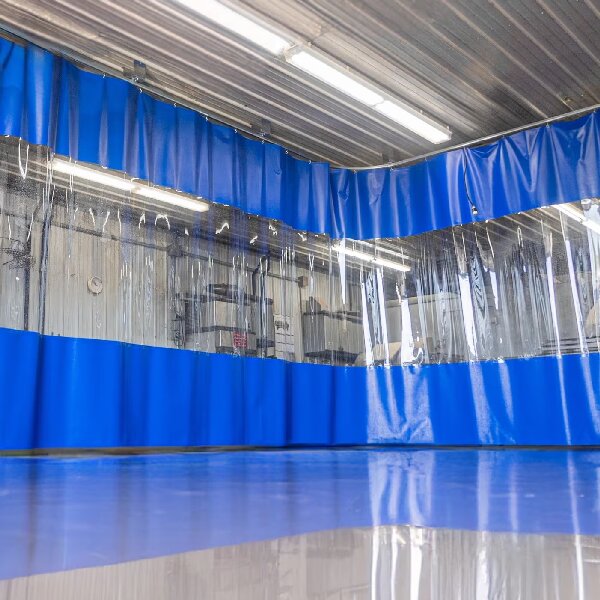
A factory curtain tarp is a fabricated flexible barrier used to divide, enclose or screen areas inside manufacturing plants, workshops, warehouses and service facilities. Unlike a permanent wall, it can be installed as a fixed panel, track-mounted sliding curtain, modular divider or temporary enclosure.
The term usually describes a reinforced tarp-style curtain rather than a thin household curtain. Typical constructions use PVC coated polyester for strength and cleanability, with optional transparent PVC windows, mesh ventilation sections, insulated layers, reinforced hems, webbing, eyelets, sleeves, hook-and-loop connections, zippers or track fittings.
They allow facilities to create work zones without committing every layout change to masonry or sheet-metal construction. They can support dust segregation, visibility control, overspray containment, wash-down areas, localized heating or cooling, maintenance zones, equipment screening and seasonal production changes.
A PVC coated curtain face can be selected to resist water penetration and make wash-down cleaning easier. However, the complete installation is only as weather-resistant as its seams, top edge, overlaps, door openings and mounting system. Outdoor or pressurized applications should therefore be reviewed as a full curtain system rather than by fabric alone.
These are the questions that change material choice, reinforcement, hardware and finished curtain cost.
Sliding curtains need compatible roller spacing, panel weight control and track-friendly top reinforcement; fixed panels can use eyelets, straps or framed attachment.
Opaque PVC supports privacy and visual zoning. Clear windows help supervision and daylight. Mixed layouts balance visibility with lower-panel durability.
Large projects may use overlapping panels, zipper doors, hook-and-loop access, strip sections or track openings rather than one uninterrupted wall.
Solid vinyl blocks more airflow. Mesh panels or engineered gaps can be used when ventilation is more important than full dust or temperature separation.
Bottom pockets can accept a chain or pipe for weight. Floor clearance, sweep contact and equipment traffic should be defined before fabrication.
Flame-retardant, welding, antistatic or other functional claims should be linked to the selected material, exact test method and order documentation.
A heavy duty factory curtain tarp typically succeeds or fails at the interaction between fabric, reinforcement, seams, access points and hanging hardware.
PVC coated polyester is a common direction for opaque industrial panels because the woven scrim carries tensile and tear loads while the coating provides a cleanable, weldable surface.
Clear flexible PVC windows can be positioned at eye level. Mesh, tinted or specialist insert materials can be discussed when airflow, welding screening or other functions are required.
Folded hems, webbing reinforcement and localized patches around hardware reduce stress concentration at the points where curtains are pulled, opened or suspended.
Heat welding, sewing, zippers, hook-and-loop, overlap joints, sleeves and modular panel connections are selected by movement frequency and environmental sealing needs.
Eyelets, D-rings, track rollers, hooks, sleeves, bottom chain pockets or weighted pipes should be sized around panel mass and the supporting factory structure.
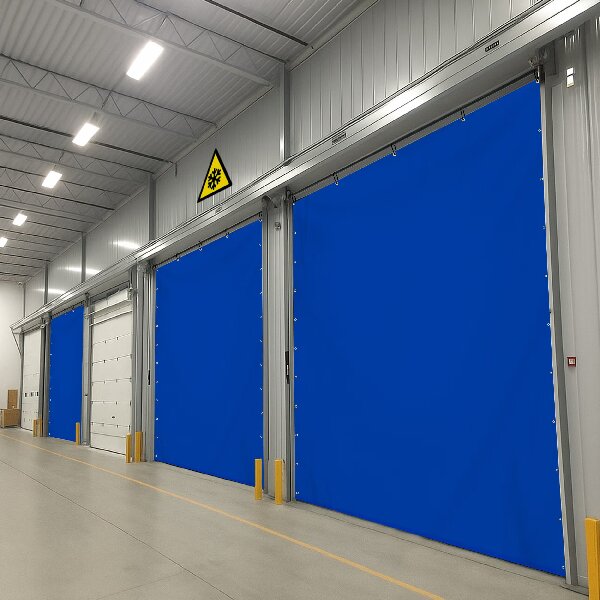
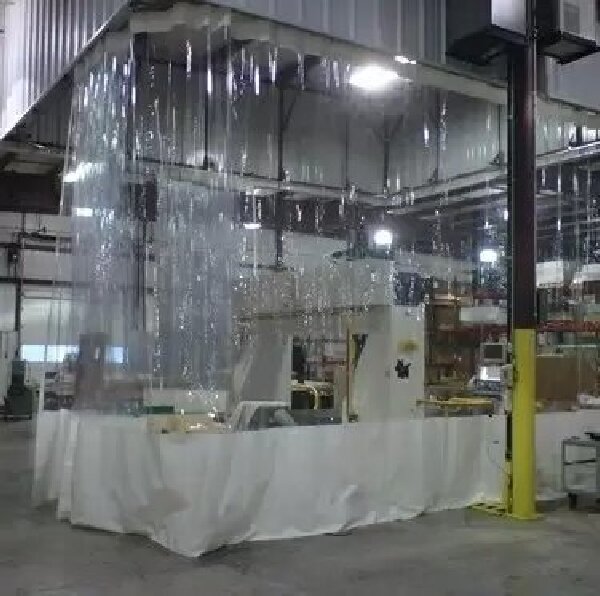
The values below are procurement directions rather than universal guarantees. Final construction, tolerance, performance and documentation are confirmed after application review.
| Item | Typical Direction | What the Buyer Should Confirm |
|---|---|---|
| Product Type | Factory curtain tarp, industrial divider curtain, factory partition tarp, PVC curtain wall | Fixed, sliding, retractable, modular, doorway or enclosure layout |
| Body Material | PVC coated polyester / laminated PVC / insulated composite as required | Indoor or outdoor exposure, tear load, wash-down, temperature and desired service condition |
| Fabric Weight | Approx. 450–1200 gsm for many reinforced curtain programs; lighter or heavier structures can be reviewed | Panel dimensions, movement frequency, hanging capacity and required strength |
| Clear Window | Flexible clear PVC panel, thickness selected by clarity and handling requirement | Window height, width, visual clarity, scratch exposure, cold flexibility and joining method |
| Width Planning | Common coated fabric widths up to about 3.2 m; wider finished curtains assembled by welding | Finished size, seam position, transport dimensions and visual layout |
| Temperature Direction | Selected PVC grades can be discussed for cold and warm industrial environments | Actual minimum/maximum service temperature and whether low-temperature flexibility is required |
| Surface | Glossy, matte, embossed, lacquered or cleanable finish | Cleaning method, print/logo requirement, anti-stick need and visual preference |
| Functional Options | FR direction, UV resistance, anti-mildew, cold resistance, blackout, antistatic or insulated options | Exact target standard/test method, report scope and destination-market requirement |
| Fabrication | Heat welding, HF welding where suitable, sewing, hems, webbing, eyelets, D-rings, zippers, hook-and-loop, sleeves | Drawing, opening position, overlap, fastener spacing and maintenance strategy |
| Supply Format | Roll material, cut panels, replacement sections, finished curtains, OEM/private-label packing | MOQ, quantity by size, labeling, carton/pallet plan and repeat-order forecast |
Material and construction should be matched to the actual exposure rather than copied from another facility.
Divide manufacturing stages, isolate maintenance work or create temporary production cells without building permanent walls.
Use solid or combined panels to reduce movement of airborne debris between work zones while retaining planned access.
Cleanable PVC surfaces can support splash and overspray separation; floor drainage and seam/opening design remain part of the system.
Reduce the volume of space being conditioned with solid or insulated curtains when site airflow and door traffic permit.
Integrate transparent PVC sections to keep visual communication and supervision without leaving the entire partition open.
Track-mounted or modular panels can be repositioned when production lines, storage plans or maintenance areas change.
DERFLEX can discuss material-only supply or finished curtain fabrication for distributors, contractors, facility integrators, industrial curtain installers and OEM/private-label programs.
Width, height, modular panel divisions, seam positions, overlaps and floor clearance can be planned from drawings or site measurements.
Specify window height, width, full-length bands or localized viewing zones according to supervision and daylight requirements.
Eyelets, track fittings, D-rings, sleeves, straps, zipper openings, hook-and-loop closures and other attachment details can be reviewed.
Webbing, multilayer hems, corner patches and localized strengthening can be added where repeated pulling or high point loads are expected.
Common industrial colors, selected custom color direction, matte/gloss surfaces, labels and logo printing can be discussed by order volume and process.
Panel codes, size lists, hardware maps, labels, packing marks and approved specifications can be documented for future replenishment orders.
For project buyers, the lowest fabric price does not necessarily equal the lowest installed cost. Compare how each supplier controls the full curtain specification.
A structured quotation process improves fit, reduces assumptions and creates a clearer basis for production inspection.
Confirm environment, purpose, dimensions, access, movement frequency and any required standards.
Select reinforced body fabric, clear PVC, mesh or insulated structure according to the project.
Review panel divisions, windows, hems, fasteners, colors and sample material when needed.
Inspect dimensions, joins, reinforcement, hardware locations, labels and finished appearance.
Prepare packaging, panel identification and approved specification records for delivery and replenishment.
Factory curtain tarp projects benefit from controlling both coated material characteristics and finished-panel construction.
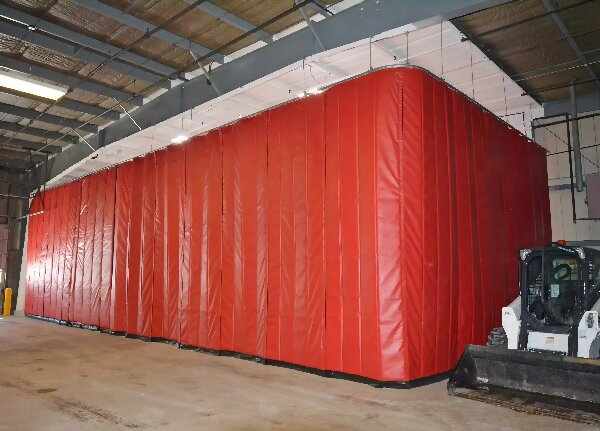
Material identity, color direction, surface, roll dimensions and specified physical properties can be checked according to the confirmed purchase specification.
Finished width, height, window placement, overlap and access positions should be inspected against the approved drawing or size list.
Welded/sewn joins, hems, webbing and stress patches can be checked for continuity and workmanship before hardware is packed.
Grommets, D-rings, track components, sleeves, zippers and hook-and-loop locations can be verified against the installation plan.
Where agreed, material data, dimensional inspection and relevant third-party test support can be coordinated for the selected material and order scope.
DERFLEX focuses on coated fabrics, tarpaulins and engineered flexible-material products for professional buyers. That manufacturing background is useful when a curtain program requires both material selection and finished fabrication rather than a generic stock panel.
For a custom factory curtain tarp, the project can be discussed from the coated textile level through to panel geometry, reinforcement, window integration, hardware layout, packing and repeat-order documentation. Factory curtain tarp wholesale programs can also be structured around replacement panels, standard size families or private-label packaging.
Performance requirements and test claims should always be tied to the selected grade and confirmed order, especially for flame-retardant, welding, antistatic or controlled-environment applications.
These related pages help buyers narrow material and construction choices before requesting a factory curtain tarp quotation.
Reinforced PVC coated polyester is a common choice because it combines a woven load-carrying scrim with a cleanable, weldable PVC surface. Clear flexible PVC can be integrated for viewing windows, while mesh or insulated constructions may be used for other requirements. Final material choice depends on size, movement, exposure and required test evidence.
Yes. DERFLEX can discuss finished size, panel divisions, clear-window position, access openings, hems, webbing, eyelets, D-rings, sleeves, zippers, hook-and-loop, color, labels and packing. Production feasibility is confirmed after reviewing the drawing and material specification.
A suitable PVC coated or laminated curtain face can resist water penetration. The complete curtain system may still allow water through overlaps, doors, top edges, seams or mounting penetrations, so outdoor weather protection should be evaluated as an installation rather than by fabric alone.
They can be designed for track-mounted sliding systems when panel weight, roller spacing, top reinforcement and supporting structure are coordinated. Fixed hanging, removable hooks and modular sections are also possible.
DERFLEX can discuss bulk B2B programs involving roll goods, finished panels, replacement curtains, standard size families, private-label packing and documented repeat-order specifications. MOQ and lead-time direction depend on the selected material and fabrication scope.
Provide finished dimensions, quantity, facility photos or drawings, fixed/sliding installation, access needs, window layout, environmental exposure, material preference, hardware, required tests, packing, destination and target schedule.
Send DERFLEX the opening size, work-zone purpose, installation method, material preference, quantity and destination. The team can review a practical factory curtain tarp construction for sampling and quotation.