Flexible, Not Lightweight
Large water bladders are flexible in geometry, but the stored water creates substantial load. Tank reliability depends on reinforcement, coating adhesion, seam construction, fittings and the installation surface.



DERFLEX supplies large flexible water tanks and heavy duty water bladders for agriculture, construction, emergency reserve, remote projects and industrial water management. Capacity, footprint, PVC or TPU coated fabric, welded seams, valves and accessories can be reviewed around the actual site rather than treated as a one-size-fits-all tank.
Quick answer: for 50,000 L, 100,000 L, 200,000 L and larger flexible water tanks, capacity alone is not a complete specification. Filled footprint, maximum height, ground condition, filling and drainage rate, seam layout, fitting reinforcement and intended water contact should be engineered together before the final tank dimensions are confirmed.
It is a collapsible coated-fabric containment system used when a rigid steel or molded tank is difficult to transport, install or relocate. The flexible shell is fabricated from reinforced coated textile, joined by compatible welding methods and equipped with project-specific fittings.
Large water bladders are flexible in geometry, but the stored water creates substantial load. Tank reliability depends on reinforcement, coating adhesion, seam construction, fittings and the installation surface.
Two tanks can hold the same volume while creating very different stress conditions. A lower, wider tank and a taller tank differ in hydrostatic head, footprint, seam loading and site requirements.
Large projects should begin with the available footprint, ground stability, hose routing, fill and drain method, access, protection from sharp objects and the intended operating cycle.
Fresh water weighs roughly one kilogram per liter. A 100,000 L tank therefore contains about 100 metric tonnes of water, before the mass of the tank, fittings and accessories is considered. This is why a high-capacity water bladder should be treated as an engineered containment system, not simply a larger version of a small portable bag.
Site leveling, ground preparation, maximum filled height, fitting location and controlled filling are part of the product specification. Where the site is constrained, using several smaller tanks can also be evaluated as an alternative to one very large unit.
The capacity table below is a procurement framework. Final dimensions and material construction should be confirmed for the real liquid, site, tank geometry and operating conditions.
| Capacity | Typical Project Direction | Engineering Checks to Prioritize | Procurement Note |
|---|---|---|---|
| 1,000 L | Field water, cleaning, backup supply, compact agriculture use | Portability, connection size, handling and storage when empty | Good starting size for mobile or distributed use |
| 5,000 L | Irrigation, livestock, remote worksite and temporary reserve | Groundsheet, discharge position, fill method and repeated deployment | Confirm site footprint before choosing tank geometry |
| 10,000 L | Construction water, agriculture and local emergency storage | Filled dimensions, filling rate, drain routing and abrasion protection | Do not compare suppliers by thickness alone |
| 20,000 L | Industrial site supply, irrigation and temporary process water | Seam layout, fittings, access, hose routing and ground condition | Project drawing becomes increasingly useful |
| 50,000 L | Bulk water storage, remote projects, construction and agriculture | Reinforced fitting zones, filled footprint, substrate and drain strategy | Suitable for a capacity-specific engineering review |
| 100,000 L | Large project reserve, infrastructure support and bulk temporary storage | Filled height, flow rate, valve sizing, site access and controlled filling | Request a layout proposal before finalizing dimensions |
| 200,000 L | Engineered large-volume containment and project water management | Site plan, ground loading, access, segmentation, fittings and operating cycle | Evaluate one large tank versus multiple smaller tanks |
| 500,000 L | Very large temporary or project-specific bulk storage | Feasibility, footprint, tank architecture, site protection, fill/drain plan and risk control | Project-specific engineering review is essential before confirmation |
Capacity availability is subject to final project feasibility, material selection, tank geometry and site conditions.
Material names are not substitutes for a complete tank specification. The coated fabric, textile reinforcement, weld process and liquid-contact requirement should be evaluated as one system.
PVC coated polyester is commonly evaluated for large industrial and project water storage because it combines a reinforced textile core, waterproof coated surfaces, weldability and practical cost control for large fabricated structures.
See DERFLEX PVC tarpaulin material for the coated-fabric platform used across heavy-duty fabrication.
TPU coated fabric can be evaluated when repeated folding, low-temperature flexibility, abrasion behavior, liquid-contact requirements or a specific welding route make TPU a better project fit.
Review TPU coated fabric for flexible tanks when the project requires a TPU material direction.
Real DERFLEX site images are used below to support product understanding and image-search relevance.
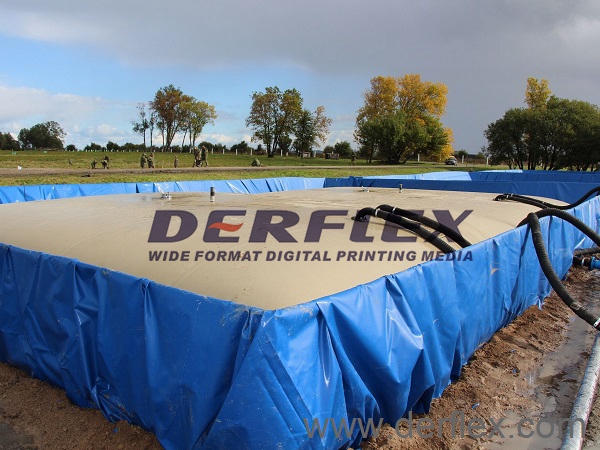
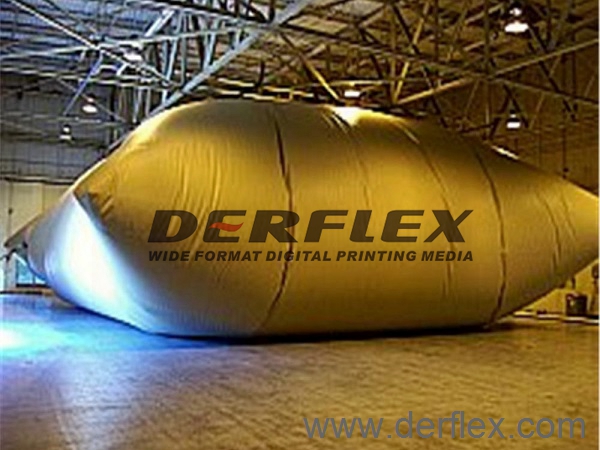
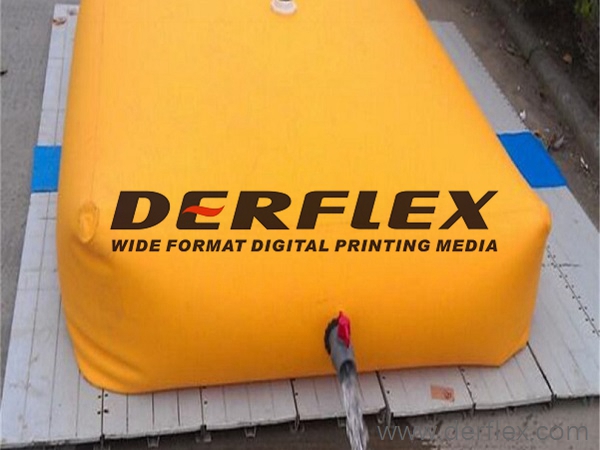
State the required operating volume and whether the tank will normally remain full, cycle frequently or be deployed only for emergencies.
Provide maximum length and width. A large flexible tank must be designed for the space available after it reaches its filled shape.
Identify compacted soil, concrete, membrane, gravel or other substrate and remove puncture or abrasion hazards before deployment.
Tank capacity is only useful if the connection system can fill and empty it in the project’s required time window.
Define inlet, outlet, drain, vent, hose connection and valve positions. Large fittings create local load and need reinforced interfaces.
State potable or non-potable use, temperature range, UV exposure, cleaning method and any required compliance documentation.
Large water bladders are most useful when storage capacity is substantial but the project benefits from compact shipping, temporary deployment, custom footprint or removal after the work is complete.
Bulk irrigation reserve, remote fields, livestock water management and seasonal storage where permanent rigid tanks may be impractical.
Temporary site water, dust-control supply, wash-down reserve and remote works where project layouts change over time.
Deployable reserve water where compact transport and temporary installation are more important than permanent rigid infrastructure.
Selected non-potable process-water buffering, maintenance shutdowns and temporary water management subject to material compatibility review.
Bulk site-water storage in locations where transporting a rigid 50,000 L or 100,000 L vessel would be difficult.
Temporary bulk storage positioned near the point of use to reduce repeated water transport during a defined project period.
Tank performance also depends on reinforced textile construction, coating adhesion, weld consistency, fitting reinforcement, filled height and the actual site. A thicker material is not automatically a better tank.
The empty package can be compact, but the filled tank needs sufficient clear space. Confirm the fully filled footprint before purchase, including hose access and drainage routing.
A very large tank with small connections may take too long to fill or drain for the project schedule. Provide pump, hose and desired operating time so fitting sizes can be discussed.
Drinking water, irrigation water, industrial water and wastewater can have different contact and compliance requirements. State the actual stored liquid before the tank material is approved.
For a broader system-level explanation, read what makes a heavy duty tarpaulin tank and the DERFLEX heavy duty tarpaulin tank specification guide.
Large-capacity fabrication should connect material selection with seam design and hardware layout. That is especially important as tank size increases and local stresses around connections become more significant.
PVC or TPU coated fabric direction is selected around tank architecture, service environment, folding cycle and liquid-contact requirements.
Panel layout and compatible welding methods are considered around the filled shape rather than only the empty cut pattern.
Valves, flanges, drains and other penetrations require local reinforcement and a fitting layout that supports real field operation.
Buyers who need a smaller portable reference can also review the existing flexible water bladder and PVC coated tarpaulin water tank pages.
A useful RFQ allows tank capacity, dimensions, material, fittings and deployment conditions to be reviewed together.
DERFLEX has existing flexible-tank references extending to approximately 500,000 L. Large volumes should be treated as engineered projects because footprint, filled height, seam load, fitting reinforcement, ground preparation and fill / drain planning become increasingly important as capacity rises.
These capacities fall within DERFLEX's existing large flexible-tank direction, but the final dimensions and construction should be confirmed from the available site footprint, tank style, material, fittings, water-contact requirements and operating conditions.
A flexible bladder can be folded when empty, reducing transport and storage volume. A rigid tank keeps a fixed geometry and may be preferable for permanent installations. Large flexible tanks are especially useful for temporary, remote or changing project sites where compact logistics and custom footprint are valuable.
Choose by service requirement rather than material name alone. Reinforced PVC coated polyester is commonly evaluated for large industrial and cost-conscious bulk storage. TPU can be considered where repeated folding, low-temperature flexibility, abrasion behavior or particular contact and welding requirements are important.
Only when the selected contact material, fittings and finished fabrication meet the potable-water requirements specified for the destination market or project. A standard industrial water bladder should not be assumed to be drinking-water approved without the required material and documentation review.
Ground protection is strongly recommended whenever the deployment surface may contain stones, rough concrete, metal fragments, roots or other abrasion and puncture hazards. The site should be level, stable and cleared before the tank is filled.
There is no universal time. It depends on pump output, hose diameter, connection size, static head, valve layout and site routing. Send the required fill or drain time during RFQ so the connection system can be reviewed together with tank capacity.
Not always. One large tank can reduce the number of separate units and connections, while several smaller tanks can provide redundancy, staged deployment and easier distribution across a site. The better layout depends on footprint, operating continuity, access, pumping and project risk requirements.
Send DERFLEX the capacity, liquid, available footprint, ground condition, fill / drain requirements, fittings, quantity and destination. The project can then be reviewed around tank geometry, PVC or TPU material direction and fabrication details before quotation.