1
Coated textile body
Woven polyester commonly provides the structural reinforcement, while PVC or TPU creates the flexible waterproof surface. Base-fabric construction, coating adhesion and flexibility all matter.



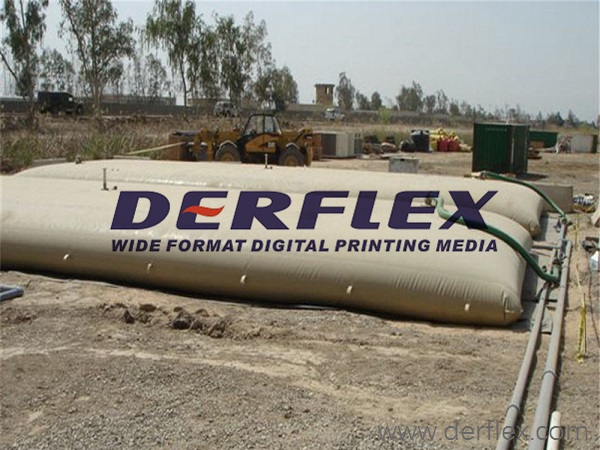
A heavy duty tarpaulin tank is a flexible or frame-supported liquid containment system made from reinforced coated fabric. In demanding service, performance depends on more than a thick tarp: the base textile, PVC or TPU coating, welded seams, fittings, reinforcement details, tank geometry, liquid type and installation surface must work as one system.
A heavy duty tarpaulin tank is a portable or semi-permanent tank fabricated from high-strength coated textile—commonly PVC-coated polyester, and in some projects TPU-coated fabric. The fabric provides a waterproof flexible shell, while welded seams, reinforced corners, valves and support details allow the tank to contain water or other approved liquids. The term “heavy duty” is not one universal thickness or GSM; it describes a tank system specified for demanding loads, handling and service conditions.
Buying only by “0.9 mm,” “1200 gsm” or another single number can create a false sense of security. A successful tank has to keep the coating intact, transfer load through the reinforcement, maintain seam integrity, protect fitting areas and survive the installation environment.
Woven polyester commonly provides the structural reinforcement, while PVC or TPU creates the flexible waterproof surface. Base-fabric construction, coating adhesion and flexibility all matter.
Panel joints become part of the pressure envelope. Weld process, overlap, geometry and consistency can be as important as the roll material itself.
Inlet, outlet, vent, drain, lifting or tie-down details concentrate stress. These areas should be designed and reinforced for the real tank size and use cycle.
The coated textile is a composite. The reinforcement and coating perform different jobs, then fabrication turns the roll material into a tank.
The reinforcement must carry membrane stress as the tank fills and changes shape. Fabric direction and tank geometry influence where loads concentrate.
Abrasion, stones, sharp debris and repeated folding can initiate damage. Ground preparation is part of tank durability.
A heavy fabric is not useful if the coating delaminates around folds, seams or fittings. Adhesion and processing compatibility should be checked.
HF welding or another compatible thermal process must create repeatable joints. The weld is part of the structure, not a secondary cosmetic operation.
Valves and drains interrupt the continuous membrane. Reinforcement patches, flanges and local geometry should distribute concentrated forces.
UV exposure, temperature, folding cycles, transport, ground condition and liquid chemistry can change the appropriate material and fabrication direction.
The phrase “tarpaulin tank” can describe several constructions. Defining the architecture early prevents a quotation from mixing products that behave very differently in service.
| Tank type | How it works | Where it fits | Buyer focus |
|---|---|---|---|
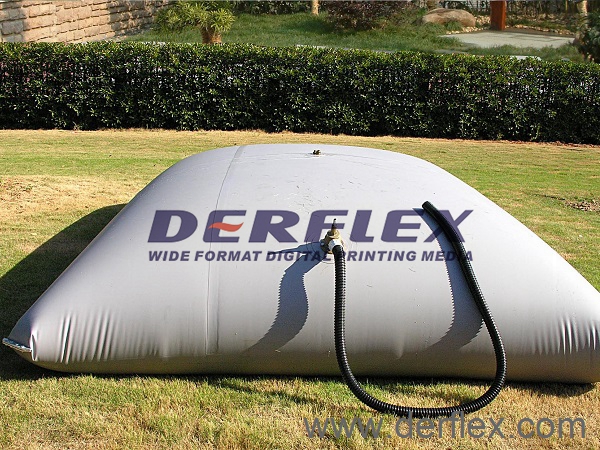
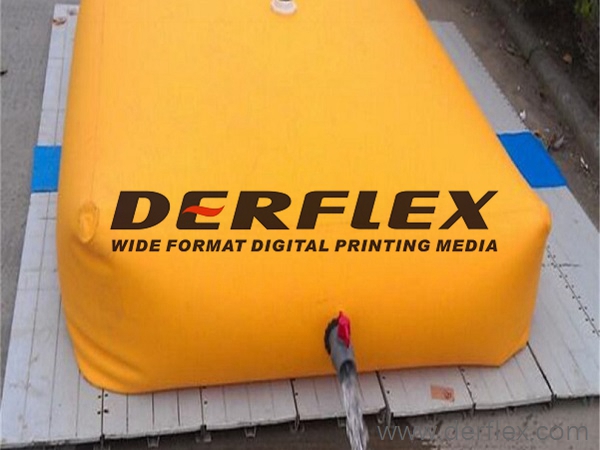
| Closed pillow / bladder tank | Fully enclosed flexible envelope expands as liquid enters. | Temporary water storage, field use, emergency reserve, transport-supported projects. | Seam design, valve reinforcement, maximum fill condition, ground protection. |
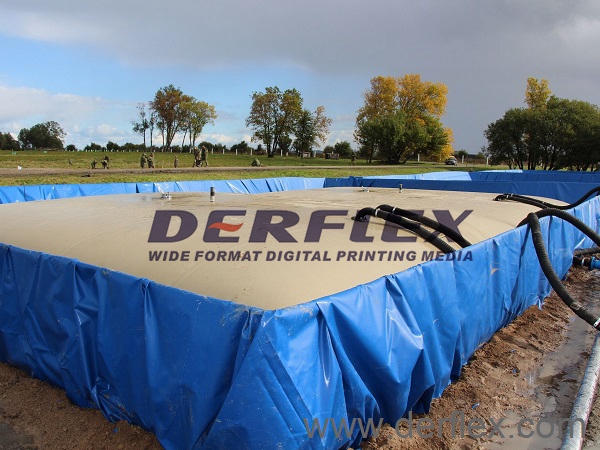
| Framed or open tarpaulin tank | A frame or supporting structure controls the tank geometry while a flexible liner holds liquid. | Agriculture, aquaculture, process water, temporary reservoirs. | Frame contact, top-edge retention, drain details, wall height, liner abrasion. |
| Installed tank liner | Flexible membrane acts as the liquid barrier inside a rigid or semi-rigid tank. | Steel, concrete, fiberglass or project-built containment. | Substrate condition, penetrations, welding, liner attachment and chemical compatibility. |
A closed bladder should not be specified the same way as an open framed tank. The load path, seam pattern, fittings and installation method are different.
For water, hydrostatic pressure increases with vertical depth. That means a tall tank can create higher local pressure than a shallow tank holding the same total volume over a larger footprint.
P = ρ × g × h
For fresh water, pressure rises by about 9.8 kPa per meter of depth. This is why tank height, not just liters, should be included in engineering review.
A 10,000 L tank cannot be specified safely from volume alone. A low, wide pillow tank and a taller framed tank may hold the same volume but create different stresses at seams, wall interfaces and fittings.
Start with the liquid and operating environment, then work backward to material, geometry, seam process and accessories. The table below is a selection framework—not a substitute for a project-specific specification.
| Application | Material direction | Critical questions | Common specification priority |
|---|---|---|---|
| Agricultural irrigation | Reinforced PVC coated fabric is commonly considered for robust outdoor storage. | Outdoor duration? Ground abrasion? Repeated seasonal deployment? Outlet size? | UV exposure, puncture protection, easy folding, field-repair planning. |
| Construction / dust suppression | Heavy reinforced PVC tank or bladder depending on deployment. | Will the tank move between sites? Is the ground prepared? Are pumps connected continuously? | Abrasion resistance, fittings, fast setup, reinforced handling points. |
| Emergency water reserve | PVC or TPU may be evaluated according to water-contact and deployment requirements. | Potable or non-potable? Storage duration? Packing volume? Required documentation? | Foldability, seam reliability, traceable material, simple deployment. |
| Potable water | Use only a formulation and finished system supported by the required drinking-water documentation for the destination market. | Which potable-water standard is required? Which side contacts water? How will it be cleaned? | Compliance evidence, migration / contact requirements, seam and fitting compatibility. |
| Aquaculture | Reinforced PVC liner or framed tank construction may be appropriate after water-chemistry review. | Tank diameter and water depth? Frame type? Drain locations? Cleaning chemicals? | Frame interface, drain reinforcement, surface finish, welding quality. |
| Industrial liquid | Material must be selected against the exact liquid, concentration and operating temperature. | What is the chemical? Temperature? Contact time? Regulatory requirement? | Chemical compatibility, seam compatibility, containment plan, documentation. |
There is no universal winner. The correct material depends on liquid-contact requirements, welding process, outdoor exposure, folding cycles, budget and expected service conditions.
Often used for heavy-duty industrial water tanks, framed tanks and cost-sensitive large-volume flexible storage because it combines reinforcement, waterproofing and weldability.
Frequently evaluated for flexible bladders where repeated folding, soft handling, specialized liquid-contact requirements or particular welding behavior are important.
Can be economical for simpler or shorter-term containment, but buyers should compare reinforcement, seam method, repairability and repeated handling requirements with coated textile systems.
| Specification item | What to define | Why it matters |
|---|---|---|
| Tank architecture | Pillow / bladder, framed open tank, liner or custom geometry. | Determines the load path and fabrication method. |
| Working capacity | Usable liquid volume plus maximum fill condition. | Controls geometry, seam stress and fitting layout. |
| Dimensions / water depth | Length, width, height or diameter and design water depth. | Hydrostatic load depends strongly on depth. |
| Liquid | Exact liquid, concentration, temperature and contact duration. | Material compatibility cannot be assumed from the word “waterproof.” |
| Coated fabric | PVC or TPU direction, reinforcement structure, target weight / thickness if required. | Defines mechanical and processing performance. |
| Seam process | HF welding, hot-air / wedge or another validated method. | Tank integrity depends on repeatable compatible joints. |
| Fittings | Inlet, outlet, vent, drain, flange type, size and location. | Penetrations are common stress and leak-control points. |
| Environment | Indoor/outdoor, temperature, UV, ground condition and handling cycle. | Changes coating, reinforcement and protection requirements. |
| Compliance | Project or market-specific potable-water, chemical-contact or other required documents. | Must be matched to the exact ordered material and intended use. |
| Packaging / deployment | Folded pack size, groundsheet, repair kit, labels, accessories and installation method. | Affects field efficiency and total procurement scope. |
Weld overlap, panel direction, process settings and seam placement should be planned around the tank geometry. A strong roll material cannot compensate for a weak or inconsistent weld.
Stones, sharp debris, rough concrete edges and concentrated supports can damage a tank from the outside. A smooth base and compatible groundsheet may provide more value than simply increasing fabric weight.
Pipe connections can pull, twist or transmit pump vibration into the membrane. Reinforcement should be designed around fitting size, hose weight and expected movement.
For flexible tanks, shape changes as liquid is added. Procurement drawings should define usable capacity, maximum filled dimensions and how overfilling will be prevented.
Capacity does not define water depth, footprint, seam stress or fittings. Send a drawing or dimensional requirement.
Fabric weight matters, but reinforcement, coating adhesion, weldability, seam layout and fittings can be equally decisive.
Potable-water projects should specify the required market standard and review the exact formulation, contact surface, seams and fittings against that requirement.
A tank can be damaged by a poor site even when the coated fabric itself is strong. Base preparation belongs in the installation plan.
Different liquid chemistry, water depth, temperature, filling rate or valve layout can justify a different material or fabrication approach.
DERFLEX already publishes PVC coated tarpaulin tank, water bladder and tank-liner products. For buyers, the practical advantage is the ability to discuss both the coated material and the finished welded assembly rather than treating them as unrelated purchases.
Review PVC or TPU, reinforcement, coating surface, weight / thickness direction and operating environment.
Translate capacity and geometry into panel layout, seam locations and local reinforcement zones.
Use a compatible thermal joining process and control the joints that form the liquid envelope.
Confirm dimensions, fittings, liquid-contact requirements and agreed inspection points before repeat production.
These existing DERFLEX pages cover adjacent product and material decisions without turning this guide into another duplicate product page.
There is no single universal GSM or thickness that automatically makes a tank heavy duty. The term should describe a complete construction suitable for demanding service: reinforced coated fabric, appropriate tensile and tear performance, reliable welded seams, reinforced fittings, compatible liquid-contact surfaces and an installation plan that protects the tank from puncture and concentrated loading.
Sometimes, but not always. A water bladder or pillow tank is a fully enclosed flexible tank. “Tarpaulin tank” can also refer to an open framed tank or a liner installed inside another structure. The architecture should be stated clearly because it changes seam, support and fitting requirements.
Reinforced PVC coated polyester is commonly used for industrial flexible water storage because it combines a textile load-carrying layer with a weldable waterproof coating. Final suitability still depends on tank size, water depth, outdoor exposure, folding cycles, seam design, fittings and any water-contact compliance requirements.
Choose by application rather than by material name alone. PVC is commonly considered for robust, cost-conscious industrial and large-volume tanks. TPU can be evaluated where repeated folding, soft handling, specialized liquid contact or a particular welding process is important. Send the liquid, temperature, tank size and compliance requirements before material selection.
No. Potable-water use should never be assumed just because a tank is waterproof. The exact coating formulation, contact surface, seam construction, fittings and required market documentation must be reviewed for the drinking-water standard specified by the buyer.
Start with tank geometry, maximum water depth, liquid, handling cycle, abrasion exposure and welding method. GSM and thickness can then be selected together with reinforcement structure, coating adhesion, seam design and fitting reinforcement. A larger number is not automatically a better tank.
Provide the liquid, working capacity, maximum dimensions or installation footprint, operating temperature, indoor/outdoor exposure, valve and drain requirements, quantity, destination and any required compliance documents. A drawing or sketch is especially useful for custom geometry.
Send DERFLEX the tank geometry and operating conditions first. That allows material structure, welding, fittings and reinforcement to be discussed as one procurement package.