News
Industry News

Roll Up Industrial Divider Curtains for Flexible Access | DERFLEX

Update:2026/10/26 19:45:06 Views:
DERFLEX logoIndustrial textiles / custom panel fabrication
Request a project quotation ↗

Home / Roll Up Industrial Divider Curtains

Large openings • vertical access • OEM supply

Roll Up Industrial Divider Curtains for Flexible Access

Open a full work bay without parking a curtain stack along the wall. DERFLEX helps curtain fabricators, industrial OEMs and facility procurement teams specify PVC-coated textile panels that raise vertically, with the right roll direction, lower-bar pocket, reinforcement, window layout and repeated-operation duty. Order the material or custom fabricated curtain panels against an approved drawing; lifting hardware, controls, structural supports and installation must be defined separately.

Vertical roll-up movementBottom bar detailingClear-view optionsCustom panel supply
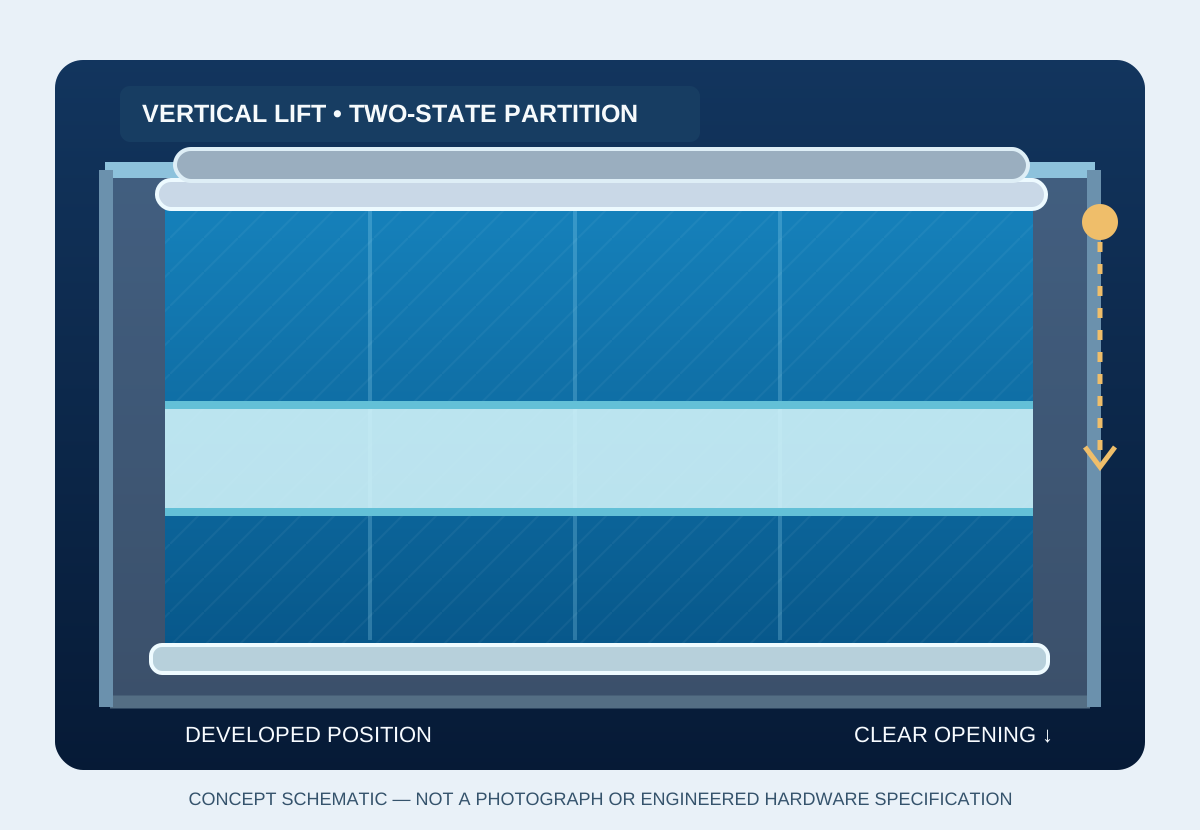
Concept diagram of a large blue PVC divider panel with a transparent section, top roll location and bottom bar
Engineering schematic: conceptual panel layout only, not an installed project or a specified roller assembly.
01 / Understand the product

What is a roll-up industrial divider curtain?

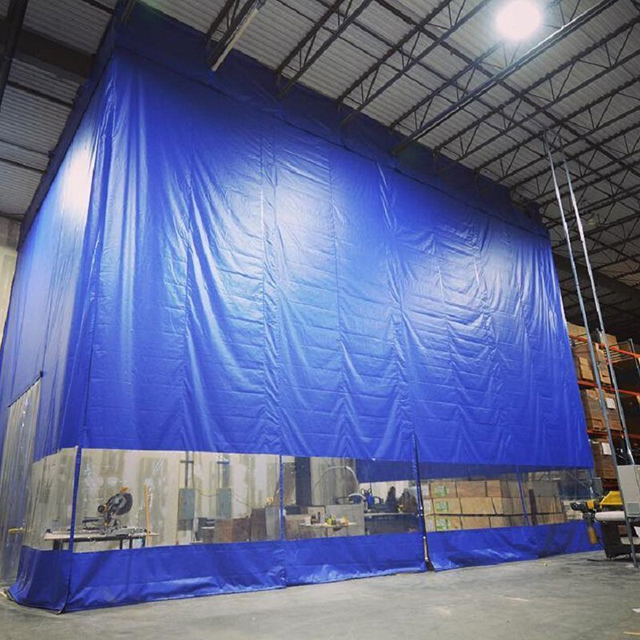
A roll-up industrial divider curtain is a flexible partition that opens vertically rather than sliding sideways. It can lower to separate a factory bay, packing zone or warehouse work area and raise overhead when equipment or personnel need the full clear opening.

Keep the floor route usable

The curtain retracts overhead instead of occupying a side stacking area. Confirm the raised bundle or tube stays outside the required clearance envelope.

Match panel to the lift

The finished panel, lower bar, pockets, lift positions and top attachment should be designed as one moving assembly—not selected by PVC fabric weight alone.

Separate scope from hardware

DERFLEX can discuss coated fabric rolls and custom curtain-panel fabrication. Roller drives, pulleys, structural anchorage, controls and site safety need their own confirmed supply and engineering scope.

Where this page sits: For general fixed or sliding partitions, compare our industrial curtain material and panel overview. This page focuses specifically on the moving vertical roll-up opening and its fabrication interfaces.

02 / Decide the motion before choosing the material

Three roll-up arrangements have different load paths

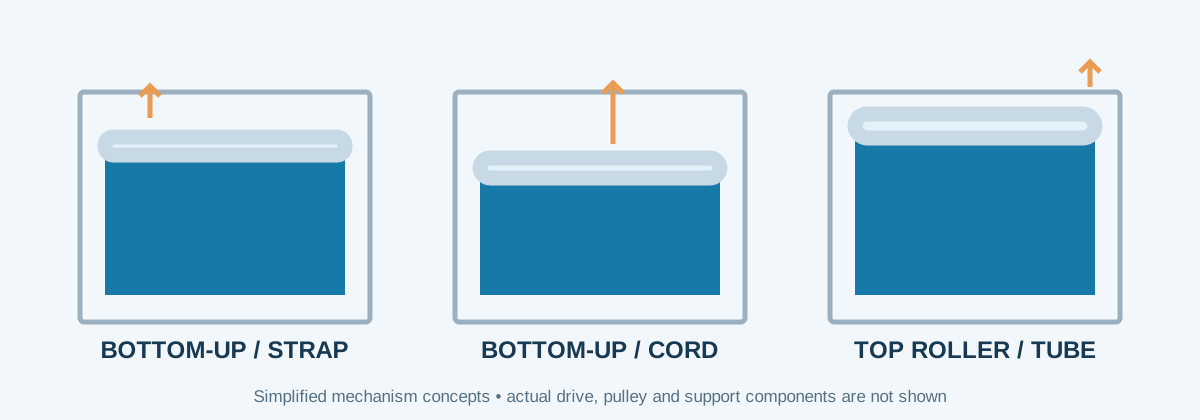
Specify what physically rotates, where the bundle is retained, how the operator releases it and who is responsible for approving the lifting arrangement. The sketch below shows movement concepts, not purchasable finished machinery.

Three engineering schematic layouts for bottom-up strap, bottom-up cord and top-roller industrial divider curtains
Concept comparison of three operating approaches; confirm the actual assembly with the hardware provider.

A / Hand roll + retention straps

Panel rolls around a lower bar and is restrained near its fixed header. Best evaluated for smaller, manageable sections and less frequent changes of layout.

Specify: bar mass, lifting reach, strap spacing, secure overhead retention and operator handling.

B / Bottom-up cord lift

Lift ropes raise a lower roll formed around a bar; a separate cleat or engineered securing device retains the raised assembly. Rope geometry must match panel width.

Specify: lift points, alignment, cord routing, pinch-point management and holding arrangement.

C / Top-tube roller

A rotating tube above the opening winds up the panel while a lower rail remains at the free edge. Gear, crank or powered operation belongs to the roller supplier's approved assembly.

Specify: tube capacity, bracket loads, winding diameter, drive selection, travel limits and user safety.

Design boundary: This industrial divider is not a rapid traffic door. If the application depends on automated, frequent forklift movements, compare high-speed roll-up door curtain fabric and obtain a suitably engineered door system.

03 / Build a procurement specification

Specify fabric, lower bar, windows and finished interfaces

For a useful comparison, describe the same real panel and use conditions to every supplier. No universal GSM, thickness, roll diameter or maximum panel width can be assigned without material and mechanism details.

Specification field What to state in the RFQ How to approve it
Material construction PVC-coated polyester grade, nominal mass in g/m², surface finish, coating and reinforcement direction Actual material sample, agreed tolerance and grade-specific supporting data
Finished panel Bay width × drop; cut-to-finish allowances; welded seams, edge reinforcement and orientation Dimensioned drawing and first-article dimension check
Rolling configuration Bottom-up strap, bottom-up pulley/cord, or top-tube winding; mounting datum and stowed envelope Assembly drawing, material roll check and hardware provider's acceptance
Bottom bar and pocket Bar cross-section, mass, stiffness, finish, cap dimensions, pocket clear size, insertion and retention Pocket sample assembled with the actual bar and inspected through motion cycles
Transparent section Window size and height, clear PVC grade, joint position, rolling direction and sight lines Film and seam sample; visibility and crease/bend behavior after cycling
Side restraint & seal Free edges, side returns, optional guide compatibility, release points and floor clearance Drawing plus safe movement and clearance checks; no assumed airtight seal
Cycle / environment Operations per shift or day, expected service pattern, cleaning exposure, temperature and drafts Application-representative cycling criteria and documented inspection points
Special duty Any required flame behavior, UV exposure, cold flexibility, dust or splash management Evidence for the selected grade or complete assembly; do not infer an enclosure rating
The PVC-coated textile face can be waterproof, but a finished partition's leakage, movement in drafts and perimeter performance depend on seams, gaps and site structure. For roll-goods construction choices, see heavy-duty PVC curtain fabric.
04 / Build around the lower edge

The bottom bar affects both the roll and the operating load

A bar helps maintain a straight lower edge and, for bottom-up curtains, acts as the core around which the curtain rolls. If its section bends, the roll can skew. If its mass is excessive, operating force and header loading increase. The finished bar assembly—not fabric mass alone—must be evaluated.

  • Match the bar's actual outside dimension to the finished pocket clearance.
  • Provide access for insertion, removal and replacement where required.
  • Protect pocket ends from rubbing, sharp corners and bar migration.
  • Set weld or stitch locations away from concentrated flex and contact points.
  • Record the lower clearance when deployed and the minimum retained opening when raised.

Useful first-article test: Lift and lower one complete bay with the proposed bar, release method and window design; inspect skew, sleeve movement, seam stress and handling effort before approving a repeat order.

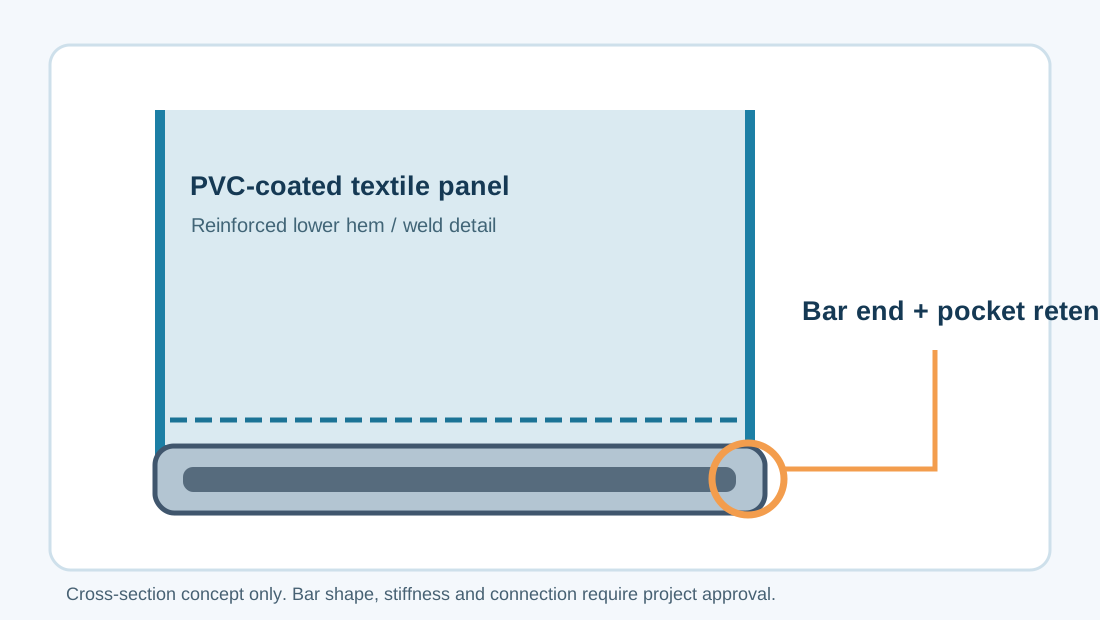
Engineering cross-section of PVC industrial divider curtain bottom sleeve with removable metal bar and protected end
Concept sketch of reinforced hem and bottom-bar pocket. Structural and mechanical detail remains project-specific.
05 / Measurement and usable access

Measure the opening and the raised envelope separately

A curtain panel is not sized only from the nominal warehouse opening. Establish the support datum, each bay width, hanging height, hardware offsets, side clearances and overhead stowage before confirming finished dimensions.

STEP 01

Record each bay

Width at top, middle and bottom; height at both sides and center. Note columns, uneven floors and service runs.

STEP 02

Mark support lines

Show where the header carries load and where the panel connects to the fixed rail or rotating tube.

STEP 03

Reserve overhead space

Obtain stowed bundle or cassette dimensions from the assembly provider, including rail and brackets.

STEP 04

Show traffic clearance

Mark the required width, height and equipment route when the divider is fully raised.

Functional relationship: usable clear height when raised = support-to-floor datum minus the lowest point of the completely stowed assembly. A panel's finished drop also depends on its top mounting offset and lower gap; no universal deduction is appropriate.

For broader warehouse layouts, sidewall returns and access planning, see warehouse divider curtain applications.

06 / Repeated operation and duty cycle

Opening frequency changes what should be tested

A curtain that is opened for weekly maintenance does not face the same flexing and handling as a partition raised every production changeover. Declare a realistic cycle requirement instead of asking a vendor to promise an unqualified number of years.

Low frequency / planned access

Assess manageable panel weight, strap or cord retention, accessible controls and smooth stowage. First-article fit and safe handling are essential.

Repeated daily changeovers

Inspect crease lines, coating whitening, seam fatigue, window transitions, bar pockets and roller alignment through an agreed representative cycle program.

Continuous traffic / rapid actuation

Escalate to a suitable industrial door system if safety interlocks, powered high-frequency movement or guided rapid access are required. Curtain material evidence is not a system safety certification.

Document the cycling trial

  • Record sample grade, thickness/mass, panel size and entire operating mechanism.
  • Specify cycle count as a buyer-defined test condition, with temperature and speed recorded.
  • Check baseline and after-test appearance, motion, seams, hems and transparent joints.
  • Agree measurable acceptance criteria before the test; keep failed samples for review.

Do not transfer unrelated ratings

Material tensile strength alone does not predict winding life. A fabric's FR declaration is not a certified fire barrier. A clear PVC window is not automatically suitable as welding protection. A divider cannot be assumed to provide rated sound isolation, contamination control or egress protection.

When these duties matter, evaluate specialized materials and complete system evidence.

08 / Scope and applications

Where vertical opening adds value

Large assembly-bay openings

Retract an area barrier above the equipment path during planned movements; keep nearby columns, cranes and services within the clearance study.

Warehouse changeover partitions

Temporarily divide inventory, sorting or packing zones without allocating a long side-track stack. Plan air currents and sight lines.

Maintenance and service enclosures

Lower a curtain during intermittent work and lift it for maintenance access. Identify process hazards separately from the physical screen.

Supply scope must be written down. Discuss roll goods, fabricated divider panels and replacement sections with DERFLEX. The gearbox, motor, curtain tube, cords, supports, electrical interlocks, safety equipment and installation are not assumed to be included. For non-vertical factory bays, explore factory curtain tarp configurations.

09 / Before you order

Approve a representative bay before a repeated OEM program

Send these six inputs with your RFQ

  1. Application: work zone, people/equipment traffic, dust/splash and weather conditions.
  2. Drawing: bay schedule, attachment line, finished drop, clearance and raised-bundle location.
  3. Movement: bottom-up vs top-roller, operating frequency and specified hardware interface.
  4. Panel: proposed material grade, color, windows, welded joins and reinforced hems.
  5. Lower edge: actual bar/pocket dimensions, caps, insertion, and side-edge controls.
  6. Commercial: quantities, rolls vs panels, destination, packing and required documentation.

Four acceptance points

  • 01 — Fit: verify dimensions and alignment on the first assembled bay.
  • 02 — Move: cycle the complete installation; watch for skew, edge binding and fold stress.
  • 03 — Stow: check holding/retention and effective opening height.
  • 04 — Return: inspect bar ends, pockets, seams and window transitions after the agreed sequence.

Material grade, useful roll width, seam layout, reinforced edge construction, windows, hardware interface, panel count, inspection and packing all affect price. MOQ, lead time, delivery terms and evidence are quotation-specific, not universal published promises. For traffic-focused entrances rather than a general vertical partition, compare industrial door curtain fabric choices.

Questions from project buyers

Roll Up Industrial Divider Curtain FAQ

What is an industrial roll-up divider curtain?

It is a flexible partition panel that raises vertically to clear an opening and lowers to divide a work area. Some designs roll from the bottom with cords and a lower bar; others wind onto a top tube. Curtain material and the lifting system are separate specification items.

Is a roll-up divider the same as a high-speed industrial door?

No. A roll-up divider is generally selected for occasional or planned opening of large work zones. High-speed doors are engineered access systems with their own guides, controls, safety devices and rated duty. Repeated vehicle traffic should be assessed as a door-system requirement.

Which is better: a bottom-up pull-cord curtain or a top-roller curtain?

A bottom-up pull-cord arrangement may suit intermittent access when the raised roll can be safely secured. A top-roller system may better suit controlled winding and some higher-frequency applications, but it requires compatible tube, brackets and drive. Choose using actual opening size, complete panel mass and duty cycle.

How should the bottom bar and pocket be specified?

Provide the bar cross-section, length, end caps, intended stiffness and weight, plus finished pocket dimensions, bar insertion method and end retention. Approve a representative assembled sample because the bar changes roll balance, lift force and the usable opening.

Can reinforced PVC curtain fabric be used with clear viewing windows?

Yes, an opaque reinforced PVC-coated polyester body can be paired with suitable clear PVC viewing material when both materials and the joint are compatible. Position windows for actual sight lines and review creasing, rolling radius and repeated flexing at the window edges.

What does DERFLEX need to quote a custom roll-up divider panel?

Send a marked opening drawing, photographs, mounting and lift concept, panel sizes and quantities, expected opening frequency, material and visibility needs, operating conditions, bar/pocket interface and destination. State whether you want roll goods, fabricated panels or replacement sections; drive hardware and installation must be explicitly quoted if required.

Start with your opening drawing

Specify a divider panel that can actually roll, clear and return.

Send the bay size, layout photo, lifting concept, expected operation frequency, bar/pocket details and quantity. DERFLEX can review suitable PVC-coated fabric and custom panel options against your project scope.

Material or fabrication suitability, test reports, sample availability, MOQ and timing are confirmed during quotation. No hardware design or installation is implied.

DERFLEX • International OEM and industrial fabric sourcing

DERFLEX / industrial coated fabrics & custom divider panel enquiries. Updated 27 October 2026.

Consulting Services
+86-021-54361792 / 54361798
Email
sales@derflex.com