


 TRANSPORT FABRICS · OEM
Walking Floor Trailer Tarps for Bulk Cargo Protection
Custom roof tarp materials and replacement covers for open-top walking floor and moving floor trailers. DERFLEX helps converters, trailer body builders and fleet buyers specify the top loading opening, roll or track interface, overlap, wear zones and cargo exposure together—not as an ordinary flat truck tarp. Discuss waterproof PVC-coated polyester, selected ventilated mesh, reinforced finishing and OEM supply using a drawing or existing sheet.
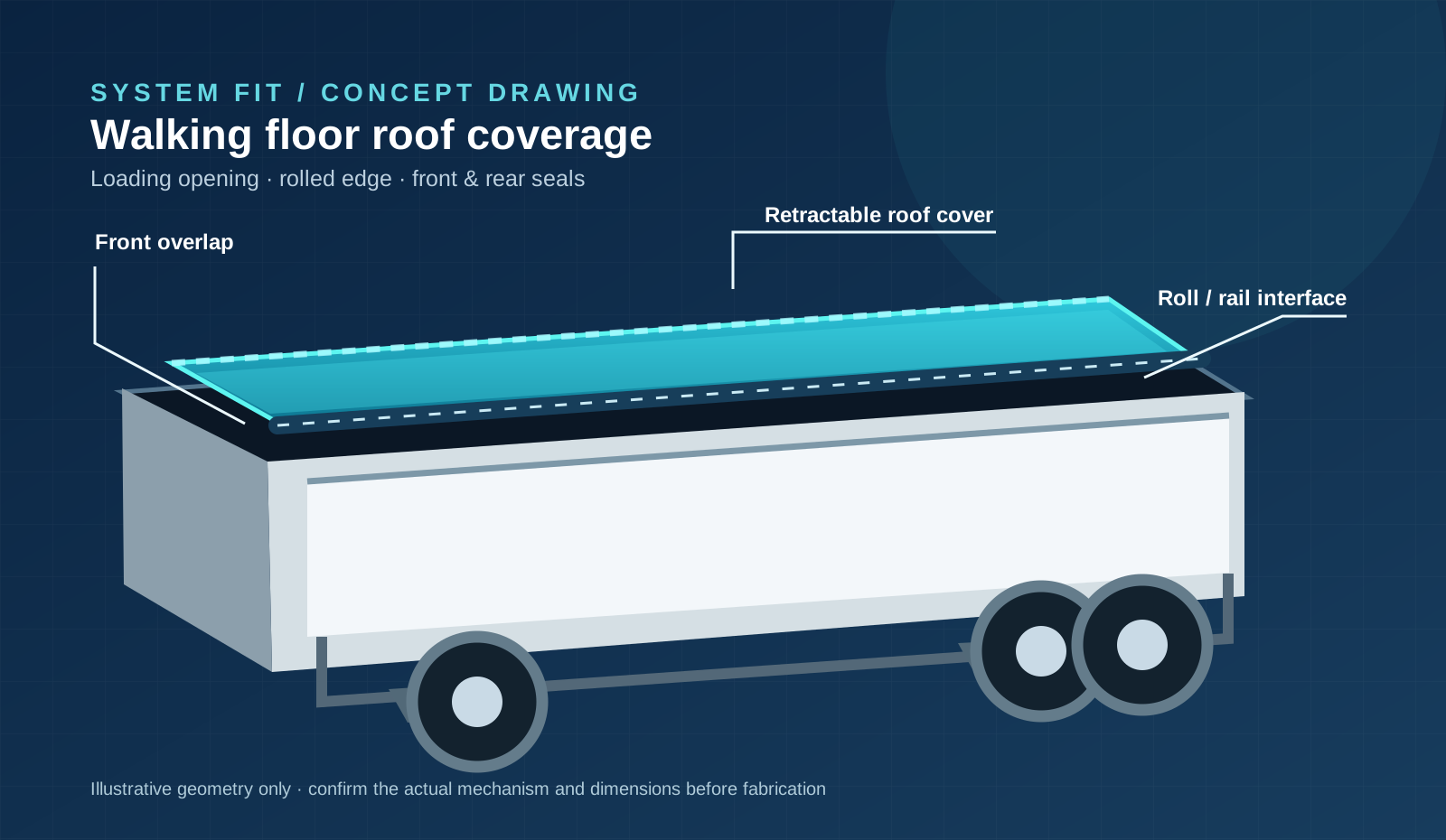
What Is a Walking Floor Trailer Tarp?
A roof cover is selected according to the trailer’s discharge system, top loading access and the load being transported. A walking-floor trailer is not a tipping trailer: its moving floor conveys bulk material to the rear without lifting the body.
Its primary tasks are to shield appropriate cargo, reduce wind exposure and help retain loose material during transport. The cover may roll across the roof, run in a guided arrangement or form part of another OEM mechanism. Waterproof fabric alone does not certify a complete weather-tight roof or secure a load that exceeds the permissible body height.
Roof access, not just width
Confirm the opening that loaders must clear when the sheet is retracted. Roof bows, hinges and material overfill change the practical space.
Repeated operating cycles
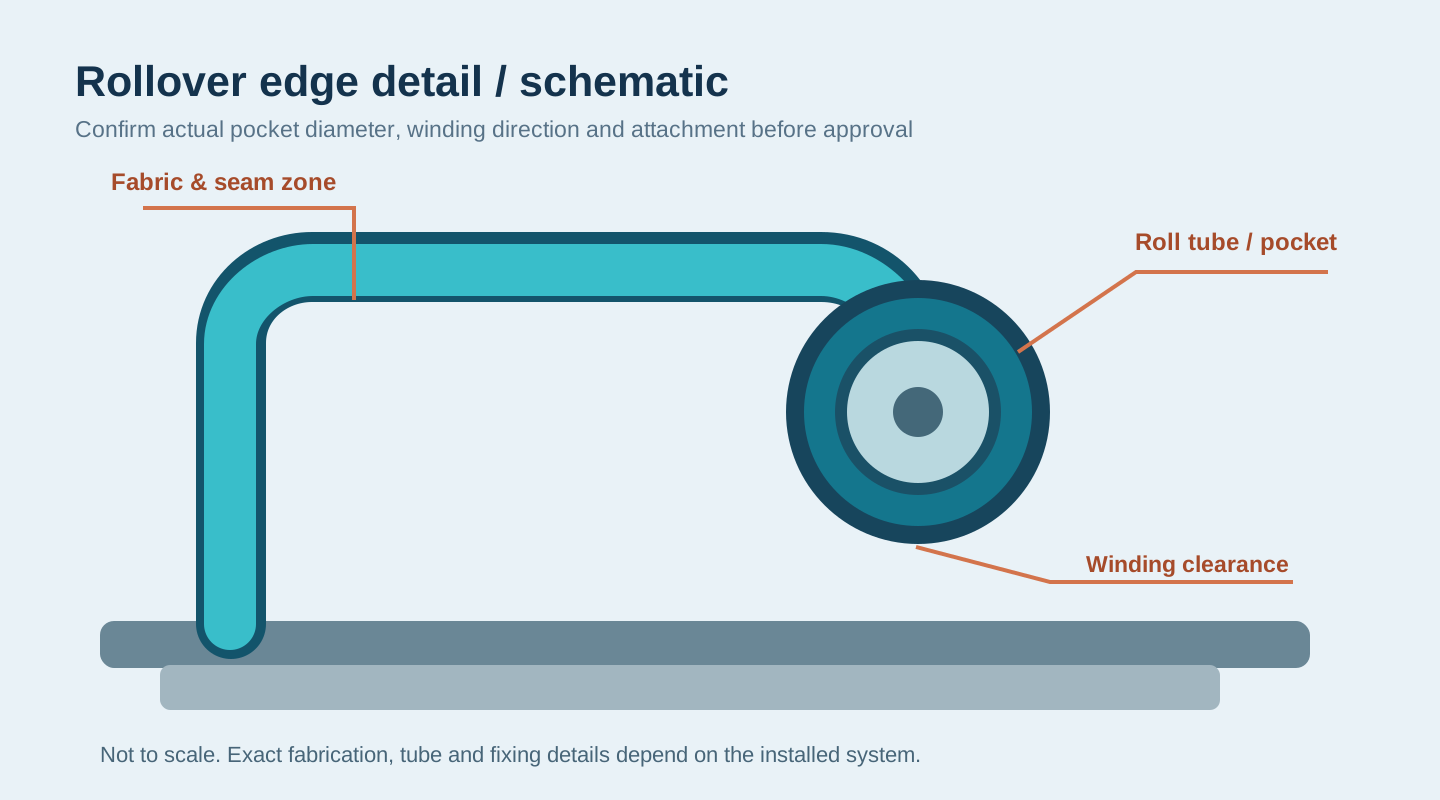
Rolling places bend and rubbing stress at pockets, edge finishes and the same crease lines. Reinforcement must follow the mechanism.
Bulk transport duties
Wood chips, recyclables, grain and other loads differ in moisture sensitivity, dust escape, puncture risk and ventilation needs.
For the broad market context, see DERFLEX trailer tarp materials and OEM covers; this page focuses specifically on moving-floor roof geometry and compatible replacements.
Measure the Opening Before Specifying the Finished Tarp
Do not use only the nominal trailer length. Two trailers of similar capacity can use different roof apertures, winding pockets, front bulkheads and end closures.
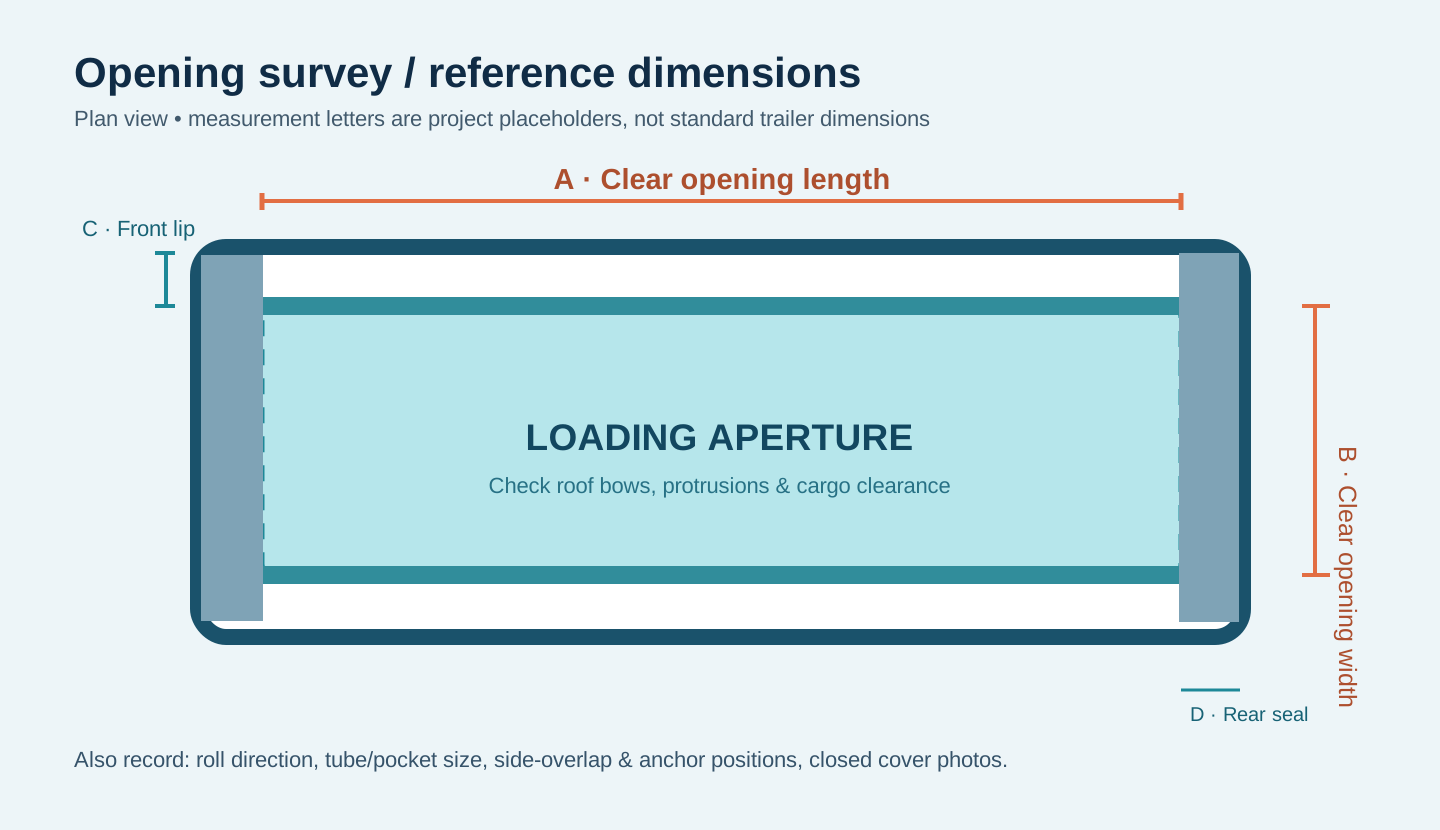
Six measurements that prevent a wrong fit
- Clear opening length: inside usable distance between the front and rear end structures.
- Clear opening width: gap at the actual cover seat or support plane, not an exterior sales brochure width.
- Side edge / guide locations: rail positions, overhang and seam-safe zones on both sides.
- Front and rear overlaps: sheet termination, seal flap depth and elastic or strap anchoring positions.
- Roller interface: tube/pocket dimensions, roll direction and closed-sheet position.
- Operating clearance: bow profiles, hinges, rear door movement and loading equipment approach.
For replacement orders, the old tarp plus photos with a ruler are especially useful. Finished dimensions may differ from the measured aperture because of hems, pocket circumference, seam allowances and tensioning requirements.
Match the Tarp to the Installed Roof and Roll Mechanism
Walking-floor trailers may use a simple rollover sheet, a guided tarp system or an OEM hydraulic covering assembly. A fabric quotation does not imply that DERFLEX supplies the complete mechanism or hydraulic controls.
| Existing roof approach | Tarp design focus | Verify before fabrication |
|---|---|---|
| Manual rollover sheet | Roll-tube pocket, fabric bend radius, reinforced leading edge and front/rear fastening flaps | Winding direction, installed tube diameter, rolled-up envelope, hand-crank access and parked-sheet position |
| Guided / sliding cover | Edge attachment path, guide/track geometry and panel tension where movement is concentrated | Actual rail hardware, sliders/attachments, travel distance and opening clearance; do not assume a rollover pocket fits |
| Hydraulic or powered roof system | System-specific panel, edge and attachment profile | OEM documentation, sequence, pinch zones and approved compatibility; engineering of motors and controls is outside a fabric-only quote |
| Fixed or removable sheet | Perimeter overlap and fastening layout without a rolling zone | Access frequency, wind restraint and whether it blocks loading or maintenance |
For adjacent automated or retractable projects, review DERFLEX tarp system material options. The new cover must be approved against the installed trailer and equipment maker’s requirements.
Choose Solid PVC or Mesh According to the Bulk Cargo
Start with what the cover must control—moisture ingress, escape of light pieces, airflow, weathering or abrasion—not with a universal “heavy-duty” label.
| Cargo / duty | Material direction to evaluate | Critical checks and limits |
|---|---|---|
| Wood chips & biomass | Solid PVC-coated polyester when rain shielding is needed; mesh only where ventilation and containment are compatible | Water sensitivity, pile height, resinous debris, snag points, windborne fines, possible dust generation |
| Recovered paper & light recyclables | Solid fabric or suitable reinforced mesh after escape-risk review | Loose sheets catching wind, sharp packaging, wet conditions and regional containment duties |
| Dry grain / feed ingredients | Solid coated roof cover where a continuous water barrier is required | Seam/closure sealing, dust, contamination controls and any food or feed-contact requirements; roof tarp is not a hygienic liner |
| Compost / green waste | Evaluate weather protection against drainage, moisture and necessary ventilation | Wet material, organic residue, odor, temperature and washing chemistry; mesh will not retain fines or liquid |
| Abrasive or mixed waste | Reinforced solid or mesh design based on particle size and exposure | Protruding metal, tearing, dust escape, overfilling and local load-covering law |
Cover selection does not replace lawful load restraint, dust controls or the trailer manufacturer’s operating instructions. For hazardous, hot, chemically aggressive or regulated loads, obtain application-specific compatibility and compliance review before choosing a sheet.
For waste-focused cover geometries beyond moving-floor trailers, compare our transfer trailer tarp guidance.
Where a Walking Floor Roof Tarp Usually Wears First
A strong center sheet is not enough if the rolling edge, front overlap or anchor zones fatigue first. These are specification and prototype-check areas—not claims of a guaranteed service life.
01. Tube pocket & repeat bend line
Coordinate pocket circumference, seam placement, fabric stiffness and winding direction. Ensure the sheet can roll without catching crossbars or rubbing the body rim.
02. Front / rear wind control
Specify the way the front flap overlaps the bulkhead and how rear edges are retained. A continuous sheet is not the same as a weather-tight installed roof.
03. Rails, hems & localized wear
Reinforce only where pull, rubbing or repeated anchoring warrants it. Excess material can make a rolled cover bulky or interfere with travel.
Where the main concern is moisture protection and industrial coated material, see PVC tarpaulin manufacturing and finish options. A finished roof still needs seam and attachment validation.
DERFLEX Material References & Construction Drawings
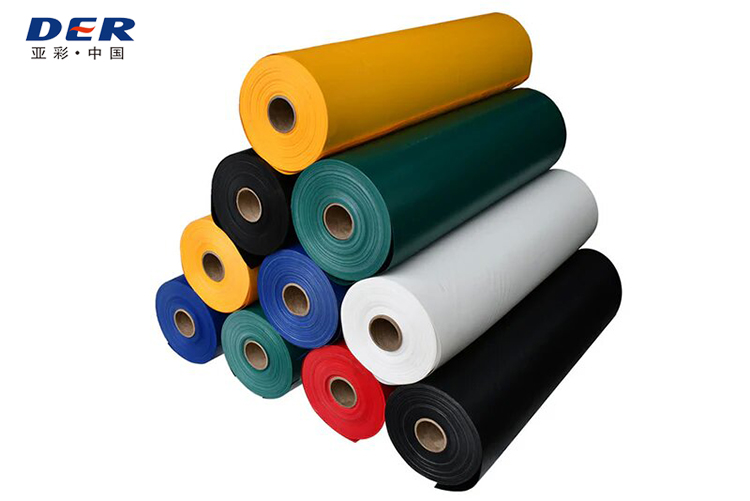
These are genuine DERFLEX site photographs of coated tarpaulin material and original diagrams of roof geometry. They are not presented as photos of a completed walking-floor installation.

If you are also comparing different vehicle top cover families, see roll-off truck tarps for containers; their arm clearance and deployment geometry are different from moving-floor roof covers.
Supply the Material, a Conversion Panel or a Finished Replacement
Choose the purchasing format that fits your workshop and vehicle-body program. No trailer chassis, moving floor, motor, rail kit or hydraulic control is included merely because a fabric panel is quoted.
Coated material rolls
For fabricators who handle pattern development, cutting, pockets and installation locally. Approve fabric weight, color, coating and test needs by actual grade.
Pre-cut or conversion-ready panels
For body builders who need a defined panel layout but perform final assembly and interface fitting themselves.
Finished replacement tarp
For approved patterns with the agreed hems, pockets, reinforcements, termination flaps, labels and packing. Prototype checking is appropriate for unfamiliar equipment.
For the wider family of fleet-cover materials and fabricating options, explore DERFLEX truck tarp manufacturing.
Send a Trailer Roof Survey, Not Just a Nominal Tarp Size
Detailed RFQs reduce revision cycles and make sample approval more useful. A basic sketch and photographs can start the discussion if you do not have CAD files.
Buyer checklist
- Trailer brand/model or roof system type; distinguish manual rollover, guided, hydraulic or fixed sheet.
- Inside top-opening length/width; front/rear overlap and side-edge geometry.
- Existing tarp sample, winding direction, roller pocket details and attachment photos.
- Cargo type, moisture/dust sensitivity, anticipated load height and local coverage rules.
- Opening cycles, weather, abrasion points and failure photos from prior covers.
- Order quantity, desired material or performance direction, color, branding, packaging, destination and inspection needs.
What changes the quotation?
Material: coated fabric vs mesh, base fabric, finish and validated performance options.
Fabrication: pattern complexity, number/placement of seams, pocket construction and reinforced zones.
Program: trial or repeat run, quantity, custom branding, packing and any approved inspection plan.
Fit confirmation: whether a reference tarp, drawing or first article is needed to establish a repeatable OEM pattern.
A Practical Route From Roof Measurements to Repeat Supply
System review
Identify the actual roof and cargo duty, with photos of the fully open and closed positions.
Fabric & pattern
Agree the grade direction, sheet path, clearances, pockets and construction details.
Sample check
Inspect the material and confirm a first-fit trial where the mechanism is not previously approved.
OEM reorder
Record approved dimensions, construction revision and packing references for later quantities.
Walking Floor Trailer Tarp FAQ
Practical answers for replacement buyers, trailer converters and bulk-cargo fleets.
What is a walking floor trailer tarp?
It is a roof cover for the top loading opening of a moving-floor semi-trailer. It helps retain suitable loose cargo and limit exposure to rain or wind, depending on whether the selected cover is solid PVC-coated fabric or a ventilated mesh. The tarp must match the roof mechanism and trailer geometry.
Can you supply only a replacement walking floor trailer tarp?
A replacement cover or conversion-ready panel can be discussed without ordering a new trailer. Send the old tarp, system photos or a measured drawing so pocket dimensions, fixing points, front and rear overlaps, and the winding direction can be checked before fabrication.
Should I choose solid PVC or mesh for bulk cargo?
Solid PVC-coated polyester is the starting point when a rain barrier and shielding of moisture-sensitive goods are essential. Mesh may be appropriate for selected dry, bulky loads where airflow and handling weight matter. Neither option is universally suitable for fine dust, liquid-bearing loads or all containment regulations.
Will a tarp fit any walking floor trailer model?
No. Different bodies use rollover sheets, rail-guided covers, hydraulic roofs or other systems. Opening geometry, roll diameter, attachment method and safety clearance vary. Confirm the actual trailer and sheet mechanism rather than ordering by trailer length alone.
How do I measure the tarp for a rollover roof?
Record the clear loading-opening length and width, the front and rear overlaps, the side edge or track locations, and the roller pocket or fastening detail. Also provide photos of the tarp open and closed, roof bows, loading height, and any worn areas. Finished cut dimensions are set after allowance and interface review.
What information is needed for an OEM quote?
Provide the trailer or roof system type, quantity, dimensions or old tarp sample, roll direction, cargo type, climate, daily opening cycles, required material direction, color and branding, attachment photos and delivery destination. Test reports and project-specific performance limits should be agreed before the order.
Need a Tarp That Fits Your Walking Floor Roof?
Send your clear opening dimensions, system photos, old tarp or pattern, cargo type, quantity and market. DERFLEX can discuss fabric rolls, conversion panels or finished cover construction based on the verified mechanism.