


Replacement curtain solutions
Replacement Industrial Tarp Curtain Panels for Existing Tracks
Replace damaged, cloudy or worn factory divider panels without automatically rebuilding the whole curtain system. DERFLEX can discuss custom PVC-coated industrial curtain replacement panels that follow your existing hanger geometry, finished panel size and window layout. The critical work is checking the rail and carriers, re-measuring top grommets, identifying each section and approving its connection to neighboring panels—not simply copying a stretched old curtain.

What is an industrial curtain replacement panel?
An industrial curtain replacement panel is a fabricated fabric section made to take the place of an existing divider curtain while retaining suitable tracks, hooks, carriers or neighboring panels. It may include a reinforced header, grommets, clear viewing band, overlaps and a lower hem. It is not the same as buying a complete track-mounted partition system.
Short answer: Retaining an existing rail is feasible only after its condition, load capacity and connector geometry are verified. For a replacement to hang correctly, the finished dimensions, hanger-hole coordinates, clear-window alignment and side connections must match the approved site survey.
Choose local replacement before committing to a full refit
Start with the failed component. A damaged fabric panel does not necessarily mean the track has failed, but a worn track should not be retained just to reduce scope.
| Observed condition | Practical direction | Verify before releasing the order |
|---|---|---|
| One torn section; rail and remaining panels sound | Replace the identified panel only | Panel boundary, header holes, side joining and window continuity |
| Clear window scratched, cloudy or torn; body still sound | Assess local window repair versus a whole-section remake | Condition of the surrounding PVC coating, seam process and view quality |
| Several panels degraded, but hardware appears serviceable | Consider staged, numbered panel replacement | Drawing revision, material consistency, accumulated dimensions and order sequence |
| Rollers seize, rail bends or brackets loosen | Stop and obtain hardware/structural assessment | Rated system capacity, mounting integrity and safe travel; replacing fabric alone will not solve this |
| Process duty or fire/welding requirement changes | Reassess the material and complete assembly | Exact duty, required standard, engineering review and material evidence |
System approval, installation safety and structural adequacy belong to the responsible site or track-system engineer; curtain fabric data alone cannot establish them.
Re-measure the rail, hanging points and finished drop
Old vinyl can stretch around grommets or distort along the lower edge. Survey the installed system and the removed panel independently, then resolve differences on the new drawing. These fields matter more than a generic “width × height” request.
Rail profile or model, straight/curved path, available travel, carrier and hook type, condition and documented load capacity.
Measure the intended left and right finished edges, the side overlap and any return. Identify the operating and parking arrangement.
Record hole-center X coordinates from one datum, end offsets, varying pitch, clear aperture and the centerline below the reinforced top edge.
Measure from an agreed rail or hook datum to the finished hem and floor. Include hardware drop, actual floor variations and required lower clearance.
Detail left/right overlaps, zip or hook-and-loop orientation, access edge, seam position and whether the curtain stacks to one side.
Include fabric body, reinforcement, window, pockets and other additions when the existing hardware is assessed for reuse.

A useful measuring rule: Specify grommet-center positions as coordinates from a single finished edge: X1, X2, X3 … Xn. Keep hole diameter and center-to-top-edge distance as separate fields. This catches irregular spacing that an average pitch would conceal.
Place the transparent band relative to the installed height—not the old cut edge
When only panel B-02 is renewed, its clear window should align visually and functionally with neighboring A-01 and C-03. A difference in top hem depth, hanger drop or clear-film construction can misalign the viewing band even if the replacement has the same overall fabric drop.

Approval points for clear PVC windows
- Window location from a common rail, floor or approved datum.
- Clear-film reference and agreed nominal thickness; no assumed one-size-fits-all gauge.
- Joining method and interface between transparent film and coated fabric.
- Visibility, surface finish, scratch exposure and cleaner compatibility.
- New-versus-aged color and transparency expectations.
- Repeated folding and the window's position near high-stress hems.
Existing clear film may have yellowed or changed in clarity. A new section can match the approved specification without perfectly matching an aged adjacent panel.
Number every section so the right curtain is replaced the first time
A multi-panel run becomes difficult to service when sections are described only as “left curtain” or “middle piece.” Use a consistent site/run/panel reference in the drawing, production label and packing list.
Example panel schedule — illustration only
| Panel ID | Action | Drawing checks |
|---|---|---|
| RUN-01 / A-01 | Retain | Measure its right overlap and window reference |
| RUN-01 / B-02 | Replace | Hole schedule, finished width/drop, both side edges, clear band |
| RUN-01 / C-03 | Retain | Confirm left connection and installed window alignment |
For a repeat-order program, maintain a revision-controlled approved drawing showing the panel ID, material code, orientation, header geometry, finished dimensions and acceptance criteria.

Specify the replacement fabric and attachment construction together
PVC-coated polyester is one common body material for industrial divider curtains because the textile reinforcement carries tensile loads while the coating provides a flexible working face. Clear flexible PVC may be joined where sightlines are necessary. Material suitability must be confirmed for the actual cleaning, movement and exposure conditions.
Opaque coated fabric
Select the approved material reference, coating finish, nominal mass or thickness where documented, color and required flexibility. Compare samples with the old curtain where appearance continuity matters.
Reinforced header
Define webbing or folded reinforcement, grommet aperture, end offsets, seam type and attachment loads. Reinforcement should suit the actual hanger forces and repeated movement.
Panel interfaces
Specify overlaps, closures, leading edge, bottom hem or pocket, and any detachable section connection. Confirm the curtain can park and move without fouling the old hardware.
See DERFLEX's industrial curtain material and panel range for the broader construction context and custom factory curtain tarp fabrication for complete new-zone projects.
Replace panels around the actual work-zone duty
The original construction may be appropriate to copy—or it may have failed because the area changed. Confirm what the curtain must withstand now, not just what it was called when installed.
| Working area | Panel choices to review | Specific boundary |
|---|---|---|
| Warehouse partition or staging zone | Opaque coverage, access edge, stack area and clear vision | Airflow and open perimeter gaps can affect separation |
| Automotive service or body-shop bay | Clear windows, repeated opening, suitable cleanable surface | Overspray, solvents and fire requirements need duty-specific review; see body-shop curtain considerations |
| Dust-generating workshop | Coverage continuity, local wear zones and adjacent overlaps | A curtain alone is not an engineered dust-extraction system; see dust containment curtain design |
| Noise-sensitive machinery partition | Possible multilayer/acoustic assembly instead of a basic replacement | Do not infer a sound reduction rating from plain vinyl; review acoustic curtain constructions |
Choose panel-only supply with clear responsibilities
DERFLEX can discuss coated-fabric material and custom fabricated replacement curtain sections for industrial and OEM programs. The quotation must say whether the supply is fabric rolls, cut pieces or finished replacement panels—and whether windows, reinforced edges, packaging and specific accessories are included.
Typical panel specification deliverables
- Approved drawing per identified panel.
- Fabric grade and appearance reference.
- Finished width/drop, seam layout and tolerance criteria.
- Window section coordinates, if applicable.
- Attachment hole schedule and header details.
- Panel labels, quantity and packing instructions.
- Agreed inspection or material evidence.
Do not assume hardware is part of the order
Rails, carriers, brackets, anchors, load checks, system certification and installation are separate unless expressly itemized. The customer's hardware team or installer should confirm that the existing assembly safely supports the proposed new finished panel.
For a broader approach to like-for-like and corrective fabric renewal, consult DERFLEX's custom replacement tarp specification guide.
Four checkpoints before repeat fabrication
Existing installations often lack complete original drawings. Documented measurement and sample approval reduce the risk of reproducing an old error across multiple panels.
Survey the installed run
Number sections, photograph rails and hangers, confirm clear opening, measure hole coordinates and note panel condition.
Prepare the drawing
Distinguish finished size from old stretched size; map header, windows, overlaps, access and lower clearances.
Review a sample or detail
Agree material, appearance, hook-to-grommet fit, fold behavior, window seam and required evidence.
Release by panel ID
Inspect finished dimensions and attachments; retain drawing revision and pack sections in the installation sequence.
See an existing DERFLEX curtain configuration
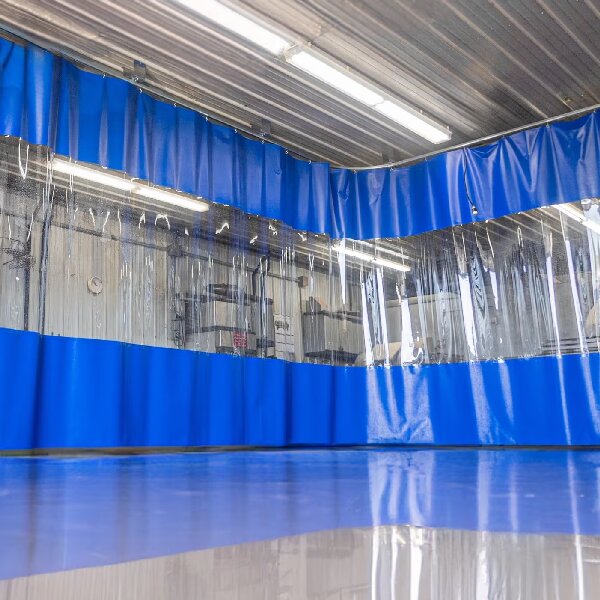
The image below is a DERFLEX-site industrial curtain application reference. It demonstrates blue opaque fabric and a clear viewing band. It does not document a replacement order, original track dimensions or a tested assembly rating.
What the photo can—and cannot—confirm
- Illustrates how opaque and clear curtain sections can share a working area.
- Helps buyers identify details to photograph in their own facility.
- Does not give a reliable grommet pitch or panel gauge by visual inspection.
- Does not prove compatibility with a different rail or attachment design.
Send photos of your actual installed rail, hooks, adjacent panels and damaged section for a meaningful replacement review.
Details that frequently cause replacement fit problems
Site and operational checks
- Inspect existing rail, hooks, trolley travel, brackets and support capacity before reuse.
- Measure from a consistent datum; verify floor slope and actual curtain clearance.
- Do not copy torn grommets, shrunken film or stretched hems as nominal dimensions.
- Confirm travel direction and stack room with adjacent sections installed.
- Maintain safe pedestrian routes, emergency access and separation from machinery.
Material and replacement checks
- Agree clear-film handling and cleaner compatibility on the proposed grade.
- Confirm required material documentation for any fire or specialist duty.
- Make color-matching expectations realistic against old weathered panels.
- Set a physical trial when the track model or hook shape is uncertain.
- Keep a revision-controlled panel schedule for later partial replacements.
What to send for a custom replacement panel quotation
A hand sketch and a few well-lit photos are a useful start. A manufacturing release needs a reviewed specification; availability, samples, lead time and minimum quantity are confirmed in the quote.
- Factory or project name, track run and panel IDs.
- Photographs of rail cross-section, carriers, hooks and existing panels.
- Finished panel width/drop, quantity and preferred replacement sequence.
- Each grommet center position, aperture and reinforced-header detail.
- Clear-window top/bottom coordinates and desired material finish.
- Overlap, closure, leading edge, bottom hem and floor-clearance details.
- Exposure, cleaning routine and any specified test-document requirements.
- Delivery destination, packaging needs and target project schedule.
Industrial curtain replacement FAQ
Practical answers for maintenance teams, fabricators and industrial procurement managers.
Can I replace only one industrial curtain panel and keep the existing track?
Often yes, if the rail, brackets, carriers and hooks are still fit for service and compatible with the new panel. Verify their condition, load rating and geometry, then approve the new header and finished dimensions before fabrication.
How should I measure grommet spacing for an existing curtain track?
Photograph the installed hooks and measure each grommet center from a fixed finished-panel edge. Record the first and last center offsets, every center-to-center distance, aperture size and centerline distance below the top edge. Do not assume uniform pitch or use stretched fabric alone as the master dimension.
Can DERFLEX copy a worn curtain panel from an old sample?
An old panel is useful evidence for materials, hems, window seams and attachment construction, but wear can distort its width, drop and hole pattern. Compare the sample with site measurements and agree a corrected drawing before cutting.
Can a replacement panel match the clear viewing strip on adjacent curtains?
A replacement can be specified with a clear flexible PVC section, subject to material and fabrication review. Measure the window from a common installed datum and confirm its top, bottom and side edges, visibility requirements and joining method. Exact color and transparency matches to aged panels may not be possible.
Are replacement industrial curtains flame-retardant or suitable for welding areas?
Only where the selected material and the intended application are supported by the required evidence. General PVC divider panels and ordinary clear PVC are not automatically certified fire barriers or welding screens. Identify the relevant duty and standard before ordering.
Does the replacement quote include tracks, rollers and on-site installation?
Not by default. DERFLEX can discuss coated fabric and fabricated replacement panels; existing tracks, carriers, structural supports, fit verification and on-site installation remain separate responsibilities unless the written quotation explicitly includes them.