
Intercept splash
Locate side returns, viewing bands and closures around the expected spray envelope. Consider rebound from wheels, underbodies and irregular equipment surfaces.



Wash bay containment · Material & fabrication guide
Keep wash spray within a planned work zone. Specify reinforced PVC curtain bodies, clear viewing panels and perimeter details around the actual water, cleaner and handling conditions.
For fleet workshops, equipment dealers, fabricators and industrial buyers, DERFLEX offers PVC coated fabrics and custom panel options. This guide helps turn your bay drawing into a material specification and quotation brief.
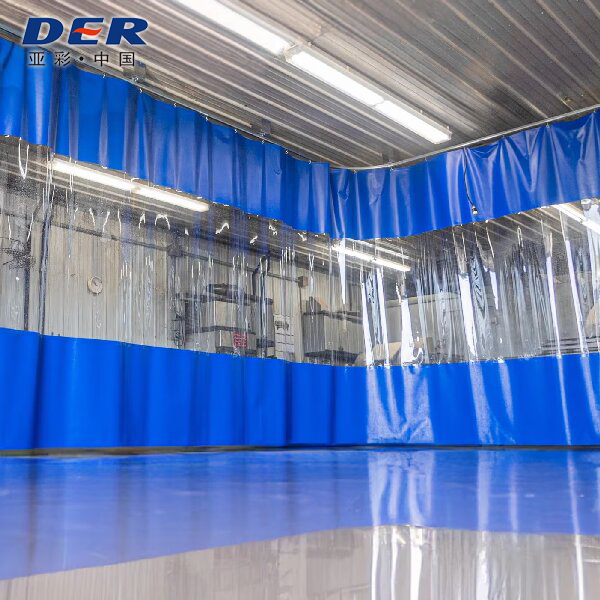
The direct answer
A suitable tarp curtain combines a compatible, water-resistant material with reinforced hanging points, sound seams and controlled edges. Reinforced PVC-coated polyester is a practical starting point for reusable wash bay curtains; clear PVC can provide observation windows. Final selection depends on the cleaning solution, water temperature, spray exposure and opening frequency.
The curtain intercepts splash and overspray. Runoff still needs a floor-level collection and recovery plan. An ordinary free-hanging tarp cannot establish a sealed wastewater containment system.
For wider factory separation needs, see DERFLEX industrial curtain materials and configurations.
Follow the water path
Design the curtain, floor and recovery equipment as a coordinated system. A waterproof curtain face can stop droplets while water escapes under an open hem, through an entrance or around a corner.
Locate side returns, viewing bands and closures around the expected spray envelope. Consider rebound from wheels, underbodies and irregular equipment surfaces.
Coordinate the curtain skirt with a suitable pad, curb, berm or collection floor. A sweep reduces a gap; it is not automatically a liquid-tight seal.
Plan vacuum or pump recovery, collection volume, sediment handling and an approved destination. Size recovery around active washer flow and any other inflows.
Check the local discharge route. For example, Portland's pressure washing guidance requires keeping wash water out of its stormwater system and obtaining authorization for sanitary-sewer discharge. This is a local example, not a universal disposal rule. Read the municipal guidance and confirm requirements with the authority for your site.
Material decision
Select the body for mechanical durability and chemical compatibility, then add transparency where observation is needed. Weight alone does not establish washdown suitability.
| Material | Useful role | Procurement advantage | Approval questions |
|---|---|---|---|
| PVC-coated polyester | Reusable opaque body, upper reinforcement and lower splash zone | Woven reinforcement, cleanable coating and welded fabrication options | Confirm cleaner compatibility, coating adhesion, flexing, wet service and seam behavior. |
| Clear flexible PVC | Observation bands or transparent panels | Line of sight without leaving a permanent opening | Check thickness, haze, scratching, hot-water exposure and attachment to reinforced sections. |
| Laminated PVC fabric | A candidate where handling and exposure are less demanding | Can offer a practical balance of weight and cost | Evaluate the actual laminate bond and repeated wet-flex performance; manufacturing route alone is not a pass or fail. |
| Woven PE tarp | Short-duration screening where an approved sample meets the duty | Light handling and potentially lower initial cost | Check eyelet tear-out, folds, wet seams and replacement frequency before repeated wash bay use. |
| Canvas or porous textile | Only where the coating and cleaning specification support wet service | May suit other protection tasks | Do not assume uncoated fabric provides an impermeable, easily decontaminated wet boundary. |
| Rigid washable panels | Fixed bays with a need for a more stable boundary | Less panel movement and defined fixed joints | Review access, joint sealing, cleaner compatibility, impact and installation cost. |
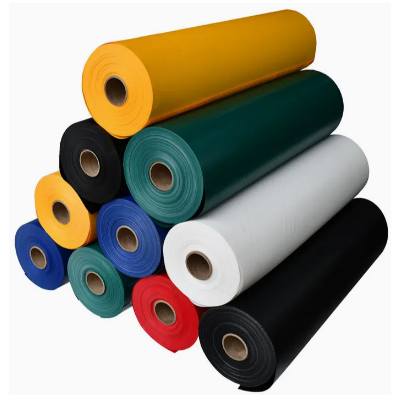
For converters purchasing roll material, DERFLEX's PVC coated polyester fabric range provides the starting point for comparing construction, width and fabrication options.
A specification you can quote
DERFLEX publishes a 650–1200 gsm direction for heavy-duty PVC curtain fabric. This is a general material range, not a validated pressure washing rating. The approved formulation, window material and finished panel require their own confirmation.
| Item | Published direction or available discussion | What to put in the order |
|---|---|---|
| Opaque body | PVC-coated polyester; heavy-duty curtain range 650–1200 gsm | Approved construction, target GSM and agreed tolerance; specify the minimum required mechanical performance. |
| Roll width | Published curtain material direction up to 5.1 m | Confirm width availability for the selected construction, panel layout and seam locations. |
| Clear sections | Published clear PVC range 0.20–1.00 mm | Select thickness and clarity by sample; define viewing height and welded or supported interfaces. |
| Finish and color | Glossy, matte or lacquered material directions | Approved reference sample; verify cleaning behavior and printing compatibility where needed. |
| Temperature | Project-specific confirmation required for wet exposure | Ambient conditions, water temperature, contact duration and any steam exposure. A generic temperature range does not approve hot washdown. |
| Chemical exposure | Confirmation with DERFLEX for the required formulation | Cleaner name/SDS, dilution, contaminants, splash or soaking, rinse process and acceptance criteria. |
| Panel construction | Welds, reinforced hems, eyelets, webbing, pockets and custom details can be discussed | Drawing showing seams, overlaps, windows, attachment positions and replaceable sections. |
| Fire performance | Options subject to exact material and documentation review | Name the project-required test and request a matching report. Opaque body and clear sections need review. |
| Commercial scope | Roll goods, cut panels, finished curtain directions and OEM supply | Quantity, destination, packaging and supply boundary. Confirm MOQ, sample terms and lead time in the quotation. |
Published material ranges are references, not a recommended setting for every wash bay. See DERFLEX's heavy-duty curtain fabric specifications; confirm the order-specific data before approval.
Service conditions
Pump pressure does not define the load on a curtain. Nozzle pattern, distance, angle, flow, temperature and repeated exposure affect the way spray reaches the material. Ordinary tarp curtains should be positioned for splash interception, not treated as direct-jet safety shields.
“Chemical resistant PVC” is too broad to approve a wash bay. A diluted detergent, a concentrated degreaser and oily runoff present different conditions. Identify the actual mixture and assess the coating, clear film, welds, closure components and hardware together.
Agree a representative exposure and cleaning trial. Look for tackiness, swelling, loss of clarity, surface change, cracking, delamination and seam deterioration. A spot check is a screening step; it does not establish a guaranteed service life.
Measure or define the water conditions where the curtain is exposed. A material's published ambient temperature direction does not prove resistance to repeated hot water or steam.
Construction details
The top edge carries the curtain, side closures limit spray escape, and the bottom interface directs runoff. Each detail should match the operating movement and water path.
Define the approved top hem, webbing, eyelets or sleeve around the chosen hardware. Check the complete load, movement and support spacing with the hardware supplier.
Weld compatible PVC materials with a process validated on the selected coating and window film. Confirm seam integrity after wetting and flexing; do not specify weld settings from fabric weight alone.
Plan overlaps or returns toward the wet zone. Hook-and-loop or zipper details can support access, but require evaluation for spray leakage and chemical cleaning.
A removable skirt can simplify maintenance. Weighted hems can limit movement. Neither detail, by itself, makes the floor boundary liquid-tight.
Set viewing height around workers and equipment. Keep the suspension load in reinforced sections where practical and avoid placing vulnerable window seams in a concentrated spray path.
Consider replaceable lower panels and documented panel IDs so worn splash zones can be renewed without replacing the entire enclosure.
Compare clear flexible PVC material options when developing the viewing section; transparency does not establish chemical, impact or hot-water suitability.
Fit, access and handling
Use a fixed layout where wet-zone separation is persistent. Use retractable panels where vehicle or machine access must reopen the bay, with enough parking space for the stacked curtain and a repeatable closure procedure.
| Application | Layout to consider | Priority details | Confirm before purchasing |
|---|---|---|---|
| Vehicle detailing bay | Retractable sides with reinforced opaque lower sections and clear viewing band | Frequent access, runoff at entry and curtain stacking | Detergent exposure, vehicle clearances and how the entrance closes before washing. |
| Heavy equipment washdown | Modular reinforced panels around a separately designed collection floor | Rebounding water, grit, grease and replaceable lower sections | Actual contamination, collection capacity, spray envelope and hardware corrosion suitability. |
| Workshop maintenance cell | Fixed returns with a defined movable entrance | Protection of neighboring work areas without blocking exits | Cleaner compatibility, visibility, ventilation and available support structure. |
| Outdoor or temporary wash area | Supported curtain panels with a separate portable containment plan | Wind, anchorage, UV exposure and recovered water | Site wind design, frame stability and curtain restraint. Added GSM is not a wind rating. |
| Sanitation-sensitive process area | Only a construction accepted for the facility's cleaning protocol | Accessible joints, inspection and drying | Sanitizer exposure and required hygiene documentation. Generic PVC is not a food-contact approval. |
Finished body drop = suspension-line height − hardware drop − specified floor clearance. Define any skirt extension separately. Measure along the intended track path, then agree fullness, overlaps, corner returns and stacking allowance with the fabricator.
Provide ceiling and floor levels, columns, doors and the full equipment travel envelope. A nominal bay size is not a finished panel drawing.
Illustrative body only: a flat 10 m × 3 m panel at 650 gsm weighs approximately 19.5 kg; at 900 gsm it weighs approximately 27 kg.
Windows, hems, additional material, weights and hardware change the total. These examples are not track ratings or suspension design values.
For broader track, fixed and modular planning, use the industrial curtain wall layout guide alongside this wet-service specification.
Real DERFLEX material references
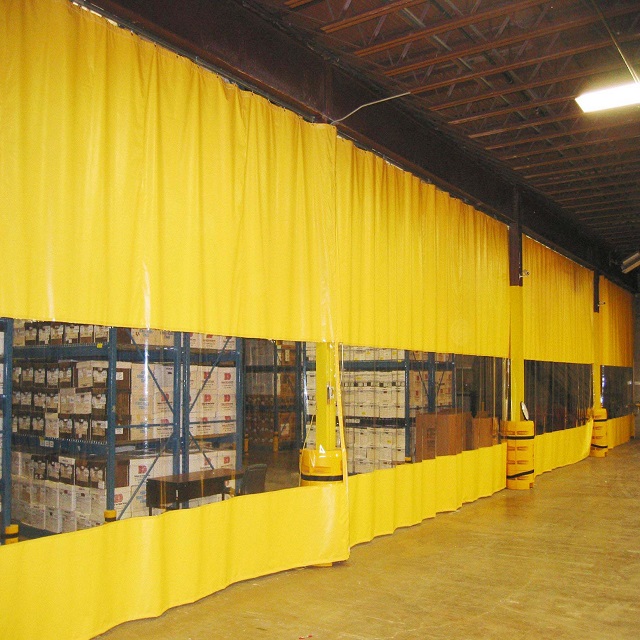
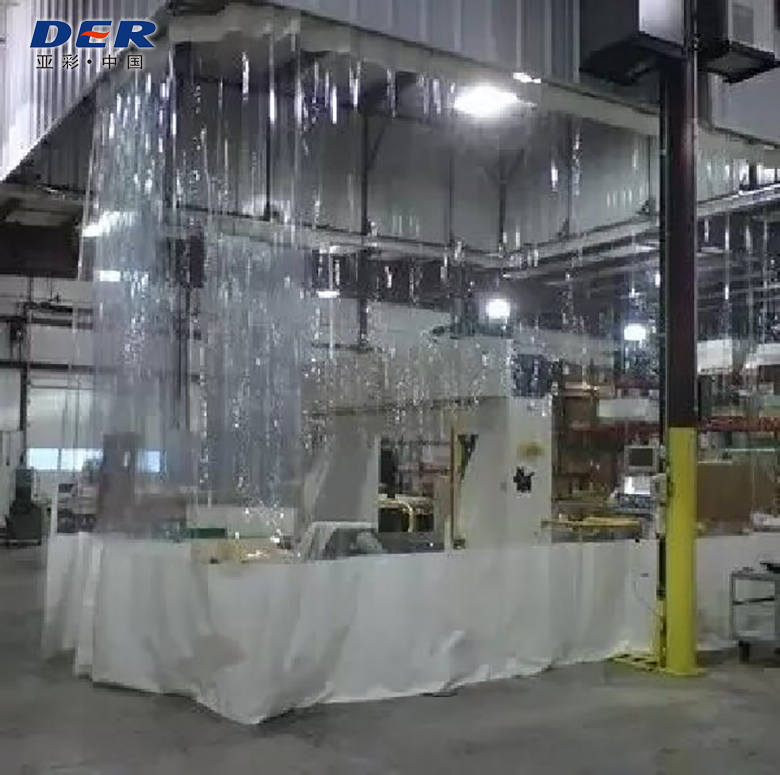
These existing DERFLEX images show industrial curtain layouts and coated-fabric supply. They support the material discussion; wash bay performance still requires project-specific approval.
Before production approval
Agree measurable acceptance criteria before the order. Material screening checks the construction; an installed wash trial checks the gaps, water path and everyday closure procedure.
Record body construction, window film, GSM or thickness, finish, color and the formulation reference. Include the required documentation and traceability.
Evaluate the approved cleaner and temperature against coating, clear sections, welds, reinforcement and closures. Agree tear, adhesion or seam tests with suitable methods when needed.
With the planned operating conditions, inspect dry-side wetting, corners, side joins, entrance and bottom interface. Confirm the collection and recovery arrangement keeps up with inflow.
Maintain the curtain with a compatible cleaning and drying procedure. Avoid directing a concentrated jet at seams or fittings. Follow the approved material-specific care instructions.
Review the DERFLEX material quality-control process and agree which evidence is required for your order.
Procurement pitfalls
Compare the coating, reinforcement, seams and compatibility. A heavier panel can add handling and suspension load without resolving a leaking edge.
Verify the water path at floor level. Small irregularities, open entrances and poorly placed skirts can bypass a good curtain body.
Request documentation for the exact construction and required standard. A flame-retardant textile is not automatically a fire-rated wall assembly.
Specify whether the quote covers roll material, fabricated curtains, suspension hardware, installation or floor recovery equipment. Do not assume every supplier provides the complete system.
DERFLEX supply discussion
DERFLEX's published offering includes PVC coated polyester fabric, clear PVC materials, custom material options and fabricated tarp directions. This supports a quotation discussion for wash bay curtain bodies and project-specific panels.
Discuss roll construction, GSM, width, surface finish and a representative weld trial before fixing the conversion process.
Submit the finished drawing, viewing-band position, edge details and wet-service conditions for material and fabrication review.
Agree panel identification, replacement specifications, labeling, packing and repeat-order references around approved samples.
Confirm finished-panel feasibility, hardware inclusion and commercial terms in the quotation. The fabric and curtain discussion does not imply supply of an engineered floor recovery system.
Make the inquiry useful
Send a layout sketch, finished dimensions, cleaner information and water conditions. State the required supply format, quantity and destination so the material recommendation and quotation use the same assumptions.
Ask DERFLEX to confirm material suitability, sample terms, MOQ, lead time, packing and the exact scope of supply.
Buyer questions
A properly specified curtain can intercept splash and overspray. Complete water containment also requires controlled seams, corners, entrances and a floor-level collection and recovery arrangement. A free-hanging curtain alone does not prevent runoff escaping.
Reinforced PVC-coated polyester is a practical starting point for an opaque reusable body, with clear PVC sections where observation is needed. Approve the actual formulation, seams and hardware for the cleaner, water temperature, spray conditions and handling cycle.
There is no universal thickness or GSM. Consider panel size, tear loads, movement, reinforcement, clear sections and exposure. DERFLEX publishes general heavy-duty curtain fabric and clear PVC ranges, but the project-specific construction needs confirmation before ordering.
Do not assume compatibility from the PVC name. Provide the cleaner or SDS, concentration, water temperature, exposure duration and rinse process. Request approval of the body, clear film, seams, closures and hardware; steam or aggressive chemical service may require another material or system.
Ordinary tarp curtains should be specified for splash interception, not as direct-jet safety shields. Nozzle pattern, distance, angle and flow affect exposure. If direct impact protection is required, specify a purpose-designed guard and validate it for the process.
Send the bay drawing, finished dimensions, fixed or retractable layout, viewing panels, top and bottom details, cleaner/SDS, water temperature and spray conditions. Add the collection plan, supply format, quantity, destination and required documentation. Ask the supplier to confirm material suitability and commercial terms.
Start with the , bay drawing
Send dimensions, cleaner information, water conditions and panel details. DERFLEX can discuss the coated fabric, clear sections and custom fabrication direction for your procurement brief.