



Blackout Tent Fabric for Event Roofs and Glamping Rooms
For an event hall roof or a glamping sleeping zone, blockout performance depends on the full membrane construction—not the color of its surface. DERFLEX helps tent converters and project buyers define opaque PVC coated polyester fabric, compatible welding and Keder interfaces, and a measurable sample-acceptance plan before committing to production.
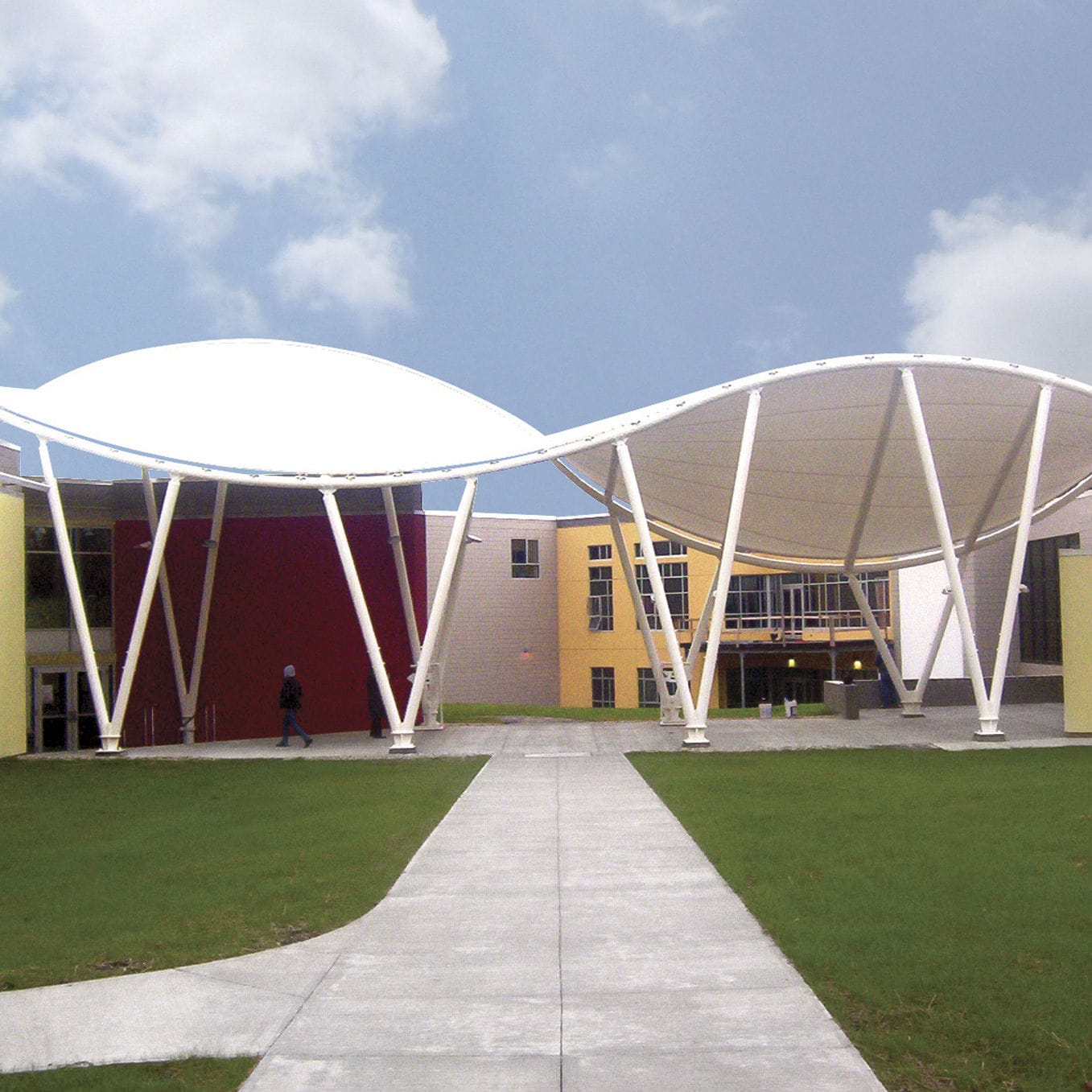
Blackout is a tested construction, not a paint colour
A blackout tent fabric is a flexible membrane selected to prevent or limit visible light transmission across its main surface. Its performance must be defined at the chosen construction and test conditions.
What the original PVC membrane page already established
DERFLEX's existing membrane range covers polyester-reinforced PVC coated fabrics, architectural canopies, awnings, membrane tents and project-dependent surface treatments. That background remains relevant to a roof-cover buyer, but a membrane advertised as “100% blockout” needs additional construction and inspection evidence.
Product weight across the wider PVC membrane family is not a guarantee of opacity. A heavier translucent fabric can still admit light; a purpose-built opaque layer can change that result independently of GSM. Specify the actual construction, not an inferred property.
For the broader range, compare Tent fabric collection and Tent membrane fabric before finalising an opaque roof grade.
Illustrative only. Layer order and the presence of any black or opaque interlayer must be confirmed for the offered sample.
A black/white face combination, black-core design and other opaque constructions should only be described after verifying the actual grade.
| Term in a specification | What it does mean | What it does not establish |
|---|---|---|
| White / ivory face | A visible surface colour | No automatic guarantee of blockout or reduced heat gain |
| Opaque / blockout | An intended very low light-transmission direction | No universal test result without stated method and condition |
| Black interlayer / black-white build | A possible construction route if confirmed on the sample | Not a default assumption for every DERFLEX membrane |
| PVDF / lacquer finish | Potential cleaning and surface-weathering direction | Not an opacity layer or proof of light-control performance |
Buying principle: define a target for visible-light transmission or an agreed practical blackout observation. Then approve the exact finish, seam construction and batch acceptance approach. Do not substitute colour names or marketing claims for inspection.
Where light blocking matters—and where it does not
A commercial tent is made of several functional zones. Roof, sidewalls, sleep partitions and window panels often need different optical and mechanical requirements.
| Tent component | Selection direction | Critical interface / acceptance question |
|---|---|---|
| Main marquee roof | Blockout or translucent roof according to event function, ambience and daylight policy | Are the roof panel, overlaps and ridge details also light controlled? |
| Glamping sleeping-zone outer shell | Opaque roof and privacy-oriented wall material may be preferred | Are door curtains, ventilation penetrations and panoramic windows separately shaded? |
| Dome cover | Curved panel shape with confirmed coating stretch, welding and optical requirements | Can a shaped sample maintain dimensional fit while preserving seam opacity? |
| Gable / perimeter wall | Privacy, appearance and optional selective light transmission | Does a bright roof require a darker wall or internal liner? |
| Transparent window insert | Clear PVC or separate glazing component; not a blockout membrane | How will privacy shade, weld transition and light spill be managed? |
| Keder replacement edge | Reinforced weld flap and cord designed for the existing rail | Will track fit, cord offset and edge strength be trial-fitted? |
For window material, see Transparent PVC tent panels; for a replacement rail interface, use the Keder replacement panels geometry and fit checklist. Those are separate components, not properties automatically included with an opaque roll.
Roof, sidewall and sleeping-zone priorities
Match the required atmosphere to the membrane and the surrounding design. Darkness, privacy and climate comfort are three related but separate decisions.
Control stage lighting
An opaque roof may limit unwanted daylight during performances or presentations. Agree acceptable edge and joint leakage as well as fabric-panel transmittance.
Protect guest sleep
An opaque outer cover can support a darker sleep environment, but transparent façades, doors and interior blind details decide usable room darkness.
Manage complex seams
Curved panels introduce multiple welded boundaries, vents and attachment points. Confirm that fabrication leaves no pinholes or uncovered seams.
A resort dome is a complete hospitality enclosure, not merely a dark fabric skin. Review Glamping dome tent systems for room planning, ventilation and insulation interfaces. For event use, cross-check finish and maintenance with Event tent fabric.
Four places an opaque membrane can still admit light
A roll sample may pass its light-transmission target while the finished canopy has bright lines or spots. Inspect the actual assembly after the converter has chosen weld type, overlap and attachments.
Inspect weld lines and overlapped edges against the agreed light source. Check any coating damage, pinholes, or narrow gaps created by a poor weld.
Inspect the covered flap, stitched or welded reinforcement, cord location and the rail edge. A blockout face does not hide an exposed gap beside the track.
Treat each transparent insert, zipper, doorway and blind interface as its own light-control detail. Define whether the adjacent room should be darkened.
Check vent collars, electrical service entries, fastener holes, edge patches and replacement-panel joins. Record the repair procedure as part of the specification.
Hot-air or high-frequency welding needs a coupon test on the actual coating/finish combination, with equipment settings recorded by the converter. For panel supply, PVC fabric for tent workshops explains the distinction between fabric rolls, welded panels and a complete installed system.
A sample approval record that purchasing can repeat
Do not accept an undefined “100%” claim on a catalogue alone. Tie opacity to an approved specimen, a stated light source and a consistent method used for incoming quality review.
| Approval field | Information to record | Why it matters |
|---|---|---|
| Optical target | Maximum transmittance or pass/fail visual criterion, illumination, distance and specimen setup | Makes “blackout” comparable between lots and assemblies |
| Construction | Face colours, coating system, polyester base and any confirmed opaque interlayer | Allows reproduction of the approved grade |
| Physical data | Nominal mass and tolerance; separately measured thickness; width and roll length | Prevents a GSM figure from standing in for thickness or strength |
| Mechanical data | Warp/weft tensile and tear tests with methods and units | Supports relevant roof tension and handling checks |
| Fire documentation | Destination requirement, material grade and actual test report scope | Prevents a general flame-retardant claim from replacing project documentation |
| Fabrication trial | Seam peel or strength test, water tightness, visible-light leakage and Keder trial fit | Checks the finished component, not just the base cloth |
| Reference sample | Signed coupon, colour reference, code, revision and traceable batch number | Supports repeat-order and incoming inspection |
Practical optical check: if measured illuminance is used, define the detector arrangement, ambient-light exclusion and incident-light level before calculating a comparison. A simple torch photo is a useful screening observation, not a universal certified transmittance report.
Before you order
- Share roof and wall drawings with joint positions, visible interior surfaces and all window locations.
- Specify whether you need roll goods, cut panels or a Keder-ready replacement section; frame and installation engineering are separate.
- Confirm the destination's applicable fire and building documentation with the responsible authority; request material-specific evidence.
- Approve a small trial assembly if darkness or a difficult seam geometry is a contractual requirement.
See the membrane in structural context
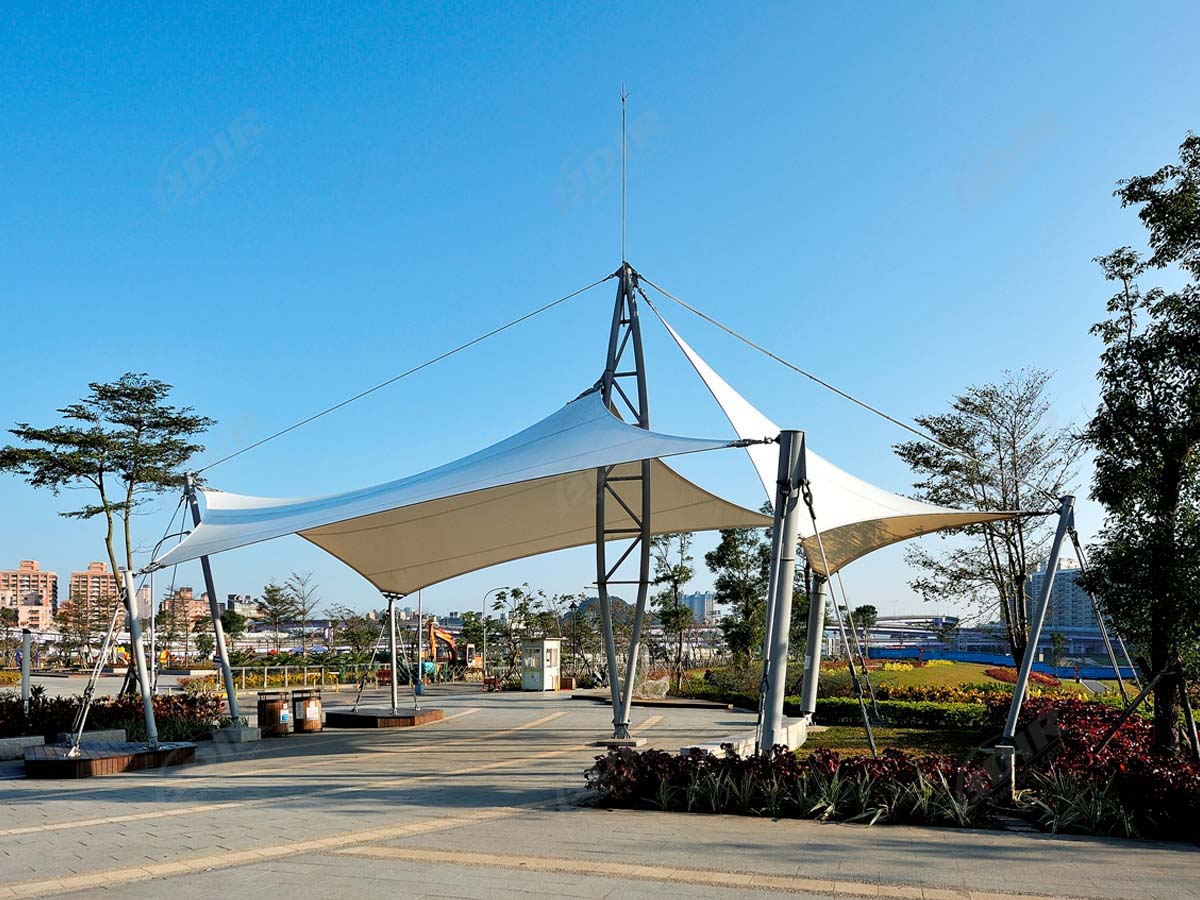
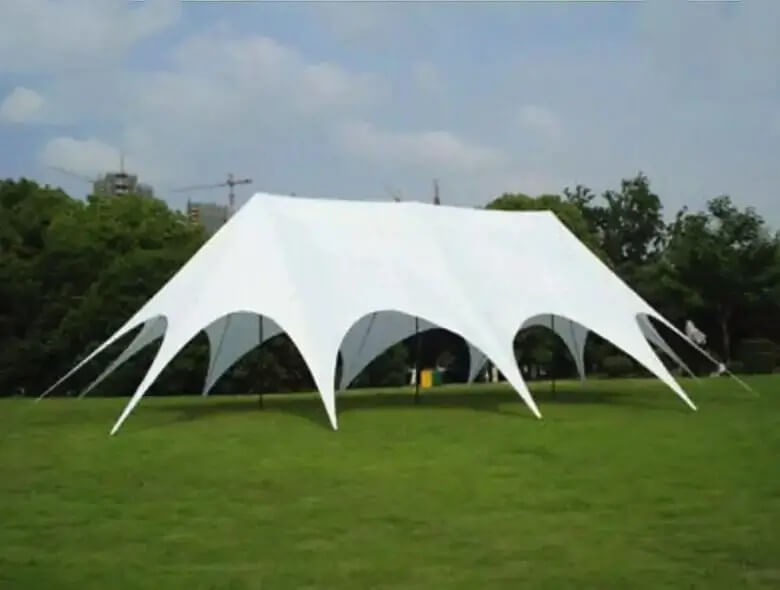
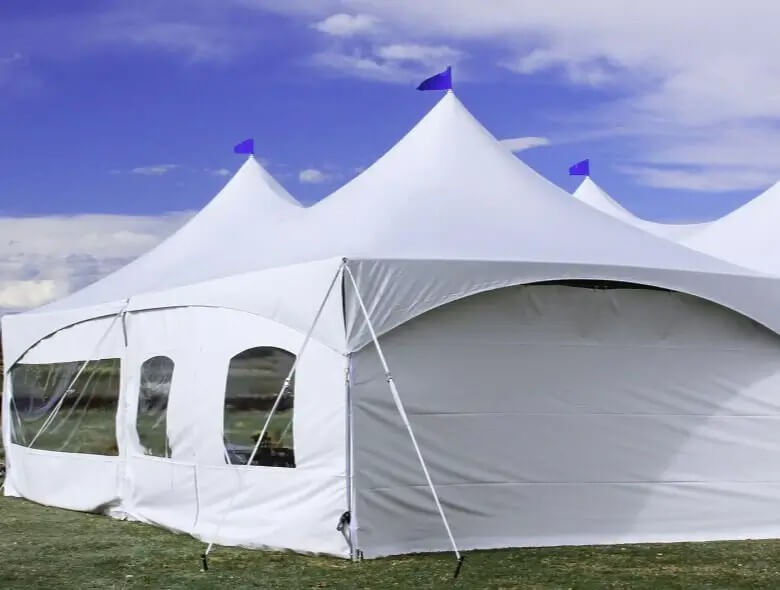
These are DERFLEX-published photographs of architectural membrane and marquee configurations. They show possible application forms—not a measured blockout grade or a documented glamping installation.
Related material and conversion options
Frequently asked questions
Answers to practical specification, fabrication and ordering questions.
Does white PVC tent fabric automatically block all light?
No. White describes the visible surface colour, not visible-light transmittance. A white translucent fabric can pass substantial daylight. Request a defined opaque construction and verify the finished sample.
Is blackout tent fabric the same as thermal insulation?
No. Blocking visible light does not establish thermal resistance or a cooler interior. Solar heat gain also depends on colour, solar reflectance, air gap, ventilation, lining and local climate.
How should a buyer verify a 100% blockout claim?
Agree a measurement method and illumination condition, test the approved membrane coupon, and inspect welded seams, windows and edge transitions. Record the result and acceptable tolerance before bulk production.
Can blackout PVC material be used with Keder tent panels?
Potentially, provided the selected coating, weld, reinforced flap, cord diameter and track interface are compatible. Check the complete assembled panel against an existing track or approved drawing.
Can a transparent window be added to a blackout sidewall?
Yes as a design approach, but the window interrupts the opaque surface. Define window position, privacy treatment, weld overlap and expected light leakage around the transition separately.
What information is needed for a bulk fabric quote?
Provide the end use, required light transmission or visual blackout test, face colours, preferred construction, GSM and tolerance, roll width, welding method, panel or Keder details, quantity and destination requirements.
Make the light-control requirement measurable.
Send the intended roof or sleeping-zone use, opacity target, colour, construction preference, nominal GSM, fabrication route, panel geometry and destination fire standard. DERFLEX can review the fabric direction and sample-validation scope before an order is agreed.