



850gsm PVC Tent Fabric for Commercial Roof Covers
850gsm is a nominal fabric weight, not a complete engineering specification. For marquee manufacturers, shelter converters and rental fleets, DERFLEX helps define polyester base cloth, PVC coating balance, surface finish, usable width, weldability and the test evidence needed before a heavy commercial roof fabric is approved. The published 0.65mm reference must be checked independently for the selected construction.
The weight identifies a category; the structure defines performance
850 grams per square metre (approximately 25.07 oz/yd²) specifies nominal areal mass. It does not by itself specify thickness, tear strength, coating adhesion, or whether a finished roof is suitable for a particular span.
What belongs in a complete construction code
A purchasing specification should identify polyester yarn, weave or thread density, coated vs laminated construction, the relative coating layers, intended weathering finish, and test procedures for each measurable property. Two fabrics with the same finished mass can distribute material differently between reinforcement and PVC.
Thickness must be measured by an agreed method on the actual production grade. The 0.65mm reference associated with this sourcing topic is a separate catalogue reference, not a physical rule that converts 850gsm into millimetres.
For alternative constructions, review PVC tent fabric material and the wider Tent fabric collection family.
Quick buying answer
Use 850gsm when the designer or converter calls for that mass class, then confirm thickness, warp/weft strength, coating adhesion, finish and welding as separate acceptance fields. Reject any specification that treats GSM alone as a mechanical guarantee.
| Specification field | Initial direction | Required purchasing confirmation |
|---|---|---|
| Nominal fabric weight | 850 g/m² = about 25.07 oz/yd² | Allowed manufacturing tolerance and test method |
| Thickness | 0.65 mm appears as a reference in the project brief | Measured nominal thickness and tolerance for the same approved grade |
| Base textile | Polyester reinforcement within PVC coated fabric | Yarn denier, weave/density and warp/weft strength |
| Coating system | Coated or laminated PVC construction by offered grade | Coating balance, adhesion and surface integrity |
| Finish | Gloss, matte or relevant easy-clean treatment by grade | Finish type, colour standard, weld compatibility and weathering evidence |
| Width and roll | Project manufacturing parameters | Usable width, roll length, edge allowance and roll packing |
| Compliance | Country- and project-dependent | Actual report scope, applicable test method and grade identification |
The values above distinguish a requested nominal category from fields that must be confirmed on a model-specific technical data sheet. No unverified strength, fire-class or service-life figures are asserted.
A side-by-side commercial roof-fabric decision
DERFLEX already has a dedicated 750gsm tent material page. This page exists to help buyers specify an 850gsm requirement without duplicating general 750gsm content.
| Decision factor | 750gsm programme | 850gsm programme |
|---|---|---|
| Nominal mass | 750 g/m², roughly 22.12 oz/yd² | 850 g/m², roughly 25.07 oz/yd² |
| Mass on 100 m² of uncut sheet | About 75 kg, arithmetic only | About 85 kg, arithmetic only |
| Handling and transport | Potentially lower areal weight | 10 kg more per 100 m² before seams, waste or packaging |
| Tensile / tear strength | Must use grade-specific tested warp/weft results | Must use grade-specific tested warp/weft results |
| Thickness | Not derived from GSM | Not derived from GSM; 0.65 mm needs a direct check |
| Best selection basis | Approved system design and service cycle | Approved system design and service cycle |
Compare the existing 750gsm PVC tent fabric page before upgrading a specification. Even if an 850gsm trial is heavier, the converter should still compare actual fabric stiffness, cleanability, weld response, finished cover weight and structural-engineer requirements. This is not a statement that the heavier sheet is universally stronger.
Strength is in the reinforcement
Specify yarn, density and warp/weft tensile or tear figures. Material weight does not describe how much load the woven polyester can carry.
Protection and fabrication
Coating uniformity, adhesion, waterproof behavior and surface finish can affect weld durability and maintenance.
Repeatable production
An accepted width, GSM range, measured thickness and colour tolerance is more useful than an isolated nominal product label.
Specify each part of the tent envelope
850gsm may be considered for roof cover systems that require a substantial coated fabric, but it is not automatically the most economical or practical choice for every wall, door or removable panel.
| Component | When to evaluate 850gsm | What to check before approval |
|---|---|---|
| Main roof slopes | Designer calls for this mass class or heavy-duty handling programme | Support spacing, tension, drainage, wind-load design and fabrication geometry |
| Gable and fascia | Appearance and reinforcement need match the roof | Compatibility of colour, finish, stiffness and edge details |
| Roll-up / removable sidewall | High-wear use, only if roll-up equipment can handle the mass | Flexibility, operating force, seam layout and hardware limits |
| Clear-view window | Use a separate clear material, not opaque 850gsm sheet | Window clarity, join method, panel dimension and fold cycles |
| Keder replacement roof | Rail-attached system with matching membrane and reinforcement | Cord profile, weld flap, pattern geometry and trial fit |
Use Keder replacement panels for panel dimensions and attachment details, and Transparent PVC tent panels for transparent window requirements. Project architects should approve structural loads and drainage independently of a roll-material supplier.
A clean surface must still make a reliable seam
Matte, gloss and weathering finishes affect appearance and maintenance. They may also affect how coating layers respond to hot-air or high-frequency welding. Confirm the specific topcoat, then test it.
Supply a coupon from the exact 850gsm candidate and weld with the intended equipment, nozzle or die, overlap and pressure. Record the successful converter settings.
Compare seam appearance, water tightness and relevant peel/strength results. Do not infer the seam result from unjoined fabric tensile data.
Approve face and back colour, gloss level and cleaning behavior on a realistic sample; white-to-white batch matching matters for large roofs.
Confirm usable width, edge allowance, roll orientation, storage temperature and bend radius for the converter’s workflow.
Separate scopes: A PVC-coated fabric quotation is not a certification of a finished tent, steel frame, wind-load resistance or installed waterproof system. Welding, seam engineering, field assembly and site approvals must be included in the appropriate party's scope.
A practical first-order approval sequence
Ask for a defined grade, not an anonymous weight swatch. A small approval sequence reduces the chance that a purchase team and a workshop are evaluating different versions of “850gsm PVC tent fabric”.
Declare the intended roof
Share roof plan, panel size, quantity, destination and processing method. Record any specified GSM, thickness, tolerance and fire class.
Approve the exact material
Inspect a labeled sample for colour, coating appearance, mass, thickness and basic tear/strength evidence. Weld a trial with your production equipment.
Control repeat procurement
Record a grade code, sample reference, test-report scope, roll dimensions, packaging, approved tolerance and any agreed change-control method.
Before you order
- Ask for the specimen's actual gram weight, thickness and test method on the same grade.
- Request separate warp/weft tensile and tear values, coating adhesion, and flame documentation where required.
- For a roof replacement, supply an old-pattern drawing or accurate bay measurements; allow for weld and Keder interfaces.
- Clarify whether the quote is for fabric rolls, pre-cut material or fabricated panels. Do not assume frames, installation or engineering are included.
- Confirm packing, labels, sample approval and destination compliance before bulk scheduling.
Commercial tent and fabrication references
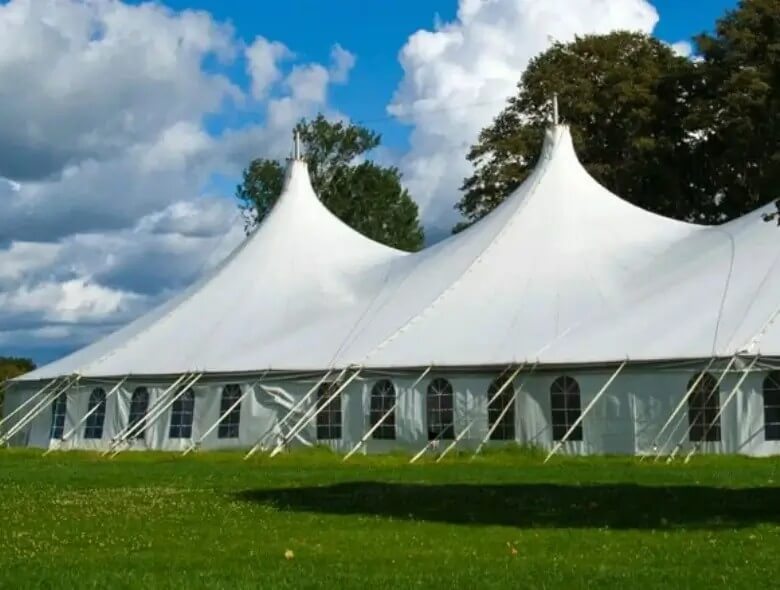
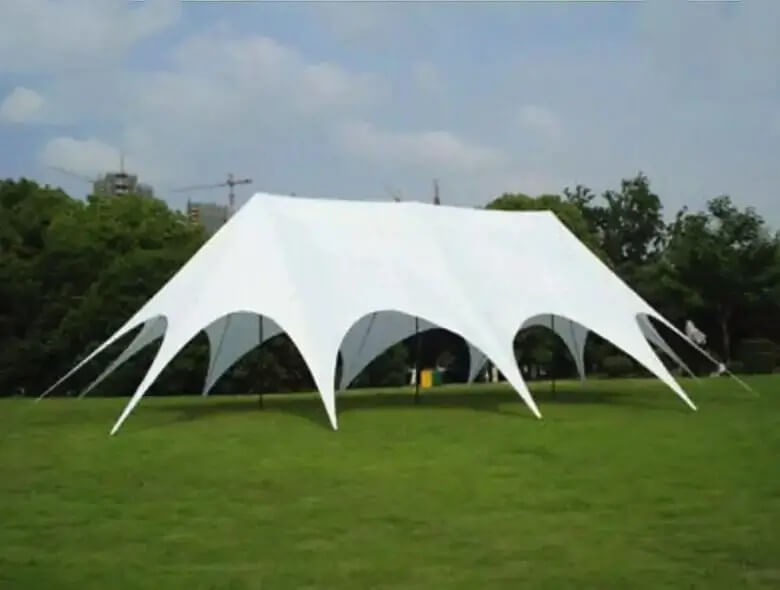
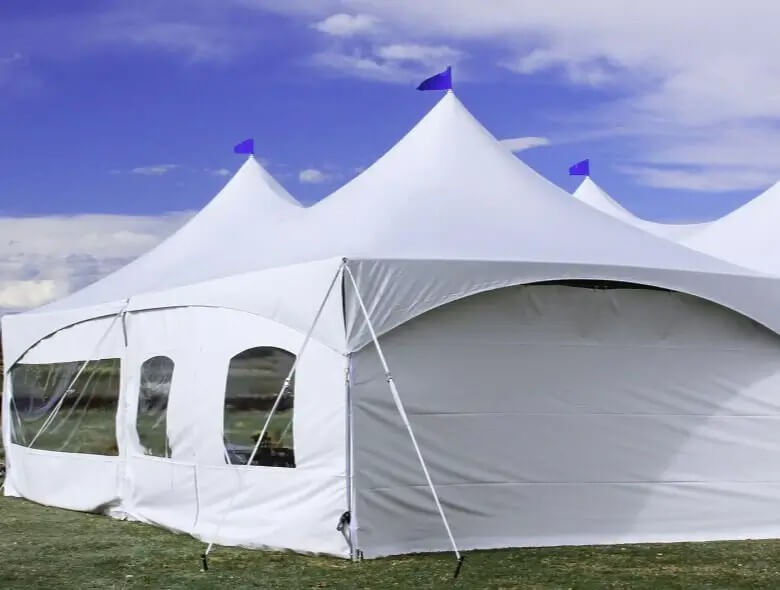
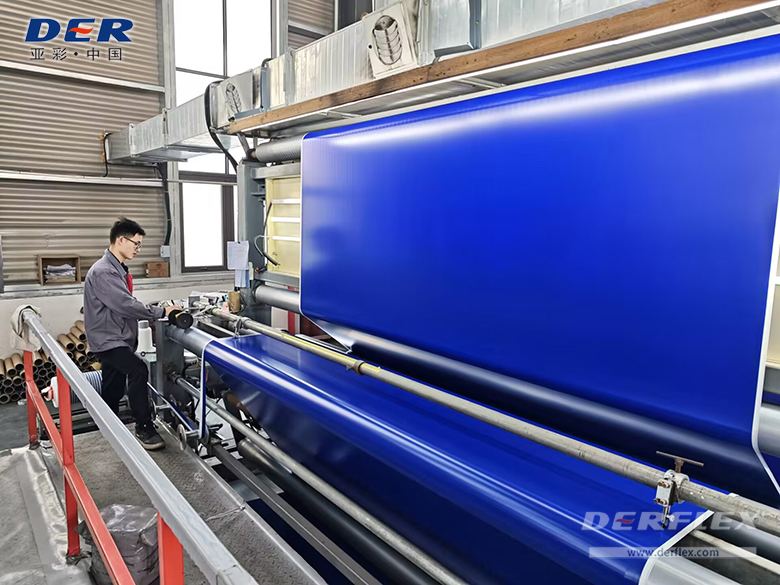
These published DERFLEX images illustrate tent applications and coated-fabric processing. They are not grade-specific laboratory evidence for 850gsm or for 0.65mm thickness.
Continue the technical review
Frequently asked questions
Answers to practical specification, fabrication and ordering questions.
Is 850gsm PVC tent fabric always 0.65mm thick?
No. GSM measures mass per unit area; millimetres measure thickness. An 850gsm construction may have a different thickness depending on yarn, coating and formulation. Specify and measure both independently.
Is 850gsm automatically stronger than 750gsm tent fabric?
No. Higher area weight alone does not prove higher tensile, tear or seam strength. Compare the actual base cloth, warp/weft test results, coating adhesion and construction under the same test methods.
Where is an 850gsm PVC tent membrane normally considered?
It can be considered for commercial marquee roofs, demanding tent-cover programmes, engineered shelters and replacement roofs where the additional mass is acceptable. Final use depends on frame design, loads, fabrication and local requirements.
Can the 850gsm tent fabric be hot-air or HF welded?
PVC-coated polyester is commonly converted using these methods, but compatibility depends on the chosen topcoat and equipment conditions. Approve weld coupons on the final material before specifying seam strength or production parameters.
Can DERFLEX supply flame-retardant or blockout versions?
These are project options to confirm against the exact construction and destination requirement. Request the applicable report and an opacity sample rather than assuming every 850gsm version has the same features.
What must a buyer approve before the first bulk roll order?
Approve weight and thickness tolerances, colour, finish, width, base fabric, tensile and tear data, coating adhesion, weld trial, relevant fire documentation, sample code, packaging and destination.
Request the 850gsm grade—not just a weight label.
Include your required 850gsm tolerance, independent thickness target, base-cloth construction, finish, width, colour, weld process, fire-documentation destination, yearly volume and preferred sample acceptance tests. DERFLEX can review the matching material and supply scope.