
Anchor Geometry
Begin with the real frame, rail, hook, trailer rub rail, equipment foot or ground anchor. Hardware positions should line up with usable anchors instead of forcing ropes to pull diagonally across the hem.



A strong tarp is not defined by fabric weight alone. The perimeter must transfer wind and tie-down force into the cover without concentrating stress at one eyelet, one corner or one row of stitching.
DERFLEX helps importers, tarp converters, fleet buyers and industrial projects coordinate finished size, anchor positions, tarp grommet spacing, reinforced hems, D-rings, webbing and straps as one fastening system. The result is a specification that is easier to approve, manufacture, install and repeat.
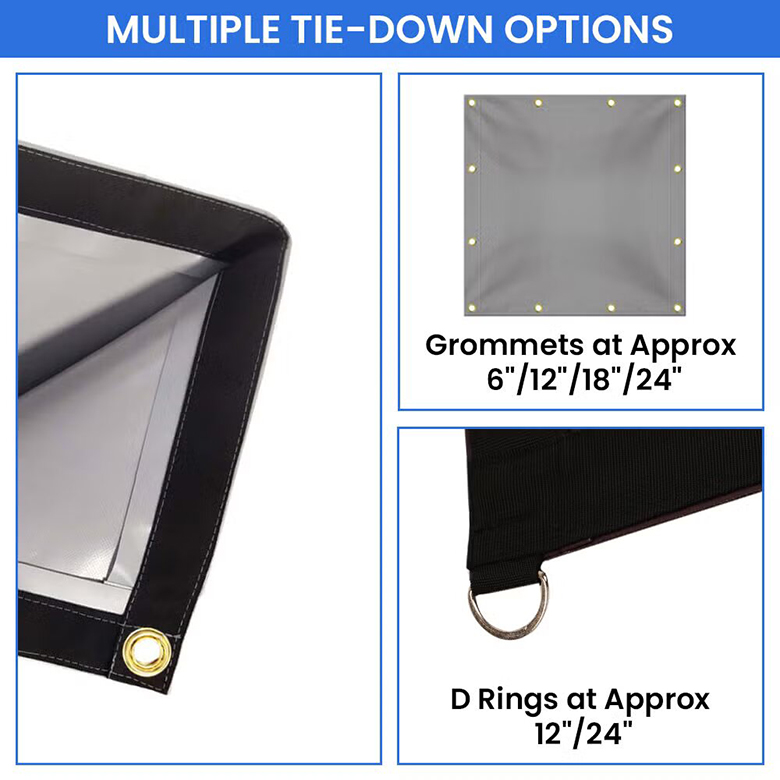
Grommets, D-rings and straps do not create strength by themselves. They only work when the tarp edge, reinforcement and anchor system distribute force in a controlled way.
Begin with the real frame, rail, hook, trailer rub rail, equipment foot or ground anchor. Hardware positions should line up with usable anchors instead of forcing ropes to pull diagonally across the hem.
Identify whether the force acts outward, downward, lengthwise or diagonally. D-rings and webbing patches should be oriented so the strongest stitched or welded area follows that direction.
Choose a folded hem, rope edge, perimeter webbing, double-layer strip or local patch according to tension, handling frequency and abrasion. More eyelets cannot compensate for a weak hem.
Rope, bungee, ratchet straps and fixed hooks load the tarp differently. A rigid system needs accurate fit and disciplined tension; an elastic system can absorb movement but still requires even load sharing.
Use closer grommet spacing when the cover needs more perimeter control, faces wind, follows an irregular shape or is attached to many fixed anchors. Use wider spacing only where exposure and pull are lower, or where D-rings, straps, pockets, lacing or continuous rails carry part of the load. Always strengthen corners and high-wear zones independently from the regular edge pattern.
The values below are specification starting points rather than universal rules. Finished size, panel area, fabric structure, exposure, corner loading and actual anchor positions may justify a different layout.
Useful for exposed edges, irregular equipment, large panels and frequent tension adjustment. Requires dependable hem reinforcement and enough anchors to use the added points.
Often practical for truck tarps, construction covers, temporary enclosures and covers that are opened, removed or retensioned regularly.
Suitable for many equipment covers, storage tarps and moderate outdoor installations where anchor positions and edge flutter remain controlled.
Consider for sheltered, temporary or low-tension covers, particularly where another system such as pockets, battens or lacing supports the edge.
| Use Condition | Typical Spacing Direction | Recommended Edge Construction | Fixing Method | Important Check |
|---|---|---|---|---|
| Sheltered storage or short-term cover | 24–36 in, subject to anchor layout | Folded or welded hem; corner reinforcement where tied | Rope, light bungee or clips | Avoid large unsupported edge sections that can flap. |
| General equipment cover | 18–24 in | Double-fold hem or perimeter webbing; local wear patches | Rope, hooks, webbing loops or selected D-rings | Match hardware to the machine frame and access points. |
| Truck, trailer or frequently handled cover | 12–18 in or drawing-based | Webbing-reinforced hem, reinforced corners and wear zones | Rubber straps, hooks, D-rings, buckles or mixed system | Allow for dynamic wind, vibration and repeated folding. |
| Large construction or temporary enclosure | 12–24 in depending on bay and wind exposure | Wide reinforcement strip, rope hem, webbing or batten pockets | Lacing, frame hooks, straps, rails or pockets | Engineering review may be needed for large tensioned surfaces. |
| Custom load with fixed anchor pattern | Exact centre-to-centre drawing | Local patches designed around each force direction | D-rings, straps, buckles, loops or custom tabs | Do not force a standard spacing onto a non-standard frame. |
A reinforced edge should spread force into a wider part of the fabric, protect cut edges and withstand the way the cover is installed, pulled and stored.
A clean perimeter fold increases thickness around eyelets and protects the cut fabric edge. Suitable PVC structures can be hot-air or high-frequency welded; sewn hems may be selected for mixed materials or specific fabrication requirements.
Polyester or other suitable webbing can spread tie-down force along the edge and create a stable base for grommets, D-rings, loops or straps. Webbing width, stitch pattern and overlap should be specified.
A rope enclosed in the hem can add body to the perimeter, support lacing and help reduce sharp folding at the edge. The rope material and hem closure should suit the use environment.
An additional strip of compatible tarp fabric can strengthen the complete perimeter or a selected section. Layer width should be sufficient to spread force beyond the eyelet washer or hardware patch.
Corners often carry diagonal forces from two edges at once. A larger patch, radius detail, extra webbing or corner D-ring can be more useful than simply adding another eyelet close to the corner.
Local abrasion may occur where the tarp contacts a rail, sharp cargo corner, frame, roller or ground. A removable pad, sleeve or sacrificial patch can solve the actual wear point without making the whole tarp unnecessarily heavy.
The correct fixing method depends on the connector, the force direction, installation speed and how often the tarp is removed. Many custom covers use two or more methods in different zones.
Compact holes for rope, hook or bungee connections. They work well when the pull is aligned and distributed across several points.
Confirm: inside diameter, metal type, washer construction, centre-to-centre spacing, edge offset and reinforcement layer.
D-rings create a defined connection for hooks, straps and buckles and can be mounted on webbing tabs or continuous reinforced rows.
Confirm: ring size, material or finish, tab length, webbing width, row height, pull angle and stitch or weld pattern.
Integrated straps simplify installation where a separate rope is inconvenient. They may use buckles, hook-and-loop closures, cam buckles or project-specific hardware.
Confirm: strap length, adjustment range, free-end direction, buckle type, abrasion exposure and replacement method.
Soft loops reduce metal contact and can accept hooks, rails, poles or rope. They are useful when hardware noise, scratching or corrosion risk needs attention.
Confirm: loop opening, webbing strength direction, stitch length, spacing and whether the loop must lie flat.
Continuous pockets can receive battens, poles, cables or weighted bars and spread force across a wider edge than individual eyelets.
Confirm: clear opening, finished diameter, drainage, access side, reinforcement and end closure.
A transport tarp may use grommets along the lower edge, D-rings in vertical rows, straps at flaps and reinforced loops at corners. Each zone can be designed around its task.
Confirm: a hardware map showing every row, spacing, height, orientation and connection method.
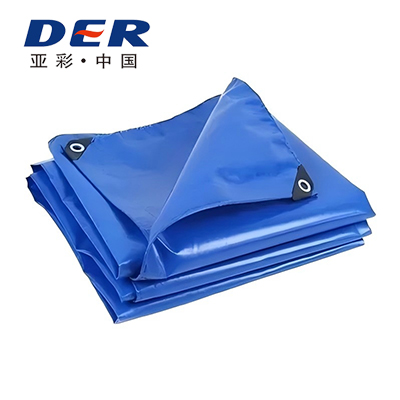
DERFLEX can supply PVC coated polyester tarp material, semi-finished panels or completed custom tarps. For finished products, the specification can cover fabric structure, colour, finished size, seam method, perimeter construction, corner patches, grommet location, D-ring rows, straps, webbing loops, pockets, printing and export packaging.
For B2B programs, the most useful starting document is a simple drawing showing finished dimensions and every fixing point. Photos of the frame, old cover or installation are also helpful. The drawing does not need to be complex, but it should distinguish corner points, regular spacing, special rows, access openings, seams and pull directions.
Field damage is often a specification clue. The location and shape of a tear can reveal whether the issue started with spacing, reinforcement, fit, tension, abrasion or hardware alignment.
The load may be concentrated at too few points, the edge reinforcement may be too narrow, the tie-down angle may be incorrect, or the anchor sequence may leave one eyelet carrying most of the force.
The corner is seeing combined load from two edges. Increase the patch area, radius the reinforcement, use a corner D-ring or redirect the tie-down so force enters the tarp more gradually.
Spacing may be too wide for the exposure, the cover may be oversized, or the anchor line may be too far from the edge. Add support only after checking fit and tensioning practice.
The webbing tab may be short, the stitch pattern may not follow the pull direction, or the ring may be loaded sideways. Review orientation, overlap and reinforcement under the tab.
A buckle, hook or strap edge may rub the coating during vibration. Reposition the connector, add a protective sleeve or use a local abrasion patch in the contact zone.
Metal selection should reflect salt, humidity, chemicals and outdoor exposure. Confirm material or plating before production and avoid mixing incompatible metals where corrosion could be accelerated.
A controlled approval process helps prevent vague phrases such as “standard grommets” or “reinforced edge” from producing different results across samples and repeat orders.
Record finished dimensions, frame or rail locations, corner positions, openings and every available tie-down point.
Show whether each point pulls down, outward, lengthwise or diagonally, and note cyclic or high-wind zones.
Confirm hem width, webbing, rope, double layer, corner patch and local wear reinforcement.
State grommet or ring size, material, spacing, row height, strap length, loop opening and orientation.
Check alignment, finished dimensions, stitching or welding, edge flatness, hardware seating and fit on the real anchor system.
Applications with wind, movement, irregular geometry or repeated installation benefit from a fastening plan based on actual use rather than a generic eyelet pattern.
| Application | Main Stress | Useful Hardware Direction | Reinforcement Focus |
|---|---|---|---|
| Truck and flatbed cargo covers | Dynamic wind, vibration, repeated folding and cargo abrasion | D-ring rows, grommets, rubber straps, buckles and webbing tabs | Lower perimeter, flap corners, cargo contact zones and rows under cyclic pull |
| Construction and temporary weather covers | Wind, irregular structures and changing installation points | Closer eyelets, lacing, rope hem, straps, pockets or frame hooks | Corners, overlaps, ridge or eave zones and large unsupported edges |
| Industrial equipment covers | Custom shape, access needs, sharp machine edges and local tie-downs | Selected D-rings, loops, straps, zippers, hook-and-loop and exact grommet positions | Machine corners, lift points, access flaps and hot or abrasive contact areas |
| Agricultural storage tarps | Large area, seasonal wind, ground anchoring and handling | Perimeter eyelets, webbing loops, rope edges and weighted sleeves | Ground contact edge, corners, ridge contact and high-pull anchor zones |
| Warehouse dividers and curtains | Suspension, sliding, repeated opening and controlled lower edge | Top grommets or rollers, side straps, bottom pockets and weighted hems | Top load line, pull handles, door openings and bottom wear zones |
| OEM replacement-cover programs | Fit consistency across many units and repeat orders | Drawing-controlled hardware map with fixed datum dimensions | Golden-sample control, dimensional tolerance and hardware batch consistency |
DERFLEX approaches a custom tarp as a finished system. Material structure, seam route, edge reinforcement and hardware layout are reviewed together so the approved specification is practical for production and field use.
Buyers can provide dimensions, drawings, photos, an old cover or a target sample. DERFLEX can help organize the request into material, finished-size, reinforcement and fixing details suitable for quotation and sampling.
For importers, distributors and branded tarp programs, the same edge and hardware details must remain clear after the first sample. Drawing revisions, approved samples, labels and packing information can be incorporated into a repeatable order specification.
These six internal resources connect the fastening plan with custom manufacturing, tarp strength, truck use, material weight and finished-size control.
Many commercial and custom tarps use spacing around 18 to 24 inches, while 12-inch and 36-inch directions are also common. There is no single spacing suitable for every tarp. Wind exposure, finished size, anchor layout, edge reinforcement, material structure and fixing method should be reviewed together.
No. Closer spacing can distribute load across more points only when the anchors are actually used and the hem is strong enough. Too many holes in weak material, uneven tie-down tension or poor anchor alignment can still produce early failure.
D-rings are useful when hooks, buckles or straps need a clear connection point, when the pull direction should be controlled, or when the hardware must sit away from the tarp edge. Grommets remain practical for rope, bungee and compact hook connections. A mixed system is often appropriate.
Corner reinforcement can include a larger fabric patch, cross-layered webbing, an enclosed rope edge, a corner D-ring or a custom tab. The patch should extend beyond the immediate hardware area and follow the diagonal force entering the corner.
Yes. Buyers can provide centre-to-centre positions, row heights, ring or eyelet dimensions, strap lengths and reinforcement details. Photos, frame drawings or an old sample can help confirm the actual installation.
Please provide the application, finished size, shape, quantity, material preference, colour, exposure conditions, anchor layout, preferred spacing, edge construction, hardware type, printing and packing requirements. A marked drawing or clear sketch usually improves quotation accuracy.
Send DERFLEX your finished dimensions, application photos, anchor positions and preferred hardware. We can review the material, edge reinforcement, grommet spacing, D-ring rows and strap arrangement for a custom sample or B2B production program.