News
Company News

Tarp Tensile Strength vs Tear Strength | DERFLEX Guide

Update:2026/8/1 18:24:29 Views:
Mechanical Performance Guide

Tarp Tensile Strength vs Tear Strength

Tensile strength shows how an intact tarp carries a broad pulling load. Tear strength shows how well it limits damage after a cut, puncture or edge split begins. A reliable industrial tarp specification needs both values, matched test methods and a finished-cover design that protects the load path.

The essential distinction

Two strength numbers answer two different failure questions

“Strong tarp” is not a single engineering category. A cover can resist a high uniform pull and still allow a small cut to spread. Another construction may control a tear well but lack the breaking load required for a large tensioned panel.

T

What is tarp tensile strength?

Tarp tensile strength, commonly reported as breaking strength or breaking force, measures the force an intact test specimen withstands while it is pulled in opposite directions until failure. It reflects the load-carrying contribution of the yarn, weave, coating integration and specimen direction.

  • Broad pulling force across undamaged material
  • Relevant to wind loading and tensioned installation
  • Usually reported separately in warp and weft directions
  • Often accompanied by elongation at break
R

What is tarp tear strength?

Tarp tear strength measures resistance to tear initiation or propagation under a defined specimen shape and test procedure. It represents localized damage behaviour: what happens when a nick, slit, puncture or edge defect concentrates force onto a small number of yarns.

  • Force concentrated around an existing defect
  • Relevant to cargo edges, snags and wind whip
  • Highly sensitive to the chosen tear test method
  • Influenced by yarn mobility as well as yarn strength
Practical rule: use tensile strength to judge the tarp before damage starts; use tear strength to judge how rapidly damage may grow after it starts. Then review seams, hems, webbing, corners and hardware because finished tarps often fail at interfaces rather than in the center of the sheet.
Side-by-side guide

Tensile strength vs tear strength: how buyers should read the data

The comparison below is designed for PVC coated polyester tarpaulin, vinyl tarp material and other reinforced tarp fabrics. Exact terminology and units depend on the referenced standard.

Decision point Tensile / breaking strength Tear strength Purchasing interpretation
Failure condition An intact strip or grabbed area is pulled until rupture. A cut or shaped specimen is loaded so a tear starts or continues. The values model different field failures and should not substitute for one another.
Main application question Can the sheet carry the expected distributed load? Can the sheet slow the spread of local damage? Large tensioned covers usually need high tensile capacity; sharp or abrasive environments also need strong tear behaviour.
Typical reporting Common formats include N/5 cm, N/50 mm, lbf/in or a force value tied to specimen width. Common formats include N or lbf, depending on tongue, trapezoid, pendulum or another method. Units alone are not enough. Confirm specimen width, geometry and test procedure.
Directional data Usually reported in warp/MD and weft/CD directions. Also directional; the tear path and cut orientation must be defined. Use the lower relevant directional value where load orientation is uncertain.
Primary material drivers Yarn tenacity, denier, weave density, yarn count, coating bond and fabric balance. Yarn strength, yarn mobility, weave architecture, coating stiffness, slit geometry and local stress concentration. A heavier or denser fabric may improve some properties without increasing every property proportionally.
Finished tarp weak points Seams, narrow necks, folds, attachment lines and areas with uneven pre-tension. Cut edges, punctures, grommet holes, corners, cargo contact points and abrasion damage. Material data should be paired with seam, hem and hardware design.
Best use in supplier comparison Screen material load capacity and dimensional reserve. Screen damage tolerance and rip-propagation reserve. Compare matched test reports or identified samples—not isolated catalogue numbers.
Distributed pull: tensile test concept
Localized defect: tear propagation concept
Think in load paths

A field failure rarely stays inside one laboratory category

A truck tarp may begin with flutter-induced abrasion, develop a pinhole at a cargo edge, propagate into a tear and finally overload a nearby grommet. A construction enclosure may carry broad wind pressure until one poorly reinforced attachment concentrates the force into a narrow strip.

This is why a professional specification connects material properties to the complete force path from the sheet body to the anchor point.

1
Material body Base fabric, coating structure, directional tensile data, tear data, adhesion and environmental resistance.
2
Fabrication zone Panel welds or seams, overlap width, heat history, reinforced patches and transition geometry.
3
Attachment zone Hem construction, webbing, eyelet spacing, D-rings, straps, corners and the anchor layout.
4
Service environment Wind, UV, temperature, water pooling, chemicals, abrasion, repeated folding and inspection frequency.
Laboratory context

Test method alignment comes before number comparison

ASTM D751 covers multiple physical tests for coated fabrics, including breaking strength and several tear procedures. Separate textile standards also define grab, strip, tongue, trapezoid and pendulum methods. Results from different procedures are not automatically interchangeable.

ASTM D751

Coated fabric methods

Relevant to coated fabrics such as tarpaulins. The standard includes breaking-strength procedures and multiple approaches for tearing strength, along with other coated-fabric properties.

ASTM D5034 / D5035

Grab and strip breaking tests

These procedures evaluate textile breaking strength or breaking force using different specimen and gripping arrangements. A grab result should not be ranked directly against a strip result without technical review.

ASTM D2261 / D5587 / D1424

Tongue, trapezoid and pendulum tear

Each method creates a different stress pattern and tear mechanism. Specify the required method in the RFQ and purchase specification rather than requesting “tear strength” as an undefined value.

Comparison checklist: confirm the standard edition, specimen condition, warp/weft orientation, unit, specimen width or geometry, conditioning, minimum versus typical status, number of test specimens and whether the report belongs to the quoted construction.
Application priorities

Which property matters more for your tarp?

The right answer depends on the dominant failure risk. Most demanding covers need a balanced construction, but the specification emphasis changes by application.

?

Truck and trailer covers

Road airflow, tie-down tension, repeated folding and cargo corners combine distributed loading with localized damage.

Tensile: highTear: high
?

Construction enclosures

Large panel size and wind pressure make tensile capacity important, while scaffold contact and fastener zones create tear risks.

Tensile: very highTear: high
?

Equipment covers

Machinery edges, handles and protrusions can initiate damage. Fit, abrasion pads and flexible handling may matter as much as fabric weight.

Tensile: medium-highTear: very high
?

Outdoor stockpile covers

Broad wind uplift and large dimensions favour stable tensile performance; perimeter anchoring must spread load without creating edge splits.

Tensile: very highTear: medium-high
?

Temporary roof tarps

Fast installation over irregular surfaces creates puncture and edge hazards, while wind can rapidly enlarge small defects.

Tensile: highTear: very high

Containment and liners

Pre, ssure, fittings, seams and puncture zones may dominate. Tensile and tear values should be reviewed with puncture, hydrostatic and seam performance.

Tensile: project-definedTear: project-defined
Specification architecture

Build the tarp around the complete mechanical system

A higher GSM, thicker coating or larger denier can be useful, but none is a universal substitute for verified performance. The four layers below help convert a general strength request into a purchase-ready specification.

01

Base fabric

The woven reinforcement carries much of the structural load and influences directional balance.

  • Polyester yarn type and tenacity
  • Denier and weave density
  • Warp/weft balance
  • Fabric construction and pretreatment
02

Coating system

PVC formulation and coating integration affect waterproofing, abrasion, flexibility and how yarns move during tearing.

  • Coated or laminated construction
  • Total GSM and thickness
  • Adhesion and surface finish
  • UV, cold, mildew or FR options
03

Fabrication

Panel layout and seam design determine how test-sheet performance transfers into a large finished tarp.

  • Hot-air or high-frequency welding
  • Overlap and seam orientation
  • Wear pads and corner patches
  • Drainage and fold-line planning
04

Attachment

Hardware must introduce tension gradually rather than concentrate it at a hole or narrow edge.

  • Hem and webbing construction
  • Grommet or D-ring spacing
  • Anchor geometry
  • Installation tension and inspection
Avoid misleading comparisons

Five reasons a “higher” strength number may not mean a better tarp

Procurement errors often come from mixing measurements that look similar but describe different constructions, procedures or acceptance levels.

1

Different test methods

A grab tensile result, strip tensile result, tongue tear and trapezoid tear cannot be treated as one common scale.

2

Different units or specimen widths

N, N/5 cm, N/50 mm and lbf may describe force differently. Convert only after confirming the test geometry.

3

Typical value versus minimum value

A typical laboratory average is not the same purchasing commitment as a minimum acceptance requirement.

4

Warp/weft data presented selectively

One strong direction can hide a weaker cross direction. Request both and define how the finished tarp will be oriented.

5

Material data without finished-product design

A strong roll material can still fail early when seams, hems, grommets or installation tension create a local stress peak.

6

Unidentified or outdated test documents

Confirm that the report matches the quoted product code, construction, color or formulation where relevant, and production status.

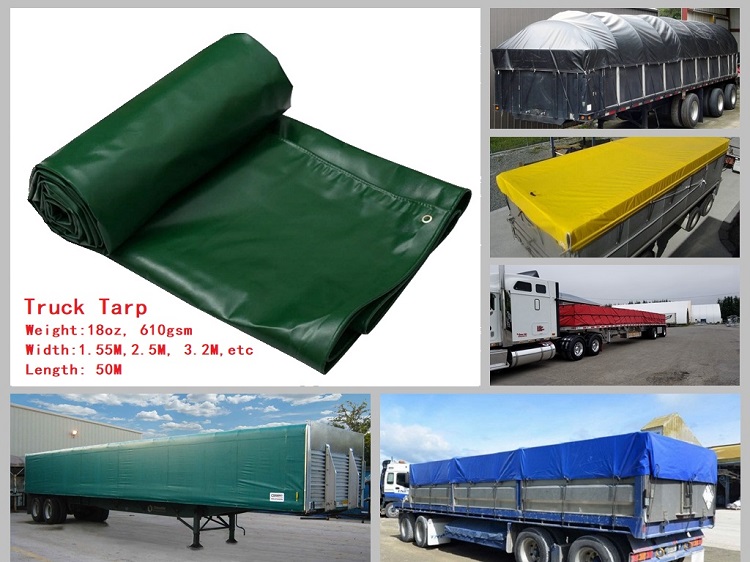
DERFLEX PVC truck tarp and heavy-duty tarpaulin applications
Product image display: PVC coated polyester tarp material and finished truck-cover applications. Final structure, color, weight, strength values and fabrication details are confirmed by project specification.
DERFLEX manufacturing support

Specify the performance before you specify the weight

DERFLEX supports B2B buyers, tarp converters, distributors, fleet programs and industrial projects with PVC coated polyester roll goods and custom finished tarp discussions. The selection process can start from the actual failure risk rather than a generic “heavy duty” label.

Material construction Discuss yarn, weave, GSM, thickness, coating route, finish and weather options.
Mechanical data Align tensile, tear, adhesion and other test requirements with an agreed method.
Finished tarp design Review welded panels, hems, webbing, grommets, D-rings, pockets and wear zones.
Sampling and repeat orders Use identified samples, approved specifications and defined inspection points for production control.
Request a Strength-Based Tarp Quote
Sample-to-order workflow

How to approve a tarp strength specification

A structured approval route reduces the risk of comparing unmatched samples or receiving a bulk order that performs differently from the evaluated material.

Define the field risk

State dimensions, load, exposure time, wind, sharp edges, abrasion, folding, temperature and the consequence of failure.

Choose methods and units

Identify the tensile and tear procedures, directions, report units and whether values are minimum or typical.

Evaluate an identified sample

Link the sample to a product code, construction sheet, color, finish, date and relevant test document.

Test fabrication zones

Review welds, seams, hems, reinforcement and hardware because the finished cover may shift the failure location.

Freeze the order specification

Record material tolerances, test requirements, workmanship criteria, packing, sample status and inspection plan.

Frequently asked questions

Tarp tensile strength and tear strength FAQ

Clear answers for importers, manufacturers, project buyers and custom tarp programs.

Is tensile strength the same as tear strength in a tarp?

No. Tensile strength evaluates how an intact specimen resists being pulled apart, while tear strength evaluates resistance to the initiation or propagation of a tear under a defined method. They describe different failure mechanisms and should both be considered for demanding tarp applications.

Which is more important for a heavy-duty tarp?

Neither property is universally more important. Truck covers, construction enclosures and large outdoor tarps usually need strong tensile performance because they carry broad tension and wind loading. Applications with cargo edges, snags, punctures or frequent handling need especially strong tear behaviour. The correct balance depends on the dominant field risk.

Does a higher GSM tarp always have higher tensile and tear strength?

No. GSM measures mass per area. Strength also depends on yarn tenacity, denier, weave density, directional balance, coating integration and manufacturing route. Two tarps with the same GSM can have different tensile, tear, abrasion and handling performance.

Can I compare N/5 cm tensile data with a tear value in N?

Not as one direct strength ranking. N/5 cm is a force value tied to a specimen width, while many tear results are reported as force under a specific tear geometry. Confirm the test method, specimen direction, width or shape, conditioning and acceptance status before comparing suppliers.

What test methods are commonly used for tarp strength?

ASTM D751 includes breaking-strength and tear procedures for coated fabrics such as tarpaulins. Other commonly referenced textile methods include ASTM D5034 and D5035 for breaking strength or force, and ASTM D2261, D5587 and D1424 for different tear procedures. The applicable method should be agreed for the product and market.

What information should I send DERFLEX for a custom recommendation?

Share the application, finished size, material preference, expected service cycle, wind and weather exposure, abrasion or sharp-edge risk, target GSM or thickness if known, tensile and tear methods or values, color, quantity, roll or finished-tarp format, seam route, reinforcement, hardware and packing requirements.

Turn strength data into a tarp that works in the field

Send DERFLEX your application conditions, target test methods, dimensions and fabrication requirements. The team can discuss a PVC coated polyester structure, sample direction and finished-cover configuration for evaluation.

Technical content is intended for preliminary product selection. Final suitability, values, tolerances, compliance and service performance depend on the approved material, agreed test methods, finished-tarp construction, installation and operating conditions.
Consulting Services
+86-021-54361792 / 54361798
Email
sales@derflex.com