News
Industry News

Tarp Roll Size Guide: Width, Length, GSM & Roll Weight | DERFLEX

Update:2026/8/15 18:22:02 Views:
PVC coated fabric & tarpaulin roll specification support Request A Quote
Roll Specification & Procurement Guide

Tarp Roll Size Guide: Width, Length, GSM & Roll Weight

Buying tarp fabric by the roll is not simply a matter of choosing “50 meters” or “61 inches.” The right tarp roll size depends on the finished cover width, seam plan, material weight, cutting yield, workshop equipment, roll handling limits and shipment method. This guide helps converters, distributors, truck tarp makers, tent manufacturers and industrial fabricators specify a roll that works in production—not just on a quotation sheet.

Quick answer: there is no single universal standard tarp roll size. In the market, vinyl tarp fabric is often sold around 60–61 in wide in North America, while PVC tarpaulin roll programs commonly use widths from about 1.5 m to 3.2 m and a 50 m reference length. Wider material can be discussed for selected constructions and production plans.
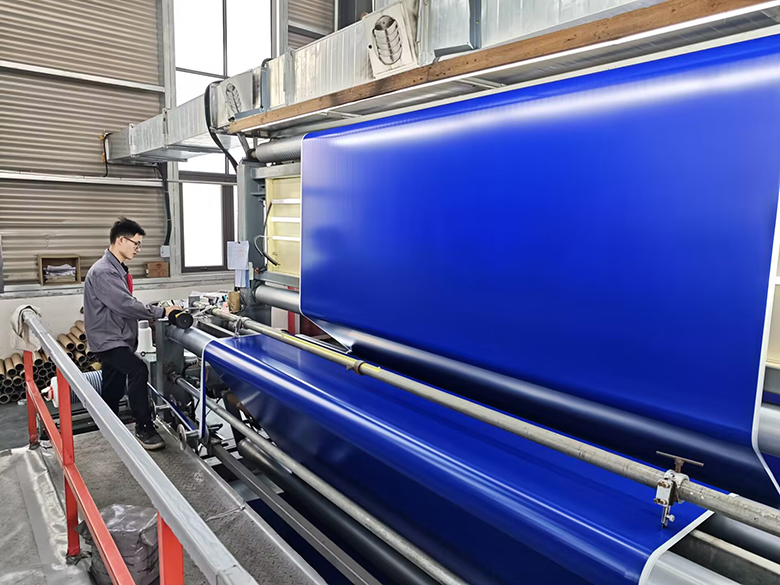
DERFLEX PVC tarpaulin roll production and coated tarp fabric roll
By RollRaw material supply
Custom WidthProject-based sizing
OEM ReadyConverters & distributors
60–61 inCommon North American vinyl fabric reference
1.5–3.2 mCommon metric roll planning range for many PVC tarp programs
50 mCommon export reference length for many coated tarp rolls
Width × Length × GSMKey inputs for estimating material weight per roll
Start With The Definition

What Does “Tarp Roll Size” Actually Mean?

For procurement, roll size is a three-part specification: usable width, roll length and material weight or construction. All three affect conversion cost.

Tarp roll size usually refers to the width and length of raw tarpaulin fabric supplied before the material is cut, welded, sewn, hemmed, printed or fitted with grommets. In industrial purchasing, the buyer should also define the material construction, GSM, thickness direction, color, surface finish and any UV, flame-retardant, cold-resistant or anti-mildew requirement.

Retail fabric sellers often describe roll goods in inches and yards—such as 61-inch-wide vinyl fabric sold by the yard or full roll. Industrial PVC tarpaulin manufacturers more often discuss width in meters and bulk roll length in meters. Both formats describe the same purchasing problem: how much usable fabric is available, and how efficiently can it be converted into the final tarp.

For DERFLEX buyers, the recommended process is to start from the finished product dimensions and fabrication method, then work backward to the roll width. This helps prevent unnecessary longitudinal seams, oversized trim waste, difficult-to-handle roll weights or a width that does not match the welding table and cutting equipment.

Tarp Roll Size Chart

Common Roll Widths in Inches, Feet and Meters

These are practical market references rather than a universal standard. Actual availability depends on material construction, coating line, edge trimming, quantity and production plan.

Nominal Width Approx. Imperial Where It Is Commonly Considered Procurement Note
1.50 m 59.1 in / 4.92 ft General coated tarp rolls, narrower conversion lines Useful when finished products are narrow or workshop equipment favors compact rolls.
1.52–1.55 m About 60–61 in / 5.0–5.08 ft North American vinyl coated fabric language 61 in is a familiar reference for vinyl-coated polyester sold by yard or roll.
1.83 m 72.0 in / 6.0 ft General PVC tarpaulin roll conversion A practical 6 ft class width for many fabricators and distributors.
2.00 m 78.7 in / 6.56 ft Tent, cover, curtain and general industrial fabrication Simple metric cutting plans and moderate roll weight.
2.10 m 82.7 in / 6.89 ft Industrial roll stock and conversion Often selected when extra width helps reduce trim waste versus 2.0 m material.
2.50 m 98.4 in / 8.20 ft Truck covers, tents and larger protective panels Can cover many 8 ft-class finished widths with less seaming, subject to hems and usable width.
3.00 m 118.1 in / 9.84 ft Large covers, industrial curtains and wide conversion Reduces seam count but increases roll mass and handling requirements.
3.20 m 126.0 in / 10.50 ft Wide PVC coated tarpaulin and large cover fabrication Useful when fewer seams are valuable; confirm workshop roll stand and forklift capacity.
Up to about 5.10 m Up to about 200.8 in / 16.73 ft Selected wide-width structures and project programs Not every GSM or construction is available at maximum width. Confirm structure, MOQ, roll length and packing before design freeze.

Important: nominal width, trimmed width and guaranteed usable width can differ. For production drawings, request the usable width tolerance instead of relying only on the marketing width.

Roll Length

50 m, 100 m or Custom Length: Which Tarp Roll Length Makes Sense?

Longer rolls reduce roll changes, but they also increase weight, diameter, warehouse handling load and damage exposure if the roll is moved manually.

50 m / 54.7 yd rolls

A 50 m roll is a common reference for industrial PVC tarpaulin because it often balances cutting continuity with manageable roll weight. It is suitable for converters that use forklifts, roll stands or manual-assisted handling and want convenient stock rotation.

Good fit: mixed production, distributors, trial specifications, custom cover workshops and frequent color changes.

100 m / 109.4 yd rolls

Longer rolls can reduce roll changes and support continuous conversion, but the same width and GSM will roughly double the material mass compared with a 50 m roll. Handling equipment, roll core strength, packaging and maximum roll diameter should be checked first.

Good fit: automated lines, stable repeat SKUs, high-volume cutting and workshops designed for heavier raw rolls.

Do not select roll length before checking roll weight.

A “longer roll for efficiency” can become inefficient if each roll is too heavy for the receiving warehouse, roll rack, forklift or unwinding machine.

Calculate Roll Weight
Procurement Calculator

Estimate Tarp Roll Weight Before You Order

Material weight is a fast way to check whether the planned roll is realistic for lifting, storage, palletizing and conversion equipment.

Roll material weight formula

For a simple fabric-mass estimate:

Weight (kg) = Width (m) × Length (m) × GSM ÷ 1000
1.83 m × 50 m × 610gsm ≈ 55.8 kg
before tube/core and packaging.
2.00 m × 50 m × 650gsm = 65.0 kg
a useful benchmark for handling review.
3.20 m × 50 m × 650gsm = 104.0 kg
wide rolls can quickly move beyond manual handling.
5.10 m × 50 m × 650gsm ≈ 165.8 kg
wide-width projects need a planned lifting and unwinding method.

Tarp Roll Weight Calculator

Enter your target width, length and GSM. The result estimates fabric mass only; actual shipped roll weight includes tube/core, wrapping and other packing.

104.0 kg 160.0 m² of material

Seam Count Planner

Estimate the minimum number of widthwise panels for a large finished tarp. This is a planning aid, not a final cutting drawing.

2 panels / 1 longitudinal seam estimated before hems and edge trimming.
How To Choose

Choose Roll Width From the Finished Tarp—Not the Other Way Around

The most economical roll is often the one that improves total conversion yield, even if its price per square meter is not the lowest.

1

Map the finished width

List finished tarp dimensions, hems, pockets, reinforced edges and any mandatory seam locations. Confirm whether the final width can fit within one usable roll width.

2

Add seam & trim allowance

Heat-welded seams need overlap. Edges may require trimming or hemming. A nominal 3.2 m roll is not the same as a guaranteed 3.2 m finished panel.

3

Check roll mass

Wider and longer rolls can reduce seams but may require forklift handling, stronger cores and higher-capacity unwinding equipment.

4

Compare total yield

Evaluate scrap percentage, seam labor, welding time, roll changes and packed roll handling—not only material price per square meter.

Example: 8 ft-class cover widths

A 61 in roll normally needs multiple panels for an approximately 8 ft-wide cover. A 2.5 m or wider roll may reduce or eliminate a center seam depending on hem and usable-width allowance. The benefit is fewer welds; the trade-off is heavier and wider raw-roll handling.

Think in total conversion cost
Width Strategy By Application

Typical Tarp Roll Size Priorities for Different Buyers

The “right” roll changes depending on what the buyer will fabricate after the material arrives.

Truck & Trailer

Reduce seams without creating unmanageable rolls

Truck tarp fabricators should compare finished cover width, reinforced edge design, weld direction and abrasion zones. Wide rolls can lower seam count, while 18oz/610gsm and heavier grades increase roll mass quickly.

Tent & Shelter

Match panel modules and FR requirements

Tent producers often work from repeatable roof and sidewall modules. The roll width should align with panel patterns, welding equipment and flame-retardant certification requirements when specified.

Industrial Curtains

Balance height, seams and installation handling

For warehouse dividers and curtain walls, roll width affects how many vertical or horizontal welds appear in each bay. Surface finish and cleaning requirements also matter.

Agriculture

Plan wide coverage and field handling

Hay, grain and equipment-cover programs may value fewer seams, but the finished sheets still need to be transportable and deployable on site. Raw-roll width should support the final fabrication method.

Distributor Stock

Choose widths that serve multiple downstream SKUs

Distributors benefit from a small number of versatile roll widths and GSM grades that local fabricators can cut into many finished sizes. Repeat color and labeled roll identification matter.

OEM Converter

Optimize for machine width and nesting efficiency

OEM workshops should provide cutting-table width, welder type, target product dimensions and annual volume. A custom roll width can sometimes reduce recurring scrap across high-volume production.

Specification Guide

DERFLEX PVC Tarpaulin Roll Specification Framework

Use this table to prepare a practical RFQ. Final values should be confirmed against the selected material structure, sample and production order.

ItemPractical Planning DirectionWhy Buyers Should Specify It
Material structurePVC coated polyester, PVC laminated polyester or project-specific constructionConstruction affects weldability, flexibility, tear performance, finish and price.
WeightCommon project grades can include 450, 500, 550, 610/650, 750, 850, 900gsm and custom directionsGSM influences roll mass, handling, durability direction and cost.
Roll widthCommon planning widths around 1.5, 1.83, 2.0, 2.5, 3.0 and 3.2m; selected structures can be discussed widerWidth determines seam count, cut yield and workshop compatibility.
Roll length50m common reference; 100m or custom length can be reviewedLonger rolls reduce changes but increase mass and diameter.
Usable width toleranceConfirm with the selected specificationFinished cut drawings should be based on guaranteed usable fabric, not only nominal width.
SurfaceGlossy, matte, embossed, lacquered or other project finishSurface affects appearance, cleaning, printing and outdoor behavior.
Performance optionsUV, FR, cold resistance, anti-mildew, anti-static and other application-specific optionsFunctional requirements should be tied to the target application or test method.
Fabrication processHot-air welding, HF welding, sewing, printing, hemming, eyeletsThe raw material should be reviewed against the customer’s actual conversion method.
Core & packingHard tube, PE wrap, woven bag, label, pallet or export-safe packingPackaging affects edge protection, handling and container loading.
Buyer Risk Control

Seven Details to Confirm Before Approving a Bulk Tarp Roll Size

Most roll-size problems appear after delivery—when the material reaches the cutting table, warehouse or welding line. Confirm these points before bulk production.

Send this with your RFQ

  • Finished product or application: truck tarp, tent, industrial curtain, cover, distributor stock or other use.
  • Target roll width and whether the value is nominal, trimmed or minimum usable width.
  • Roll length and maximum acceptable roll weight or roll diameter for your workshop.
  • GSM / oz, base fabric or previous sample reference if available.
  • Welding, sewing, printing or other conversion process.
  • Color, surface finish and any UV, FR, cold or anti-mildew requirement.
  • Quantity, pallet preference, shipping mark, destination port and repeat-order plan.

Common specification mistakes

Buying nominal width without usable-width toleranceThis can create shortages once edge trimming and fabrication allowance are considered.
Choosing the widest roll only to reduce seamsExtra-wide material can increase roll mass, forklift needs and storage difficulty.
Ignoring GSM when choosing roll lengthA 100m heavy-duty roll may be impractical even when a 100m light roll is easy to handle.
Using retail inch/yards language without unit confirmationConvert dimensions before PO approval and state whether values are exact or approximate.
Freezing a cut plan before material samplingConfirm weld overlap, shrink/relaxation behavior and actual usable width on the approved material.
DERFLEX Manufacturing Perspective

Why Roll Size Should Be Engineered With the Material

DERFLEX approaches tarp roll procurement from the coated-fabric and conversion side: roll dimensions should work together with material construction, welding behavior, packing and repeat-order consistency.

Application-led sizing

Start from the finished tarp and conversion process, then define width and length around the cutting plan.

Custom roll discussion

Width, length, GSM, color, finish and special performance can be reviewed together for qualified project orders.

Conversion support

Hot-air welding, high-frequency welding, sewing, printing and hemming requirements can be considered before sampling.

Export packing logic

Roll core, wrapping, labels, palletizing and container loading can be aligned with long-distance B2B shipment.

FAQ

Tarp Roll Size Frequently Asked Questions

What is a standard tarp roll size?

There is no single universal standard tarp roll size. North American vinyl-coated fabric is commonly seen around 60–61 inches wide, while industrial PVC tarpaulin programs often use metric widths such as 1.5m, 1.83m, 2.0m, 2.5m, 3.0m and 3.2m. A 50m roll length is a common reference. Wider or longer rolls may be available depending on construction, GSM, quantity and production plan.

How long is a tarp roll?

Many PVC tarpaulin roll orders use 50m as a practical reference length, and 100m can also be considered for selected products and conversion lines. The best roll length depends on GSM, roll weight, core strength, packed diameter, warehouse equipment and how often the converter wants to change rolls.

How do I calculate the weight of a tarp roll?

Estimate the fabric mass with: width in meters × length in meters × GSM ÷ 1000. For example, a 3.2m × 50m roll at 650gsm contains about 104kg of fabric. The shipped roll will weigh more after adding the tube/core and packing materials.

Is a wider tarp roll always better?

No. Wider rolls can reduce seam count and welding labor, but they also increase roll weight, storage footprint and equipment requirements. The better choice is the width that gives the best total conversion yield while remaining practical for your cutting, welding, lifting and storage system.

What does 61-inch tarp fabric mean?

61-inch tarp fabric refers to a vinyl or PVC-coated fabric approximately 1.55m wide. It is a familiar width in North American fabric-by-the-yard and roll-goods markets. Industrial importers may instead specify an equivalent metric width or choose wider 1.83m to 3.2m rolls to reduce seams.

Can DERFLEX customize tarp roll width and length?

DERFLEX can review custom width, roll length, GSM, color, finish and performance requirements for project orders. The feasible range depends on the selected base fabric, coating or lamination structure, target width, order quantity, packing and production plan, so the final specification should be confirmed by quotation and sample.

Build the roll around your cutting plan

Need Help Choosing the Right Tarp Roll Size?

Send DERFLEX your finished tarp dimensions, target GSM, preferred roll length, welding method, quantity and destination. The team can review a practical roll-width direction for conversion, handling and export packing.

Consulting Services
+86-021-54361792 / 54361798
Email
sales@derflex.com