


Temporary Flood Barrier Systems for Planned, Portable Protection
A temporary flood barrier is a deployable defence placed along a planned route before or during a flood response to help limit water entering a protected area. Selecting a suitable system means matching expected retained-water depth and flow with ground conditions, joints, available equipment and the warning time. DERFLEX supports international buyers evaluating reinforced PVC-coated flood-barrier materials and project-specific flexible assembly options; the exact supply format and the performance of any finished barrier must be confirmed against the agreed drawings and test evidence.
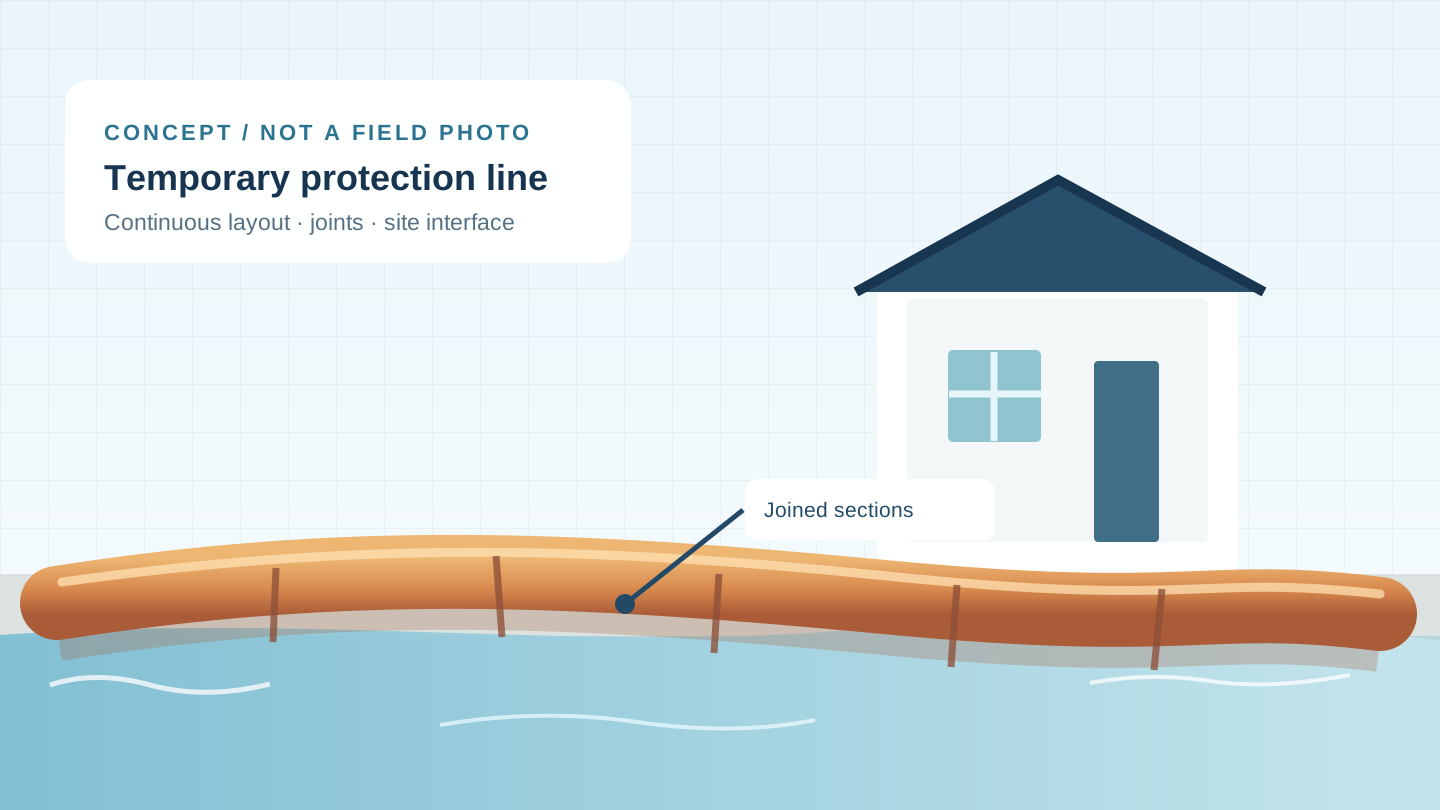
What is a temporary flood barrier system?
A temporary flood barrier system is a removable arrangement of tubes, flexible membranes, modular panels or other connected components deployed to reduce floodwater ingress along a specified route. It is different from a permanent wall or levee because the defence is mobilised for an event and taken down afterwards. Depending on the design, stability may rely on contained water, incoming floodwater, engineered bracing, ground anchors or a combination.
For commercial and public-sector buyers, the key question is not simply “Which barrier looks strongest?” It is whether the complete installed line has appropriate evidence for the anticipated load, site surface, corners, terminations and available response crew. That line also needs a plan for water entering through drains, under the barrier or from behind the protected perimeter.
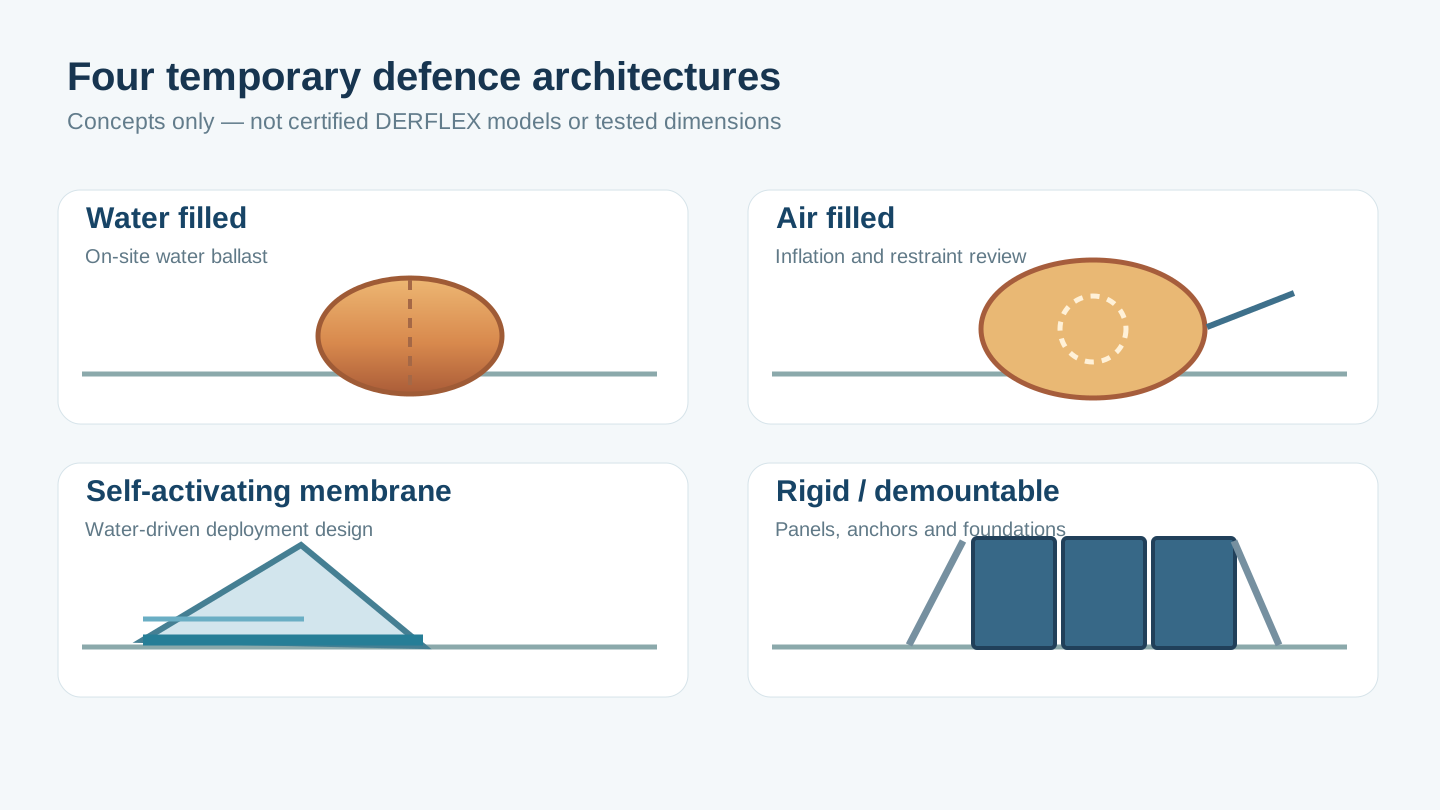
Quick selection answer: Use water-filled flexible barriers where a suitable water source, pump logistics and ground footprint can be planned; consider air-inflated systems only with an approved restraint and pressure-management design; evaluate rigid demountable walls for pre-engineered installation routes. No architecture is universally the safest or fastest.
Compare portable flood protection systems before specifying material
“Portable flood protection” covers different operating principles. This comparison is a procurement guide, not a claim that DERFLEX supplies every system or that the configurations share a common certified flood height.
| System approach | How it is deployed | Main procurement advantage | Critical design checks |
|---|---|---|---|
| Water-filled flexible barriers | Transport empty, position sections, connect and fill with water. | Ballast is added at the site rather than transported in full. | Fill supply, slope, rolling, ground contact, fill/drain ports, connections. |
| Air-filled flexible barriers | Position tube or bladder sections, inflate using approved equipment and secure according to design. | Compact transport and potentially rapid shape deployment. | Restraint, pressure monitoring, puncture response, uplift and stability. |
| Self-activating membrane barriers | Deploy a designed membrane that opens or stabilises as floodwater arrives. | May reduce active filling equipment needs in suitable designs. | Correct orientation, leading-edge contact, water entry, flow and debris. |
| Rigid modular / demountable barriers | Install panels, posts, braces or gates on a defined alignment. | Repeatable interfaces at engineered locations. | Foundations, anchors, structural loads, seals, storage and handling. |
| Sandbags and local supplements | Carry, fill and stack bags or use them to support minor local details. | Widely understood, flexible around small irregularities. | Labour, continuous layout, seepage, settlement and disposal. |
DERFLEX's related guides explain the water-filled flood barrier approach and the broader inflatable flood barrier product direction. For temporary dams with a particular water-inflated design, see inflatable water dams for flood control. Use these pages for configuration details rather than treating all filling methods as interchangeable.
Which temporary flood barrier fits your site?
The best portable flood barrier follows the site risk assessment. The table identifies questions that should be answered before a supplier proposes an assembly or before a material converter selects a fabric grade.
| Site / task | Useful system direction | Information needed | Failure route to review |
|---|---|---|---|
| Warehouse entrance / loading bay | Flexible line or engineered opening barrier | Door span, floor fall, thresholds, forklifts and closure timing | End gaps, floor drains, incoming water behind the line |
| Municipal street and road underpass | Pre-planned deployable alignment | Traffic plan, low points, access, road camber and drainage | Unclosed ends, vehicle impact, high runoff velocity |
| Utility and data facility perimeter | Engineered complete perimeter, possibly modular | Critical elevations, penetrations, backup pumps and redundancy | Hydrostatic loading, utility ducts, wall openings |
| Construction site and excavation | Temporary barriers only within a reviewed water-control plan | Ground bearing, site geometry, work access, water level and soil | Soft-ground settlement, erosion, unexpected currents |
| Riverbank and moving-water edge | Only site-engineered solutions with relevant evidence | Velocity, scour, debris, waves and flood duration | Sliding, overturning, undermining and impact |
| Coastal or tidal exposure | Specialist engineered selection | Waves, salinity, uplift, return period and evacuation plan | Overtopping, wave impact, bypass flow and corrosion |
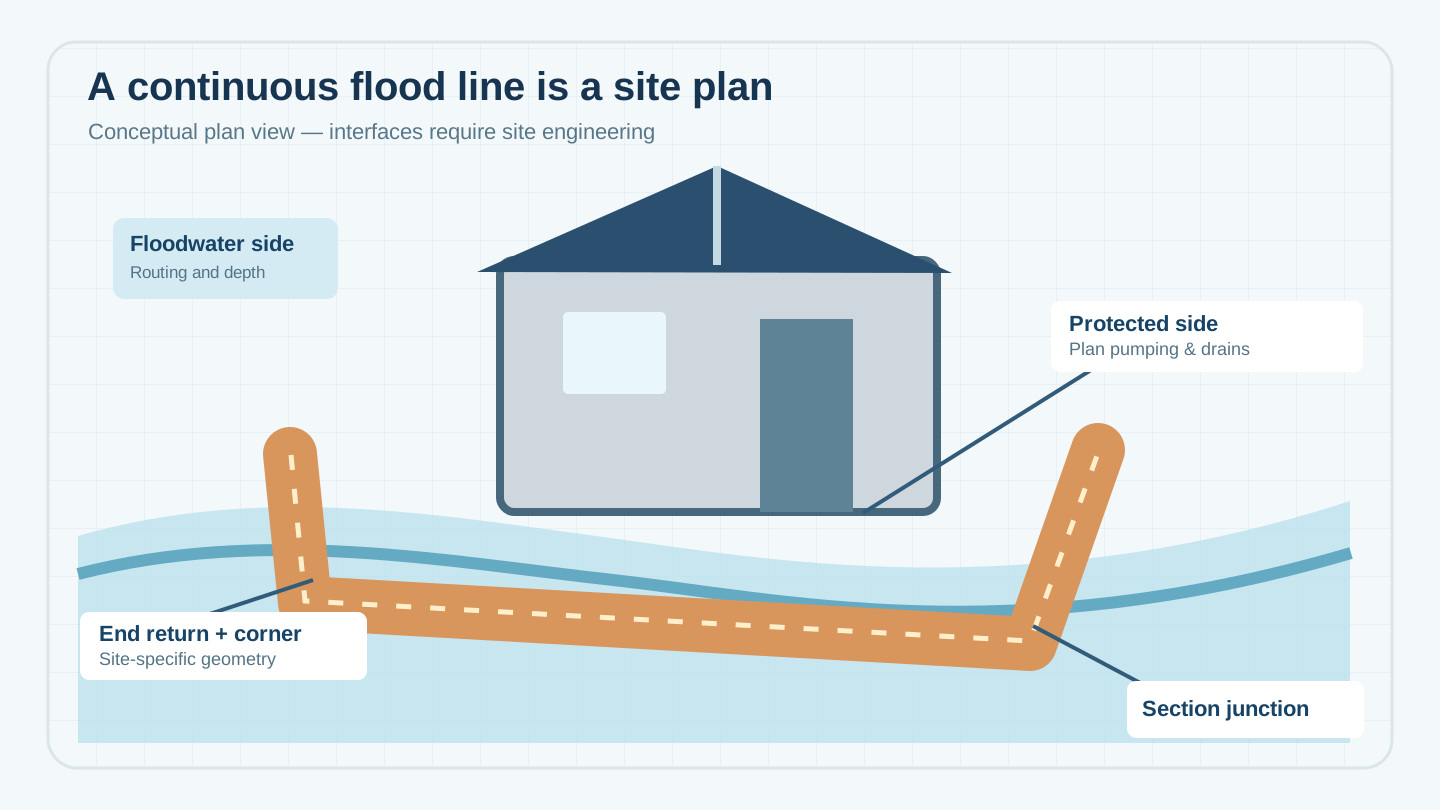
Five interfaces determine whether a temporary defence line works
At procurement stage, a sheet of waterproof PVC is only the start. Its coating and reinforcement must be matched with seam design, structural geometry and site interfaces. The following five checkpoints help purchasing teams ask useful engineering questions without inventing an allowable flood depth.
Design water condition
Record expected retained depth, duration, possible velocity, debris and local overtopping. A tube diameter or panel height is not automatically its rated flood depth.
Ground and foundations
Survey slope, pavement seams, sharp debris, soil softness, anchorage and friction. The installed base may need protection, preparation or a separate engineering method.
Joints, corners and ends
Check section junctions, end returns against structures, penetrations and changing barrier elevation. The weakest interface can bypass an otherwise sound membrane.
Leakage and drainage
Plan for underflow, seepage, rainfall on the dry side and water entering through drainage networks. Specify inspection and pumps when a site requires them.
Deployment capacity
Specify warning trigger, crew, access, machinery, water or air supply, lighting and storage. A workable installation is one that can be completed before the hazard arrives.
What evidence should I request?
Ask for reports or drawings for the exact assembled configuration and relevant conditions, not just a fabric tensile-strength sheet or a photograph of a different barrier model.
Portable flood protection for industrial and public environments
Municipal & emergency preparedness
Develop a pre-surveyed route for public buildings, access roads and infrastructure interfaces. Assign storage locations, responsible teams and drill schedules before seasonal flood warnings.
Factories, logistics & warehouses
Protect critical entrances and equipment zones without forgetting floor drains, below-grade service entries and normal vehicle movement. Agree the final closure sequence in advance.
Utilities & critical infrastructure
Consider barrier compatibility with power rooms, waterworks and telecom assets, including groundwater levels and protected-side pumping. Critical facilities require stronger evidence and operational planning.
Construction & temporary works
Review whether the aim is to retain floodwater, redirect surface runoff or isolate a work area. Temporary cofferdams and flood barriers can involve different hydraulic assumptions and approval requirements.
DERFLEX's PVC-coated fabric manufacturing overview is relevant where project buyers are seeking flexible membrane material rather than a packaged flood-defence system. Material specifications should follow the actual fabrication design.
Where reinforced PVC materials fit in a temporary flood barrier
PVC-coated polyester is an established flexible-material option for waterproof, weldable industrial products. In a barrier, the base textile contributes mechanical reinforcement while the coating supports water resistance and fabrication. The precise compound, fabric architecture and seam method must be assessed against the exposure profile, not selected by GSM alone.
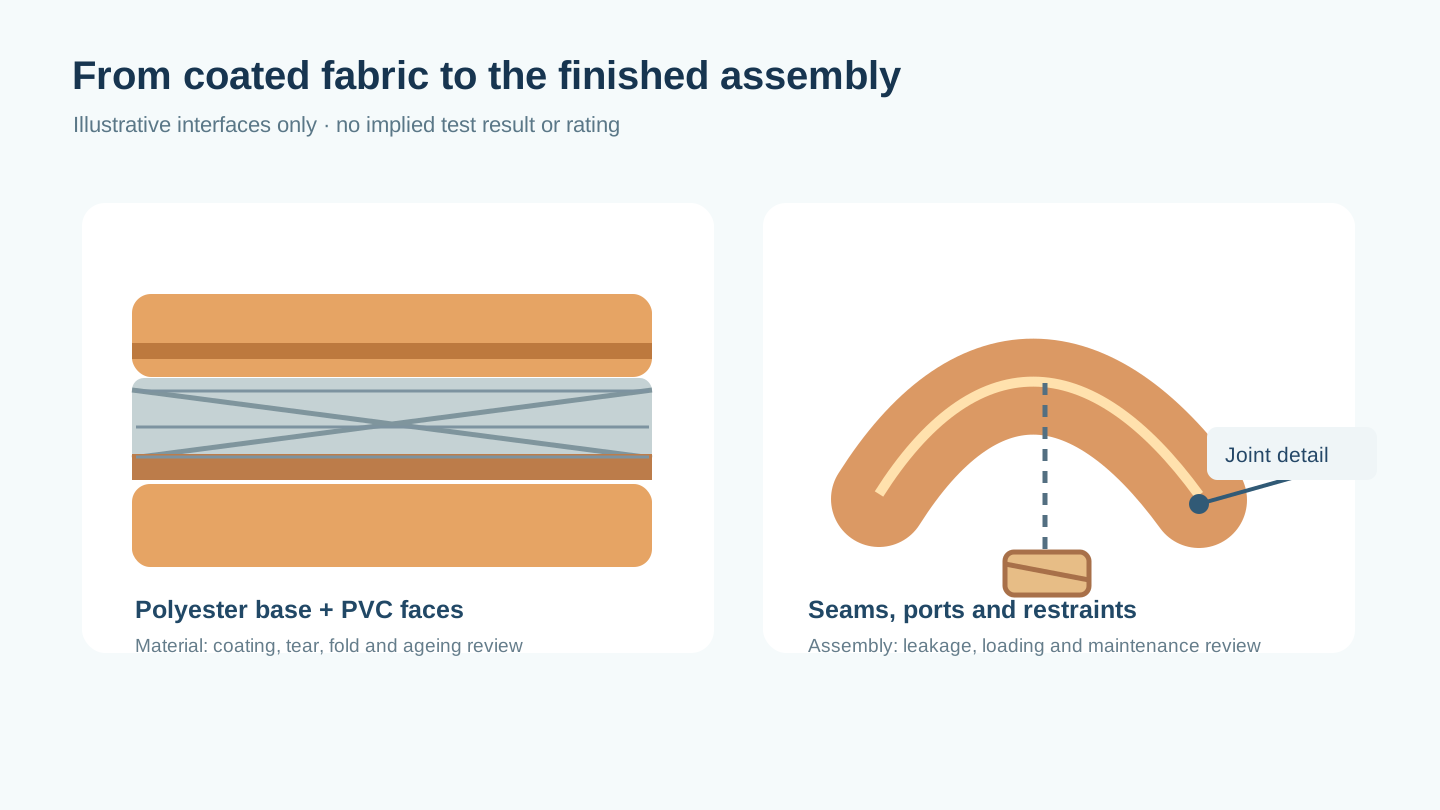
Specify the complete construction
- Fabric: polyester base, yarn architecture, finished weight, thickness and useful width.
- Exposure: hydrostatic contact, abrasion, puncture, UV, temperature and repeated folding.
- Welding: compatible seams, overlap geometry, reinforced terminations and seam verification.
- Interfaces: inflation or fill valves, vents, end seals, restraint and repair access as applicable.
- Evidence: material batch records, seam samples and system test data where performance is specified.
For material-led sourcing, explore PVC tarpaulin grades and the broader PVC-coated polyester fabric family. Finished water retention depends on much more than the coated roll.
A buyer who needs a flood tube material may prioritise airtightness, low-temperature folding and seam strength; a buyer sourcing a protective apron may emphasise abrasion and ground-contact behaviour. The supplier should confirm these in the agreed testing context. DERFLEX can review coated-fabric material selection and project-specific assembly details, while finished-system engineering and certification remain separate requirements.
Clarify what the quotation includes
Flexible flood-barrier procurement can span more than one supplier and approval party. To avoid a material quotation being mistaken for a complete flood protection system, agree the commercial boundary in writing at the beginning of the enquiry.
| Supply level | Possible scope for discussion | What the buyer must clarify |
|---|---|---|
| Coated-fabric roll | Industrial PVC-coated textile to an agreed material specification. | Width, construction, weight, surface, roll length, applicable reports and processing method. |
| Cut or welded component | Fabricated pieces or membrane parts where feasibility is confirmed. | Drawing, seams, tolerance, reinforcement, sampling and acceptance tests. |
| Flexible barrier section | Custom tube or barrier assembly where capability and specification are confirmed. | Section geometry, ports, joints, restraints, included accessories and assembly evidence. |
| Fully engineered installed system | May require a qualified engineering / installation partner and separate approval. | Design responsibility, flood rating, permits, foundations, site works, commissioning and maintenance. |
Design for deployment, monitoring and recovery
Procurement is incomplete until the temporary system can be stored, handled and operated by the intended team. This sequence is a planning aid; the approved product instructions and local emergency plan govern actual use.
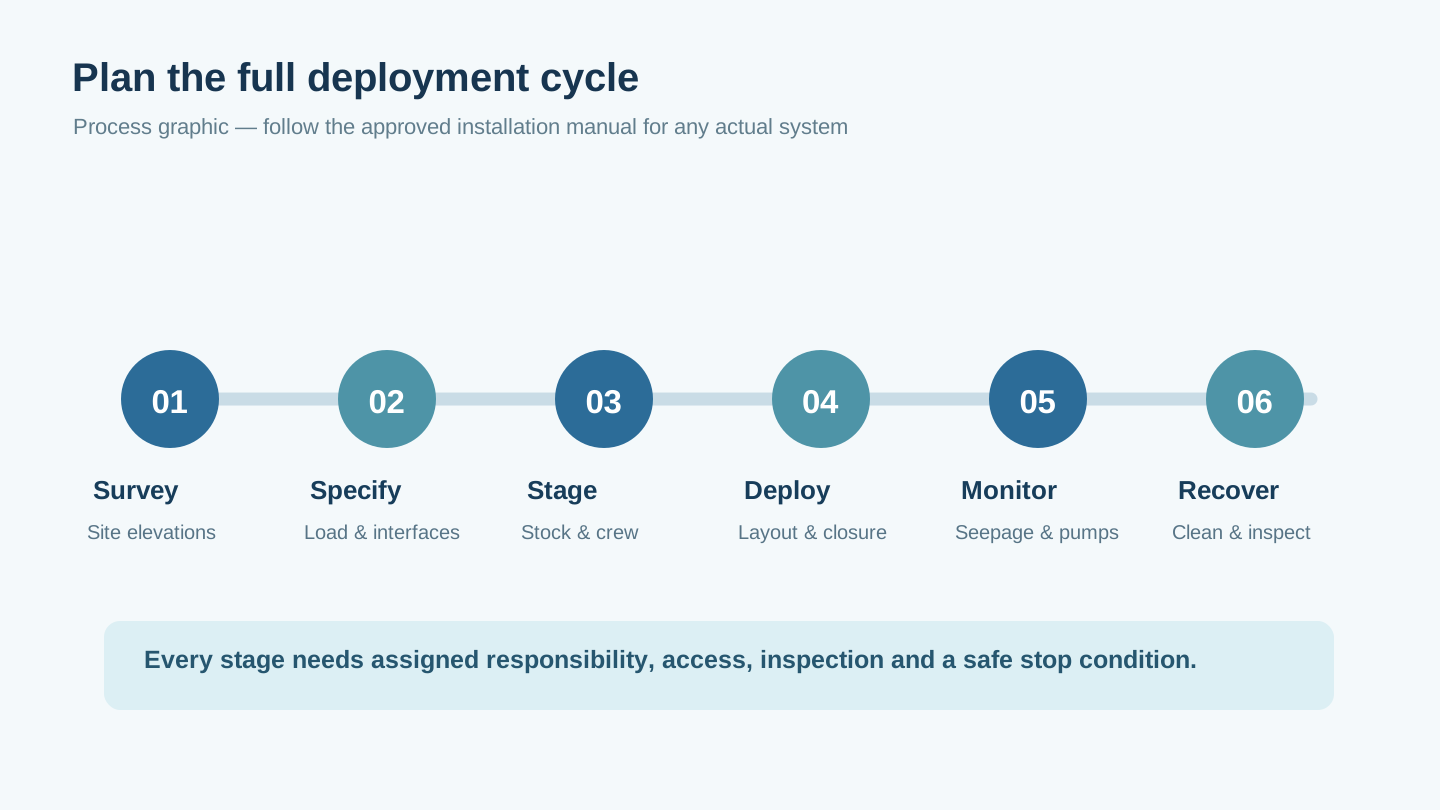
For temporary works, distinguish a barrier that holds floodwater outside a facility from a water-inflated temporary dam used for another hydraulic task. Different objectives can require different test evidence, geometry and installation procedures.
Temporary flood barrier RFQ: what to send to DERFLEX
Accurate requests start with the protected asset and site conditions, not an unsupported fabric thickness or a guessed barrier height. A sketch or photographs are acceptable for an initial discussion, followed by dimensioned drawings and agreed acceptance criteria where needed.
Site & hydraulic information
- Facility type, location and intended protection route
- Plan view, ground elevations, corners and openings
- Expected water depth, duration and any current, debris or wave exposure
- Surface type, slope, drainage points and underground penetrations
- Deployment warning time and permitted site access
Product & supply information
- Material rolls, fabricated sections or complete-system enquiry
- Approximate defence length and desired section arrangement
- Water / air source, pumps, crew and storage constraints
- Required testing, drawings, labels, spares and inspection criteria
- Quantity, destination, purchasing timetable and contact details
What changes the quotation?
Cost varies with coated-fabric construction and width utilisation, barrier geometry, weld and joint complexity, ports and fittings, batch size, validation work, packaging, shipment terms and the agreed supplier responsibility. DERFLEX will need the intended supply scope before discussing commercial parameters; no universal MOQ, flood depth rating or delivery time is assumed here.
Temporary flood barrier FAQ
What is the difference between a temporary and permanent flood barrier?
A temporary barrier is deployed for an anticipated or active event and removed afterwards. Permanent flood walls or gates remain installed as part of a fixed protection system. Both require an appropriate site assessment, but temporary systems add crew, warning-time, storage and deployment considerations.
Are portable flood barriers better than sandbags?
Some portable systems are reusable and may reduce the handling and disposal associated with sandbags. The better choice depends on the actual flood scenario, terrain, response time, trained personnel, available equipment and documented system performance. Sandbags can remain useful for limited local details.
How high can a temporary flood barrier hold back water?
There is no universal rated height. Allowable retained-water depth must be established for the specific assembled system, its joints, ground and anchorage, together with the expected hydraulic conditions. Nominal tube diameter or panel height must not be used as an equivalent rating.
Can a flood barrier be filled with air instead of water?
Some designs are air-filled and others use water ballast, incoming floodwater or rigid members. Air inflation alone does not establish stability against a flood load: an air-filled system needs appropriate restraint, pressure management and validation for the proposed site.
Can PVC-coated fabric provide a waterproof flood barrier?
PVC-coated fabric can be selected for water-resistant flexible components, but the installed barrier also depends on seams, valves, corners, ground contact, wear and complete-system testing. A fabric waterproofing result by itself cannot establish a finished system's flood-protection performance.
What should I include in a DERFLEX quotation request?
Send the intended supply format, defence route length, site sketch, ground conditions, expected water level and duration, connection details, desired quantity, required evidence and destination. DERFLEX can then discuss suitable coated materials and whether a proposed flexible assembly falls within the confirmed project supply scope.
Build the right barrier specification before you buy.
Tell DERFLEX whether you need coated textile rolls, fabricated flexible components or a specific flood-barrier assembly. Share your route drawing and site conditions so the material, joint detail, evidence and commercial supply scope can be reviewed accurately.