


 Industrial coated materials · Global project sourcing
Air Inflated Flood Barriers for Rapid, Planned Flood Defence
An air inflated flood barrier is a portable flexible tube that takes its working shape from internal air pressure. For municipalities, industrial facilities and OEM buyers, successful specification depends on much more than the inflated tube: ground sealing, anchoring or skirt design, connected sections, air retention and the site's flood conditions all matter. DERFLEX can discuss reinforced PVC-coated materials and project-specific barrier supply requirements. Final system configuration, deployment limits and validated performance must be agreed for the selected design.
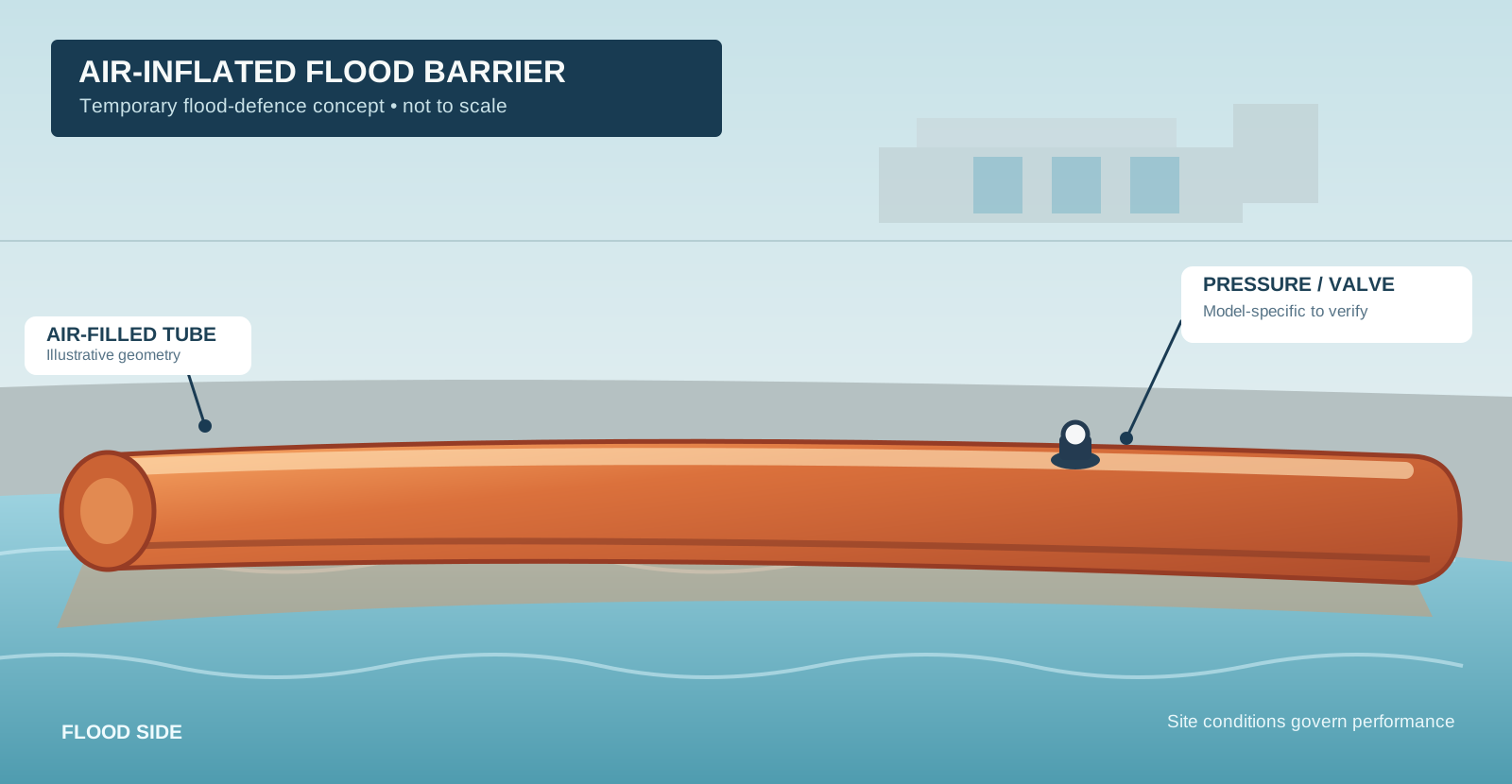
What is an air filled flood barrier?
An air filled flood barrier is a temporary flood-defence assembly that uses an inflatable membrane tube to form a continuous physical obstruction along a planned route.
Compared with water-ballasted flexible barriers, the tube itself does not carry a large quantity of water to provide operating mass. The system therefore relies on a verified method of resisting horizontal flood forces. This may include an engineered flood-side skirt, surface friction, mechanical anchoring, ballast or a purpose-designed restraint system; specific approaches cannot be assumed interchangeable.
Sections can be transported and positioned with little or no internal fill, then inflated using suitable equipment. After an event, a reusable configuration may be deflated, inspected, cleaned and stored. Whether reuse is approved depends on material condition, joints, valve integrity and the actual manufacturer's instructions.
Three questions to settle early
- Protection objective: What water level, duration, flow and exposure are expected?
- Installed stability: How is movement, lifting and underflow controlled on this ground?
- Supply boundary: Do you require coated fabric, custom fabricated tubes or a tested deployable system?
For a wider product-family overview, see DERFLEX inflatable flood barriers.
Critical engineering distinction: an inflated tube diameter is not an approved flood-retention height. Protection limits belong to the complete tested or engineered assembly under defined installation conditions.
How does an air-inflated flood barrier resist water?
Air gives the tube its geometry. The combination of membrane, joints, ground interface and an approved stabilization method determines how the whole barrier behaves.
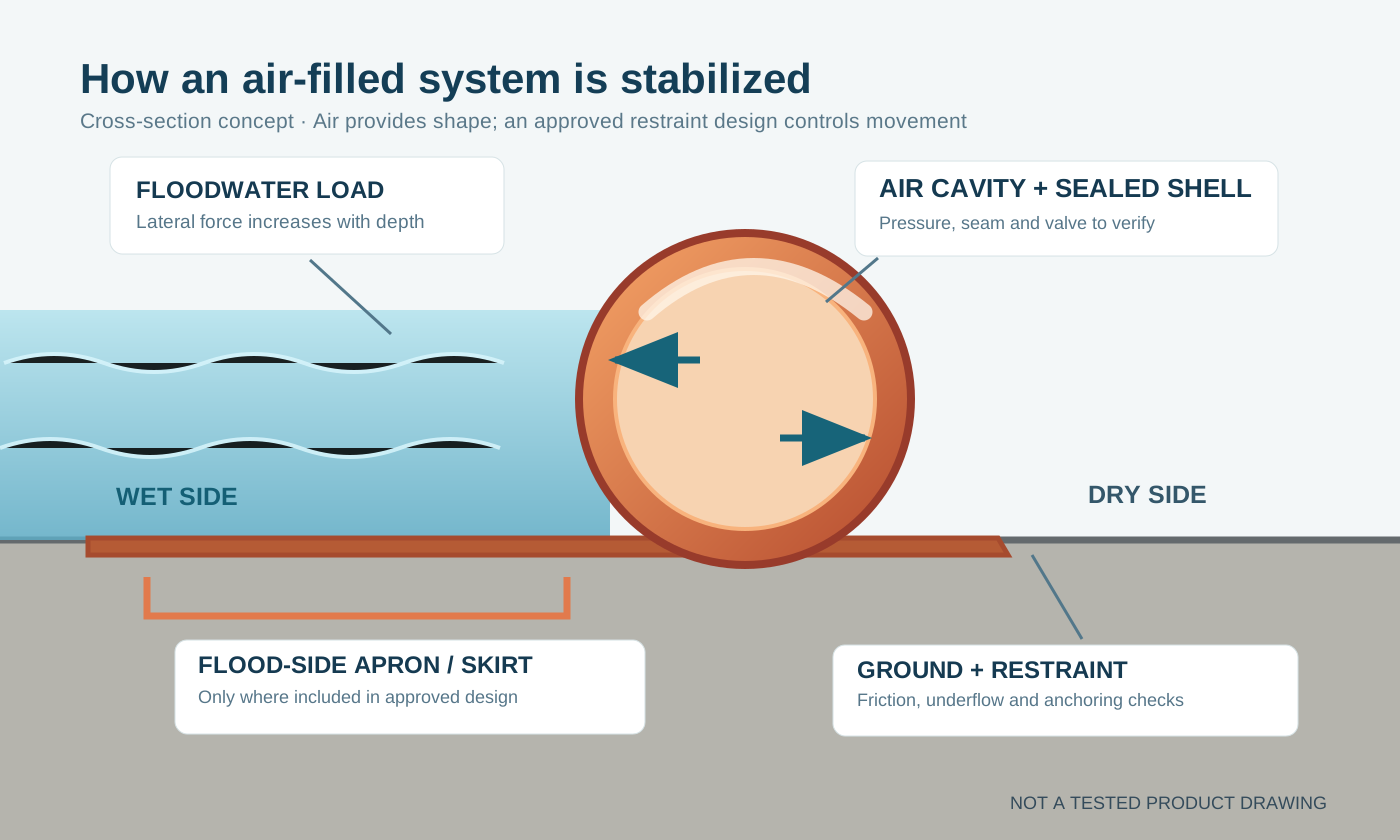
The air chamber
A sealed PVC-coated textile enclosure maintains a defined operating shape. Inflation pressure must be compatible with the selected material, seam construction and valves. Greater pressure does not automatically produce a safer defence; overinflation can damage the envelope or connections.
The flood-side interface
Hydrostatic pressure rises with water depth. Some engineered systems use an extended skirt that is pressed toward the ground by floodwater and thereby increases resistance to movement. Other systems use different anchoring arrangements. These are design-specific features, not general properties of any air tube.
Ground contact and drainage
Even a sound air chamber can fail to protect a site if water passes beneath it, at the ends or through drains behind it. Pavement texture, debris, transitions, slopes, soil saturation, surface friction and the intended floodwater flow must be considered.
Continuity under load
Every corner, connector and transition needs a documented detail. Adjacent tubes that appear to touch may still permit seepage or separation under load. The connection design must account for installation tolerance and changing flood conditions.
Choose the right air-filled configuration for the site
Start with the ground and the hydraulic scenario before deciding the tube size, the number of sections or the accessory package.
| Site condition | Selection priority | What buyers should verify |
|---|---|---|
| Level paved warehouse approach | Continuous contact and controlled entry points | Threshold profile, surface debris, joints, end returns and indoor drains |
| Urban roadway or access corridor | Temporary traffic closure and rapid section layout | Kerbs, gullies, utility covers, approved access and deployment crew |
| Uneven gravel or soft ground | Protection from puncture and loss of sealing | Ground preparation, underlay, settlement, restraint and seepage |
| Industrial perimeter with multiple bends | Verified joint geometry and corner transitions | Permitted angle, tie-ins, inflation hose routing and line continuity |
| Moving water, riverbank or debris exposure | Hydrodynamic loads and erosion resistance | Qualified engineering evaluation; standard still-water assumptions are insufficient |
| Coastal surge or waves | Complex loads and corrosion / exposure | Dedicated hydraulic design, approved system evidence and emergency contingency |
If the procurement is primarily for ballast-based construction instead of air pressure, compare water-filled temporary flood barriers and water-inflated dam systems before selecting a product family.
PVC membrane, air retention, welds and section joints
A strong fabric alone does not prove a strong barrier. Every interface that retains air or connects one section to the next belongs in the approval plan.
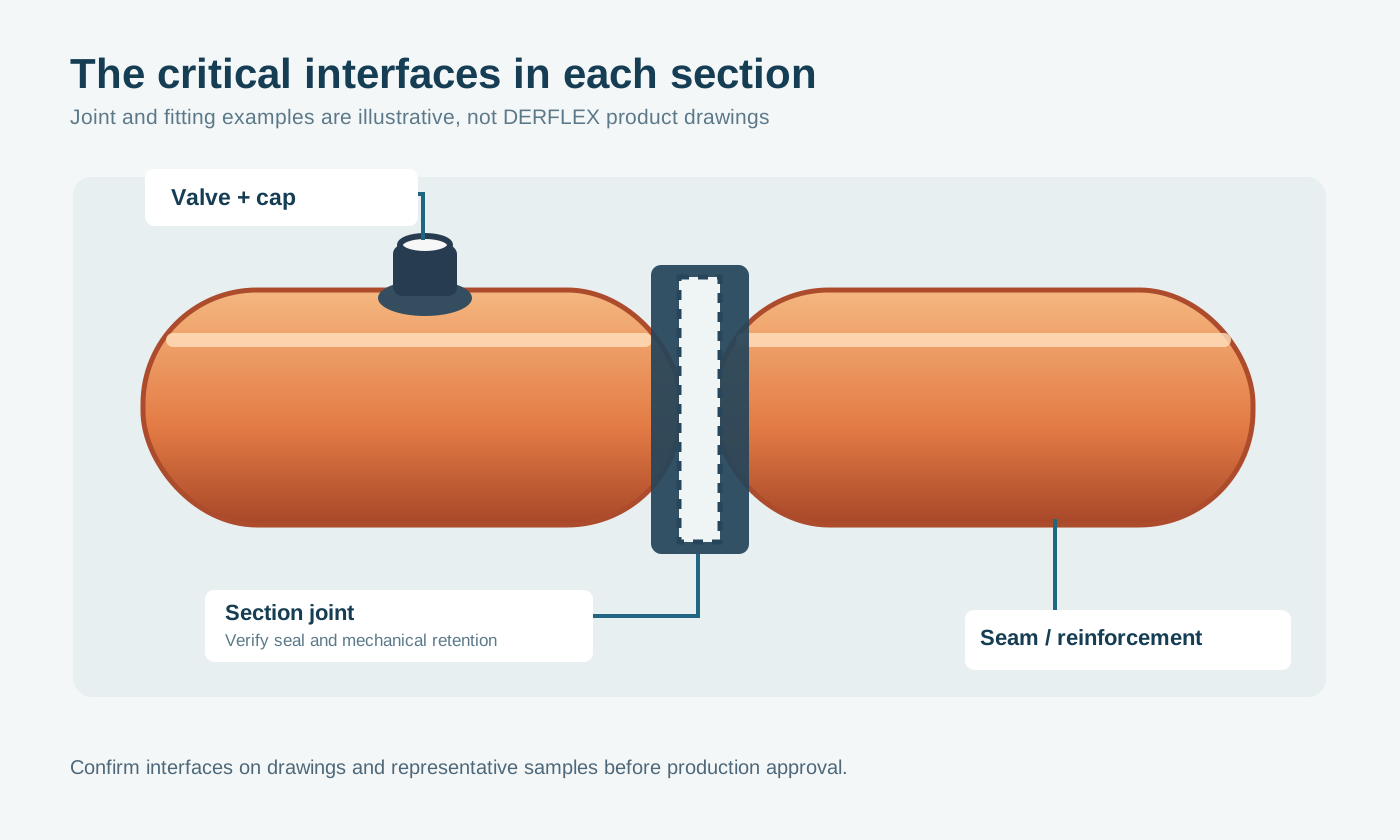
Reinforced coated fabric
For technical textile selection, assess polyester reinforcement, coating adhesion, flexing during repeated folding, puncture exposure, air permeability, seam compatibility and outdoor storage conditions. DERFLEX offers PVC-coated fabric and PVC tarpaulin material for industrial conversion. The selected grade must be assessed for the intended air chamber; general waterproofing is not proof of airtightness.
Welded seams
Specify seam type and overlap for the chosen fabric and fabrication process. Acceptance may require representative weld testing, air leakage inspection and a repair plan. Results for a straight test seam do not automatically qualify highly loaded corners or valve penetrations.
Inflation equipment and valves
Confirm inlet diameter, connector type, pressure indication, cap security, access location and permitted operating pressure in the system instructions. Blower size, inflation time and pressure-retention intervals cannot be inferred from section length alone.
Section connectors and accessories
Request detail drawings for the approved joint cover, corner layout, end closure and optional apron, underlay, tie-down or restraint system. Pumps, hoses, gauges, replacement valves and repair materials should be listed separately unless a quotation explicitly includes them.
Supply note: DERFLEX material expertise and general inflatable product pages do not establish that every finished air-filled flood-defence configuration is in stock or certified. Define the exact scope and request evidence for the specific assembly.
Technical fields to agree before quotation
The table sets out design decisions and acceptance questions, not invented standard model specifications or flood-depth ratings.
| Item | Customer requirement | Supplier confirmation |
|---|---|---|
| Flood condition | Retained-water depth, duration, flow and debris | System-level suitability evidence, design limitations and freeboard |
| Barrier route | Total length, slopes, corners, clearances | Section dimensions, layout plan and permitted transitions |
| Air chamber geometry | Transport and installed footprint limitations | Approved inflated dimensions, pressure and pressure-loss criteria |
| Textile construction | Abrasion, cold-flex, UV and handling needs | Exact fabric grade, coating, weight/thickness and traceable test results |
| Seams / air fittings | Air retention and field repair requirements | Weld method, valve types, inspection procedure and replacement options |
| Stabilization | Surface type, slope, seepage, access | Approved apron / anchoring / ballast system and ground-preparation details |
| Scope and logistics | Units, packing, destination, readiness date | Included hardware, deployment manual, documentation, MOQ and lead time |
For related airtight technical fabric families beyond flood protection, review DERFLEX materials for inflatable structures. Material construction, fabric roll supply and a commissioned flood barrier are distinct commercial deliverables.
From site survey to safe recovery
The site emergency plan and the verified supplier installation manual always take precedence over these procurement-stage planning steps.
Survey elevations and openings
Mark ground levels, low points, underground routes, access requirements and the whole flood-defence line.
Prepare the surface
Remove sharp debris and define any underlay, anchoring or skirt placement needed for the approved system.
Connect sections
Arrange joints, approved bends and end returns before pressure is introduced; check usable crew access.
Inflate to approved conditions
Use compatible blowers and fittings, follow the specified inflation sequence and confirm pressure with a suitable method.
Monitor the complete line
Observe pressure loss, displacement, underflow, overtopping, drain backflow and changing water conditions.
Recover, dry and inspect
Deflate when safe, clean, inspect fabric, seams and valves, record damage and store under the approved plan.
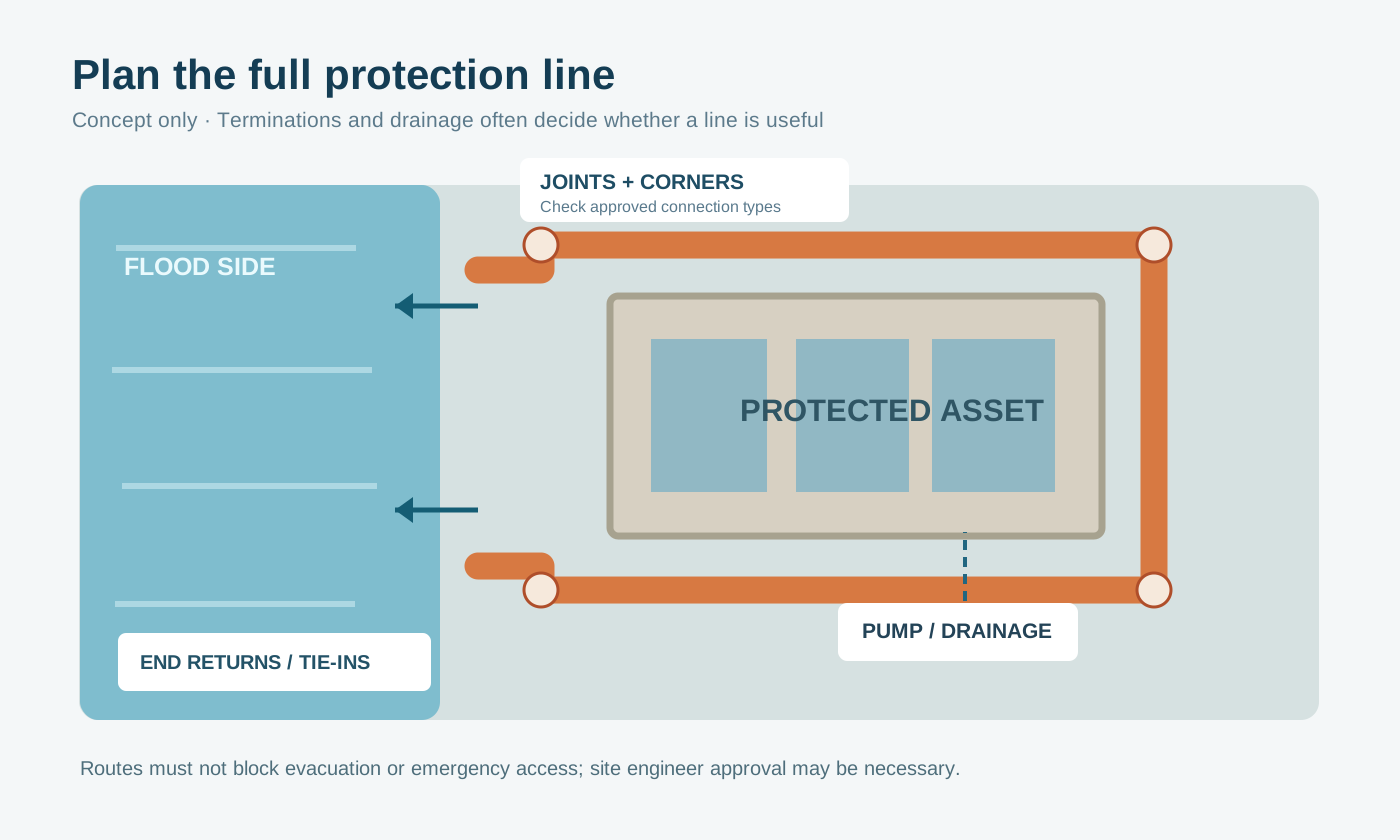
Deployment readiness depends on more than a low packing volume. A pre-season trial should confirm personnel roles, inflation equipment, power availability, line identification, leak checks, storage access and a backup plan if the barrier cannot be deployed before floodwater arrives.
Where air-filled flood barriers may fit
Municipal emergency inventory
Preplanned deployment for exposed roads or public assets where crews can train with the exact sections, their joints and inflation equipment before a flood warning.
Warehouses and manufacturing
Temporary protection around loading approaches and external entrances, with ground penetrations, site drains, utility rooms and protected-side pumping considered separately.
Infrastructure construction
Short-duration project protection at suitable surface transitions, subject to civil-engineering review of excavation edges, flow and subsurface water movement.
Commercial property planning
Seasonal or event-based flood preparation where protected entrances, perimeter closure, responsible operators and access to air-inflation equipment are defined in advance.
These are screening scenarios, not case-study claims or statements that DERFLEX has completed projects at named locations. Exposed riverbanks, fast flow, debris impact, tidal surge and critical infrastructure can require specialized flood-defence systems or additional engineered measures.
Air-filled tubes vs water-filled tubes vs sandbags
Choose based on proven installation behaviour and on-site resources rather than a universal claim that one product is always faster or stronger.
| Decision point | Air-filled barrier | Water-filled barrier | Sandbag line |
|---|---|---|---|
| Operating fill | Air for shape; separate stabilization method | Water as ballast plus structural geometry | Sand or aggregate in many small bags |
| On-site equipment | Blower, pressure checks, compatible connections | Water supply, pump, venting and drain plan | Fill material, bags, tools, transport and labour |
| Primary technical concern | Movement, air loss, joint sealing and ground interface | Rolling, underflow, mass distribution and filling logistics | Seepage, settlement and continuous placement |
| Potential storage pattern | Compact when deflated, subject to folding limitations | Compact when emptied and dried | Material and contamination dependent |
| Project review | Verified restraint + pressure / assembly evidence | Verified filled geometry + hydraulic evidence | Engineered line and adequate labor / materials |
Neither an air-filled tube nor a water-filled dam should be described as a substitute for permanent protection, local flood-warning systems or safe evacuation. For the broader material category, DERFLEX inflatable flood barriers covers additional fill concepts.
Confirm performance evidence and the complete supply boundary
What evidence matters?
- Product-specific installation manual, pressure limits, air-retention acceptance and recommended equipment.
- Approved sectional drawings, joints, end closures, apron or anchoring details and a site-condition statement.
- Selected material technical data and seam / valve verification relevant to the fabricated assembly.
- System-level flood performance records, where required, linked to the exact product geometry and installation method.
What is included in the quotation?
- Clarify whether the scope is fabric rolls, cut panels, fabricated tubes, accessories or a complete system.
- Separate blowers, hoses, pressure gauges, ground protections, restraints and spare parts unless included in writing.
- Ask about packaging, labelling, inspection records, replacement components, dispatch terms and required quantities.
- For critical sites, have the flood-risk design and approved installation conditions reviewed by qualified professionals.
Operating boundary: a temporary barrier can reduce risk but cannot promise zero leakage. Do not deploy a generic unverified system in fast-moving or hazardous water. Follow emergency authority advice and maintain access, monitoring and evacuation procedures.
What to send DERFLEX for a useful quotation
A short site sketch and a few critical conditions are enough to begin defining the appropriate material or assembly, even if a final engineering drawing is not yet available.
Recommended request details
- Site photos, location type and required defence route
- Expected retained-water depth, duration and flood dynamics
- Section length, bends, ends, obstacles and ground type
- Inflation power, equipment availability and maintenance plan
- Order quantity, destination, required documents, and timeline
What drives cost?
Material structure, fitted section dimensions, number and type of seams, valve specification, approved joints and restraints, accessories, inspection requirements, packing and order volume all affect a commercial quote. Without an agreed design and supply boundary, a per-metre price comparison can be misleading.
Do not assume a standard flood rating, minimum order, fixed lead time, installed service or on-site commissioning is included without the final offer.
Air Inflated Flood Barrier FAQs
Practical answers about the air fill, anchoring, flood rating and OEM specification process.
What is an air inflated flood barrier?
An air inflated flood barrier is a portable temporary defence that uses air pressure to give a flexible tube its shape. The installed system must also provide an approved way to resist sliding, rolling and underflow, such as a purpose-designed skirt, anchor or restraint arrangement.
Does an air filled flood barrier need anchors?
Not every design uses ground pins, but every air-filled system needs a verified stability method. Some proprietary systems use floodwater pressure on an extended skirt; others require mechanical restraint. Do not assume any DERFLEX configuration is self-anchoring without its specific drawings and performance evidence.
Can the barrier height equal the tube diameter?
No universal equivalence applies. The permissible retained-water depth is established for the exact system and site conditions, including ground slope, joints, underflow, flow velocity and freeboard. The inflated diameter alone is not a flood-protection rating.
How are air inflated flood barrier sections connected?
Possible interfaces include purpose-designed joint sleeves, covered couplings or other engineered connections. Their geometry, continuity, leakage behaviour and ability to tolerate changes of direction must be documented and validated for the chosen assembly.
Is an air-filled barrier better than a water-filled barrier?
Air filling can simplify transport and inflation logistics when air equipment is available, while water-filled barriers use contained water as ballast. Neither is universally superior. Compare site conditions, restraint method, warning time, equipment, required evidence and total deployment package.
What should an OEM buyer send to request a quote?
Send the protection-line drawing or site photos, target retained-water depth, total length, ground conditions, corners, air-inflation resources, quantity, delivery destination and required technical documentation. Clarify whether the order is for coated fabric, fabricated tubes or a complete verified system.
DERFLEX · Technical coated materials and project-led procurement. Guidance is for initial product selection; final flood-defence approval requires design- and site-specific review.