



Tarpaulin Container Loading: Plan the Shipment Before the Doors Close
For importers, distributors and tarp converters, container loading is not the last warehouse step—it is part of the product specification. DERFLEX helps buyers plan PVC tarpaulin rolls, finished tarps and mixed export orders around packed weight, package geometry, container type, handling method and repeat-order control.
What Does “Tarpaulin Container Loading” Mean for a Buyer?
In B2B tarpaulin purchasing, the phrase usually refers to how bulk tarpaulin products are packed, counted, arranged and released into a shipping container for export. The useful question is not merely “How many square meters fit?” but “How many approved packed units can be loaded safely and repeatably?”
The practical loading equation
Tarpaulin container loading quantity = the lower of the weight limit and the physical-fit limit.
For dense PVC rolls, payload may become the constraint before the container is full by volume. For folded finished tarps, cartons or mixed SKUs, cubic utilization and handling space may become more important.
Product format
Roll fabric, folded sheets, finished covers, cartons, pallets and hardware kits create different loading patterns.
Packed weight
Net fabric weight must be adjusted for cores, wrapping, cartons, straps, pallets and other packing materials.
Package geometry
Roll diameter, roll width, bale size and carton dimensions determine whether theoretical payload can actually be used.
Container choice
20GP, 40GP and 40HQ provide different volume and payload characteristics. Dense and bulky goods should be planned differently.
Loading method
Floor loading can improve volume use; pallets can simplify handling but consume payload and cubic space.
Delivery sequence
Mixed SKU orders should be loaded around unloading priority, labeling and inventory identification—not only maximum density.
Export Packing Is Part of the Tarpaulin Product
A bulk tarp order can leave the production line in several forms: wide PVC coated rolls for local converting, compact folded finished tarps, custom covers with grommets and webbing, or mixed private-label SKUs. Each format changes the container loading plan.
DERFLEX can discuss roll length, core direction, bundle dimensions, protective wrapping, pallet use, carton marks and mixed-order sequencing before production is released. This matters for buyers who need predictable warehouse receiving, faster SKU identification and repeatable replenishment rather than a one-time shipment that is difficult to reproduce.
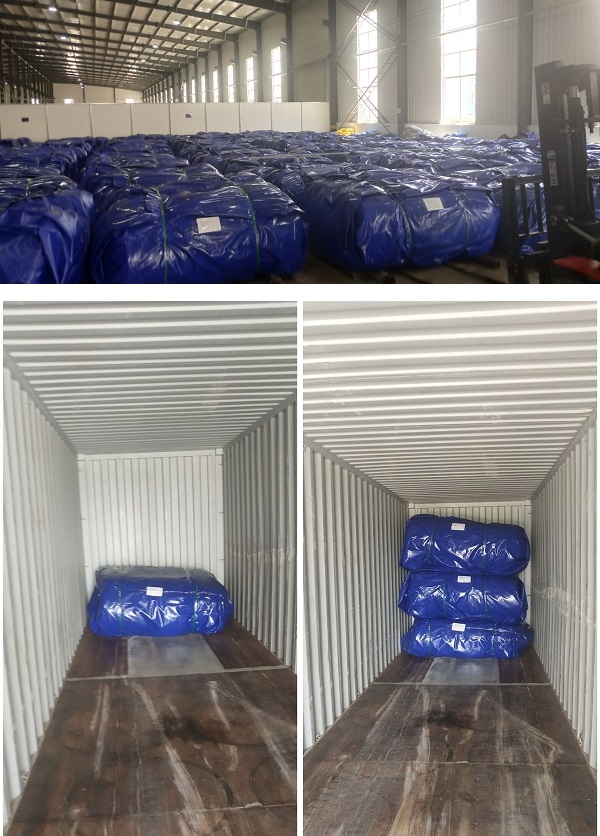
The image shown is a DERFLEX loading reference. It illustrates why the final container quantity should be calculated from the finished package specification rather than from fabric area alone.
Estimate Roll Weight Before You Estimate Container Quantity
The calculation below is a procurement planning tool. It estimates packed roll weight and a weight-based roll ceiling. The final loading quantity still requires a physical loading pattern, container specification, carrier release and local transport-limit check.
Roll weight formula
Net fabric weight (kg) = width (m) × roll length (m) × GSM ÷ 1,000
Packed roll weight adds the core, wrapping, labels and protective ends. A palletized plan also needs pallet and dunnage weight deducted from the available cargo payload.
Use the booked equipment's confirmed cargo limits rather than a generic internet capacity figure.20GP vs. 40GP vs. 40HQ for Tarpaulin Export Orders
Choosing a container by outside size alone can create an inefficient loading plan. The product density and package shape should drive the decision.
| Container direction | Often suitable when | Main planning risk | Buyer should confirm |
|---|---|---|---|
| 20GP | Dense PVC tarpaulin rolls, compact heavy bundles, smaller replenishment orders. | Payload may be reached before the internal volume is visually full. | Roll weight, floor loading pattern, weight distribution and receiving equipment. |
| 40GP | Longer or more numerous packages where standard-height volume is useful. | Long floor-loading runs can complicate SKU sequence and manual unloading. | Package orientation, unloading method, SKU map and moisture protection. |
| 40HQ | Bulky finished tarps, cartons, mixed private-label programs or palletized loads where extra cubic volume is helpful. | Extra height does not mean the container can carry proportionally more dense fabric by weight. | Payload, carton/pallet stack height, void space and destination warehouse constraints. |
Match the Packing Method to the Buyer’s Receiving Process
The most compact packing method is not automatically the most economical if it creates excessive unloading labor, damage risk or slow warehouse identification.
Roll goods
Specify width, roll length, core diameter, outer wrap, end protection, roll label and preferred orientation. Dense rolls often require careful weight-distribution planning.
Folded finished tarps
Define finished dimensions, fold size, pieces per bale/carton, hardware protection and lifting/handling needs. Grommets or D-rings should not be allowed to abrade adjacent products.
Palletized programs
Pallets can simplify forklift receiving and SKU segregation, while reducing the container space available for product. The trade-off should be deliberate.
Mixed SKU containers
Use carton or bale marks, SKU grouping and a loading map. Products needed first at destination should not be buried behind the longest-unloading sequence.
Private-label retail tarps
Retail cartons, inserts, labels and barcodes change both package cube and loading quantity. Approve the final packaging—not only the tarp—before the loading plan is locked.
Oversized custom covers
Large welded covers may need protective folding, edge padding and controlled hardware placement so repeated compression does not damage coated surfaces or accessories.
A Seven-Gate Tarpaulin Container Loading Process
A repeatable shipment is easier to control when packing and loading decisions are approved before the production batch is finished.
What to Check Before the Container Doors Are Sealed
The inspection point should connect the approved purchase specification with the actual shipment. Buyers can request evidence that supports receiving and traceability.
Product & package checks
- Product code, color, GSM and supply format match the packing list.
- Roll or bundle labels are readable and consistent with the approved SKU system.
- Outer wrap, end protection, straps and cartons are intact before loading.
- Metal grommets, D-rings or hooks are protected from rubbing against adjacent tarp surfaces.
- Mixed SKUs are grouped and sequenced according to the loading map.
Container & loading checks
- Container floor and walls are visually checked for contamination, standing water or obvious damage before loading.
- Weight is distributed according to the loading plan rather than concentrated at one end.
- Dunnage or moisture-control measures are used where the approved shipment plan requires them.
- Final package count is reconciled with the packing list before doors close.
- Loading photos and seal information are retained with the shipment record when required.
From PVC Coated Fabric Production to Export Loading Planning
For a repeat-order tarp program, loading efficiency starts upstream. Material construction, roll length, converting details and package format should be coordinated as one supply project.
| Supply item | Common discussion points | Why it matters to container loading |
|---|---|---|
| PVC coated tarpaulin rolls | GSM, width, roll length, surface finish, core, roll label and wrapping. | Roll weight and diameter directly affect weight-based and geometry-based loading limits. |
| Finished rectangular tarps | Size, welded seams, hems, grommets, webbing, fold size and pack unit. | Hardware and folded dimensions can make the shipment volume-limited rather than fabric-weight-limited. |
| Custom cargo covers | Drawing, reinforcement, shaped panels, accessories, printing and protective folding. | Irregular finished products need packaging designed around both protection and receiving efficiency. |
| OEM / private label | Color, logo, labels, cartons, barcode direction, assortment and mixed SKU ratio. | Retail-ready packaging changes cubic volume and makes loading sequence more important. |
Continue the Tarp Specification from Material to Shipment
These six DERFLEX pages connect container loading with the material, product and procurement decisions that determine the final package.
Tarpaulin Container Loading Questions
How do I calculate how many PVC tarpaulin rolls fit in a container?
Start with net roll weight: width × roll length × GSM ÷ 1,000. Add core and packing weight to obtain packed roll weight, then compare the weight-based count with a physical loading plan based on roll diameter, roll width and container dimensions. Use the lower practical quantity and retain a safety allowance.
Is 40HQ always better than 20GP for tarpaulin container loading?
No. A 40HQ provides more internal volume, but dense PVC tarpaulin rolls may reach a payload or transport limit before the extra volume is fully used. A 40HQ can be more attractive for bulky finished tarps, cartons, pallets or mixed SKU programs. Final selection should use the actual package and booked equipment specifications.
Can DERFLEX provide a loading quantity before I place an order?
DERFLEX can prepare a preliminary estimate after the product format, GSM, width, roll length or finished size, package dimensions, pallet method and container direction are known. The final quantity should be confirmed after the approved packing specification and loading layout are available.
Should PVC tarpaulin rolls be palletized for export?
It depends on the receiving process. Pallets can simplify forklift unloading and SKU control, but they add weight and consume cubic space. Floor loading may use container volume more efficiently, while requiring more unloading labor. The packing method should be agreed with the buyer before production.
What information should I send for a tarpaulin container-load quotation?
Send the tarp type or application, material/GSM, roll width and length or finished tarp size, total quantity, packing preference, pallet requirement, private-label details, destination and preferred container direction. If you already have a target pieces-per-container quantity, include it so feasibility can be reviewed.
Can different tarpaulin SKUs be mixed in one container?
Yes, subject to production and packing feasibility. A mixed-container plan should define SKU quantities, package marks, loading sequence and unloading priority. Color, size, GSM and private-label cartons should remain easy to identify when the shipment reaches the destination warehouse.
Send the Package Inputs—Not Just “One Container of Tarps”
DERFLEX can review a practical material, packing and loading direction when the order specification is clear. Final capacity, lead time and loading quantity are confirmed against the approved project details.
- Roll goods or finished tarps
- GSM, width, length or finished size
- Quantity and mixed-SKU ratio
- Core, bale, carton or pallet preference
- OEM label / private-label requirement
- Destination and preferred container type