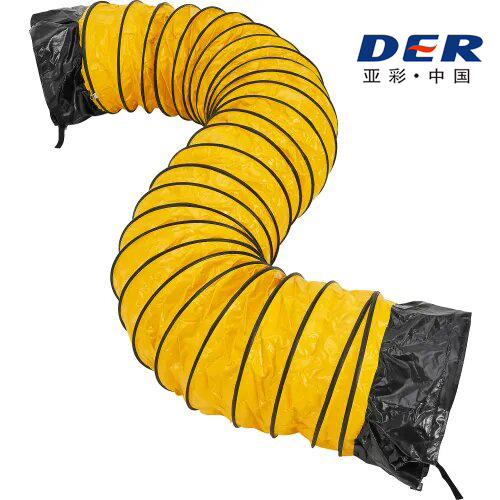
Layflat positive-pressure duct
Collapsible coated-textile duct that inflates when the fan supplies air. It is practical for long temporary routes where low packed volume, fast extension and suspended installation matter.



Project-configured flexible duct hose for industrial ventilation, portable blowers, fresh-air supply, fume extraction and temporary airflow systems—built for distributors, equipment OEMs, contractors and repeat procurement programs.
DERFLEX can coordinate coated textile, duct structure, wire reinforcement, seams, end cuffs, couplings, suspension details, color, marking and packaging as one finished supply specification. Final pressure, temperature, flame-retardant or antistatic performance is confirmed against the approved construction and requested test method.
A flexible duct hose is a bendable or collapsible conduit that carries air between a fan, machine, work zone, extraction point or discharge location. In industrial service, the phrase can describe several different constructions: a compact layflat tube for positive-pressure fresh-air supply, a spiral wire-supported hose for suction and exhaust, or a portable blower duct designed for repeated deployment.
Those products may look similar in a catalog, yet they respond differently to vacuum, fan pressure, bending, dragging and repeated compression. For wholesale buyers, selecting one generic hose by color and diameter can create avoidable returns or site problems. A better purchasing specification identifies pressure direction, media, temperature, route geometry, connection method and duty cycle before the final material and reinforcement are fixed.
DERFLEX focuses on project and industrial flexible ducting made from coated technical textiles. This is particularly relevant when buyers need larger diameters, compact packing, portable ventilation, custom lengths, blower interfaces, OEM identification or repeatable finished sections rather than retail HVAC flex duct.
A wholesale line can include more than one construction because different pressure directions need different mechanical behavior.
Collapsible coated-textile duct that inflates when the fan supplies air. It is practical for long temporary routes where low packed volume, fast extension and suspended installation matter.
A continuous helix helps the airway retain shape during extraction, suction, bends and portable blower connections. External wear protection can be added for high-contact handling.
Reducers, bends, branches, fan adapters, storage bags, straps, zippers and custom cuffs can be coordinated where a standard straight section does not complete the airflow route.
The hose body is commonly based on polyester textile with PVC coating. The textile contributes tensile and tear support, while the coating forms the air barrier and supports welding, cleaning and moisture resistance. Mechanical details around the body then determine whether the finished duct can hold shape, connect to equipment and survive repeated field handling.
For distributors and OEM buyers, this construction-based approach makes it easier to create a repeatable product family instead of relying on a vague “heavy duty hose” description.
Industrial flexible hose suppliers can quote more precisely when the RFQ describes the operating condition instead of sending only a keyword.
Confirm fan outlet, inside diameter, section length, total route and any maximum packed size. Undersizing can increase pressure loss; oversizing can add cost and handling burden.
State actual process and ambient temperatures. PVC-coated ducting suits many industrial ventilation duties, but it is not a universal choice for high-temperature exhaust.
Fresh air, dust, welding fumes, humidity, oil mist and chemical vapors impose different requirements on coating, seam construction and cleaning.
Positive-pressure supply can use collapsible structures; suction or extraction generally requires reinforcement against collapse.
Specify cuffs, rings, clamps, zippers, suspension and any named flame-retardant or antistatic test route before mass production.
Add annual demand, order frequency, packaging, SKU labels, private branding and replacement-section logic to create a more repeatable supply program.
The table is intended for early RFQ discussion. Final values should be governed by the approved drawing, datasheet, sample and project requirements.
| Specification field | Reference direction | Wholesale buyer note |
|---|---|---|
| Product form | Finished flexible ventilation duct / duct hose section | Can include duct body, reinforcement, seams, end interfaces and suspension details. |
| Base construction | PVC-coated polyester technical textile | Coating and textile construction are selected around duty, not appearance alone. |
| Duct structures | Layflat positive-pressure / spiral wire-reinforced / project-specific assembly | Choose according to supply, exhaust, suction or reversible airflow. |
| Reference diameter | Approx. 300–2000 mm for common industrial discussion; other project sizes reviewed separately | Final diameter depends on fan data, route length, airflow target and clearance. |
| Section length | Commonly 5 m / 10 m / 20 m or customized | Balance installation speed, packed size, connection count and replacement strategy. |
| Connection options | Cuff, ring, zipper, hook-and-loop, clamp interface, fan adapter | Send drawings or photos when matching an existing blower or duct system. |
| Suspension / handling | Eyelets, fins, straps, carrying handles, storage bag or project layout | Required spacing should reflect how the duct will be hung or moved on site. |
| Functional options | Flame-retardant, antistatic, abrasion-focused, high-visibility color, OEM marking | Specify the required test method and acceptance limit; options are not universal claims. |
| OEM / private label | Color, logo, label, SKU, carton / bag marking and packaging format | Useful for equipment brands, regional distributors and replacement-part programs. |
| MOQ / lead time | Confirmed by final size, structure, material, accessories and quantity | Ask for a project quotation rather than assuming one MOQ or delivery time for all duct types. |
A useful flexible duct hose wholesale program turns a first approved sample into a repeatable purchasing specification. DERFLEX can discuss finished duct assemblies, matching accessories and OEM details so distributors and equipment suppliers can standardize SKUs instead of re-defining the hose with every order.
Application determines the correct duct structure. The examples below help buyers describe the working condition more precisely.
Fresh-air delivery or extraction for tanks, vessels, basements, manholes, utility work and temporary maintenance zones.
Flexible links between extraction hoods, machines, work zones and exhaust points where rigid ductwork is inconvenient.
Temporary or advancing ventilation routes that may require large diameters, suspended sections, branches and project-defined flame/static requirements.
Portable air movement during building work, restoration, equipment-room maintenance and seasonal temporary climate control.
Spiral-supported duct routes for localized extraction where media compatibility and abrasion should be reviewed before selection.
Custom hose sections, matching fan interfaces, private markings and packaging for blower manufacturers, rental fleets and regional distributors.
For repeat business, quality control should follow the approved specification rather than depend on visual appearance alone.
Check diameter, section length, quantity, marking and any model / SKU information against the order sheet.
Review weld or seam continuity, helix placement, wear-strip details and any reinforced suspension zones.
Confirm cuffs, rings, zippers, hook-and-loop, clamps or adapters match the approved sample or drawing.
Where flame-retardant, antistatic or other project evidence is required, verify the report scope and ordered construction before shipment.
Check labels, section sequence, packed dimensions, storage bags and carton marks so field crews can identify the correct component quickly.
Six related internal pages help procurement teams compare finished duct formats, pressure direction, blower use and project safety options.
Short answers for importers, distributors, contractors, blower suppliers and industrial procurement teams.
Provide the application, airflow direction, fan outlet and pressure information, required diameter, section length, total route, temperature, media, connection method, suspension, quantity, destination and any named flame-retardant or antistatic test requirement. Packaging and private-label information also help when the order is for distribution or OEM supply.
Not always. Positive-pressure supply can use a collapsible or layflat duct, because airflow inflates the section. Negative-pressure extraction can collapse an unsupported tube, so a spiral wire or other shape-retaining support is generally required. Reversible systems should be specified for both operating directions.
Common industrial constructions use reinforced polyester textile with PVC coating, combined with welded or fabricated seams and, when required, steel-wire helix support. The final coating, textile structure and accessories should match the project environment.
Custom dimensions and interfaces can be discussed. A useful RFQ includes the fan outlet, hose diameter, section length, connection style and installation method. Non-standard adapters, reducers, bends or branches can also be reviewed from drawings or sample interfaces.
Yes, project-defined flame-retardant and antistatic configurations can be discussed. These are separate performance requirements, so the buyer should name the test method, classification or resistance limit needed for the project. Final evidence is confirmed against the approved ordered construction.
This page focuses on industrial and project-configured flexible ventilation duct hose for blowers, extraction, construction, tunnels, temporary HVAC and OEM equipment. Residential insulated HVAC flex duct uses different standards and construction priorities and should not be assumed to be the same product.
Send DERFLEX your airflow direction, diameter, section length, connection style, quantity and project conditions. The quotation can be built around the finished duct configuration rather than a generic hose description.