


Tarp with D-Rings
A tarp with D-rings is most useful when the fixing system needs defined connection points for hooks, webbing straps, buckles or repeated tensioning. DERFLEX develops custom heavy duty tarps by coordinating the PVC fabric, reinforced edge, D-ring position and pull direction as one fastening system.
Specify finished size, application, anchor locations, fabric duty level, D-ring layout, reinforcement method, color, branding and quantity. DERFLEX can discuss finished tarps, semi-finished panels or material supply for B2B programs.
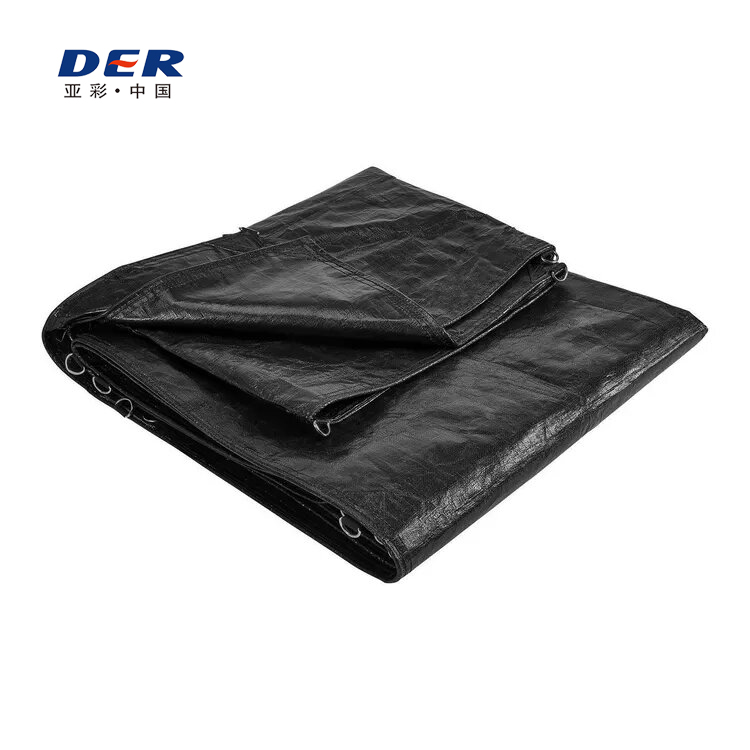
A D-ring tarp is not automatically stronger than a grommet tarp. Its advantage comes from how the ring is connected to webbing or reinforced fabric and how that reinforcement transfers pull into the tarp.
What Is a Tarp with D-Rings?
A tarp with D-rings is a protective cover fitted with metal D-shaped attachment rings at selected edges, corners or internal rows. The rings can connect to hooks, straps, buckles, rope systems or vehicle hardware without requiring every tie-down force to pass through a small eyelet opening.
For professional use, the important specification is the complete load path: ring size and finish, webbing tab, stitch or weld pattern, backing patch, hem construction, spacing, orientation and the position of the real anchor. This is why buyers should treat D-rings as part of the tarp structure rather than a simple accessory.
For truck-specific layouts, see DERFLEX's truck tarpaulin with D-rings. This page covers the broader product category for transport, equipment, construction, outdoor storage, agriculture and custom industrial covers.
Use the Hardware to Match the Connection, Not as a Substitute for Reinforcement
D-rings make sense when the installation uses hooks, straps or defined pull points and when the connection needs to be positioned away from the tarp edge or arranged in rows. The supporting fabric and webbing still determine how safely the load is distributed.
Defined Tie-Down Point
A D-ring gives a clear attachment point for hooks, ratchet straps, buckles and webbing systems, which can simplify installation and repeat positioning.
Reinforced Pull Zone
The ring can be connected to a wider webbing tab or reinforcement patch so force is transferred into more fabric than a small unsupported hole.
Custom Row Placement
D-rings can be positioned along edges, on vertical rows, near flaps or at selected stress points where a uniform grommet pattern would not match the anchor geometry.
Custom Tarp with D-Rings: Procurement Specification Options
The table below is a starting framework for quotation and sample development. It is not a universal performance guarantee. Final construction should be confirmed against application, approved drawing, material code and required test method.
| Specification Item | Typical / Custom Direction | What the Buyer Should Confirm |
|---|---|---|
| Main Fabric | PVC coated polyester is a common heavy-duty direction; laminated PVC, PE woven tarp, mesh or other project-based structures can be discussed. | Waterproof need, handling frequency, abrasion, outdoor exposure, welding/sewing route and target duty level. |
| Fabric Weight | Approx. 450–1200 gsm is a common discussion range across many DERFLEX PVC tarp programs; final grade depends on use. | Balance handling weight with tear/tensile demand, folding frequency, abrasion and finished cover size. |
| D-Ring Layout | Drawing-based spacing, edge rows, vertical rows, corner rings or selected stress-point positions. | Center-to-center positions, row height, ring orientation, distance from corners and real anchor locations. |
| D-Ring / Metal Finish | Galvanized, zinc-plated, stainless or project-specified metal direction depending on exposure. | Ring opening, wire size, corrosion environment, hook/strap compatibility and required finish. |
| Webbing & Backing | Individual webbing tabs, continuous perimeter webbing, double-layer tarp patches, corner patches or combined reinforcement. | Webbing width, overlap, stitch/weld pattern, patch size and direction of pull. |
| Edge Construction | Folded hem, welded hem, sewn hem, webbing-reinforced edge, rope-in-hem or mixed construction. | Hem width, reinforcement material, seam route and whether the edge is repeatedly tensioned or folded. |
| Seams | Hot-air welding, hot-wedge/HF welding, sewing or mixed fabrication where appropriate. | Panel width, water-shedding expectation, seam position and relation to high-stress areas. |
| Finished Size & Shape | Rectangle, square, drop-side cover, fitted equipment cover, flap, pocket, cut-out or drawing-based geometry. | Finished size vs. cut size, tolerance, datum points, overlap allowance and installation fit. |
| Surface / Functional Direction | UV-oriented, abrasion-resistant, cold-flexible, anti-mildew or flame-retardant options can be discussed by project. | State the actual target test method or market requirement before quotation; confirm on the selected material. |
| Branding & Packing | Custom color, logo printing, labels, bale/carton/pallet packing and private-label directions. | Artwork, color reference, label language, packing count, barcode and shipping requirements. |
Specification directions are based on current DERFLEX tarp product and technical guidance. Final values, tolerances and test requirements should be locked in the quotation and approved sample.
Which Fastening Method Fits the Job?
Many industrial covers use more than one fastening method. D-rings, grommets, straps and loops solve different connection problems, so the most practical layout often combines them by zone.
D-Rings
- Good connection for hooks, webbing straps and buckles.
- Can be mounted on a reinforced tab or continuous webbing row.
- Useful when the fixing point needs a specific orientation or row position.
- Requires clear control of ring size, tab length, backing area and pull angle.
Grommets / Eyelets
- Compact fixing points for rope, bungee and hooks.
- Efficient where regular perimeter lacing or multiple small tie points are needed.
- Strength depends heavily on hem, washer/backing area and aligned pull.
- For grommet-led products, review DERFLEX's tarp with grommets.
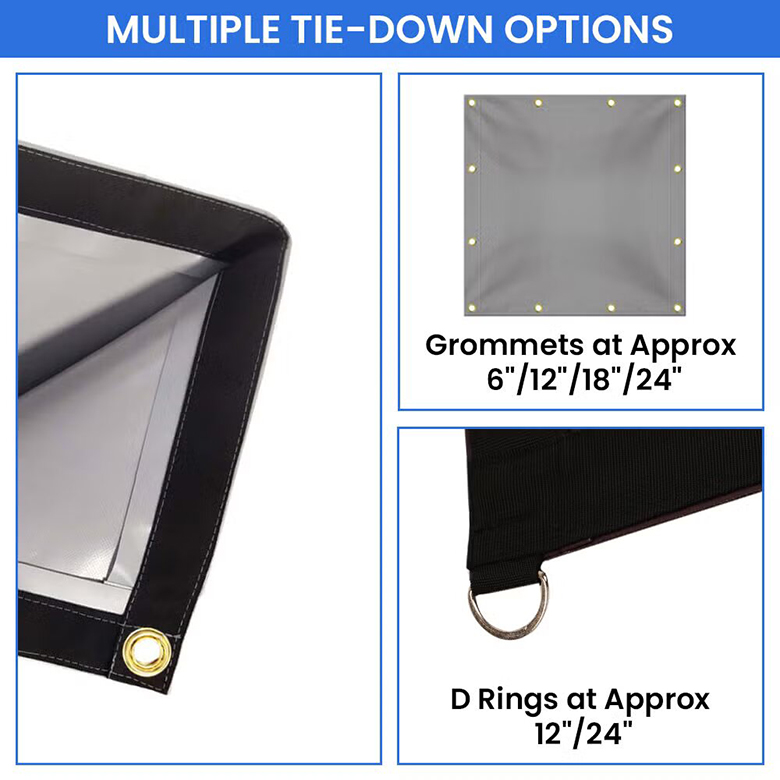
D-rings and grommets can be positioned at different intervals or combined according to the real tie-down method.
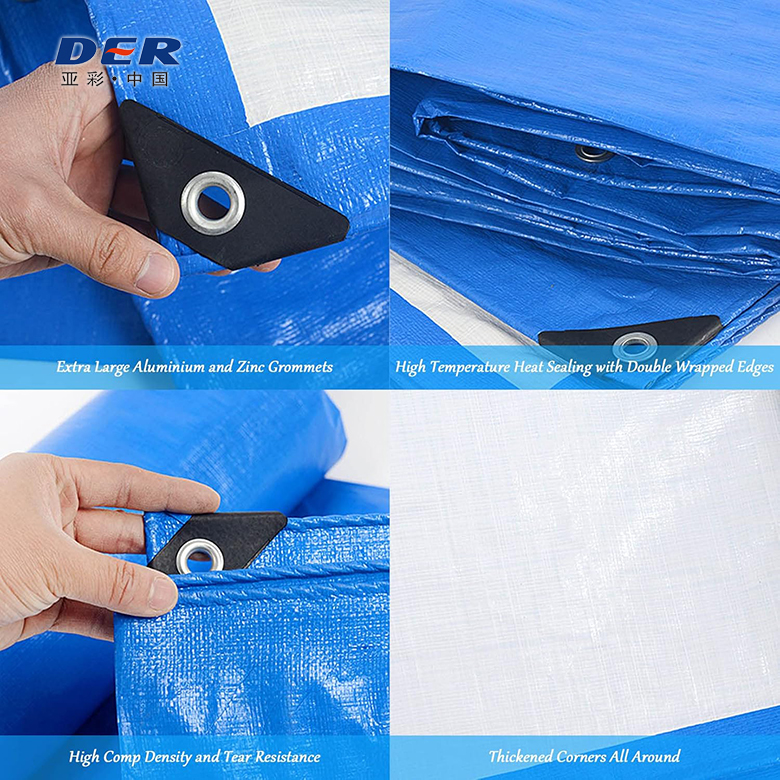
Corner patches, folded edges and compatible backing materials help spread tie-down force beyond a single hardware point.
How Far Apart Should D-Rings Be on a Tarp?
There is no universal D-ring spacing. The right layout depends on panel area, exposure, anchor positions, pull direction, edge reinforcement and how frequently the tarp is installed or retensioned. The following ranges are useful starting points for discussion, not fixed rules.
| Use Condition | Spacing / Layout Direction | Reinforcement Direction | Why It Matters |
|---|---|---|---|
| Truck, trailer or frequently handled cover | Approx. 12–18 in or drawing-based | Webbing-reinforced hem, reinforced corners and local wear patches | Dynamic wind, vibration, folding and repeated tension can create cyclic loading. |
| General equipment cover | Approx. 18–24 in where anchors support that layout | Double-fold hem or perimeter webbing with local patches | Good balance between usable tie points and manageable hardware density. |
| Large construction / temporary enclosure | Approx. 12–24 in depending on bay size and exposure | Wide reinforcement strip, rope hem, webbing or pockets | Larger exposed panels need better perimeter control; project engineering may be required. |
| Sheltered storage / lower-tension cover | Approx. 24–36 in where exposure and pull are low | Folded or welded hem; strengthen tied corners separately | Avoid unnecessary hardware while still controlling unsupported edge sections. |
| Fixed custom anchor pattern | Exact center-to-center drawing | Local patches designed around each pull direction | The anchor map should determine the hardware map rather than forcing standard spacing. |
If your main concern is perimeter strength rather than hardware type, compare this design logic with DERFLEX's tarp with reinforced edges.
Where D-Ring Tarps Make the Most Sense
Transport & Open-Deck Cargo
Use D-rings where hooks, straps or repeated tie-down points must align with trailer rails, rub rails or cargo geometry. Reinforcement should account for vibration, wind and folding.
Industrial Equipment Covers
Custom ring locations can line up with machine frames, legs or support brackets. Local wear patches are useful where the tarp touches corners, handles or moving components.
Construction & Site Protection
D-rings can simplify controlled tensioning around temporary covers, materials and equipment when the anchor pattern is known and the edge structure is designed for the pull.
Agriculture & Outdoor Storage
Large covers may need stronger corners, lower perimeter rows or selected strap points for hay, machinery and seasonal storage. Wind exposure and ground contact should guide the layout.
Warehouse & Industrial Curtains
D-rings, straps, grommets, pockets and loops can be combined where top suspension, side restraint, access and bottom control require different fastening methods.
OEM / Replacement Cover Programs
For repeat orders, control ring coordinates from defined datum points and keep the approved drawing, material direction, reinforcement detail and packing specification on record.
What Common D-Ring Tarp Damage Says About the Specification
Damage patterns often reveal a design issue before they reveal a fabric issue. Photos of failed covers are useful during redevelopment because they show where force, abrasion or misalignment actually occurred.
D-Ring Tab Peels or Rotates
The tab may be too short, reinforcement may not follow the pull direction, or the ring may be loaded sideways. Review orientation, overlap and backing area.
Corner Tear Starts Diagonally
The corner is carrying combined load from two edges. A larger patch, crossed webbing or dedicated corner ring can spread the force more gradually.
Edge Flaps Between Points
Spacing may be too wide, the cover may be oversized or the anchor line may sit too far from the edge. Check fit and tension before simply adding more hardware.
Strap Chafes the Coating
A hook, buckle or strap edge may rub the tarp during vibration. Reposition the connector or add a protective sleeve / abrasion patch where contact occurs.
Hardware Corrodes
Metal selection or surface finish may not suit salt, humidity, chemicals or outdoor exposure. Specify the environment before the hardware is locked.
Replacement Cover Does Not Align
Hardware positions may have been measured from inconsistent edges. Use defined datum points and an approved drawing for repeat production.
Build the D-Ring Assembly Around the Load Path
The center fabric, perimeter and attachment point should not be specified independently. A practical D-ring assembly usually needs enough backing area to spread pull away from the ring, while the webbing or patch should connect into a stable hem or reinforced zone.
PVC coated polyester is commonly selected for heavy duty waterproof covers because it supports welded fabrication and can be configured for different weights, finishes and functional directions. For a broader material overview, see DERFLEX PVC tarps.
If your business performs local cutting and hardware installation, DERFLEX can also discuss tarp fabric roll supply rather than finished covers.
Five Details to Mark on the Drawing
- Anchor geometry: frame, rail, hook, ground anchor or equipment connection point.
- Pull direction: outward, downward, lengthwise or diagonal.
- D-ring coordinates: spacing, row height, distance from corners and orientation.
- Reinforcement zone: webbing width, patch size, hem build-up and wear protection.
- Handling path: fold lines, roll-up areas, drag zones and access flaps that hardware should not obstruct.
From Field Requirement to Repeatable D-Ring Tarp
A controlled approval process reduces ambiguity in phrases such as “heavy duty D-ring,” “standard spacing” or “reinforced edge.” The objective is to turn the cover into a repeatable production specification.
Map the Installation
Provide finished dimensions, photos or drawings, frame geometry, anchor points, openings and expected pull directions.
Select the Fabric Duty Level
Match material structure to rain exposure, UV, abrasion, temperature, handling cycle, welding route and finished cover size.
Define D-Rings and Reinforcement
Confirm ring size/finish, webbing or patch design, row positions, orientation, hem construction and local wear zones.
Approve the Sample
Check finished dimensions, ring alignment, pull direction, weld/sew quality, edge flatness, folding behavior and fit on the real anchors.
Lock Repeat-Order Details
Reference the approved drawing revision, material code/direction, hardware map, labeling and packing method for future batches.
Material Production and Finished-Tarp Coordination
D-ring tarp quality depends on more than attaching hardware after a sheet is finished. Material width, panel seams, edge build-up, backing zones and the order of fabrication steps influence how consistently the final cover can be produced.
DERFLEX's manufacturing background in coated fabric enables buyers to discuss material supply and finished-tarp requirements in the same project. The exact fabrication route should be selected according to the chosen material and hardware construction.
- Material and finished-cover specification coordination
- Drawing-based size, edge and hardware positioning
- Custom color, logo and private-label packing direction
- Sample approval before repeat production
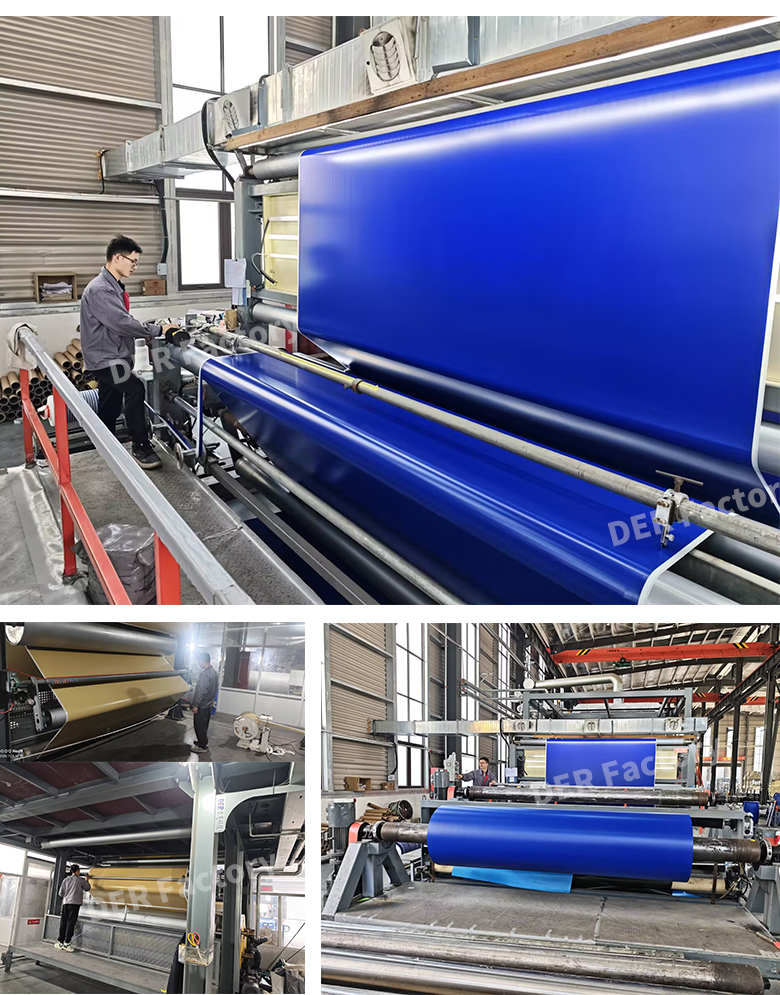
Final tarp construction and hardware details are confirmed according to the selected material and approved production specification.
What to Send for a More Accurate D-Ring Tarp Quote
The fastest way to reduce specification back-and-forth is to send a simple marked drawing or photos with the actual anchor points. Exact technical terminology is less important than showing how the tarp will be used.
- Application and service environment
- Finished length, width, drops, flaps and cut-outs
- Quantity and required supply format
- Preferred fabric weight / material direction
- Anchor positions and expected pull direction
- D-ring size, finish, spacing or drawing coordinates
- Hem, webbing, patch and corner reinforcement details
- Grommets, straps, pockets or loops used with D-rings
- Color, logo printing, labels and packing
- Destination market and any required test standard
Avoid These D-Ring Tarp Specification Problems
Copying a Spacing Number Without Mapping Anchors
A regular 12-inch or 24-inch pattern is only useful if those points can actually connect to the frame, rail or hooks. Otherwise straps pull diagonally and concentrate force.
Specifying “Heavy Duty” Without the Edge Detail
Fabric weight does not define D-ring pull resistance. State the reinforcement method, webbing/patch dimensions and ring position together.
Ignoring Fold Lines and Roll-Up Areas
Hardware placed on a frequent fold can damage the coating, make storage difficult or create abrasion. Mark the handling path before locking the ring map.
Approving Material but Not the Finished Sample
A material swatch cannot verify finished dimensions, hardware alignment, edge build-up or fit. For repeat B2B orders, approve the actual tarp construction.
Continue the Tarp Selection Process
These pages cover adjacent decisions without duplicating the role of this D-ring-focused product page.
Tarp with D-Rings: Buyer Questions
Are D-rings stronger than grommets on a tarp?
Not automatically. A D-ring can provide a practical connection for hooks and straps, but the usable strength depends on the fabric, webbing or patch, hem construction, stitch/weld pattern, ring orientation and pull direction. A well-reinforced grommet system may outperform a poorly attached D-ring.
How far apart should D-rings be on a heavy duty tarp?
There is no universal spacing. Approximate directions such as 12–18 inches for frequently handled transport covers, 18–24 inches for many equipment covers and wider spacing for sheltered low-tension covers can be useful starting points. Final positions should follow the actual anchors, panel size and edge reinforcement.
Can D-rings and grommets be used on the same tarp?
Yes. Mixed fastening systems are common. D-rings can be used at high-load corners or strap positions, while grommets can provide regular perimeter lacing. Straps, webbing loops and pockets can also be added in different zones.
What material is commonly used for a heavy duty tarp with D-rings?
,PVC coated polyester is a common direction for heavy duty waterproof covers because it combines a reinforced textile base with a coated surface and supports welded fabrication. The final fabric weight and structure should be selected for the actual application rather than by hardware type alone.
Can DERFLEX place D-rings according to my drawing?
Yes. A production drawing can define finished dimensions, D-ring coordinates, row heights, orientation, webbing or patch size, grommet positions, straps, pockets, cut-outs and wear zones. Photos of the frame or an old cover are also useful for the first sample.
What should I provide for a custom D-ring tarp quotation?
Provide the application, finished size, quantity, material direction or duty level, color, anchor layout, D-ring requirements, reinforcement method, other hardware, logo/label needs, packing method, destination and any required test standard. A marked drawing gives the clearest starting point.
Build the D-Ring Layout Around Your Real Anchor System
Send DERFLEX your application, finished dimensions, photos or drawing, quantity, preferred fabric direction, D-ring positions and reinforcement details. The team can review a practical material-and-finishing route for sampling and B2B quotation.
Product ranges and configuration examples on this page are selection directions only. Final material data, performance requirements, tolerances, test standards and commercial terms should be confirmed in the quotation, approved sample and purchase contract.