News
Company News

Tensile Strength vs Tear Strength in Tarpaulins | DERFLEX

Update:2026/7/28 18:18:07 Views:
Tarpaulin Performance & Buyer Guide

Tensile Strength vs Tear Strength in Tarpaulins

Tensile strength tells you how a tarp carries a distributed pulling load. Tear strength tells you whether a cut, puncture or damaged edge will keep spreading. Reliable tarpaulin selection requires both values—and the test method behind each number.

Uniform load Tensile Strength

Resistance to being pulled apart across an intact strip of tarpaulin.

Localized damage Tear Strength

Resistance to the growth of a pre-cut, nick, puncture or edge tear.

Two Different Failure Mechanisms

High Tensile Strength Does Not Automatically Mean High Tear Strength

Both properties describe mechanical durability, but they answer different procurement questions. Treating them as interchangeable can lead to a tarp that looks strong on paper yet fails at a corner, grommet, seam or small puncture.

01

What Is Tarpaulin Tensile Strength?

Tarpaulin tensile strength—often shown as breaking strength—is the maximum pulling force an intact coated-fabric specimen can withstand before rupture. It describes the load-bearing capacity of the polyester scrim when force is distributed across the material.

Most relevant to: tensioned covers, wind load, tie-down loading, suspended panels, large spans and dimensional stability.
02

What Is Tarpaulin Tear Strength?

Tarpaulin tear strength measures the force needed to initiate or continue a tear under a defined test method. It focuses on localized damage and the ability of yarns, coating and fabric construction to resist crack propagation.

Most relevant to: sharp cargo edges, punctures, snagging, grommet zones, reinforced corners, repeated handling and flapping in wind.
!

The Practical Buying Rule

Use tensile strength to judge how an undamaged tarp carries load. Use tear strength to judge how it behaves after damage begins. Then check abrasion resistance, coating adhesion, seam strength and edge reinforcement because field failure often involves several mechanisms at once.

Side-by-Side Comparison

Tensile Strength vs Tear Strength: What Each Result Tells a Buyer

A useful comparison must keep the specimen direction, unit, test method and conditioning consistent. Numbers from different methods should not be ranked as though they were equivalent.

Comparison Point Tensile Strength Tear Strength Buyer Interpretation
What is stressed? An intact strip or grabbed area of fabric A notched, cut or specially shaped specimen The tests reproduce different failure conditions.
Main question How much pulling load can the fabric carry before breaking? How much force is needed to start or continue a tear? Specify both when a tarp will be tensioned and exposed to damage.
Common reporting Often N/5 cm or another force-per-width format Often N, depending on the selected tear method Never compare figures without confirming the unit and specimen geometry.
Material drivers Yarn tenacity, denier, weave density, direction and coating integration Yarn mobility, yarn strength, weave, coating adhesion and damage geometry A denser weave may improve load distribution but does not guarantee the same increase in tear propagation resistance.
Typical failure location Across the fabric, seam or a heavily loaded span At cuts, punctures, edges, corners and attachment points Finished-cover design can be as important as the base fabric.
Direction Warp/longitudinal and weft/transverse Warp/longitudinal and weft/transverse Ask for both directions because woven tarpaulin is not always mechanically identical in each direction.
Testing Language Matters

Which Standards Are Used for Coated Tarpaulin Fabric?

A strength value is meaningful only when the supplier states how it was obtained. Coated-fabric standards use different specimen shapes and loading procedures, so the method must travel with the number.

Tensile / Breaking Strength

ISO 1421 and ASTM D751

  • ISO 1421:2016 covers tensile strength of rubber- or plastics-coated fabrics using strip and grab methods.
  • ASTM D751 includes breaking-strength procedures for coated fabrics, including grab and cut-strip approaches.
  • Results should identify the method, specimen direction, specimen width, conditioning and unit.
  • Elongation at break can add useful context where stretch and dimensional change matter.
Tear Resistance

ISO 4674-1 and ASTM D751

  • ISO 4674-1:2016 covers constant-rate tear testing and includes tongue-tear and trouser-tear methods.
  • ASTM D751 includes pendulum, tongue-tear and trapezoidal-tear procedures for coated fabrics.
  • Results from tongue, trouser, trapezoid or pendulum tests are not directly interchangeable.
  • Ask whether the reported value represents tear initiation, tear propagation, a peak or an average defined by the method.
Reading a Supplier Data Sheet

Five Details to Verify Before Comparing Tarpaulin Strength

Procurement teams can eliminate most specification confusion by checking the test basis before negotiating price, GSM or delivery.

1
Test standard and procedure

Confirm the exact ISO, ASTM, DIN or customer-specific method rather than accepting “tested” as sufficient.

2
Warp and weft values

Request both machine/longitudinal and cross/transverse directions for a woven tarp.

3
Unit and specimen width

Distinguish N from N/5 cm, N/mm and other formats. A number without its unit cannot be compared reliably.

4
Conditioning and ageing

For outdoor projects, ask whether values are original, wet, cold-conditioned or measured after UV/heat ageing.

5
Batch traceability

Confirm whether the report belongs to the proposed production grade and whether batch inspection can be documented.

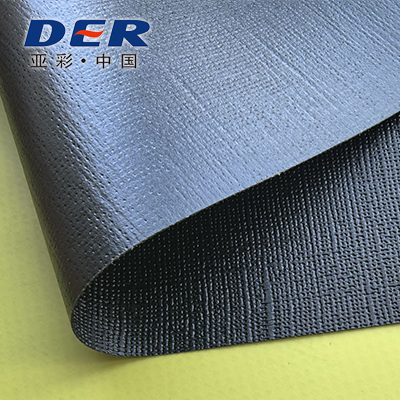
DERFLEX PVC coated polyester tarpaulin fabric close-up
DERFLEX PVC Coated Polyester Tarpaulin Woven polyester scrim and PVC coating form a configurable material system for industrial covers, transport tarps and custom fabrication.
DERFLEX Material Engineering

Strength Is Designed Through the Whole Tarpaulin Structure

DERFLEX can match the base yarn, weave density, fabric weight, coating process, surface treatment and finished-cover reinforcement to the expected load and damage risk. This is more useful than choosing a tarp from GSM alone.

Buyers can discuss PVC tarpaulin rolls, cut panels or finished custom covers, with performance requirements stated by direction and test method. Optional project directions include UV resistance, flame-retardant formulation, cold flexibility, anti-mildew treatment, color matching, printing, welded seams, hems, webbing, corner reinforcement and hardware layouts.

Custom denier & weave
Rolls or finished tarps
Warp/weft test reporting
Weld & edge engineering
UV / FR / cold options
OEM color & packaging
,
Illustrative Published DERFLEX Grade Example only: 610 gsm PVC-coated polyester construction. Final specification depends on the selected test method, sample approval and application.
Base Fabric 1000D × 1000D
Construction 20 × 20
Breaking Strength L/W ≈2550 / 2350 N/5 cm
Tearing Strength L/W ≈260 / 255 N
Do not transfer these example values to another GSM, weave, coating system or test method. Request a product-specific data sheet and approved sample for your order.
Application-Based Specification

Which Strength Property Matters Most in Your Tarpaulin Application?

The correct answer is usually “both,” but the dominant risk changes by installation, movement, environment and finished-cover design.

TRUCK / TRAILER

Transport Tarps

Wind pressure, tie-down force and cargo movement create tensile loading, while sharp edges, corners and hardware create tear initiation points.

Priority: tensile + tear + reinforcement
CONSTRUCTION

Site Covers & Enclosures

Scaffolding, steel edges, debris and repeated relocation make tear propagation and abrasion especially important under wind load.

Priority: tear + abrasion + tensile
TENT / CANOPY

Tensioned Fabric Systems

Continuous membrane tension and wind suction increase the importance of tensile capacity, dimensional stability, seams and local tear control.

Priority: tensile + seam + tear
AGRICULTURE

Hay, Grain & Equipment Covers

Outdoor ageing, repeated folding and rough ground contact can reduce retained strength even when initial laboratory values are adequate.

Priority: retained strength + UV + tear
WAREHOUSE

Dividers & Large Covers

Large panel size and attachment spacing affect load distribution. Edge, seam and hardware design should be reviewed with fabric tensile data.

Priority: tensile + edge integrity
MACHINERY / STEEL

Heavy Industrial Protection

Concentrated contact with hard corners can begin a cut, while lifting, handling and wind can propagate it through an under-reinforced panel.

Priority: tear + patches + abrasion
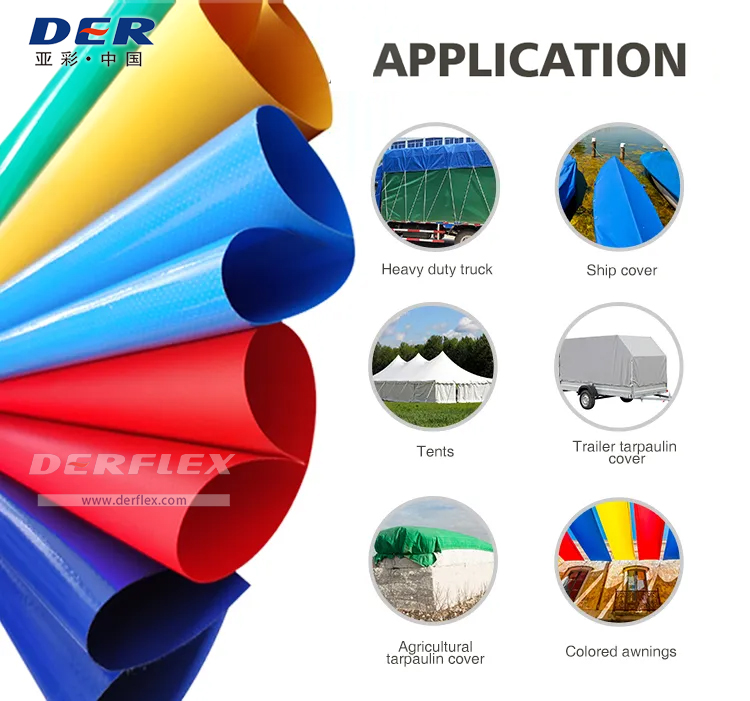
DERFLEX heavy duty tarpaulin fabric applications
Heavy-Duty PVC Tarpaulin Applications Truck covers, ship covers, tents, trailer covers, agricultural protection and awnings create different load and damage patterns.
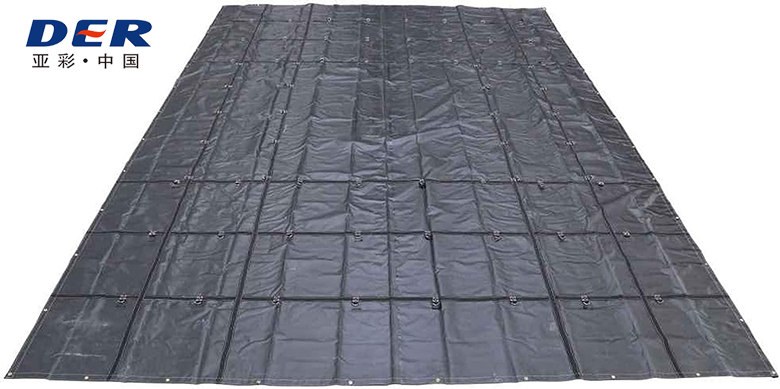
DERFLEX reinforced PVC steel tarp with hardware
Finished Tarp Reinforcement Webbing, seams, D-rings, grommets and corner layouts help distribute force beyond the base-fabric test values.
Procurement Workflow

How to Specify a Stronger Tarpaulin Without Overspecifying It

Higher numbers can increase material cost and weight without solving the actual failure point. Start with the duty profile, define the likely failure mode and then set measurable acceptance criteria.

Send Your Application Details

Map the load

Describe span size, wind exposure, tie-down tension, cargo movement, lifting, repeated folding and installation geometry.

Map the damage risk

Identify sharp edges, puncture hazards, rubbing surfaces, grommet stress, corner loading and likely snag points.

Choose the test language

State the agreed tensile and tear standards, methods, directions, units and whether aged performance is required.

Engineer the finished cover

Match welds, seams, hems, webbing, patches, rope edges, D-rings and grommet spacing to the fabric and load path.

Approve a sample and report

Confirm appearance, fabrication, key mechanical values and documentation before volume production.

Control repeat orders

Use a product code, approved construction and batch inspection plan to reduce variation across future supply.

FAQ

Frequently Asked Questions About Tarpaulin Strength

Concise answers for buyers, fabricators, distributors and project engineers comparing heavy-duty tarpaulin specifications.

Is tensile strength the same as tear strength in tarpaulins?

No. Tensile strength measures how much pulling force an intact specimen withstands before breaking. Tear strength measures resistance to starting or propagating a tear in a notched or cut specimen. They use different test geometries and should be specified separately.

Can a tarpaulin have high tensile strength but low tear strength?

Yes. A dense, high-strength fabric may carry a large distributed load but still allow a localized cut to spread if yarn mobility, coating adhesion, damage geometry or local reinforcement is unfavorable.

Which is more important for truck and trailer tarps?

Both are important. Tensile strength supports wind and tie-down loading, while tear strength helps control damage from cargo edges, punctures, corners and hardware. Reinforced hems, patches, webbing and attachment spacing must also be considered.

How should I compare tensile and tear values from different suppliers?

Compare only values produced with the same standard, procedure, direction, unit, specimen width and conditioning. Ask for warp and weft results and confirm that the report corresponds to the proposed material grade or batch.

Does higher GSM always mean a stronger tarpaulin?

Not necessarily. GSM includes the base textile and coating mass. Strength also depends on yarn denier, yarn tenacity, weave density, coating integration and finished-cover design. A heavier tarp can still fail at a weak edge, seam or attachment point.

What information should I send DERFLEX for a custom strength recommendation?

Provide the application, tarp dimensions, installation method, expected wind or pulling load, sharp-edge and abrasion risks, outdoor exposure, target service conditions, required standards, quantity, color, finishing and whether you need roll material or finished tarps.

Need a Tarpaulin Specification Built Around Real Load and Tear Risk?

Send DERFLEX your application, dimensions, fabric format, test requirement, reinforcement details and order quantity. The team can discuss a practical PVC-coated tarpaulin structure and sampling direction for your project.

Request A Quote
Technical values and service conditions should be confirmed through the agreed product specification, test method and approved sample before production.
Consulting Services
+86-021-54361792 / 54361798
Email
sales@derflex.com