
Surface barrier
Select a solid coated or laminated material suited to precipitation, temperature, sunlight and handling.



For demanding rain exposure, a heavy-duty PVC-coated polyester tarp is usually the strongest practical direction—but fabric alone does not keep a load dry.
For buyers comparing a heavy duty waterproof tarp, reliable protection also depends on welded seams, drainage slope, reinforced edges, correct overlap and a fastening layout that controls wind movement. DERFLEX helps importers, distributors, contractors and OEM buyers specify all of these elements together.
Search results often reduce the decision to a material name or a minimum thickness. Those factors matter, but severe rain exposes weaknesses that are easy to miss on a product label. Water can enter through needle holes, poorly joined panels, low points that collect a pond, loose overlaps, damaged coating or fastening points that have stretched under wind load.
A heavy-rain cover should therefore be specified as a temporary or reusable protection system. The sheet must block precipitation, the profile must drain, the perimeter must remain stable and every contact point must avoid cutting or rubbing through the coating.
Duration, wind, installation angle, exposed area, load shape, sharp edges, handling frequency and temperature all change the appropriate tarp construction. A compact machinery cover and a large temporary roof may use the same material family but need very different seams, reinforcements and anchoring.
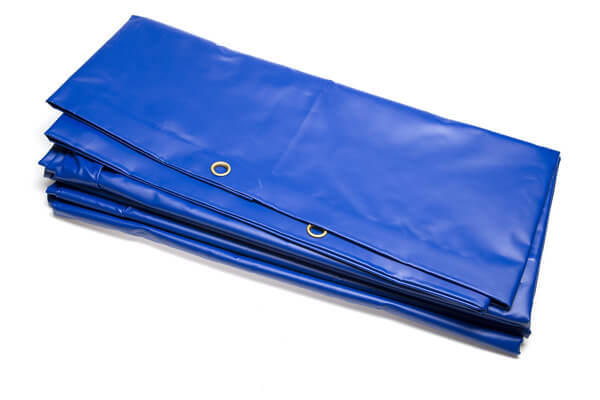
The right choice depends on whether the cover is temporary, reusable, breathable, mobile or exposed to abrasion. The table below is a procurement guide rather than a universal standard.
| Material direction | Heavy-rain suitability | Where it fits | Strengths | Points to confirm |
|---|---|---|---|---|
| PVC-coated polyester Preferred for repeat use | Strong direction for prolonged rain when seams and installation are correctly designed. | Equipment covers, construction, truck cargo, outdoor storage, temporary roofing and industrial protection. | Waterproof coating, strong scrim, weldability, abrasion resistance and flexible reinforcement options. | GSM, yarn structure, coating formula, cold flexibility, UV direction, seam design and edge hardware. |
| Heavy-duty PE / poly tarp | Useful for temporary rain protection and price-sensitive programs; heavier grades provide better field durability. | Emergency covering, short projects, general storage, seasonal use and high-volume retail ranges. | Lightweight, economical, waterproof construction and easier manual handling. | Actual finished size, mil or GSM, weave, UV treatment, heat-welded seams, corner reinforcement and expected reuse. |
| Treated canvas | Can shed rain, but many canvas products are water-resistant rather than intended for continuous saturation or ponding. | Breathable equipment covers, loads where condensation control matters and applications needing a softer surface. | Breathability, abrasion tolerance and reduced condensation in suitable installations. | Treatment type, shrinkage, maintenance, seam behavior, staining risk and whether full waterproofing is actually required. |
| Mesh tarp | Not suitable as the main waterproof layer. | Shade, debris control, privacy screening and lower-wind-pressure enclosures. | Airflow, visibility control and reduced wind loading compared with a solid sheet. | Do not substitute mesh for a waterproof solid tarp when the protected goods must remain dry. |
Retail poly-tarp guides often use mil thickness, while industrial PVC tarp procurement usually also considers GSM, base-fabric strength, coating method, seam construction and perimeter reinforcement.
Each layer controls a different failure path. Leaving one out can reduce the value of the others.
Select a solid coated or laminated material suited to precipitation, temperature, sunlight and handling.
Use appropriate welding or sealing, minimize unnecessary joints and orient seams with the water-shedding direction.
Create a continuous slope, remove low points and avoid wide unsupported spans where water can accumulate.
Distribute load through reinforced hems, webbing, rope edges, corner patches, D-rings or suitable grommets.
Use a fastening pattern matched to wind exposure, cover geometry, access requirements and inspection frequency.
These levels are a practical buying framework, not a formal weather standard. They help purchasing teams explain the intended use before requesting samples or quotations.
Short exposure, sheltered storage and limited wind. Lightweight waterproof structures may be sufficient when the cover is properly sloped.
Longer wet periods and repeated outdoor use. Give more attention to seam quality, UV stability, edge strength and mildew direction.
Large exposed surfaces, uplift and flapping can overload corners and grommets. Reinforcement and anchoring become central design decisions.
Do not rely on a flat tarp to hold standing water. Redesign the support and drainage system or use a purpose-engineered containment solution.
For reusable outdoor covers, project discussions commonly move from medium-duty PVC structures into heavier grades as span, abrasion, wind load and handling frequency increase. DERFLEX can discuss approximately 450–650 gsm for general reusable coverage, 650–900 gsm for more demanding roofing or equipment protection, and heavier structures for specialized industrial work. Final selection should be confirmed by sample and specification.
Discuss double-sided PVC coating or lamination, UV stabilization, anti-mildew treatment, lacquer or easy-clean finish, low-temperature flexibility and any market-specific flame-retardant direction. Requirements should be tied to the intended climate and test method.
Large covers normally require joined panels. Panel width, seam position and water-flow direction should be planned together. Hot-air or high-frequency welding can create continuous joints for compatible PVC structures, while sewn details may require additional waterproof design.
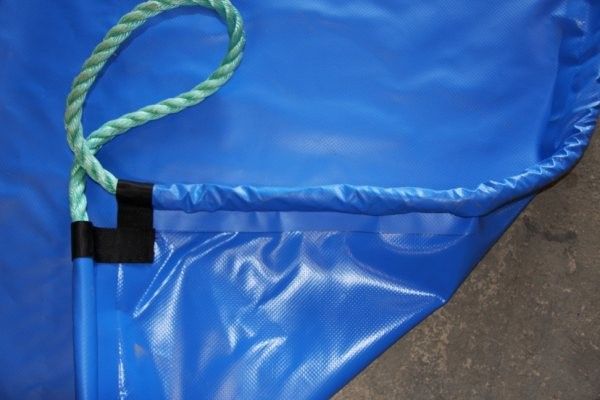
Specify double-fold hems, rope-in-hem, perimeter webbing, corner patches, D-rings, eyelets, straps or pockets according to how the tarp will be tensioned. Dense hardware spacing does not automatically solve a weak edge; load must be distributed into the fabric.
Confirm whether dimensions are cut size or finished size. Add enough side drop and overlap to protect the load without leaving excessive loose fabric. For roof-like use, include the slope, support spacing and runoff path in the drawing.
Approve color, hand feel, surface, weld quality, finished dimensions, reinforcement placement and packaging before volume production. For repeat programs, retain an approved sample and controlled specification to reduce variation between orders.
One material family can be converted into very different protection systems.
Prioritize waterproofing, road-wind stability, abrasion resistance, strong tie zones, repeated folding and accurate finished dimensions.
Plan slope, overlap, seam direction, perimeter restraint, sharp-edge protection and inspection after storms.
Use fitted shapes or controlled drape, protect protrusions, allow required ventilation and prevent water from collecting on flat surfaces.
Consider UV exposure, wet-season duration, mildew risk, ground moisture, access frequency and whether the stored product needs airflow.
Large covers need a panel plan, tie-down map, protected contact points and safe access for adjustment or inspection.
Build clearly separated economy, reusable and heavy-duty tiers with controlled labels, packing, sizes and performance claims.
DERFLEX , supplies PVC tarp roll material, cut panels, semi-finished sheets and fabricated covers. Specification options can be discussed for distributors, tarp converters, contractors, fleets and private-label product programs.
Use one before installation and the other before issuing a purchase order.
These six related pages cover waterproof products, PVC construction, outdoor resistance and customization in greater detail.
Clear answers for contractors, distributors, fabricators and industrial buyers.
For repeated, demanding outdoor use, heavy-duty PVC-coated polyester is usually the strongest practical direction because it combines a waterproof surface with reinforced fabric, weldability and customizable edge construction. Heavy-duty PE can be appropriate for temporary or price-sensitive coverage. Final performance depends on seams, slope, overlap and anchoring as well as the sheet material.
No. Thickness or GSM is only one indicator. Base-fabric strength, coating quality, seam construction, UV stability, edge reinforcement and installation geometry can matter just as much. An extremely heavy flat cover that ponds water or has weak fastening points may still fail.
PVC-coated polyester is often preferred for reusable industrial covers, long outdoor exposure, abrasion and custom welded fabrication. Poly tarps are lighter and commonly more economical for temporary protection. The appropriate choice depends on expected service, handling and budget rather than rain alone.
Water collects when the cover is too flat, the span is unsupported, the center sags or tie-down tension creates low pockets. A waterproof material does not solve ponding. Add a ridge, slope or support system and provide a clear runoff path.
Needle holes can become water-entry paths unless the seam is designed and treated for the required exposure. Compatible PVC fabrics can often be hot-air or high-frequency welded to form continuous joints. The correct method depends on material, load and fabrication design.
Common options include double-fold hems, rope-in-hem, perimeter webbing, corner patches, D-rings, straps and correctly installed eyelets. Reinforcement should distribute load into the fabric and match the tie-down direction rather than concentrating force around a single hole.
DERFLEX can discuss custom PVC tarp weight, finished size, panel layout, color, surface finish, welding, hems, webbing, ropes, eyelets, D-rings, logo printing, labels and packaging. Suitability and final specifications should be confirmed from the application details, drawing and approved sample.
Tell DERFLEX what must stay dry, how the cover will be supported, how it will be fastened, the expected weather, order quantity and target market. The team can then discuss a more relevant PVC tarp structure and finishing plan.