News
Industry News

How to Evaluate a Tarp Manufacturer | 12-Point Buyer Scorecard | DERFLEX

Update:2026/8/13 17:21:08 Views:
Procurement Guide · Factory Evaluation

How to Evaluate a Tarp Manufacturer

Compare suppliers with evidence, not adjectives. This buyer-focused framework turns factory capability, material control, sample testing, custom fabrication, delivery planning and repeat-order consistency into a practical evaluation process for importers, distributors, OEM brands and industrial procurement teams.

Quick Answer

Evaluate the system behind the tarp.

A tarp manufacturer should be assessed on its ability to translate your use conditions into a controlled specification, reproduce that specification in bulk and document what was actually supplied. Price matters, but it should be compared only after the technical scope is aligned.

For custom or repeat B2B programs, the most useful evidence usually includes a clear material construction, sample approval criteria, relevant test data, finishing details, tolerances, production timing, inspection method and a documented process for repeat orders or changes.

1. Specific answersThe supplier asks about application, exposure, size, fastening and expected use rather than quoting from a vague “heavy duty” description.
2. Traceable specificationsGSM, construction, coating direction, finish and test method can be connected to the sample and production order.
3. Fabrication evidenceWelding, sewing, hems, webbing, grommets, D-rings and reinforcement are discussed as engineering choices, not decoration.
4. Production realismLead time, minimum quantity, packaging and capacity are explained with assumptions and project dependencies.
5. Repeat-order disciplineThe manufacturer can explain how approved samples, revision records, color or material changes and inspection results are handled when you reorder.
12-Point Evaluation Matrix

Score a tarp manufacturer before the quotation becomes the decision.

Use the weighting below as a starting framework. Adjust the importance of each factor to your application, destination market and commercial risk.

Evaluation AreaWeightWhat to VerifyEvidence to Request
Application engineering12Can the supplier convert weather, abrasion, handling, wind, fastening and service conditions into a practical tarp structure?Requirement review, proposed structure, drawing comments, use-condition questions.
Material transparency12Is the substrate, denier/weave, PVC structure, nominal GSM, finish and functional treatment clearly identified?Technical data sheet, construction description, sample code, tolerance statement.
Manufacturing process scope12Which production stages are factory-controlled and which are outsourced? Can the supplier explain the process that affects your specification?Process flow, factory images/video, audit information, process responsibility map.
Testing and sample evidence12Are strength, tear, adhesion, waterproof, UV, FR or other claims linked to a test method and the actual grade being quoted?Sample, TDS, test report, inspection report, approved reference sample.
Custom fabrication capability10Can the manufacturer control seams, hems, webbing, reinforcement, eyelet spacing, D-rings, rope edge, printing and packaging?Finished-tarp photos, fabrication drawings, seam samples, hardware options.
Batch consistency & traceability10How are approved materials, colors, dimensions and revisions identified for bulk production and repeat orders?Lot references, retained sample policy, revision control, inspection records.
Capacity & lead-time planning8Is the delivery commitment based on product complexity, quantity, material availability, production slots and inspection?Production plan, realistic lead-time range, capacity assumptions, milestone updates.
OEM / private-label support8Can the supplier handle custom branding, labels, packaging, item codes and repeatable program specifications?Artwork workflow, label examples, packaging options, approval process.
Export packing & documentation6Can packaging, marks, palletization, documents and shipment requirements be matched to the destination and buyer process?Packing specification, document list, shipping marks, photo records.
Communication & change control5Are technical questions answered clearly? Are scope changes confirmed in writing before production?Revision records, pre-production confirmation, named point of contact.
Commercial transparency3Does the quotation identify what is included, MOQ assumptions, packaging, testing, tooling or special finishing costs?Itemized quotation and explicit exclusions.
Post-delivery response2Is there a defined way to document nonconformity, investigate causes and agree corrective action if needed?Complaint workflow, inspection reference, corrective-action process.

Interactive supplier screening tool

Choose Not Verified, Partial or Verified for each criterion. The weighted score updates automatically.

0of 100

Screening aid only. A numerical score does not replace product testing, contracts, regulatory review, factory audits or application-specific engineering.

Evidence Before Claims

Ask questions that force the quotation to become measurable.

Strong supplier evaluation is less about asking “Are your tarps heavy duty?” and more about asking what construction, test method, tolerance and fabrication detail supports the answer.

01

Material construction

Ask for the base fabric construction, nominal weight, coating/lamination direction, surface finish and any performance treatments that are relevant to your application.

02

Mechanical performance

Where strength matters, compare tensile and tear results by direction and confirm the test method. Do not treat values produced by different methods as directly equivalent.

03

Finished size & tolerance

Confirm whether dimensions are cut size or finished size, how seams affect dimensions and what production tolerance applies to the approved product.

04

Edge and hardware design

Review hem width, webbing, rope edge, corner patches, grommet material and spacing, D-rings and attachment points against expected tension and handling.

05

Environmental requirements

Specify exposure time, UV intensity, temperature, rain, snow, mildew, chemical contact or flame-retardant requirements rather than relying on generic marketing labels.

06

Production acceptance

Agree how samples, bulk inspection, packaging, markings and repeat-order references will be approved. The goal is to reduce interpretation after production has started.

Supplier Screening

Red flags are usually process gaps, not just bad answers.

A single missing document does not automatically disqualify a supplier. What matters is whether the manufacturer can explain the gap, provide a reasonable alternative and control the final specification.

Signals that require more checking

  • The quotation says only “PVC tarp” or “heavy duty” with no construction, weight or finishing detail.
  • Test values are supplied without a test method, grade reference or connection to the quoted product.
  • The supplier agrees to every requirement immediately without discussing technical tradeoffs or limitations.
  • Finished dimensions, reinforcement and hardware spacing are not confirmed before production.
  • Lead time is stated as a fixed promise without quantity, material availability or production assumptions.
  • Changes are handled informally through chat with no revised drawing, specification or order confirmation.
  • A repeat order cannot be linked to a retained sample, product code, batch reference or approved revision.

Signals of a controlled buying process

  • The manufacturer asks how the tarp will be installed, loaded, tied down, cleaned and stored.
  • Technical data and test evidence are presented with limitations, methods and product references.
  • The sample approval process includes dimensions, seams, reinforcement, hardware and appearance.
  • Production timing is tied to material, quantity, fabrication complexity and inspection steps.
  • OEM artwork, labels and packaging are approved as controlled production inputs.
  • Bulk inspection criteria are agreed before shipment rather than after a complaint.
  • Repeat orders use a defined reference to the approved specification and any authorized revisions.
Sample Evaluation

Use the sample to test the manufacturer’s control system.

A sample is not only for checking color and hand feel. It is your opportunity to connect the quotation, technical data, fabrication details and acceptance criteria before a bulk order.

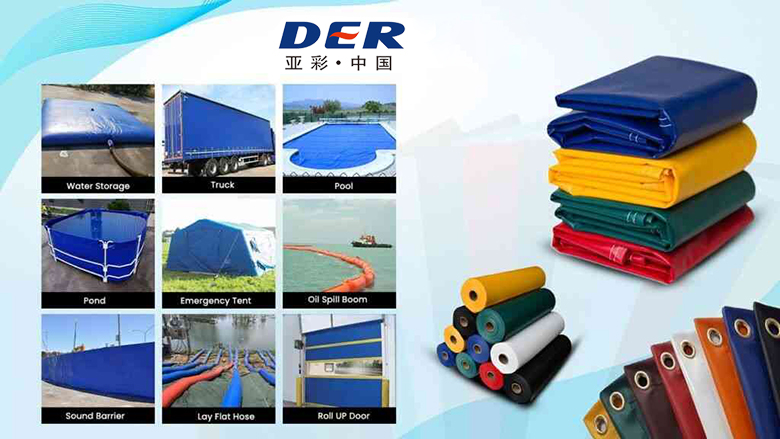
DERFLEX custom PVC tarp product and application display

Product display: PVC tarp materials and finished-cover applications

When evaluating a tarp manufacturer, request a sample that represents the construction and finishing method intended for the final order. Final specifications should be confirmed for each project.

Confirm sample identity

Product code, color, nominal GSM, construction, finish and revision should match the quoted grade.

Measure what affects fit

Check finished dimensions, seam allowance, hem width, grommet spacing, webbing placement and any custom cut-outs or flaps.

Review surface and fabrication

Look for coating uniformity, weld/seam quality, reinforcement alignment, edge finishing and hardware installation appropriate to the intended use.

Match test data to the sample

If tensile, tear, adhesion, waterproof, cold-flex, UV or FR performance is important, confirm that the evidence refers to the same or agreed equivalent construction.

Record acceptance criteria

Convert the approved sample into written checkpoints so bulk production can be inspected consistently.

Retain a reference

For repeat programs, keep an approved reference sample or documented master specification and define how authorized changes will be recorded.

Choose the Right Supply Model

Manufacturer, trader or online seller can each be useful—for different jobs.

The evaluation should match the buying task. A stock seller can be efficient for a standard replacement tarp; a manufacturing partner is more relevant when specification control, custom fabrication and repeatability matter.

Online tarp seller

Often suitable when speed, standard sizes and immediate availability are the priority.

  • Fast product selection
  • Standardized catalog choices
  • Useful for replacement or small-quantity purchases
  • Customization may be limited by stocked materials

Trading / sourcing supplier

Can coordinate multiple factories or product categories and may add sourcing convenience.

  • Broader sourcing network
  • Consolidation possibilities
  • Quality control depends on supplier management
  • Factory ownership and process control should be verified

Direct tarp manufacturer

Most relevant when the program depends on material structure, finishing details, OEM requirements or repeat production.

  • Closer link to production decisions
  • Custom material and fabrication options
  • Potential for specification-based repeat orders
  • Still requires evidence, sample approval and clear commercial terms
DERFLEX Procurement Workflow

Evaluate DERFLEX through your actual tarp specification.

DERFLEX presents PVC coated polyester tarp materials, finished heavy-duty tarps and OEM tarp programs for B2B applications. Available construction, fabrication, documentation, MOQ and performance should be confirmed against the final project requirements.

STEP 01

Application review

Share the use, environment, dimensions, fixing method, quantity and expected operating conditions.

STEP 02

Specification direction

Discuss material construction, nominal weight, finish, functional treatments and required fabrication.

STEP 03

Sample approval

Verify the physical sample, dimensions, finishing, evidence and acceptance criteria before bulk production.

STEP 04

Bulk control

Confirm production scope, inspection checkpoints, packing, labels, shipping marks and approved revisions.

STEP 05

Repeat-order reference

Use the approved specification and authorized changes as the basis for future production discussions.

RFQ Checklist

Give every manufacturer the same input.

A fair supplier comparison starts with a controlled RFQ. If different manufacturers quote different assumptions, the lowest unit price may not represent the same product.

Request A Quote
ApplicationTruck, construction, agriculture, equipment cover, storage, OEM or another use.
EnvironmentOutdoor duration, UV, temperature, abrasion, rain, snow, mildew or chemical contact.
DimensionsFinished size, shape, drawing, flaps, cut-outs and fit requirements.
Material directionExisting sample, target GSM/denier, PVC construction or performance-based requirement.
PerformanceTensile, tear, waterproof, FR, UV, cold-flex or other project-specific needs.
FabricationWelding/sewing, hems, webbing, grommets, D-rings, rope edge and reinforcement.
BrandingLogo, printing, labels, item codes, private-label packing and artwork approval.
Quantity & scheduleSample quantity, bulk quantity, delivery window, destination and shipping preference.
InspectionSample approval, test reports, pre-shipment inspection or third-party requirements.
Repeat programExpected reorder frequency, reference sample, change control and batch documentation.
Frequently Asked Questions

Questions buyers ask when comparing tarp manufacturers

What is the most important factor when evaluating a tarp manufacturer?

The most important factor is whether the supplier can convert your actual application into a controlled specification and reproduce it consistently. Material data, fabrication quality, testing, delivery and commercial terms should all connect to that specification.

Should I choose the tarp manufacturer with the lowest price?

Not before the scope is aligned. Compare quotations only after confirming material construction, finished dimensions, reinforcement, hardware, performance requirements, packaging, testing and quantity assumptions. A lower price for a different specification is not a like-for-like comparison.

How can I verify that a tarp supplier is a real manufacturer?

Request information that is difficult to answer without production knowledge: process scope, material construction, fabrication capability, factory audit evidence, sample traceability, inspection method and how repeat orders are controlled. If a trading company is involved, ask which production stages it controls and which factory will make your product.

What documents should I request before a bulk tarp order?

Depending on the project, useful documents may include the quotation, approved specification or drawing, technical data sheet, relevant test reports, sample approval record, packaging specification and agreed inspection criteria. Destination-market compliance should be reviewed separately for the actual application.

How do I evaluate a custom tarp sample?

Check identity, construction, finished dimensions, seams, reinforcement, grommet or D-ring layout, surface finish and any project-specific performance. Record the approved characteristics so production inspection and future reorders have an objective reference.

What should I send DERFLEX for a manufacturer evaluation or quotation?

Send the tarp application, dimensions or drawing, quantity, material direction or existing sample, color and finish, required performance, seam and reinforcement details, hardware layout, branding, packaging, destination and any testing or inspection scope. DERFLEX can then discuss an appropriate material and fabrication direction for confirmation.

Turn your tarp requirement into an auditable supplier comparison.

Send DERFLEX the same specification you are using to evaluate other manufacturers. Compare the response on technical clarity, sample evidence, fabrication detail, delivery assumptions and repeat-order control—not just the headline unit price.

Note: Product performance, tolerances, test requirements, documentation, MOQ, production capability and delivery timing should be confirmed for the final specification, quantity, destination and order conditions. The evaluation framework on this page is intended as a procurement screening aid.

Consulting Services
+86-021-54361792 / 54361798
Email
sales@derflex.com