


 ARCHITECTURAL MEMBRANE MATERIALS
PVC vs PVDF Membrane: Choose the Right Architectural Fabric
For tensile roofs and canopies, the useful comparison is usually PVC-coated polyester with a specified surface finish versus PVC-coated polyester with a PVDF topcoat. The textile carries the tensile load; PVC provides the flexible weather barrier; the surface finish affects cleanability, weathering and fabrication. This guide helps architects, membrane fabricators and project buyers compare the complete construction, approve samples and prepare a clear material RFQ for DERFLEX.
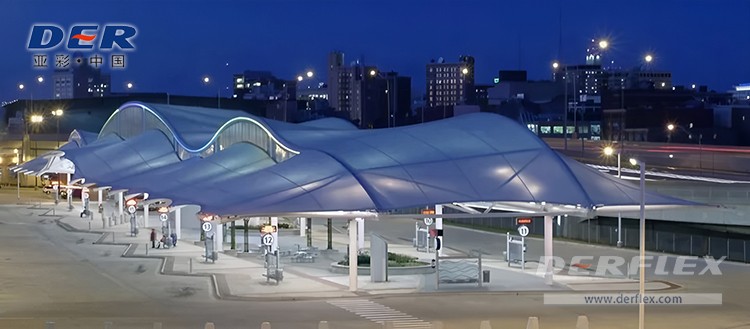
What does “PVDF membrane” actually mean?
In architectural coated textiles, PVDF membrane usually means a PVDF-finished PVC-coated fabric, rather than a sheet made entirely of PVDF. PVC stands for polyvinyl chloride. PVDF stands for polyvinylidene fluoride, a fluoropolymer used in protective lacquer systems. Ask what lies underneath the finish and which side is treated before comparing two offers.
A quotation reading only “PVC” may describe an unlacquered material, an acrylic-finished architectural fabric or another specified surface system. A quotation reading “PVDF” may describe different lacquer formulations, one-sided or two-sided treatment, and different welding requirements. Those names are a starting point, rather than a complete specification.
PVC membrane with non-PVDF finish
Specify the actual surface, for example an architectural acrylic lacquer, instead of assuming that all PVC fabrics have the same finish.
PVC membrane with PVDF topcoat
The principal difference is the specified protective surface. Reinforcement and PVC formulation must still be compared separately.
Layer diagrams are schematic and not to scale. Primers, adhesion layers and backside lacquer vary by product. This guide concerns architectural textiles, rather than porous PVDF filtration membranes or the full design of single-ply roof assemblies.
Explore the material family in DERFLEX PVC architectural membrane and the specific surface route in PVDF lacquered PVC membrane.
PVC vs PVDF membrane: the practical comparison
Hold the reinforcement grade, intended application and test conditions constant wherever possible. A surface upgrade can be useful, but it cannot replace a suitable structural textile or compensate for a poorly made seam.
On small screens, scroll inside the table to compare all columns.
| Buying criterion | Specified non-PVDF PVC system | Specified PVC/PVDF system |
|---|---|---|
| Material identity | Reinforced PVC fabric; identify the actual lacquer or surface treatment. | Reinforced PVC fabric with a PVDF-based topcoat; identify front and back finishes. |
| Tensile performance | Depends on reinforcement, fabric construction and the finished composite. | Must be checked independently. The PVDF name alone does not establish strength. |
| Water protection | Continuous coating provides the material barrier; seams and details need verification. | The underlying PVC coating remains important. Topcoat selection does not approve the assembly. |
| Dirt release | Depends on the specified finish and the approved cleaning routine. | Often selected for easier dirt release and appearance retention; grade-specific evidence matters. |
| Outdoor weathering | Assess PVC formulation, stabilizers, finish and exposure conditions. | Assess the full coating system, including topcoat weathering and retained properties. |
| Welding | Qualify the exact finish and equipment combination. | May be directly weldable or require approved surface preparation. |
| Fire performance | Requires a report for the selected construction and intended use. | Requires its own applicable evidence. PVDF is not a fire classification. |
| Light and color | Check color, translucency and opacity on the actual grade. | Check the same properties; a PVDF label does not specify solar or daylight performance. |
| Maintenance | Plan cleaning access, inspection and compatible repairs. | Keep the same planning; an easy-clean finish does not remove maintenance. |
| Cost decision | Compare the offered material with the required approval and fabrication scope. | Evaluate any topcoat premium alongside preparation, welding, cleaning and replacement costs. |
Ask for a complete material description. “PVC-coated high-tenacity polyester, specified top and back finishes, agreed tensile grade and approved fabrication procedure” is more useful than “premium PVDF” without supporting documents.
Does PVDF make a membrane stronger or longer lasting?
Strength follows the full construction
The textile reinforcement is central to load-bearing behavior. Compare tensile values in both warp and weft, elongation, tear resistance and coating adhesion. The structural designer also needs suitable information about the membrane’s response under the intended loading, rather than a single maximum breaking-force number.
A change from one surface finish to another does not prove that two fabrics have equivalent structural behavior. Even two rolls with the same area weight can have different yarns, coating distribution and mechanical characteristics. PVC fabric for tensile structures should be selected against the project performance brief.
Durability follows exposure and care
PVDF-based finishes are used to support surface protection and cleanability, but service depends on the exact formulation and site conditions. UV exposure, airborne contamination, ponding, repeated movement, abrasion and the cleaning method all belong in the comparison.
Keep appearance expectations separate from structural serviceability and from warranty coverage. A supplier’s exposure test or warranty for one product cannot be transferred to a different formulation. Laboratory weathering hours do not provide a universal conversion into outdoor years.
For humidity-sensitive edges and seam zones, also review low-wick tensile membrane. A surface topcoat and anti-capillary treatment address different parts of the construction; neither replaces protected edges and sound detailing.
Look at the surface, then verify the specification
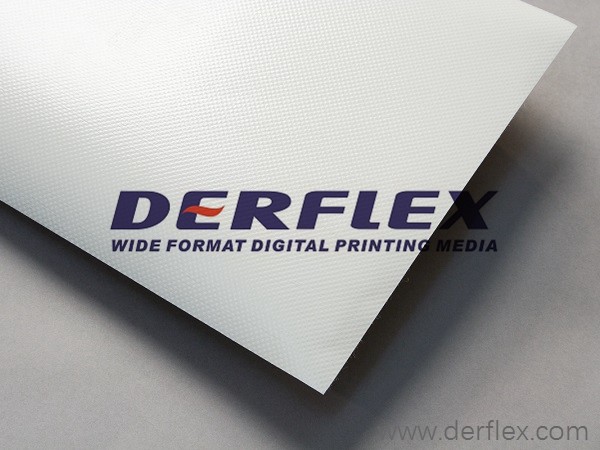
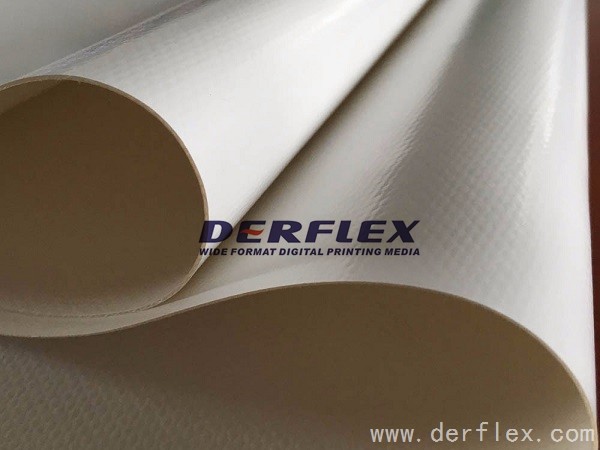
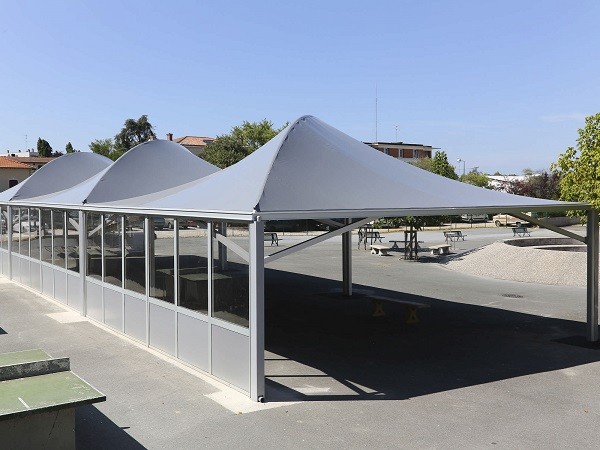
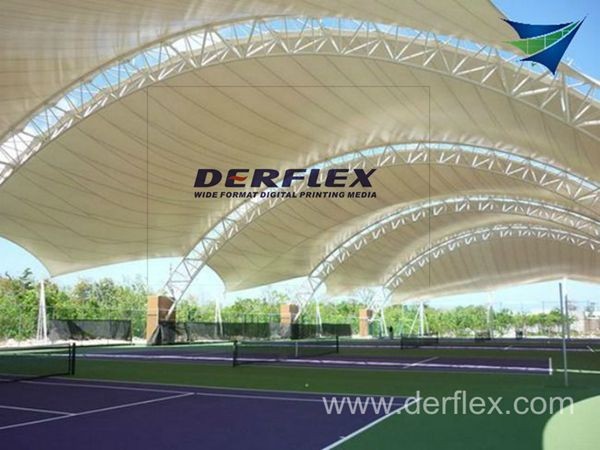
These existing DERFLEX website images show coated fabric and architectural uses. Appearance alone cannot establish PVDF chemistry, a fire rating, seam strength or a documented project supply history.
Can you weld PVDF-coated PVC membrane?
Suitable PVC/PVDF grades can be welded, but not every PVDF finish is processed in the same way. Some architectural products are directly weldable; others require manufacturer-approved preparation in the joining area. “PVDF cannot be welded” and “all PVDF welds exactly like ordinary PVC” are both unreliable rules.
Identify the actual surface system
Obtain front and back coating descriptions and the supplier’s joining instructions. Check which face enters the overlap and whether patches, hems or multilayer corners require a different procedure.
Qualify the fabricator’s process
Use the proposed production fabric, equipment and representative seam layout. Agree on the preparation, overlap and acceptance method. Record settings established by trials; do not copy a generic temperature or speed from another material.
Check more than a flat seam coupon
Evaluate the joints that matter to the project: primary panel seams, reinforcement patches, edge pockets and repair interfaces. Review the failure location and retained performance under the agreed conditioning, as well as the measured result.
Preserve the approved route in production
Link approved samples, roll lots and fabrication records. If the grade, finish, equipment or process changes, review whether the qualification still applies. Keep a retained sample and traceable records for later inspection or repair.
Where surface preparation is required, control it through the approved work instruction. Uncontrolled abrasion can harm the coating or reinforcement. Repairing an aged or contaminated membrane also needs a separate assessment rather than assuming a new-fabric weld trial is sufficient.
Which membrane should you choose for your application?
A PVC membrane with an appropriate non-PVDF finish can be a practical option when it meets the project’s documented requirements. Compare a PVDF-finished grade where exterior appearance, cleaning access or persistent exposure makes surface performance especially important. Neither route is automatically right for every roof.
Scroll within this table on smaller screens.
| Project condition | Selection focus | Evidence or boundary |
|---|---|---|
| Budget-led canopy with accessible cleaning | Compare a suitable architectural PVC/non-PVDF grade with the equivalent PVC/PVDF option. | Use equal strength, fire-document and fabrication requirements; compare total scope. |
| Highly visible permanent roof | Give greater weight to appearance retention, dirt release and a realistic maintenance plan. | Request grade-specific exposure information, cleaning guidance and warranty conditions. |
| Urban pollution or difficult cleaning access | Review a PVDF-finished option together with roof drainage and access planning. | Surface treatment does not eliminate cleaning or make every deposit washable. |
| Humid site or vulnerable cut edges | Review low-wick reinforcement, edge protection and coating continuity. | PVDF topcoat alone does not specify anti-capillary behavior inside exposed yarns. |
| Frequent dismantling or folding | Assess flexibility, crease damage, abrasion and the packing method. | Evaluate representative handling cycles; a high-gloss surface is not a fold-durability result. |
| Long span or demanding structural conditions | Let the designer define material, seam and connection requirements before surface selection. | GSM, thickness and PVDF branding cannot establish whole-structure wind or snow capacity. |
For a broader family comparison, see membrane structure materials. A change to another material family requires a fresh design and fabrication review.
What should you compare before approving a membrane?
Request a matched comparison rather than two unrelated sample swatches. Ask each supplier to identify the exact grade, supplied side finishes, test methods, tolerances and document revision. Mark every sample with its grade and lot so that the approved reference remains useful when the bulk rolls arrive.
The evidence table scrolls horizontally on small screens.
| Check | What to request | Approval decision |
|---|---|---|
| Identity and dimensions | Construction, front/back finish, area weight in g/m², thickness in mm, usable width and tolerances. | Confirm that the quoted grade and received sample are the same construction. |
| Mechanical properties | Warp/weft tensile and tear data, elongation, coating adhesion and relevant conditioning. | Compare equivalent methods, units and directions against the design brief. |
| Fabricated seams | Joining instructions and trial results for representative seams and reinforcement details. | Approve the exact fabric/process combination with the fabricator and designer. |
| Weathering and appearance | Exposure method, conditions, evaluation criteria and retained properties for the selected grade. | Separate measured evidence from marketing lifespan statements. |
| Color and light | Approved physical sample and relevant optical data for the intended color and construction. | Agree on appearance and allowable variation; avoid approving from a screen image. |
| Fire documentation | Applicable classification/report, specimen construction and test scope required for the project. | Check that the document covers the proposed grade and intended use. |
Weight is a control value, rather than a strength grade. GSM measures mass per unit area; thickness measures depth. Neither determines the yarn strength or surface chemistry by itself. Keep fabric results separate from engineered assembly performance and obtain the appropriate project approvals.
Is PVDF membrane worth the additional cost?
Evaluate any quoted PVDF premium against the actual benefit required: easier cleaning, appearance retention or another documented surface requirement. A lower roll price may be attractive for one project, while another project places greater value on cleaning access and long-term appearance. The decision needs the buyer’s operating plan and comparable offers.
Material and fabrication cost
Compare reinforcement grade, PVC formulation, lacquer treatment, color, usable width, order quantity and packing. Then include cutting utilization, required surface preparation, welding trials and fabrication labor. Wider material only helps if the panel layout and equipment can use it efficiently.
Ownership and maintenance cost
Compare access equipment, cleaning frequency, approved products, inspection, repair and eventual replacement. Use the owner’s assumptions consistently. Avoid converting “easy clean” into a claimed saving without a supported maintenance schedule and actual project costs.
No universal price per square meter or payback period applies to every PVC/PVDF membrane. Ask DERFLEX for a quotation based on the same technical brief, quantity and delivery scope. For material supply discussions, use the PVC/PVDF tensile membrane fabric supply page.
Prepare a clear material RFQ
DERFLEX offers architectural membrane material options in roll form. Use the inquiry to agree on the construction, sample review and documentation required for your application. Patterning, finished panel fabrication, hardware, structural calculations and installation need their own confirmed scope.
Tell us about the project
- Structure type, location and expected outdoor exposure.
- Drawings, approximate dimensions or application photographs.
- The designer’s required material and seam performance.
- Surface preference, exposed side, color and daylight requirements.
Tell us about the supply
- Roll quantity, required usable width and packing needs.
- Fabrication equipment and proposed seam construction.
- Fire-document and other approval requirements.
- Delivery destination, planned date and requested quotation scope.
Before production, agree on the approved sample, roll identification and acceptance criteria. Before installation, review drainage, clamp contact, exposed edges and the maintenance route with the responsible fabricator or designer. Do not substitute a different coating system without reviewing the effect on welding, documentation and approvals.
PVC vs PVDF membrane FAQ
What is the main difference between PVC and PVDF membrane?
For tensile architecture, PVC is the principal coating on a reinforced textile, while PVDF commonly describes a protective topcoat on that PVC-coated fabric. Compare the specified PVC surface finish with the proposed PVC/PVDF system, including reinforcement, coating formulation and fabrication requirements.
Is PVDF membrane stronger than PVC membrane?
A PVDF topcoat does not by itself establish higher structural strength. Compare warp and weft tensile results, tear resistance, elongation, seam performance and the structural designer’s requirements for the exact grades. A lighter PVDF-finished grade may have lower tensile strength than a heavier PVC grade.
Can PVDF-coated PVC membrane be welded?
Yes, suitable grades can be welded, but the surface system determines the procedure. Directly weldable grades and grades requiring approved surface preparation both exist. Obtain the manufacturer’s instructions and qualify representative seams, reinforcement patches and repairs before production.
How long do PVC and PVDF membranes last outdoors?
There is no reliable universal lifespan for either label. Grade, climate, UV exposure, prestress, drainage, pollution, cleaning and damage all affect service. Ask for the exact product’s documented warranty terms and relevant weathering evidence; accelerated exposure hours do not directly equal years in service.
Is PVDF membrane completely self-cleaning?
No. A suitable PVDF topcoat can make dirt release and cleaning easier, but rainfall does not remove every deposit. Roof geometry, local pollution and the approved cleaning routine still matter. Do not use unapproved solvents, abrasives or pressure-washing settings.
What should I send DERFLEX for a membrane quotation?
Send the project location, structure type, drawings or dimensions, required material performance, surface preference, color, roll quantity, fabrication method, fire-document requirements and delivery destination. If the grade is undecided, include the application photos and the designer’s performance brief.
Compare the membrane your project actually needs
Send DERFLEX your application, drawings, exposure conditions and performance brief. Request a PVC or PVC/PVDF roll-material proposal with the surface system, fabrication considerations and supply scope clearly identified.