



PU Leather Jacket Material for Fashion & OEM Apparel
Select polyurethane synthetic leather for jackets by how it moves, folds and sews—not by its leather grain alone. DERFLEX supports PU leather roll-material enquiries for apparel brands, fabric importers and garment manufacturers seeking controlled surface design and production-ready specifications. For a jacket project, the key choices are supple hand feel, backing construction, drape, seam compatibility, color direction and the required flex and aging evidence.
Supply scope: custom PU leather material investigation and roll-goods quotation; finished jacket manufacturing is not included unless separately confirmed.
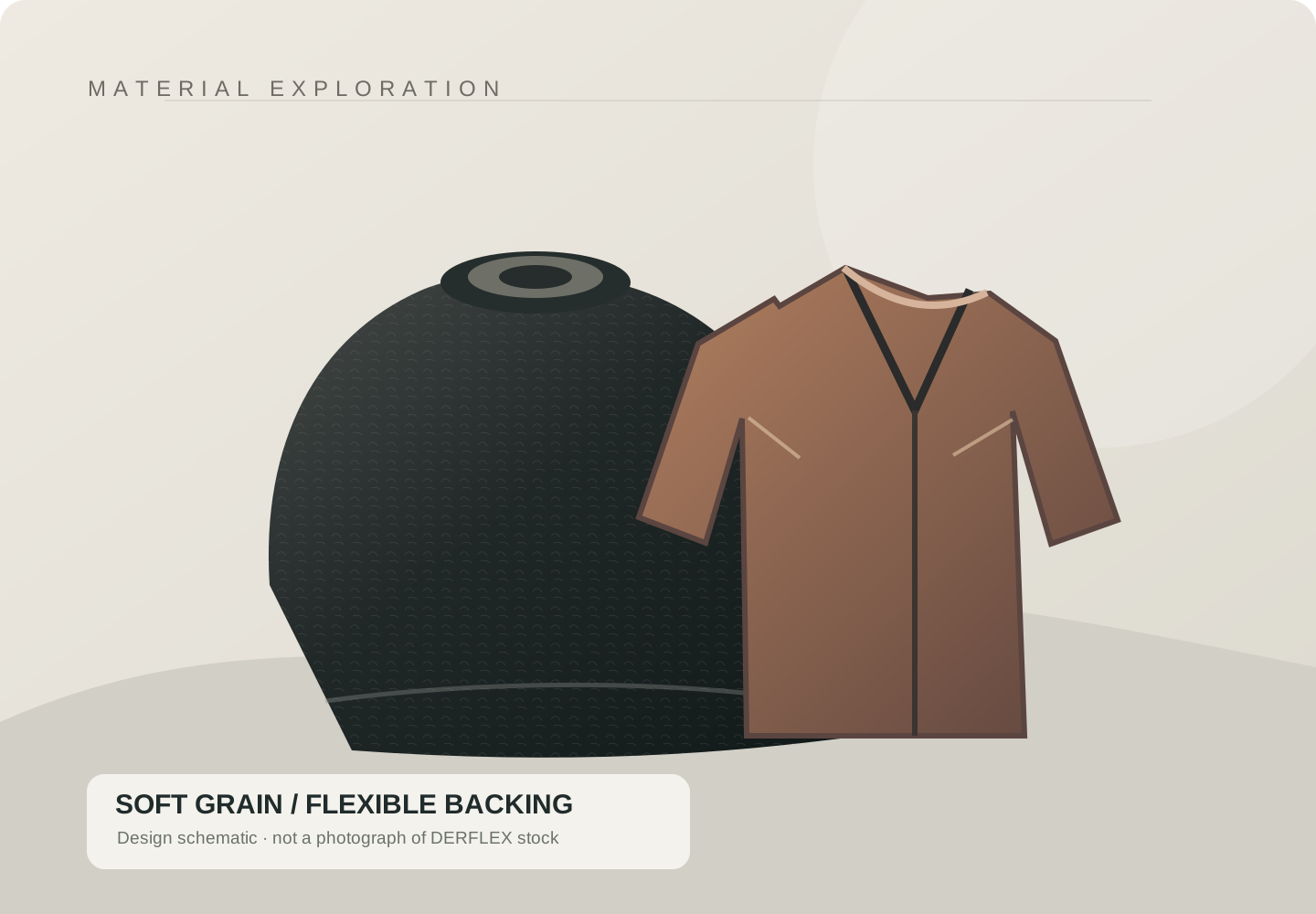
What Is PU Leather Jacket Material?
PU leather jacket material is an apparel-oriented coated textile with a polyurethane-based leather-look surface and a flexible supporting layer. In a fully synthetic construction, that support may be knitted, woven, nonwoven or microfiber textile. It is used for fashion jackets, biker-inspired outerwear, shirt jackets and garment panels where a leather appearance and workable fabric behavior are important.
Short answer: a successful PU jacket fabric combines a suitable surface with the right backing and drape. A material that feels convincing on a small swatch can still become heavy, stiff, noisy or awkward once cut into a large sleeve or body panel. Test the composite in the intended garment construction before bulk approval.
“PU leather” does not always mean an animal-free product. Some coated split-leather constructions contain genuine hide underneath. Specify the complete material composition and request a supplier declaration if the garment will be marketed as synthetic, vegan or animal-free. For background terminology, see the DERFLEX guide on what PU leather is and how it is constructed.
Surface, Backing and Drape Must Be Specified Together
Buyers often start by asking for “soft faux leather.” That describes a feel, not a repeatable material specification. A jacket-grade material needs a coordinated surface, supporting textile and finishing system.
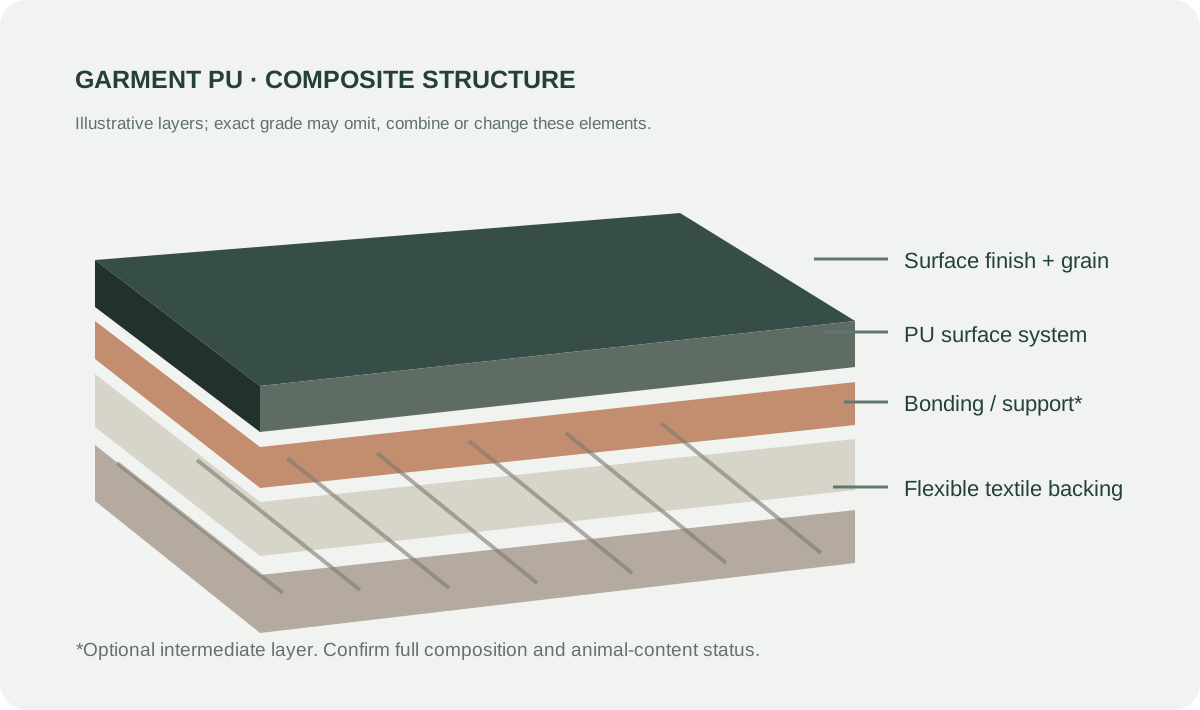
The coating face
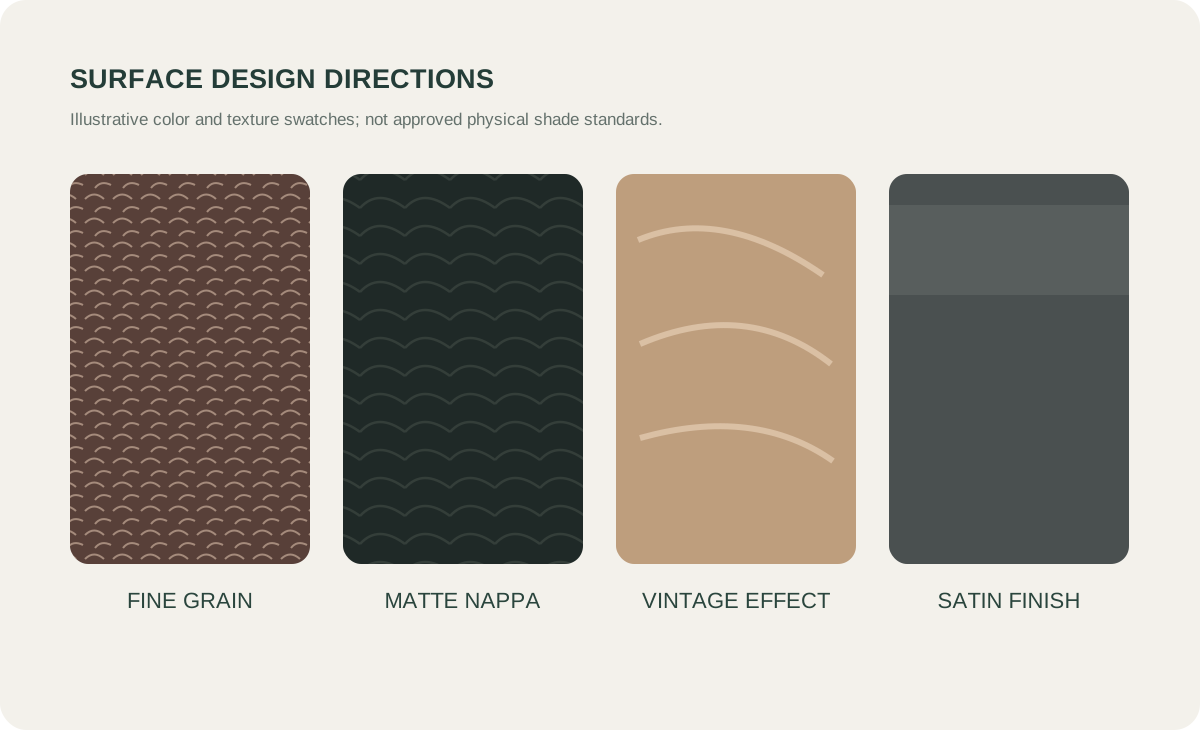
Fine pebbled grain, smooth nappa-style texture, worn or vintage effects and matte-to-satin finishes influence visual design. Coating and top-finish choices also affect tack, cleaning response, scuff behavior and surface feel in humid conditions.
The backing
A flexible knitted backing may be considered for more fluid apparel silhouettes; woven or other engineered structures may be useful where the pattern needs greater stability. The same surface can behave differently on different bases, including at shoulder seams and sleeve folds.
The full composite
Thickness, mass per unit area, residual stretch and recovery depend on the combined construction. Request a representative full-width material sample instead of approving only a colored grain card. DERFLEX's custom PU leather material program provides the broader context for color, backing and surface development.
PU Jacket Fabric Specifications That Actually Affect Production
There is no reliable universal thickness, GSM or roll width for every PU jacket. Use the following purchase specification checklist to turn your garment brief into measurable acceptance criteria. Values should be agreed for the exact approved grade, rather than copied from a generic online listing.
| Specification | What to agree with the supplier | Why it matters for jackets |
|---|---|---|
| Surface / grain | Matte, fine-grain, smooth, semi-gloss or reference-sample finish | Appearance under bending, light and garment movement |
| Backing & composition | Fiber and PU system, construction, backing stretch; animal-content declaration if needed | Drape, care labeling, sewing stability and product claims |
| Thickness (mm) | Nominal target, measurement method, tolerance and multiple-point consistency | Collar turnover, topstitching, pocket edges and seam bulk |
| Mass (g/m²) | Measured composite weight with stated test method | Garment weight, wearer comfort and shipping yield |
| Usable roll width | Measured usable width, selvage allowance, defect policy and roll length | Pattern marker efficiency and cutting wastage |
| Directional stretch | Length / cross-width extension and recovery, matched to pattern | Ease, seam puckering and panel distortion |
| Flex & aging | Method, temperature, cycles / time and pass-fail criteria | Risk of cracking, delamination and stiffness with use |
| Surface / color behavior | Dry / wet rub, abrasion, color migration, cleaning and humidity exposure as applicable | Contact with lining, light shirts, skin-facing trim and other garments |
| Sewing behavior | Needle choice, stitch length, seam strength, needle-hole damage, pressing / bonding limits | Pilot-garment quality and repeatable production |
| Documentation | Approved swatch, composition statement, lot code and relevant test report for chosen grade | Inspection, repeat order control and market compliance |
This is an RFQ worksheet, not a claim that DERFLEX currently stocks every construction or has passed every listed test. Target values and test methods must be confirmed for each project.
How to compare two quotations: make sure both suppliers quote the same backing, usable width, thickness tolerance, surface finish, expected cutting yield, inspection acceptance level and test conditions. An apparent lower price per meter may not represent the lower cost per approved jacket panel.
Which PU Leather Construction Fits Your Jacket Design?
Start with the garment silhouette and construction details, then specify material behavior. A fabric suitable for structured outerwear may not perform the same way in an oversized shirt jacket.
| Jacket direction | Material priority | Production risk to evaluate |
|---|---|---|
| Soft fashion jacket | Supple hand, natural drape, controlled panel weight, flexible backing | Hard folding, poor recovery, bagging at elbow and underarm |
| Biker-style / moto jacket | Defined grain, moderate body, acceptable multi-layer seam bulk | Too-thick lapels, collar roll, zipper-edge stiffness |
| Oversized shirt jacket | Flowing silhouette, balanced stretch and lightweight construction | Panel swing, curling edges and stitched-panel distortion |
| Vintage-look jacket | Consistent distressed finish, rub behavior and shade repeatability | Unplanned color transfer or coating changes after abrasion |
| Lined winter jacket | Outer shell and lining compatibility, flex at cuffs and shoulders | Condensation trapping, excessive weight and pressing damage |
Application directions are selection guidance, not verified DERFLEX catalog SKUs or jacket case studies.
Check Drape, Stitching and Wear Before Approving Bulk Rolls
A small swatch cannot reproduce the stresses and appearance of a complete jacket. A meaningful trial should use larger panels, the actual lining, the planned seam construction and finishing conditions.
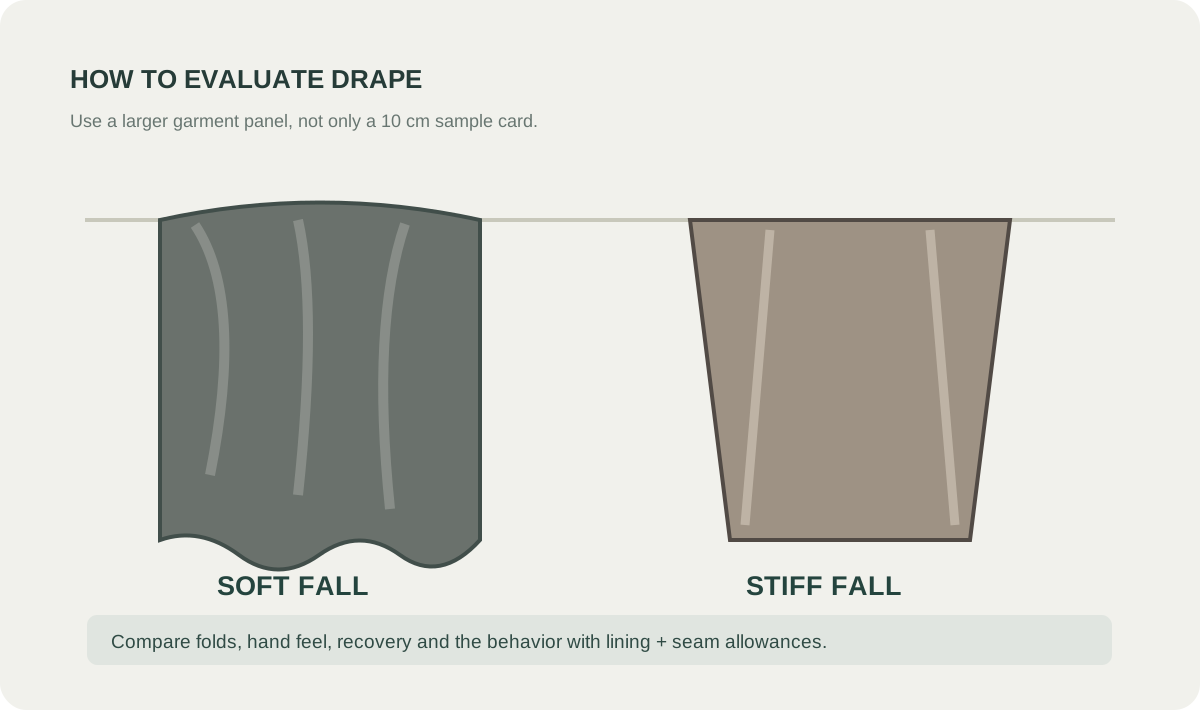
1. Hang a large panel
Compare the fall and bending of each candidate to the intended jacket silhouette and reference garment.
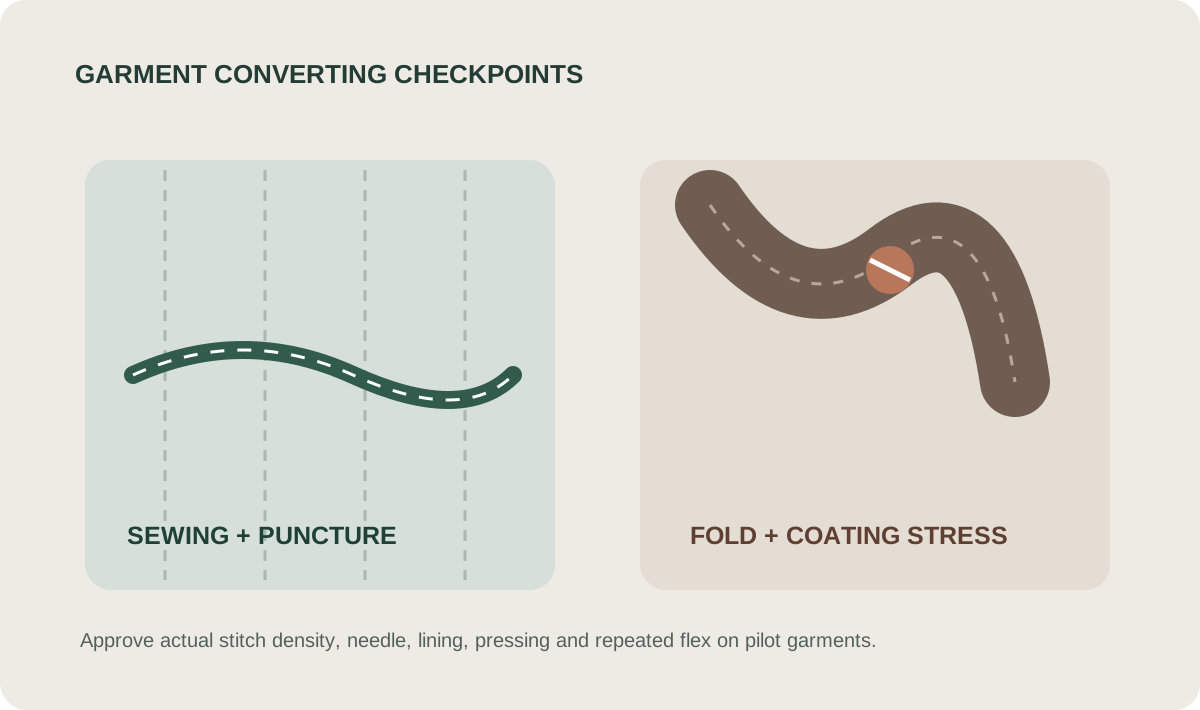
2. Sew critical details
Use actual seam allowances, collar structure, zip edge and layered pocket construction.
3. Move and fold it
Assess repeated creasing at elbows, shoulders and cuffs plus recovery after relaxed storage.
4. Test color contact
Check rub and transfer against light-colored lining and adjacent fabrics under appropriate conditions.
Make the pilot jacket the approval sample
Compare your first garment against the approved roll swatch, not only a PDF color reference. Track seam puckering, stitch holes, adhesive marking, edge folding, pressing temperature sensitivity and appearance after a planned care trial. Add hydrolysis, cold flex or cleaning tests when the destination climate and garment use justify them.
If you need to understand moisture claims, review the PU leather water-resistance guide. A resistant coated surface does not make a stitched jacket waterproof, and material abrasion results do not prove whole-garment durability.
Finish and Color Matching for Jacket Collections
Texture is a design choice, but it also changes how a surface appears after folding, abrasion and storage. A color target that is acceptable on a flat sheet may shift visually under curved light.
Specify the look in usable terms
- Provide a physical color standard or current reference swatch, plus lighting conditions for approval.
- Define emboss depth, grain repeat, face gloss and any deliberate vintage or worn effect.
- Check stretch-direction appearance and whether the face whitens, shines or changes texture on creasing.
- Use one approved master standard for bulk inspection and future color repeat orders.
- Discuss the usable-width and roll-length implications of custom embossing or backing changes.
When considering alternatives beyond PU, DERFLEX's synthetic leather material overview explains the wider coated-leather family, while the TPU versus PU coated-fabric comparison clarifies where those polymer systems differ.
PU Leather vs PVC Leather vs Genuine Leather for Jackets
Material names alone do not determine garment quality. Evaluate actual softness, panel weight, wearer comfort, cleaning requirements, price structure and repeatability together.
| Decision factor | Synthetic PU leather | PVC synthetic leather | Genuine leather |
|---|---|---|---|
| Typical jacket fit | Can be formulated for softer drape and fashion finishes | Can offer durable surface and cost options but may feel stiffer depending on grade | Natural material with hide-to-hide variation and distinctive feel |
| Appearance control | Repeatable embossed grain, custom shade and gloss possible | Wide range of embossed and colored surfaces | Natural grain character; shade and hide selection vary |
| Flex and care | Depends on PU chemistry, coating, backing and test evidence | Depends on plasticizer, cold-flex direction and finish | Depends on hide, finish, conditioning and care routine |
| Labeling / composition | Requires confirmation of full backing; synthetic grades may be animal-free | Generally engineered polymer/textile composite; declaration still required | Animal-derived material with its own labeling and sourcing documentation |
| Buying decision | Approve full-panel drape, sewing trial and aging tests | Approve flexibility, odor, abrasion and cold bending | Approve hide grading, panel matching and leather care expectations |
Comparative tendencies—not guaranteed properties for any untested construction. For further decisions on format and conversion, see faux leather sheets and roll-to-sheet options.
From Jacket Tech Pack to Approved PU Leather Rolls
DERFLEX's existing coated-material and synthetic-leather pages describe custom material development and B2B supply. Garment-specific grade availability, factory allocation, testing and bulk lead time should be agreed during this project workflow—not assumed from a furniture material sample.
Share the jacket brief
Silhouette, target market, material sample, lining, color, quantity and production calendar.
Agree material direction
PU surface route, backing, hand feel, grain and acceptance tests for garment use.
Approve pilot material
Check a larger swatch and pilot jacket, documenting fit, seams and color criteria.
Control bulk release
Confirm roll identification, width, lot consistency, packing and inspection records.
Quotation variables that matter: coating formulation and backing, number of requested custom colors, embossing needs, usable width, order volume, inspection plan, packaging and destination. Minimum order quantity, lead time, test fees and delivery terms require a project-specific confirmation.
Application Notes That Prevent Expensive Garment Rework
PU leather is a composite. A surface-only specification or a simple “waterproof” claim will not resolve the construction issues that affect finished jackets.
Pattern direction
Confirm stretch direction, grain orientation, roll usability and panel nesting before costing.
Needle holes
Needle punctures may remain visible. Evaluate seam allowances, stitch spacing and rework risks.
Press & bond
Check iron, heat press and adhesive behavior on the actual material; do not assume a universal setting.
Humidity & flex
Set test requirements for the real climate and care cycle where hydrolysis or cracking matters.
Lining & cleaning
Confirm rubbing, color transfer and approved cleaners before creating care labels.
Composition claims
Obtain exact backing and material declarations; test restricted substances per destination market.
Frequently Asked Questions About PU Leather Jacket Material
Practical answers for apparel developers and purchasing teams comparing jacket fabrics.
Is PU leather suitable for making jackets?
It can be. Choose a garment-oriented construction with appropriate drape, backing flexibility, weight and sewing performance. Verify a larger material panel and pilot jacket; upholstery PU leather is not automatically suitable for garments.
What thickness of PU leather is best for a jacket?
There is no single best thickness for every jacket. A lightweight shirt jacket and a structured moto jacket may need different body and seam bulk. Specify thickness together with the backing, composite weight and silhouette, then approve a pilot garment.
Is PU leather jacket material real leather or vegan?
Fully synthetic PU leather is not animal hide and may be suitable for animal-free product claims when its complete composition is verified. PU-coated split leather contains animal-derived substrate. Request a written composition declaration for the exact grade.
Will PU leather jackets peel or crack?
Peeling or cracking risk depends on the polyurethane formulation, bonding, flex exposure, hydrolysis, storage and care. Ask for applicable flex, peel and aging evidence for the intended use. No generic PU label guarantees a fixed service life.
Can DERFLEX supply custom jacket fabric colors and backing options?
DERFLEX already offers custom PU leather material enquiries covering surface appearance, backing and roll formats. Garment-specific availability, samples, minimum quantities and manufacturing route should be confirmed from your jacket tech pack before bulk commitments.
What should I send for a PU jacket leather quotation?
Provide the jacket style or tech pack, target material composition, a physical or visual reference, desired grain and color, backing and drape goals, usable roll width, anticipated order quantity, relevant testing requirements and delivery destination.
Request a PU Jacket Fabric Material Review
Tell DERFLEX what your jacket needs to look, feel and perform like. We can review the material route and confirm whether a suitable garment-oriented PU leather construction can be sampled and supplied.
Quotation is for material supply discussion. No standard apparel SKU, certification, MOQ or lead time is implied before confirmation.
Useful details for your inquiry:
- Jacket photo, sketch or tech pack
- Color / finish reference and backing preference
- Target thickness, drape or weight
- Quantity, market, testing and delivery terms