News
Company News

Double Membrane Biogas Holder | Gas Storage Membrane Solution | DERFLEX

Update:2026/8/17 17:18:47 Views:
DERFLEX logo Engineered Coated Fabric & Membrane Supply

Double Membrane Biogas Holder

Project-specific membrane materials and fabricated panel directions for low-pressure biogas storage—built around the different jobs of the inner gas membrane, outer weather membrane and optional bottom sealing layer.

Two-Membrane Logic Gas storage inside; shape and weather protection outside.
Low-Pressure Storage Designed around the operating pressure defined by the holder system.
Custom Material Build Weight, coating, PVDF surface, FR and weldability matched by project.
Buyer-Focused Supply For EPCs, gas-holder builders, fabricators and wastewater equipment companies.
System Definition

What is a double membrane biogas holder?

A double membrane biogas holder is a flexible gas-storage system commonly used between anaerobic digestion and downstream gas consumption, upgrading or energy-generation equipment. Its inner membrane changes with the amount of stored biogas, while an outer air-supported membrane maintains the holder's external shape and provides protection from weather.

The key purchasing point is that the two membranes do not have identical duties. The inner layer is primarily a gas-contact membrane, so low permeability, chemical resistance, flexibility and repeatable seam welding matter. The outer layer faces UV, rain, wind, snow and temperature cycling, so tensile performance, weathering and surface durability become more important.

  • Flexible buffer storage between gas production and gas use
  • Suitable for agricultural, municipal and industrial anaerobic digestion projects
  • Available as tank-mounted or free-standing system architecture
  • Membrane specification should follow pressure, gas chemistry and local climate—not GSM alone
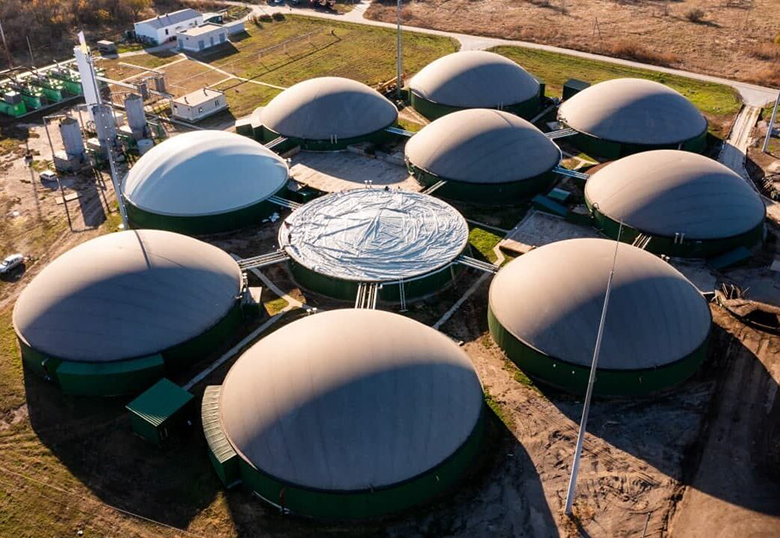
Double membrane biogas holder domes using engineered membrane fabric
Double membrane biogas holder applications. Actual membrane construction, dimensions and system components are project-specific.
Three Different Jobs

Specify each membrane by function, not by one generic fabric grade

For procurement teams, separating membrane roles early helps reduce the risk of over-specifying one layer while under-specifying another.

01

Outer Membrane

The outer envelope stays inflated by support air and protects the gas-storage membrane from the external environment.

Priority: UV stability, weathering, wind/snow load capability, tensile and tear strength, low-wick edge control and durable surface treatment.

Common direction: reinforced PVC-coated polyester with a PVDF or upgraded weather-resistant surface where specified.

02

Inner Gas Membrane

The inner membrane expands and contracts with gas volume and remains in contact with methane-rich biogas and condensate.

Priority: low gas permeability, H?S/CO?/moisture resistance, controlled flexibility, seam integrity and repeatable welding behavior.

Common direction: gas-barrier PVC-coated polyester; alternative coating structures can be discussed for demanding conditions.

03

Bottom / Sealing Membrane

Some free-standing or dome configurations use a bottom membrane to complete the flexible gas envelope or interface with the supporting structure.

Priority: gas sealing, puncture and abrasion resistance, weld reliability, dimensional stability and compatible connection detailing.

Common direction: project-defined reinforced coated fabric matched to the floor, slab or anchor arrangement.

Design Basis

Six project inputs should come before material pricing

A useful RFQ for a double membrane gas holder does more than state diameter or capacity. Material selection improves when the supplier understands the complete operating envelope.

Storage volumeNormal and maximum gas inventory.
Pressure rangeNormal, design and transient conditions.
Gas chemistryCH?, CO?, H?S, ammonia and condensate.
ClimateTemperature, UV, rain, humidity and altitude.
External loadsWind and snow design criteria.
Fabrication routeRF/HF, hot-air, hot-wedge and field seams.
Material Specification Framework

Typical DERFLEX membrane directions for double membrane gas storage

The ranges below are a practical starting point for technical discussion. Final values should be confirmed against the project drawing, gas composition, structural calculation, applicable standard and approved technical data sheet.

Specification item Inner gas membrane direction Outer membrane direction Why buyers should define it
Base reinforcement High-tenacity polyester fabric High-tenacity polyester fabric Controls tensile, tear, dimensional stability and welded-panel handling.
Coating system PVC gas-barrier direction; selected TPU option by project PVC with optional PVDF / weather-resistant surface Inner and outer layers face different chemical and weather exposures.
Typical weight direction Approx. 900–1500 g/m2, customizable Approx. 900–1500 g/m2, customizable Weight is only one variable; yarn, coating and strength targets also matter.
Thickness direction Project-specific; commonly around 0.9–1.5 mm for PVC directions Project-specific; commonly around 0.9–1.5 mm for PVC directions Should be tied to material structure rather than used as a stand-alone quality indicator.
Gas permeability Low-permeability target defined by gas, test method and project requirement Usually secondary unless outer layer also forms part of the gas envelope Waterproof performance is not the same as methane-barrier performance.
Temperature direction Common project discussion range: about -30°C to +70°C for selected PVC constructions Common project discussion range: about -30°C to +70°C for selected PVC constructions Low-temperature flexibility and heat aging should match the installation climate.
Flame-retardant option Project-based DIN / EN / NFPA direction where required Project-based DIN / EN / NFPA direction where required Specify the exact test method and certificate requirement before production.
Welding process HF/RF, hot-air or hot-wedge compatibility by formulation HF/RF, hot-air or hot-wedge compatibility by formulation Seam behavior is part of gas-tight performance and fabrication repeatability.
Supply format Roll goods, cut sheets, fabricated panels or OEM specification supply Roll goods, cut sheets, fabricated panels or OEM specification supply Allows membrane fabricators and system builders to align supply with their workflow.
Engineering note: membrane selection alone does not establish the safe working pressure, storage volume, wind/snow resistance or overall compliance of the finished gas holder. Those values depend on the complete holder geometry, support-air system, anchoring, valves, controls, seams and project design basis.
Where It Is Used

Double membrane gas holder applications across the biogas value chain

Flexible low-pressure storage helps decouple continuous or fluctuating gas production from downstream use, subject to the plant's process design.

Agricultural Biogas Plants

Livestock manure, slurry and crop-residue digestion systems where biogas is buffered before CHP, heating or upgrading.

Municipal Wastewater

Sludge digestion facilities requiring controlled storage between anaerobic digesters and gas utilization equipment.

Food & Beverage Waste

Organic-waste and high-COD wastewater projects for food processing, breweries, distilleries and related facilities.

Industrial Anaerobic Treatment

Process wastewater and organic residue treatment where methane-rich gas is collected for energy recovery.

Landfill & Waste-to-Energy

Selected gas-management systems requiring flexible buffer storage as part of a broader collection and utilization train.

Biomethane / CBG Projects

Buffer storage upstream or downstream of gas treatment, according to the pressure and purity requirements of the plant design.

Procurement Guide

What to send for a useful double membrane biogas holder quotation

A clear technical package helps DERFLEX discuss membrane structure, supply format and fabrication compatibility without relying on generic assumptions.

  1. Holder type: tank-mounted or free-standing
  2. Storage volume, tank diameter and main dimensions
  3. Normal and design pressure range
  4. Biogas composition and H?S level if available
  5. Lowest / highest temperature, UV exposure, wind and snow criteria
  6. Required membrane role: inner, outer, bottom or complete membrane set
  7. Preferred welding / fabrication process and panel layout
  8. Fire-retardant standard, test documents, quantity and destination

DERFLEX's practical role in a gas-holder project

DERFLEX's core strength is the coated technical membrane layer: reinforced base fabric, coating structure, gas-barrier direction, weather-resistant surface, welding behavior and repeatable OEM supply.

Depending on the project and quotation scope, supply may include roll material, cut sheets or fabricated membrane panels. Blowers, pressure sensors, safety valves, control panels, structural calculations, anchors and installation engineering should be confirmed as separate scope items with the responsible system integrator unless specifically included in a written offer.

This scope-first approach helps EPC contractors and biogas equipment companies compare quotations on the same basis and reduces ambiguity during approval.

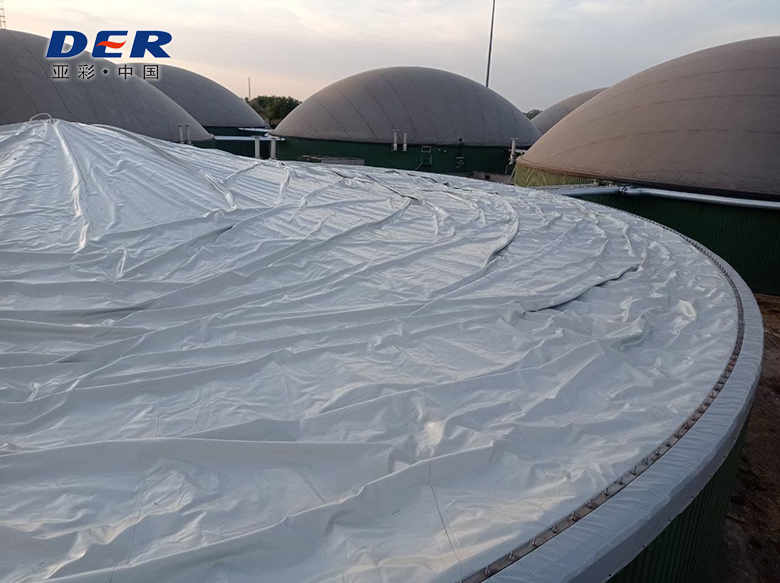
DERFLEX biogas membrane material on anaerobic digestion tank
Biogas membrane application image from DERFLEX. Membrane layer and fabrication details should be matched to the final holder design.
Selection Logic

Double membrane holder vs. a rigid gas storage vessel

The choice is not simply “membrane is better” or “steel is better.” A double membrane holder is often attractive where the project benefits from flexible storage volume, relatively lightweight envelope construction and integration with low-pressure anaerobic-digestion systems. A rigid vessel may be preferred where the process requires a different pressure regime, mechanical protection or code pathway.

  • Double membrane holder: flexible volume, air-supported outer shape, membrane-specific weather and gas-barrier design.
  • Rigid vessel: fixed geometry, different foundation and corrosion-control requirements, pressure class defined by vessel design.
  • Decision basis: process pressure, gas inventory, footprint, climate, maintenance strategy, local code and total installed scope.
Quality & Approval

Four checkpoints before membrane material enters serial project supply

Testing should be tied to the buyer's specification and agreed methods rather than relying on broad marketing claims.

01 · Base & Coating Check

Verify reinforcement, coating uniformity, weight/thickness direction, adhesion and surface treatment against the approved specification.

02 · Weld Sample Approval

Approve seam settings and peel/strength behavior using the fabricator's actual HF/RF, hot-air or hot-wedge process where possible.

03 · Gas / Weather Requirements

Confirm the gas-permeability criterion, chemical exposure, UV/weathering expectation and any low-temperature requirement that applies.

04 · Document Control

Align TDS, color, roll width, batch identification, fire-test documents and packaging requirements before repeat production.

Why DERFLEX

A material-first partner for biogas system builders and membrane fabricators

DERFLEX approaches a double membrane biogas holder from the technical textile outward—helping buyers define what the membrane must do before locking in weight, coating or surface finish.

A

Inner / Outer Differentiation

Gas contact and outdoor exposure create different failure modes. DERFLEX can discuss separate material directions for each membrane position.

B

Coating & Surface Options

PVC, PVC/PVDF and selected TPU directions allow the material structure to be adjusted for gas barrier, UV, cleanability and fabrication requirements.

C

OEM Repeatability

For repeat gas-holder programs, specification control, approved samples, roll identification and packaging can be aligned with the buyer's production workflow.

FAQ

Double Membrane Biogas Holder FAQ

Buyer-focused answers for EPC contractors, biogas equipment companies, wastewater engineers and membrane fabricators.

What is the difference between a double membrane biogas holder and a biogas digester cover?

A double membrane biogas holder is primarily a flexible gas-storage system using an inner gas membrane and an air-supported outer membrane. A digester cover closes the digestion tank and may also provide some gas storage. Some projects combine both, functions in a tank-mounted double membrane roof, while others use a separate free-standing gas holder.

What material is commonly used for the inner membrane?

Reinforced gas-barrier PVC-coated polyester is a common material direction because it combines strength, flexibility and weldability. The final coating formulation should be matched to gas permeability, H?S and condensate exposure, temperature and the fabricator's welding process.

Why is PVDF often considered for the outer membrane?

A PVDF or upgraded weather-resistant surface can be considered for the exposed outer layer where UV resistance, surface durability and cleanability are important. Whether it is needed depends on climate, life-cycle target and project budget.

Can DERFLEX supply a complete double membrane gas holder?

DERFLEX's core offering is engineered coated membrane material and project-specific membrane fabrication support. Roll goods, cut sheets or fabricated membrane panels may be discussed. Blowers, control panels, valves, anchors, structural calculations and complete installation scope should be confirmed separately in the written quotation.

What capacity can a double membrane biogas holder be?

Capacity is determined by the system design rather than the membrane fabric alone. Double membrane holders can be engineered across a wide range of storage volumes, but the feasible size depends on geometry, pressure, wind/snow criteria, foundation or tank dimensions, anchoring and the complete control system.

What information should I provide to request a quotation?

Send the holder type, storage volume, tank diameter or foundation size, normal/design pressure, gas composition and H?S level if known, climate and wind/snow data, membrane layer required, welding method, fire-retardant standard, quantity, destination and any project drawings.

Build the membrane specification before comparing holder prices

Send DERFLEX your storage volume, pressure range, membrane position, gas conditions, climate, welding method and drawings. We can discuss a project-matched coated-fabric direction and quotation scope.

Useful RFQ attachment Tank / foundation drawing · gas volume · pressure · CH? / H?S information · wind & snow basis · membrane layer · welding method · required standard · quantity & destination
Consulting Services
+86-021-54361792 / 54361798
Email
sales@derflex.com