Define the test route
Projects may reference standards such as NFPA 701, DIN 4102-B1/B2, M-class systems or a mine-specific FRAS route. The named method, acceptance criterion and report scope should be confirmed before production.



 Industrial Flexible Airflow Products
Flexible ducting configured around airflow direction, fan pressure, route geometry and the flame-performance evidence your project actually requires.
DERFLEX supplies finished ventilation duct sections for tunnel construction, mines, confined-space work, temporary industrial ventilation and equipment exhaust. Rather than treating “flame retardant” as a generic label, the duct specification can be built around the named test method, duct structure, connection system, suspension details and required documentation.
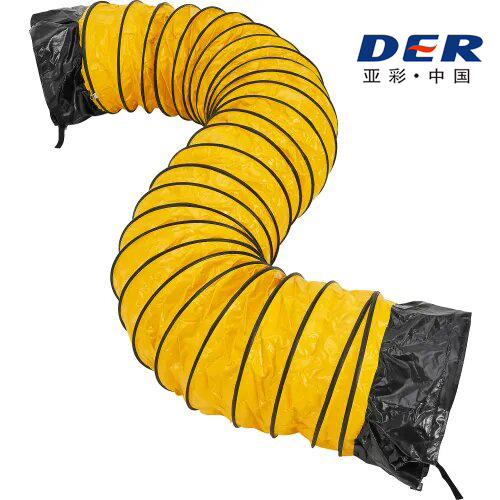
A buyer searching for a flame retardant flexible duct usually has a safety reason behind the request: underground work, welding fumes, confined-space ventilation, tunnel construction, plant maintenance or a jobsite rule. The useful procurement question is therefore not only “is the duct flame retardant?” but “what exact construction was tested, by which method, and does that configuration match the intended airflow duty?”
Projects may reference standards such as NFPA 701, DIN 4102-B1/B2, M-class systems or a mine-specific FRAS route. The named method, acceptance criterion and report scope should be confirmed before production.
Coated polyester, seams, wire reinforcement, cuffs, zippers, suspension strips and repair details all form part of the working duct. A compliant raw fabric does not automatically describe the whole finished assembly.
Positive pressure, negative pressure, fan static pressure, route length, bends and leakage points determine whether a layflat or shape-supported duct is appropriate and how the finished product should be built.
The duct is a mechanical airflow component. Material selection matters, but pressure behavior, seams, connections, hanging points and shape retention often determine whether the installation performs as intended.
Flexible ventilation ducting is repeatedly installed, extended, connected and moved. Long runs can lose useful fan pressure through undersized diameter, excessive leakage, poor coupling geometry or unnecessary bends. In suction duty, an unsupported hose may collapse even when the fabric itself is strong.
For that reason, DERFLEX can review the ventilation duct as a finished system component: duct body, reinforcement, suspension and end interfaces. The goal is to establish a repeatable purchase specification that can also be used for future replacement sections.
A fire-retardant coating option can be applied to different duct structures. The structural format should first follow the ventilation function.
| Ventilation duty | Typical duct concept | Why it is selected | Key points to confirm |
|---|---|---|---|
| Forced fresh-air supply | Layflat positive-pressure duct | Fan pressure inflates the duct; sections collapse for transport and storage. | Diameter, section length, seam leakage, coupling, hanging points, flame test. |
| Exhaust / suction | Spiral wire-reinforced flexible duct | Continuous or periodic reinforcement helps the hose retain its airflow passage under suction. | Negative pressure, bend radius, wire pitch, wear strip, end cuffs, flame test. |
| Mine or hazardous underground route | Flame-retardant + optional antistatic duct | Used where both fire behavior and electrostatic control are defined by site or regulation. | Exact FR/FRAS route, surface resistance test, fittings, identification and traceability. |
| Low-clearance tunnel heading | Custom shaped / oval positive-pressure duct | Can reduce interference with vehicles, services or equipment compared with a large round profile. | Equivalent airflow area, hanging geometry, headroom, branch layout, flame test. |
| Portable blower or confined-space work | Compact flexible blower duct | Prioritizes quick deployment, flexible routing and compatibility with portable ventilation equipment. | Blower outlet size, hose length, cuff method, handling, temperature and flame requirement. |
The matrix is a selection guide, not an engineering calculation. Final airflow design remains the responsibility of the project ventilation plan.
Sending these fields with an RFQ helps the supplier avoid quoting the wrong duct structure and reduces revision cycles after sampling.
Forced supply, exhaust/suction, reversible duty or separate sections.
Outlet diameter, airflow target and available static pressure data.
Total line length, bends, branches, elevation changes and available clearance.
Preferred diameter, section handling length and any maximum packed size.
Name the test standard, classification, report language and acceptance route.
State the resistance limit and test method if antistatic performance is required.
Zipper, ring, cuff, hook-and-loop, fan adapter or an existing interface to match.
Eyelets, fins, straps, rail system or site-specific hanging pitch and hardware.
Temperature, moisture, oil/dust exposure, abrasion and outdoor storage conditions.
Quantity, destination, packaging, markings, sample needs and requested delivery window.
The following ranges are intended for early technical discussion. A final order should be governed by the approved datasheet, sample and any agreed test documentation.
| Product form | Finished flexible ventilation duct section, with selected end connection, suspension and optional reinforcement. |
| Base construction | Polyester textile with PVC coating on both sides; formulation and textile structure selected by application. |
| Typical fabric-weight range | Approximately 400–900 g/m2 reference range; heavier is not automatically better for every duty. |
| Reference diameter | Approximately 300–3000 mm; non-standard sizes can be reviewed against airflow, fan and installation data. |
| Duct structure | Layflat positive-pressure, spiral wire-reinforced, shaped/oval or project-specific fabricated sections. |
| Connection options | Zipper, hook-and-loop, end ring, cuff, eyelet interface, fan adapter or custom connection. |
| Suspension options | Reinforced fins, eyelets, straps or project-specific hanging geometry. |
| Flame-retardant option | Material and finished construction can be developed around the named test method requested for the project. |
| Antistatic option | Available where a defined resistance limit and test method are provided; not assumed by the words “flame retardant.” |
| Color / marking | High-visibility and project colors can be discussed, with identification marks or OEM information subject to order requirements. |
| Accessories | Reducers, bends, Y-pieces, transition pieces, repair sections and fan connections can be quoted from drawings or measured interfaces. |
Reference values are not universal guarantees. Final performance depends on approved construction, manufacturing tolerances, test method, duct route and operating conditions.
The same search term can represent very different systems. A tunnel contractor and a portable-blower distributor may both request “fire retardant ducting,” but the product structures and acceptance documents may be different.
Fresh-air forcing, localized extraction and route extensions where the mine specifies flame behavior and, in some cases, antistatic performance.
Long temporary ventilation runs that may require layflat positive-pressure sections, large diameters, custom branches and durable suspension.
Portable blowers and flexible ducting used to introduce fresh air or remove contaminated air during cleaning, inspection or repair tasks.
Shape-supported ducting can route smoke and fumes toward suitable extraction equipment where the jobsite also requires flame-resistant materials.
Air movement around maintenance shutdowns, equipment rooms, drying, cooling or temporary process zones without installing rigid ductwork.
Custom cuffs, private markings, repeat dimensions and packaging can support distributors or equipment manufacturers purchasing ducting with fans.
For procurement teams, the goal is a clear, auditable specification that describes the operating duty and the required evidence without paying for features the project does not use.
DERFLEX’s ventilation range includes finished ducts and coated-fabric engineering options. This supports buyers who need to coordinate the duct body, reinforcement, connection hardware and safety-related material configuration instead of sourcing each element as an unrelated item.
Quotation can cover fabricated sections rather than only rolls of coated fabric.
Layflat and shape-supported concepts can be discussed according to forcing or extraction duty.
Couplings, fan adapters, branches and transitions can be organized around route interfaces.
Flame-retardant and antistatic configurations are specified against the requested test route rather than assumed universally.
Reference diameters extend into project-scale ducting, with final selection reviewed against airflow and installation data.
Defined dimensions, end details, colors and markings support repeat orders for equipment and contractor programs.
Reducers, bends, Y-pieces and repair sections can be included in a coordinated ventilation route.
Fan data, route geometry and acceptance documents can be reviewed before the final production specification is frozen.
These six internal resources cover duct format, mine safety, tunnel accessories and material engineering without forcing every topic into one page.
Short answers for con, tractors, mine operators, industrial buyers, ventilation-equipment suppliers and OEM procurement teams.
No. “Flame retardant” normally describes behavior under a defined test method and acceptance criterion. It should not be interpreted as a universal claim that the duct cannot burn or cannot be damaged by fire. The requested test standard and the exact tested construction should be stated in the project specification.
Use the standard named by the project, customer, mine, authority or equipment specification. Different markets may reference NFPA 701, DIN 4102 classifications, M-class systems or mine-specific FRAS requirements. DERFLEX can review the requested route, but the buyer should identify the governing requirement.
Yes, the two requirements can be combined when the project calls for both. They are separate performance fields, so the electrical resistance limit and test method should be written into the specification rather than assumed from the flame-retardant description.
Layflat duct is commonly used for positive-pressure air delivery because fan pressure inflates it. Spiral wire-reinforced duct is generally preferred when the hose must retain its shape during suction, exhaust or tighter routing. Final selection should consider fan duty, route length and pressure losses.
DERFLEX’s current ventilation product range uses approximately 300–3000 mm as a reference diameter range. Final diameter should be selected from airflow target, fan pressure, route length, clearance and duct structure; non-standard requirements can be reviewed separately.
Send the application, airflow direction, fan outlet and pressure data, preferred diameter, route length, section length, coupling, suspension method, required flame or antistatic test, quantity, destination and any drawings or installation photos. This produces a more meaningful quote than sending only the keyword “flame retardant ventilation duct.”