



Blowing Ventilation Duct
Project-configured flexible ducting for forcing fresh air from a fan toward tunnel headings, mine work zones, underground construction areas and temporary industrial spaces. Specify the duct around your fan outlet, airflow route, pressure conditions and installation method—not around a generic hose size.
If the system must pull contaminated air under suction, specify a wire-reinforced negative-pressure duct instead of a plain layflat duct.
What a blowing ventilation duct actually does
“Blowing ventilation duct” is commonly used by mine, tunnel and industrial buyers to describe flexible air-forcing duct connected to a supply fan. The fan creates positive pressure inside the duct, inflating the tube and carrying outside air toward the required work area.
Fresh-air supply
Moves clean intake air toward crews, machinery, excavation faces or enclosed work zones.
Layflat logistics
Collapsible duct sections reduce storage volume and can be extended as the working route changes.
Pressure-led design
Diameter, seam integrity, couplings and route length influence how much fan output reaches the discharge end.
Project configuration
Suspension, connection style, color and safety treatments can be selected around site practice and specification.
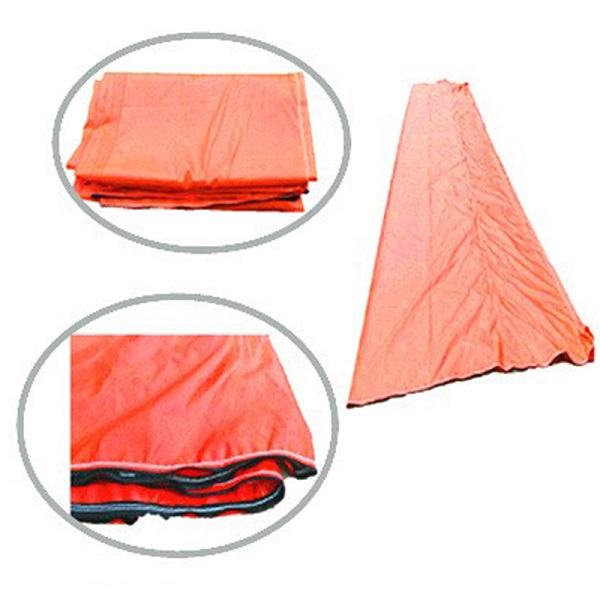
Do not treat every flexible duct as interchangeable
A layflat air-forcing duct relies on internal pressure to open its cross-section. This makes it practical for supply-air routes because the duct can collapse flat when disconnected from the fan and can be packed efficiently for transport.
Negative-pressure extraction is different. Suction can collapse an unsupported layflat wall, so exhaust duty normally calls for a spiral or wire-reinforced structure that can resist vacuum. When a project uses both supply and exhaust circuits, the duct construction should be identified separately for each airflow direction.
Five points that determine real blowing performance
A duct is part of an airflow system. Buyers get a more reliable quotation when the fan interface, duct body, joints, suspension and discharge location are specified together.
Fan outlet
Diameter, shape, flange and available pressure.
Duct body
Diameter, coated fabric, seam and section length.
Connections
Cuffs, zippers, rings, straps or project hardware.
Suspension
Hanging line, fins, grommets and spacing.
Working face
Total run, bends, branches and required air delivery.
Configure the blowing duct around the project
The following matrix is intended for RFQ preparation. Values and options are configurable and should be confirmed against actual site conditions and required standards.
| Product form | Finished flexible blowing ventilation duct / air-forcing duct assembly | Fabricated duct sections rather than unprocessed roll fabric. |
|---|---|---|
| Airflow mode | Positive pressure / blowing air | For suction duty, choose shape-supported or spiral wire-reinforced ducting. |
| Typical diameter | 300–3000 mm, project selected | Diameter should be matched to airflow, velocity, route resistance and fan capability. |
| Section length | 5–300 m options, subject to construction and logistics | Shorter modular sections may simplify handling and replacement; longer runs can reduce connection count. |
| Duct body | Reinforced PVC-coated technical textile | Fabric weight, tensile performance and surface formulation can vary by operating environment. |
| Seam construction | Heat-welded fabrication according to duct structure | Joint design is selected to manage leakage and handling loads. |
| Connections | Zipper, hook-and-loop cuff, steel ring, sleeve or eyelet-based formats | Connection geometry can be matched to existing duct sections or fan adapters. |
| Suspension | Single/double fins, reinforced patches, grommets or custom hanging points | Layout depends on diameter, section weight and site suspension practice. |
| Performance options | Flame-retardant, antistatic, cold-resistant or other project-specific treatments | Only specify a compliance claim after the exact test method and acceptance criteria are agreed. |
| Color / marking | Project colors, identification, logo or section marks where required | Useful for distributors, fleet management and multi-route installation. |
| Accessories | Reducers, bends, tees, adapters, storage bags and repair items by project | Send route geometry when branches or changes in diameter are involved. |
Low leakage begins before the duct reaches the jobsite
Blowing performance is affected by the coated textile, welded seams, end construction and connection details. DERFLEX can supply both PVC-coated ducting material and finished duct sections, which helps keep the material specification and fabrication requirements aligned during custom programs.
- Reinforced PVC-coated textile selected for duct duty
- Smooth inner surface to support airflow through extended routes
- Heat-welded body construction to limit avoidable leakage points
- Reinforced end and hanging zones for repeated installation handling
- Project-specific interface dimensions confirmed before production
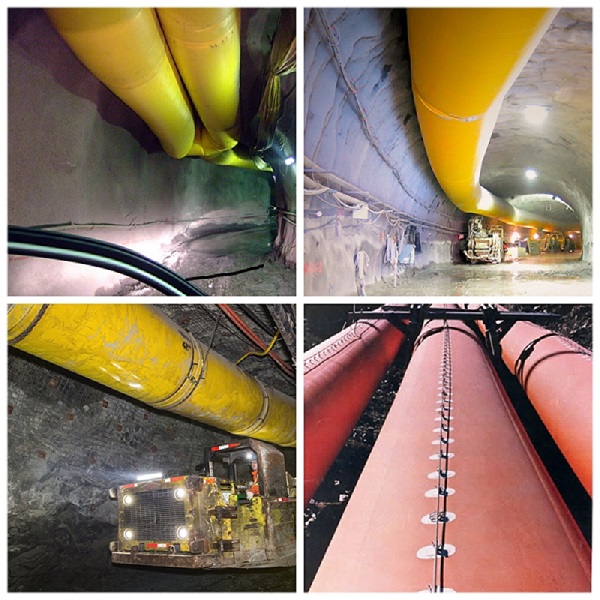
Start with required airflow—then check pressure loss
For preliminary sizing, airflow, duct cross-sectional area and air velocity are directly related. That first calculation is useful, but a long underground route still needs fan-curve and pressure-loss review.
Preliminary airflow relationship
Q = airflow, A = internal cross-sectional area, v = average air velocity. For a round duct, area is based on the internal diameter. This relationship does not replace pressure-loss or system calculations.
Applications for positive-pressure blowing duct
The same basic airflow mode appears across underground engineering and temporary industrial ventilation, but each application can require different diameter, suspension, safety treatment and connection details.
Road, rail and utility tunneling
Fresh-air delivery toward advancing headings where the duct line is extended as excavation progresses.
Underground mine auxiliary ventilation
Positive-pressure supply routes in drifts, development headings and remote work areas.
Metro and hydropower galleries
Temporary air supply through enclosed civil works with long access routes and changing work zones.
Confined-area fresh-air delivery
Portable blower ducting for tanks, basements, shutdown work and equipment maintenance areas where controlled supply air is needed.
Fan + duct packages
Custom cuffs, adapters and identification for blower manufacturers, rental fleets and system integrators.
OEM / private-label duct programs
Repeat configurations for ventilation-equipment distributors requiring consistent dimensions, branding and packing.
Send system data, not just “need 1,000 m duct”
A useful blowing ventilation duct quotation should reflect the fan, route and installation. The more complete the RFQ, the easier it is to avoid underspecified couplings, wrong suspension layouts or an unsuitable duct structure.
Send Your Duct RFQBuilt around repeatable project details
DERFLEX combines coated-fabric know-how with finished flexible duct fabrication. For contractors, ventilation equipment companies and distributors, the useful advantage is the ability to define the complete duct assembly before bulk production.
Material-to-duct coordination
PVC-coated duct textile, seam method and assembly details can be reviewed as one product specification rather than separate disconnected purchases.
Interface customization
Fan cuffs, section connections, reducers, hanging details and labeling can be matched to equipment or project drawings.
Pre-production confirmation
Reference photos, samples and dimensioned drawings can be used to reduce ambiguity before repeat or bulk orders proceed.
Continue the ventilation duct selection
Use these six related pages to compare pressure mode, reinforcement, safety configuration and accessory requirements.
Blowing ventilation duct questions
Answers for tunnel contractors, mine operators, equipment integrators, ventilation distributors and industrial buyers.
What is a blowing ventilation duct?
It is a flexible duct used with a fan to push fresh air through the duct under positive pressure. In underground works it is commonly used to deliver intake air toward the active work zone or advancing face.
Is a blowing duct the same as a suction duct?
No. A layflat blowing duct is held open by internal positive pressure. A suction duct must resist collapse under negative pressure, so it normally uses spiral wire or another shape-supporting structure.
How should I choose the duct diameter?
Start from the required airflow and practical air velocity, then check the complete route against fan pressure and pressure losses. Total length, bends, branches, leakage and connection details can all affect delivered airflow.
Can DERFLEX match an existing fan or old duct connection?
Yes, custom interface dimensions can be discussed. Send the fan outlet dimensions or an old connection sample/photo with measurements so the cuff, ring, zipper or adapter can be reviewed before production.
Can flame-retardant or antistatic blowing duct be supplied?
Project-specific flame-retardant and antistatic configurations can be discussed. The RFQ should state the exact test method, acceptance criteria and documentation required for the project.
What should I send for a fast quotation?
Provide fan outlet size, airflow direction, available pressure data, duct diameter, total run, section lengths, connection and suspension method, route bends/branches, required safety tests, quantity and packing requirements.
Specify the duct around your fan and route
Send DERFLEX the fan outlet, airflow requirement, duct run, connections and project standard. We can organize the quotation around the finished blowing ventilation duct assembly required for installation.