Closed Pillow / Bladder Tank
Useful when compact transport, enclosed storage and controlled inlet / outlet connections are priorities. The tank expands as it fills and requires a prepared, level base.



DERFLEX supplies flexible firefighting water tanks for temporary fire-water staging, wildland and rural response, industrial emergency reserve and mobile water-transfer projects. Tank format, coated fabric, capacity, filled footprint, pump connection and coupling standard can be reviewed around the actual field operation.
Specify the job first: required usable volume, whether crews need open drafting access or closed storage, pump flow, hose diameter, local coupling standard, deployment surface, operating temperature, quantity and destination.
Answer-first definition for buyers, engineers and emergency-equipment distributors.
A firefighting water tank is a temporary or reserve water-storage system positioned near an incident, remote work area or emergency staging point so water can be filled, transferred, drafted or pumped where permanent supply is limited. A flexible fire water tank uses reinforced coated textile instead of a rigid shell, allowing the empty unit to fold for transport and storage. Depending on the operation, the system may be a closed pillow / bladder tank, a self-supporting open field tank or a frame-supported tank.
Useful when compact transport, enclosed storage and controlled inlet / outlet connections are priorities. The tank expands as it fills and requires a prepared, level base.
Useful when fast top filling, visible water level and direct access are important. The exact open-tank structure should be confirmed for the intended capacity and field workflow.
Provides a more predictable open geometry for repeated staging, drafting or working access, while the flexible liner remains replaceable or project-customized.
Capacity matters, but access method, fill rate, drafting method and connection compatibility often decide whether the tank works in the field.
| Operating Need | Tank Direction | What to Specify | Why It Matters |
|---|---|---|---|
| Water shuttle staging | Open self-supporting or frame-supported tank | Usable volume, tanker discharge method, overflow control, drafting access, ground footprint | Fast transfer only works when tank access and fill / draft paths are planned together. |
| Remote wildland reserve | Closed bladder or compact open field tank | Packed dimensions, handler count, groundsheet, hose interface, relocation cycle | Empty-state logistics and field setup can matter as much as nominal capacity. |
| Industrial emergency reserve | Closed flexible bladder or framed tank | Connection layout, fill source, discharge pump, site containment, inspection access | A reserve tank should integrate with the emergency response plan and local project requirements. |
| Rural / temporary fire-water point | Project-specific flexible tank | Capacity, local hose/coupling standard, pump suction conditions, refill source, access route | Compatibility with local equipment is more important than a generic valve description. |
| Closed reserve near sensitive areas | Pillow / bladder tank | Water-contact requirement, venting, protected fittings, fill limit and ground protection | Closed storage helps reduce open exposure but requires controlled filling and vent design. |
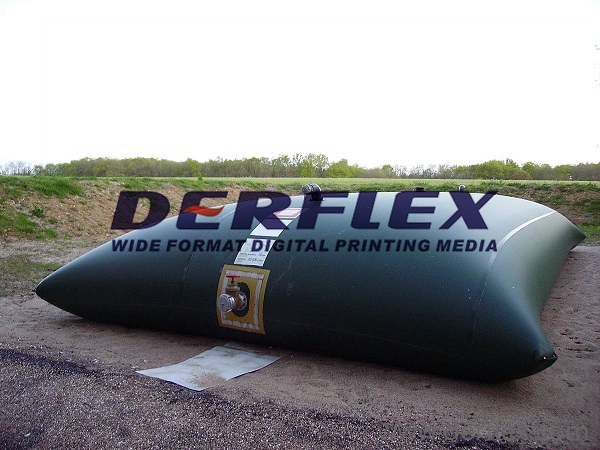
A valve is not a complete firefighting interface. The connection should be reviewed as a system: hose inside diameter, coupling standard, pump flow, suction or discharge method, valve body, gasket, flange reinforcement and the physical location of the fitting on the tank.
DERFLEX's collapsible water storage tank guide already uses this connection-first logic for emergency and firefighting applications. Storz-type, camlock and threaded interfaces may be discussed, but the exact standard and availability should be confirmed before order.
For emergency staging, the tank has to work between the water source and the firefighting equipment.
Tank volume is useful only when the inlet and outlet can support the required operating window. State desired fill and transfer time during RFQ.
Filled length, width and height should be checked before purchase. A large flexible tank needs clear access for hoses, pumps and personnel.
For larger reserve requirements, multiple smaller tanks may offer staged deployment and operational redundancy compared with one very large tank.
Use project requirements where exact values are not yet approved. Avoid buying by thickness or capacity alone.
| Item | DERFLEX Direction | Buyer Confirmation |
|---|---|---|
| Tank format | Closed pillow / bladder, open self-supporting direction, frame-supported or custom geometry | Drafting access, contamination control, deployment speed, packed size and available footprint |
| Coated fabric | Reinforced PVC coated polyester; TPU coated fabric for selected projects | Outdoor exposure, folding cycle, abrasion, weld route, water-contact requirement and commercial target |
| Capacity | Custom; existing DERFLEX flexible-tank family references span approximately 500–500,000 L | Usable volume, filled footprint, filled height and whether one tank or several tanks are preferred |
| Thickness | Existing selected flexible-tank references include approximately 0.75–1.20 mm | Do not select thickness alone; tank structure, textile reinforcement, seams and fittings must be reviewed together |
| Connections | Custom inlet, outlet, drain, vent, flange, hose or coupling arrangement | Exact Storz-type / camlock / threaded standard, hose ID, pump flow, gasket and valve requirement |
| Ground protection | Groundsheet or protective underlay can be discussed | Concrete, compacted soil, grass, gravel or other substrate; remove sharp objects before filling |
| OEM options | Color, marking, model labeling, repair items, transport bag and export packing can be discussed | Distributor range, tender marking, emergency-equipment kit or project identification requirements |
Existing family references are a starting point only. Final firefighting-tank construction should be confirmed for the actual capacity, tank geometry, connection system, climate, deployment surface and local operating requirements.
Neither coating is universally better. Select the material around the response duty, fabrication method and deployment cycle.
Often evaluated for robust, cost-conscious fire-water staging and larger flexible storage because reinforced PVC coated textile can provide waterproofing, weldability and heavy-duty handling performance when the full tank design is appropriate.
Buyers comparing the base material can review DERFLEX's PVC coated tarpaulin water tank reference.
Can be evaluated where repeated folding, soft handling, compact deployment or a specialized water-contact direction is important. The selected TPU grade still needs to be matched to the finished tank, welding process and required documentation.
For OEM material development, see TPU flexible water tank fabric.
Real DERFLEX site images help buyers compare open, closed and compact flexible containment structures.
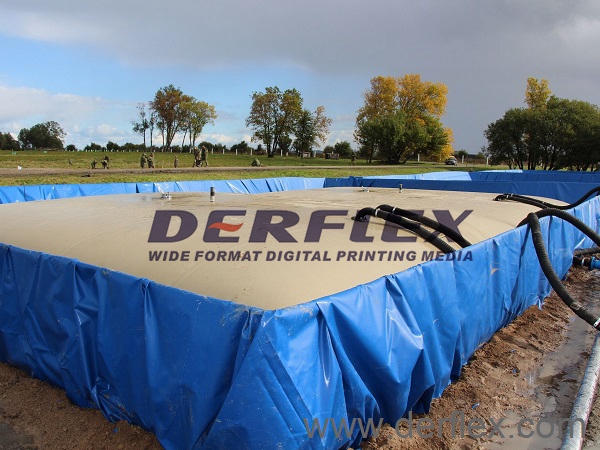
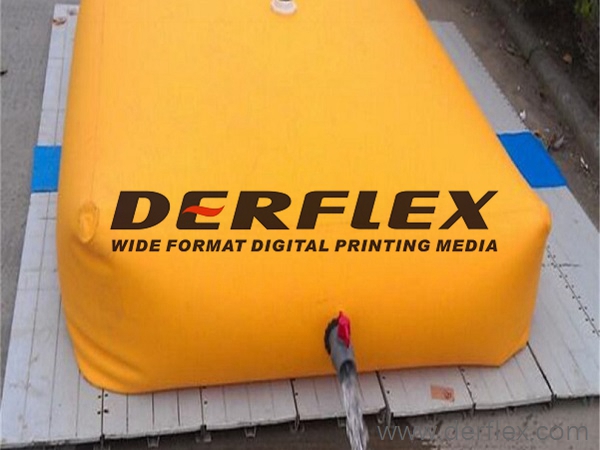
A heavy-duty coated fabric can still be damaged by a poor installation surface. Before filling, the site should be level, stable, clear of sharp debris and large enough for the fully filled tank plus hose and pump access.
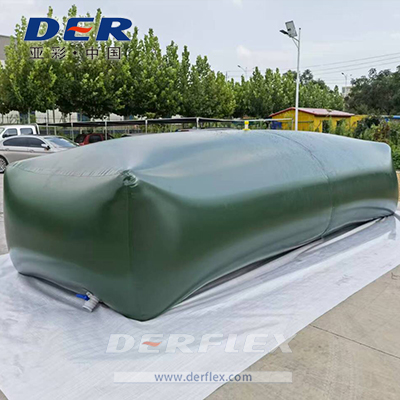
The strongest use cases are temporary, remote or changing locations where permanent rigid storage is difficult to move or install.
Portable reserve storage close to field operations where transport volume, deployment speed, hose interface and ground protection are key considerations.
Temporary staging between tanker delivery and pumping equipment when hydrant access or fixed supply is limited.
Temporary fire-water reserve for maintenance periods, remote facilities or contingency plans, subject to site-specific engineering and local requirements.
Deployable reserve water for large temporary sites where the water point may move as work progresses.
Compact empty-state storage for emergency caches, response depots and disrupted-infrastructure support.
Custom tank size, connection layout, color, marking, accessories and packing for distributors or equipment integrators.
There is no universal tank capacity. Start with the response plan, replenishment source, pump demand and available deployment area.
Ask how long the tank needs to support pumping before it can be refilled, how many tenders or sources feed the site, whether the tank is a buffer or a reserve, and how quickly crews must redeploy it.
For high-volume projects, DERFLEX's large capacity flexible water tank guide explains why filled footprint, connection sizing and ground preparation become more important as volume increases.
One large unit can reduce connection count, while several smaller tanks can provide redundancy, staged deployment and easier distribution across a site. The better choice depends on access, water shuttle rhythm, pump arrangement and incident layout.
For the broader product family, compare DERFLEX's soft water bladder reference and larger flexible containment directions.
Better input creates a more useful tank, fitting and accessory proposal.
These verified DERFLEX pages support material, capacity, fabrication and adjacent liquid-containment decisions.
Direct answers to common sourcing and field-deployment questions.
Common portable directions include folding or frame-supported open tanks for rapid staging and drafting, self-supporting open field tanks, and closed pillow / bladder tanks for compact transport and enclosed reserve storage. The best format depends on how the water will be filled, accessed, pumped and moved.
Yes, a flexible bladder can be used for temporary fire-water reserve when the tank construction, capacity, fittings, ground preparation and local operational requirements are suitable. For active firefighting systems, confirm local authority and equipment compatibility before purchase.
Provide required usable volume, expected pump demand, replenishment source, target operating time between refills, available footprint, deployment frequency and whether one large tank or several smaller tanks are preferred.
Project connection options may include Storz-type, camlock, threaded or other hose interfaces, depending on availability and the approved tank design. Send the exact local coupling standard, hose size and pump requirement before production.
Select by service duty rather than material name alone. Reinforced PVC coated polyester is often evaluated for robust and cost-conscious flexible containment. TPU can be considered where repeated folding, softer handling or a specialized material direction is important. Final selection should match tank geometry, welding process, field conditions and documentation needs.
Ground protection is strongly recommended when the surface may include rough concrete, gravel, roots, stones, metal fragments or other abrasion and puncture hazards. The deployment area should be level, stable and cleared before filling.
DERFLEX can discuss custom capacity, dimensions, color, connection layout, model marking, accessories, transport bag, groundsheet, repair items and export packing for repeat project or private-label programs.
Send DERFLEX the required capacity, tank format, pump flow, hose / coupling standard, available footprint, ground condition, quantity and destination. The tank material, connection layout and accessories can then be reviewed around the actual firefighting or emergency-staging workflow.