01
Flame behavior
Specify the exact fire or flame-retardant test route required by the project. Material formulation, seam construction and sampling should be aligned with the requested acceptance criteria.



 Flexible Underground & Industrial Ventilation
Flexible ventilation duct assemblies configured for airflow performance and documented flame-retardant / antistatic requirements in mines, tunnels, confined work zones and selected hazardous industrial environments.
DERFLEX can coordinate the coated textile, welded duct body, reinforcement, suspension, couplings, fittings and requested test pathway as one project specification. Final suitability is confirmed against the fan duty, site risk assessment and local approval requirements.
Flame retardant antistatic ducting is flexible ventilation ducting specified to address two different ignition-related hazards: flame spread and electrostatic charge accumulation. In underground or hazardous work areas, the duct wall is typically based on a reinforced coated technical textile, then fabricated into complete duct sections with welded seams, end connections and suspension details.
The important purchasing point is that “flame retardant” and “antistatic” do not describe one universal performance level. Different countries, mines, tunnel owners and industrial operators can require different tests, limits and approval routes. A supplier therefore needs the written requirement before material formulation and finished-duct production are confirmed.
Send the fan data, airflow direction, duct diameter, route length, project location, required flame test, antistatic limit, coupling method and installation layout. This produces a more comparable and technically useful offer.
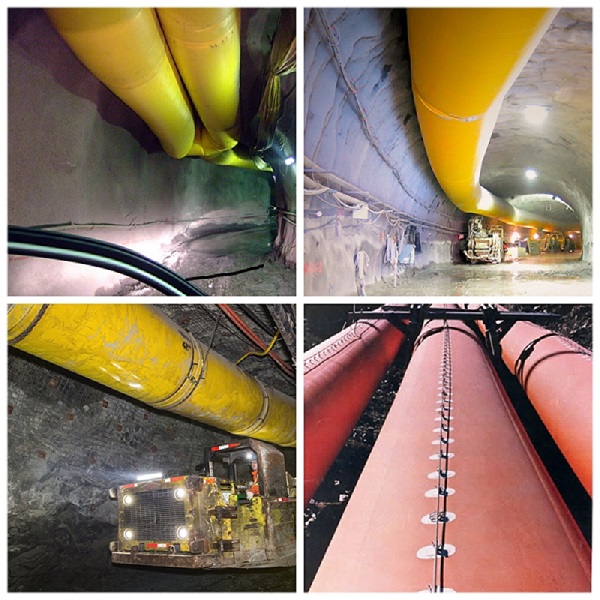
A safer procurement process separates performance claims from the evidence and operating conditions needed to support them.
Specify the exact fire or flame-retardant test route required by the project. Material formulation, seam construction and sampling should be aligned with the requested acceptance criteria.
Define the electrical resistance or surface-resistance requirement and how it will be measured. Antistatic performance should not be inferred from color or from a generic “conductive” description.
Some systems may require conductive components, helix bonding or earthing points. Whether these are necessary depends on the site engineering design and applicable hazardous-area practice.
Pressure stability, leakage, handling and serviceability also depend on the complete duct: seams, couplings, reinforcement, suspension spacing and fittings—not only the coated fabric.
The same flame-retardant and antistatic requirement can be applied to different duct structures. The airflow direction and installation envelope decide which structure is appropriate.
Collapsible duct sections that inflate under forced airflow and pack down efficiently when the fan is stopped.
Continuous helix reinforcement holds the duct passage open where suction, extraction, bends or frequent relocation would collapse an unsupported tube.
Redistributes the air passage horizontally where a round duct would interfere with mining equipment, services or tunnel clearance.
These fields are intended for early RFQ development. Final values are confirmed after reviewing fan duty, route geometry, project standard and required documentation.
| Specification item | Typical DERFLEX project direction | Buyer selection note |
|---|---|---|
| Product form | Finished flexible duct assembly | Duct body, welded seams, selected reinforcement, suspension and end connections can be supplied as one product. |
| Duct body | PVC-coated reinforced technical textile | Fabric construction and coating formulation are selected around pressure, handling, abrasion, FR and antistatic requirements. |
| Diameter | Approx. 300–3000 mm reference range | Final diameter should follow airflow demand, permissible velocity, route length, available headroom and fan curve. |
| Section length | Project-configured | Handling weight, connection frequency, tunnel advance rate and packing method influence practical section length. |
| Airflow mode | Positive pressure / negative pressure / selected reversible duty | Layflat and wire-reinforced structures behave differently under suction. |
| Reinforcement | None, periodic rings or continuous helix | Use helix support where collapse resistance, suction or tight bends require it. |
| Connections | Zipper, hook-and-loop, ring, clamp, eyelet or custom interface | Joint leakage, installation speed, compatibility and repair access should be considered together. |
| Suspension | Single/double fins, patches, D-rings, eyelets or custom hangers | Spacing is coordinated with diameter, duct weight, route curvature and movement. |
| Flame-retardant requirement | Specified by project test method | State test standard, classification, sample format, report language and third-party requirement before quotation. |
| Antistatic requirement | Specified resistance target and test method | State limit, conditioning method and any earthing/bonding expectation. |
| Color & marking | High-visibility or custom color; section/airflow/project marking available | Color does not itself indicate FR/AS performance. |
| Fittings | Reducers, branches, fan adaptors, elbows, transitions and repair sections | Send dimensions or drawings for interface review. |
A well-written duct specification avoids treating two separate safety functions as one vague marketing label.
Across mining, tunneling and hazardous industrial work, different jurisdictions can use different fire tests, electrostatic limits and approval procedures. DERFLEX therefore asks buyers to identify the acceptance route before mass production.
Intended to limit ignition, flame spread or continued burning according to a defined test. It does not mean a flexible polymer duct is non-combustible.
Intended to reduce charge accumulation or support charge dissipation according to a stated electrical test. It does not eliminate every ignition source in a hazardous area.
Tensile, tear, seam, coupling and reinforcement design must support the airflow pressure and repeated installation loads.
Leakage, friction, bends, diameter and joint count affect how much of the fan output reaches the work zone.
The final construction must still be approved for the actual site. The applications below describe typical procurement contexts, not automatic suitability for every hazardous location.
Fresh-air supply or extraction in coal, metal and mineral mine headings where fire and electrostatic controls form part of the operator’s safety specification.
Road, rail, metro, hydropower and civil tunnel ventilation where long duct runs, repeated extension and confined fire risk require documented material performance.
Temporary ventilation around tanks, vessels, pits and enclosed equipment where flexible routing and site-specific ignition-control procedures are required.
Wire-supported ducting for selected process exhaust routes, maintenance shutdowns and portable air-moving equipment, subject to chemical and temperature review.
Duct packages can be developed around specified hazardous-area documentation, but equipment zoning, fan certification and overall system compliance remain project responsibilities.
Custom duct sections, cuffs, colors, labels and packing for fan manufacturers, ventilation contractors, distributors and project integrators.
DERFLEX’s value for this product category is the ability to coordinate material selection with finished-product fabrication and export order execution.
Review mine/tunnel type, airflow direction, fan data, route, duct geometry, wear exposure and the requested flame / antistatic test criteria.
Select coated textile construction, layflat or helix-supported format, reinforcement zones, color and surface formulation for the intended service.
Confirm welded seams, cuffs, zippers/rings, suspension fins, branches, reducers, fan adaptors, markings and packing before production approval.
Dimensional checks, seam review, connection fit and agreed performance records can be planned according to the purchase specification and order requirements.
A complete RFQ reduces repeated clarification and makes quotations from different suppliers easier to compare.
The cheapest-looking duct on a spreadsheet can become expensive if the pressure mode, couplings, test requirements or installation load were not included in the original comparison.
Send Project RequirementsThese six internal links connect safety requirements with finished-duct selection, pressure direction and coated textile engineering.
FRAS is commonly used as shorthand for flame-resistant/flame-retardant and antistatic performance. However, it should not be treated as one universal certification. The project should state the exact flame test, electrical resistance requirement and approval route.
Only if the finished structure is designed for the required pressure direction. A layflat duct normally depends on positive pressure to stay open. Negative-pressure or extraction duty usually requires spiral wire or another collapse-resistant reinforcement.
No. Antistatic ducting addresses only part of the ignition-control strategy. Fans, electrical equipment, grounding, gas/dust classification, work procedures and the complete ventilation design must be reviewed under the applicable site rules.
Grounding-related details can be reviewed where the duct structure includes conductive components or a project calls for earthing provisions. The required arrangement should be defined by the project engineer and applicable standard before production.
DERFLEX uses an approximate 300–3000 mm diameter window as a project reference for flexible mine and tunnel ducting. Zipper, hook-and-loop, ring, clamp, eyelet and drawing-based interfaces can be discussed. Final availability depends on the duct structure and order specification.
Provide the project location, mine/tunnel or industrial application, fan airflow and pressure, positive/negative pressure duty, diameter, total route, section length, bends, couplings, suspension, flame standard, antistatic limit, fittings, quantity and delivery destination.
Send your airflow data, project standard, flame-retardant requirement, antistatic target, diameter, route length and connection drawing. DERFLEX can review a finished flexible duct configuration and quotation scope for the project.