


 DERFLEX
Greenhouse Roll Up Sidewall Tarps for Ventilation Openings
Open the sidewall for fresh air. Close it for weather separation. DERFLEX helps greenhouse builders, agricultural distributors and OEM fabricators specify roll-up sidewall tarp materials and replacement panels around the actual vent opening, roll tube and operating routine. Choose light-transmitting film or a suitable reinforced material, then confirm the top attachment, tube connection, clear opening, end restraint and repeat-use performance. These movable wall panels are not the same as a full greenhouse roof covering or a complete drive-system kit.
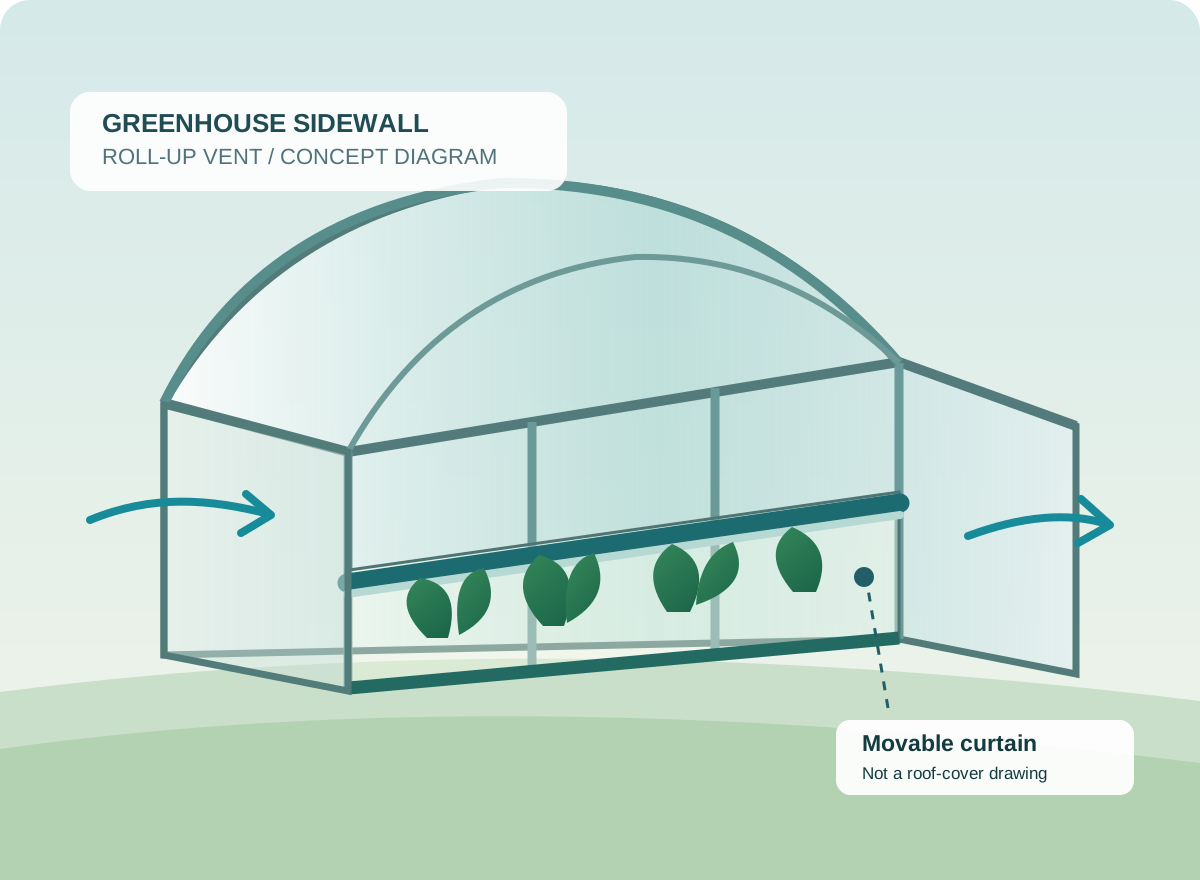
What is a greenhouse roll-up sidewall tarp?
It is a flexible curtain that raises or lowers over a side ventilation opening. The curtain is held at a fixed edge and rolls around a compatible tube or lifting assembly, allowing air exchange when open and reducing weather exposure when closed.
Typical installations sit along the long wall of a hoop house, tunnel greenhouse or commercial growing bay. Both sides may be used for crossflow ventilation when the greenhouse designer calls for it. The curtain may be clear, translucent or an application-specific screen; the crop, light requirement, climate and operating hardware determine the selection.
A greenhouse tarp or roof cover forms part of the permanent weather skin, whereas a roll-up sidewall is a moving interface that must tolerate repeated winding, rubbing and changes in tension. Sizing a sidewall from only its roof-film width is a frequent specification mistake.
Scope: material, panel or system?
Material roll: greenhouse film or coated flexible sheet delivered for the customer's converting process.
Fabricated sidewall panel: custom length, hems or tube-interface details agreed on a drawing and approved sample.
Not implied: greenhouse frame, motors, gearboxes, tubes, automation, structural design, on-site fitting and installation unless separately and expressly quoted.
Design the side ventilation opening around the roll tube
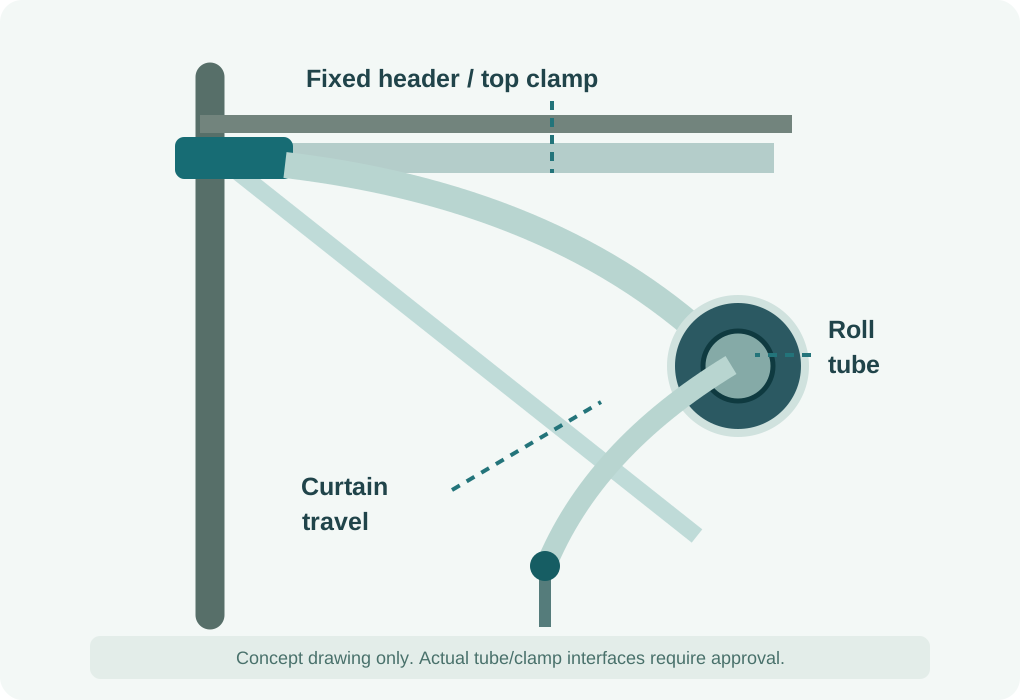
For a bottom-up roll curtain, the top edge remains attached to a fixed header while the lower edge winds around a tube and travels upward. For other drive configurations, obtain the system supplier's section drawing rather than assuming the same finish will fit.
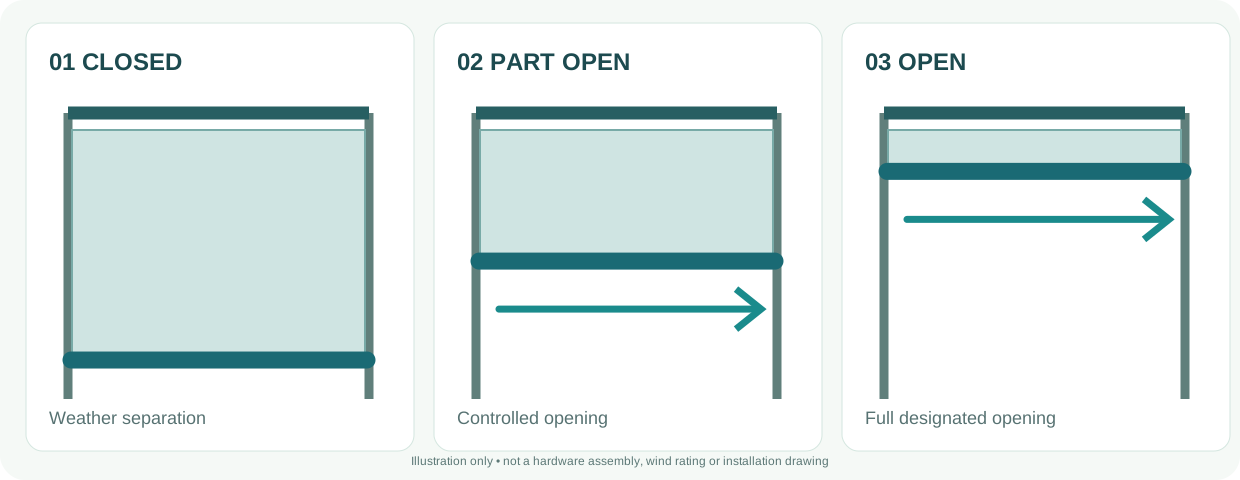
Clamp without point stress
Confirm lock-channel, batten or other top attachment, expected clamp capture and seam position. Avoid exposed edges that cut or crease film.
Match tube and fabric
State tube outside diameter, clip/pocket interface, overlap or wrap requirement, travel direction and clearance. Confirm roll straightness in a trial.
Restrain wind and rain
Locate side guide or wind rope, end returns, closing seal and runoff direction. Friction and unrestrained edges can shorten useful life.
How to measure a replacement greenhouse sidewall curtain
The clear vent opening is not automatically the same as the finished fabric size. Record the installed hardware geometry, then approve the cut length and the top/tube allowance with the converter.
| Measurement | Record on the drawing | Why it matters |
|---|---|---|
| Vent length (A) | Clear span, posts and bay divisions | Long spans can skew when the tube or curtain winds unevenly. |
| Vent opening height (B) | Top clamp to lower closing line | Defines movement range; not the sole cut-height input. |
| Roll tube (C) | Outside diameter, segment joins and attachment system | Controls fabric wrap, clips or pocket dimensions. |
| Header capture (D) | Actual extrusion/batten type and captured material length | Prevents accidental under-length at the fixed edge. |
| Side/end closures (E) | Guide spacing, overlap, wind rope and end returns | Controls leakage paths and repeated contact zones. |
| Operating condition (F) | Hand crank / geared / motorized, cycles, wind and temperature | Determines handling stress and grade selection. |
Clear, translucent or reinforced: select by growing conditions and movement
These are material directions for an application review, not one universal DERFLEX SKU. Thickness, weight and UV properties must be tied to an approved grade and actual test data before purchase.
| Material direction | When to consider | Trade-off & sample check |
|---|---|---|
| Greenhouse-grade PE film | Light-transmitting moving walls, existing poly-film vent systems and lower winding mass. | Verify UV package, tear and puncture behavior, clamp compatibility, condensation and repeated winding. Compare greenhouse films. |
| Clear flexible PVC film | Selected fabricated clear panels where visibility, weldability or a particular curtain finish is wanted. | Assess actual light needs, haze, thickness, mass, cold stiffness, UV yellowing and tube effort. Explore clear PVC roll material. |
| Reinforced clear/translucent tarp | Large or abrasion-prone sections where added fabric stability matters more than unobstructed clarity. | Reinforcement can reduce light or line-of-sight; confirm bending radius, seam flexibility and repeated-cycling performance. View reinforced clear tarpaulin. |
| Opaque PVC-coated fabric | Non-light-critical perimeter areas, removable privacy or selected weather barriers. | Not a default substitute for clear crop-facing sidewalls; mass and roll radius may require hardware changes. Review agricultural PVC fabrics. |
| Shade cloth or mesh | Air-permeable shade or side screening where deliberate openness is desired. | It is not a sealed rain curtain. Confirm shade factor, insect screening, wind restraints and crop needs. Compare greenhouse shade fabric. |
Material performance is grade-specific. A statement about light transmission on a roof-cover product page does not verify the light level of every roll-up sidewall configuration.
Opening area, daylight and insect screens affect one another
Rolling up a greenhouse sidewall creates a controllable opening, not a rated mechanical ventilation system. Greenhouse air exchange depends on opening height, length, building layout, wind, indoor–outdoor temperature difference and other openings.
Light when the curtain is down
Choose clear or diffused material with reference to crop and growing season. Ask for measured transmission if a target is important; a visually transparent sample alone is not a quantified light-performance report.
Translucent/reinforced constructions may create additional haze or a visible textile grid.
Air when the curtain is up
Plan the usable open band after allowing for the rolled bundle, side guides and other obstructions. Insect mesh adds airflow resistance; its opening size also affects pest exclusion and cleaning.
Coordinate side vents with roof vents, fans and the grower's wider climate plan.
Common failure points to check before accepting production
A sidewall can look excellent on the ground but behave poorly when winding. Test the actual film, attachment, tube and restraints together on a representative span.
Skewed winding. Check tube straightness, uneven tension, film stretch and buildup at seams or edge bands.
Abrasion at frames. Protect tube joints, guide ropes, posts, clamps and any protruding fasteners.
Condensation & runoff. Direct water outward at top overlaps and lower closures; don't create a pocket behind the rolled bundle.
Weather response. Follow the greenhouse supplier's secure/close instructions before high winds or storms.
Cleanability. Use appropriate mild cleaning, inspect scuffs and avoid storage while wet or sharply folded.
Replacement service. Agree on material code, layout drawing, panel numbering, label and accessible maintenance points.
Review the material before finalizing the curtain assembly
Visual inspection is useful for surface quality and transparency, but only sample testing on the intended hardware can verify rolling behavior. The illustration above explains geometry; the DERFLEX image below is a real clear-film roll material reference, not a photograph of an installed roll-up greenhouse curtain.
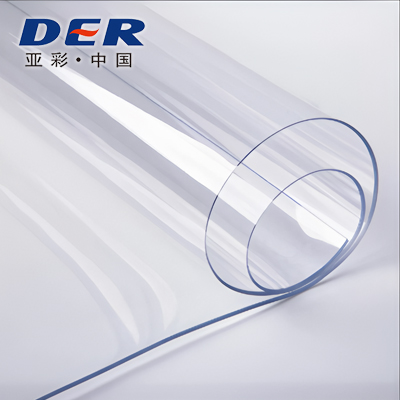
What a material photo cannot confirm
A photo does not prove light transmission, weathering life, tear resistance, approved winding cycles or greenhouse compatibility. Request the grade designation, formulation direction, sample sheet, tests relevant to the project and a small completed-edge trial.
The same is true of coated greenhouse tarp material: a robust sheet for fixed covering is not automatically suitable for a frequently moving side curtain.
For the finished product gallery: photograph the approved sidewall in closed, partially open and fully opened positions, including tube attachment and edge details. Those real project images should replace or supplement concept visuals after verification.
Specify a repeatable sidewall panel—not just a tarp size
For greenhouse equipment brands, growers' suppliers and fabricators, the specification must connect the material to a drawing and an acceptance sample.
Send the arrangement
Vent location, greenhouse bay drawing, film sample or grade, opening length × height, tube/clamp photos and operator method.
Approve the prototype
Check film face, clarity, hems, captured edges, connection method and repeated winding on representative hardware.
Control repeat orders
Confirm the grade, dimensions, tolerance, assembly orientation, panel number, packaging and applicable test report.
Frequently asked questions
Material, opening measurement, drive-system boundaries and final acceptance before a bulk order.
What is a greenhouse roll-up sidewall tarp?
It is a movable curtain or flexible sheet that covers a greenhouse side ventilation opening. A roll tube or compatible lifting arrangement raises the panel to admit outside air and lowers it for weather separation. It is specified separately from the fixed roof covering.
Which material is best for a clear greenhouse roll-up sidewall?
Light-transmitting greenhouse-grade PE film is a common starting point where crop light, low rolling mass and compatibility with existing poly-film hardware matter. Flexible clear PVC or reinforced transparent constructions can be evaluated for selected fabricated-panel duties. Compare actual light transmission, flexibility, UV exposure and tube compatibility before choosing.
How do I measure a replacement sidewall curtain?
Measure the clear opening length and height, the fixed top-clamp position, the roll-tube outside diameter, side restraints and end returns. Ask the installer to define the additional material required for clamp capture, tube wrap, edge finishing and shrink or fit tolerance; do not treat the opening size as the cut size.
Can DERFLEX supply the roll tube and crank system?
DERFLEX can discuss film or coated-fabric roll goods and project-specified fabricated tarp panels. Roll tubes, gearboxes, motors, guides, wind restraints and structural hardware are separate system elements and should not be assumed included unless the quotation expressly lists them.
Will a transparent sidewall still provide ventilation when closed?
No. A closed solid film or PVC curtain is not a free-air ventilation opening. Ventilation occurs when the side is opened, or through a separately designed and protected airflow path. Insect screens, wind restraints and other layers may reduce the effective open area.
What should be checked before repeat production?
Approve a representative material and finished-edge sample with the actual tube or clamp, then trial repeated raising and lowering. Check skew, winding effort, abrasion, light appearance, closure overlap, rain runoff and the approved material specification before placing a repeat OEM order.
Request a greenhouse sidewall tarp quotation
Send the greenhouse bay drawing or installation photo, working opening, film grade or light target, tube and clamp details, cycle conditions, quantity and intended destination. DERFLEX can review a material or fabricated-panel approach and confirm the scope of supply in writing.