


Industrial Mesh Curtains for Airflow & Area Separation
Define a work zone without turning it into a sealed room. DERFLEX supports PVC-coated polyester mesh material and custom curtain-panel enquiries where air passage, partial visibility and a durable hanging perimeter matter more than waterproofing or temperature isolation. Compare opening geometry, color, reinforcement and the intended opening method before selecting a mesh grade.
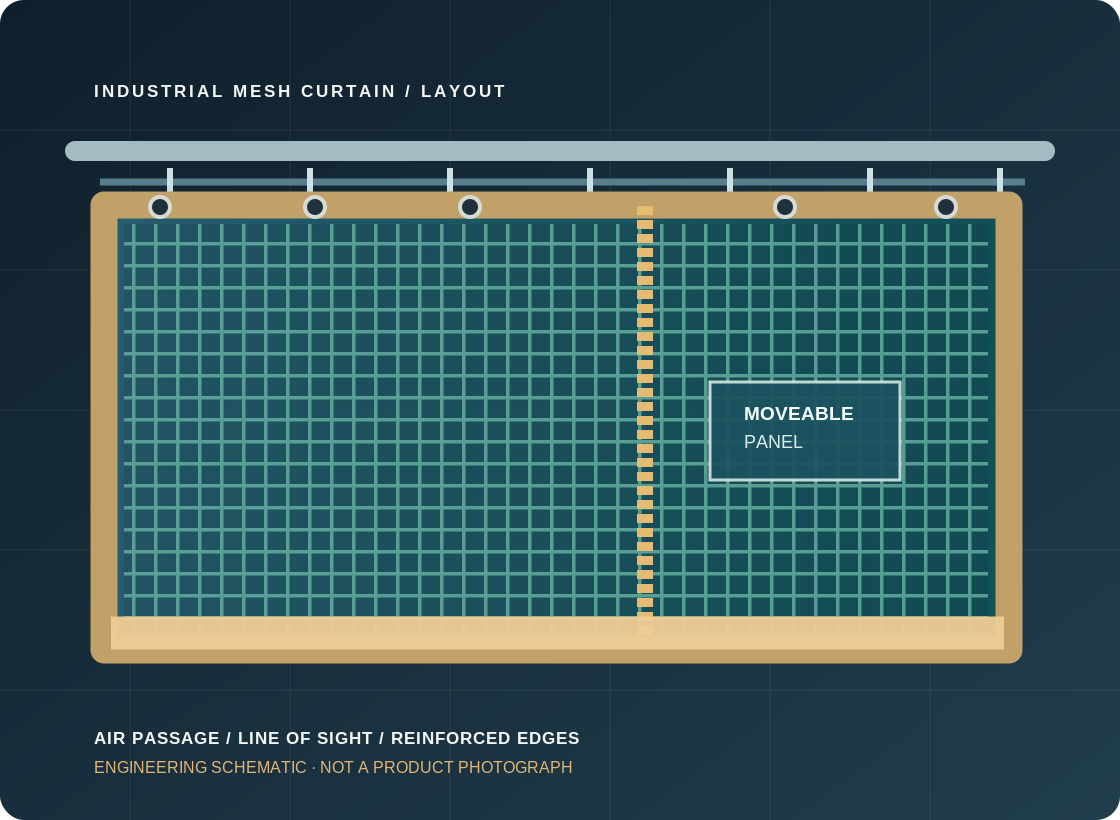
What is an industrial mesh curtain?
An open, flexible textile screen that divides space while allowing some light and air to pass through.
Industrial mesh curtains are suspended sheets with controlled openings, used to mark boundaries around production cells, maintenance areas, loading interfaces and other work zones that should remain ventilated. PVC-coated polyester mesh is one material direction: the textile carries the principal tensile load while the coating protects the yarn surface and influences processing and appearance. The curtain itself is defined by its opening geometry, reinforced edge construction and fixing arrangement.
Unlike a solid warehouse divider tarp, an open mesh screen is not intended to form a tight air, dust or water seal. Buyers requiring sealed work-zone barriers should compare the solid industrial curtain range rather than expecting more fabric weight to turn mesh into a solid barrier.
Specify the opening—not just the GSM
Mesh weight alone cannot tell a buyer how much air, light or visibility a curtain will provide.
Mesh opening & pitch
Record clear opening dimensions, repeat spacing and the orientation of the grid. Ask how projected void area was measured.
Through-view & shade
Judge visibility at the actual working distance and lighting condition. Dark or dense mesh can look different in backlight.
Air passage under pressure
Geometric openness is not an air-permeability result. When required, specify the test method and pressure difference.
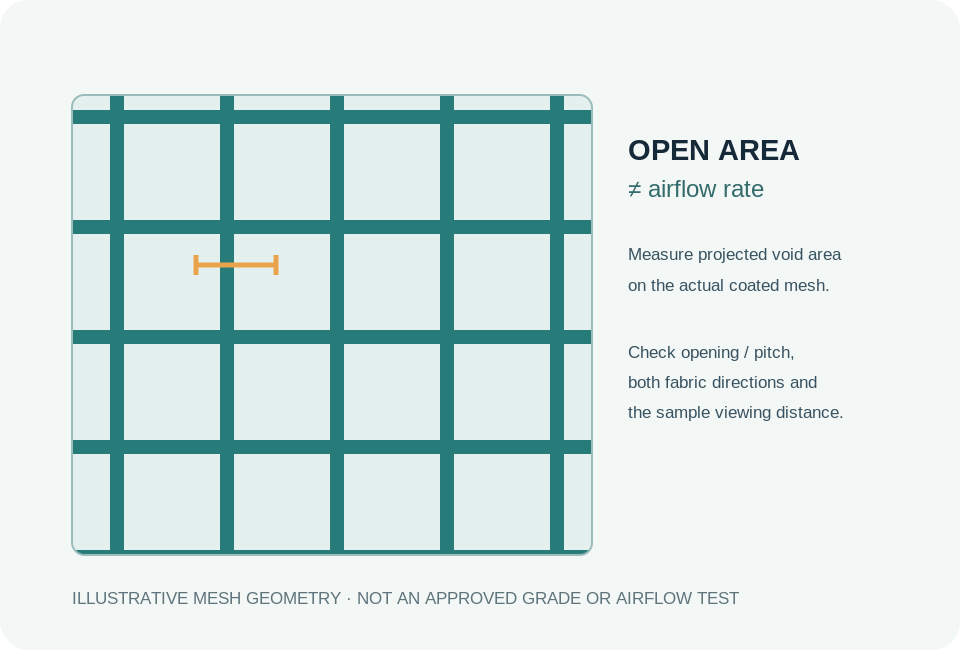
How to interpret open-area percentage
Geometric open area is the projected void portion of a mesh sample under a defined measurement convention. For a simple square repeat with 10 mm pitch and a 6 mm square clear opening, the illustrative open fraction is (6 × 6) ÷ (10 × 10) = 36%.
That 36% is a worked geometry example, not a DERFLEX specification, shade value, air-flow performance or system approval. Real yarn geometry, coating thickness and irregular openings require measurement on the proposed sample.
For source material, see DERFLEX vinyl-coated polyester mesh and mesh tarpaulin materials; material grades must be confirmed for the curtain application.
Mesh curtain purchasing specification
Use this checklist to make two material and fabrication proposals comparable.
| Item to specify | What to request | Why it matters |
|---|---|---|
| Construction | PVC-coated polyester mesh, exact material reference, yarn / grid structure | Supports grade traceability and fabrication review. |
| Opening geometry | Clear opening, pitch, measured geometric open-area percentage, orientation | Affects through-view and permeable area. |
| Directional strength | Warp / weft tensile and tear results with test method and units | Loading differs across yarn directions and at hanging points. |
| Finished panel | Width × drop in mm, seams, usable roll width, tolerance | Controls fit, panel joins and edge clearance. |
| Hems & attachments | Border material, reinforcement, connection type, spacing and bottom details | Manages pulling and repeated handling loads. |
| Environment & evidence | Indoor/outdoor, cleaning, UV / FR requirements and applicable test report for exact grade | Prevents unsupported generic material claims. |
No standard open-area percentage, GSM, roll width, fire rating or finished size is asserted for this specific curtain program until its grade and drawings are approved.
Design the edge to survive opening and closing
Mesh geometry gets the attention. Hems, suspension and contact points determine whether the panel remains serviceable.
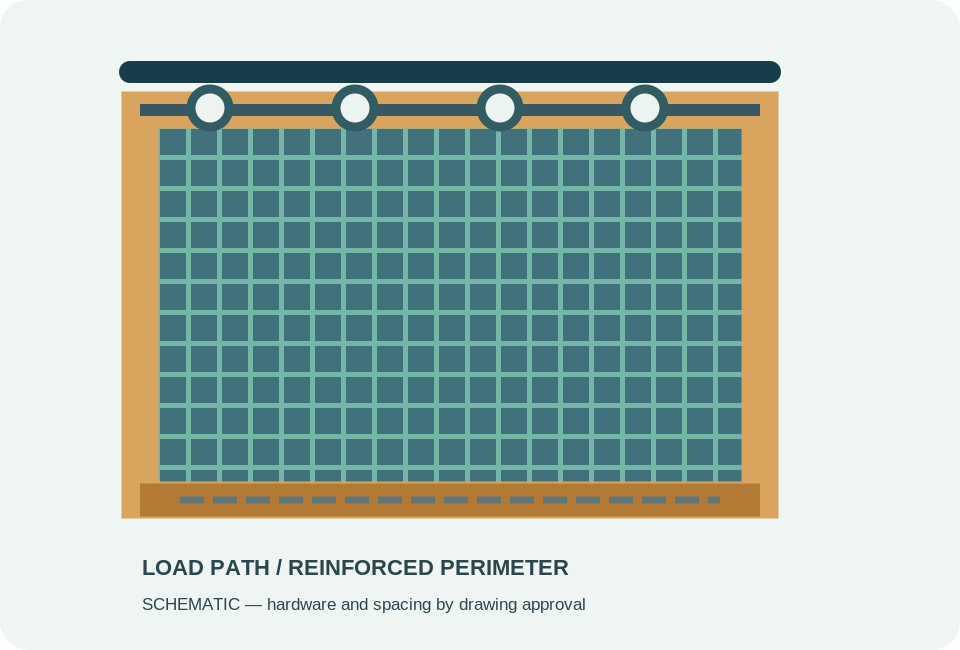 Reinforced mesh-to-hardware interface
Details worth drawing before production
- Top suspension: fixed eyelets, reinforced hanging tabs or an agreed track interface.
- Perimeter: compatible solid border or webbing with reinforcement at corners and pull zones.
- Bottom edge: a defined clearance or optional pocket / restraint to help manage movement.
- Access & replacement: where each panel opens, overlaps, detaches or can be replaced separately.
- Fabrication compatibility: sewing or joining methods confirmed by a trial on the selected mesh and border combination.
Ventilated separation for industrial workflows
Select the use case by what must pass through the opening—and what must not.
Production area zoning
Mark operational boundaries while maintaining general visual supervision and incidental air passage. Confirm machinery clearances and access routes.
Maintenance & service bays
Create a removable visual screen around a work area when close containment is unnecessary. Allow for tools, carts and repeated entry.
Open warehouse interfaces
Partially screen an opening while preserving air exchange. Outdoor wind actions and anchoring require a separate system review.
OEM screen-panel programs
Source mesh in rolls or discuss dimensioned replacement / finished panels; approve border construction and labeling for repeat fabrication.
Mesh is not a substitute for a sealed partition
When the primary need is to limit contaminant migration, block spray, control room temperature or separate conditioned areas, open-mesh material may be inappropriate. Review the more relevant dust containment curtain guidance and confirm the entire enclosure and ventilation design.
Where visibility through an otherwise solid barrier is more important than airflow, consider clear viewing areas rather than increasing mesh openness.
 Real DERFLEX mesh material reference
Mesh curtain vs. solid PVC divider
Two very different procurement choices—even when both use PVC-coated textile components.
| Decision criterion | Open industrial mesh curtain | Solid PVC partition curtain |
|---|---|---|
| Ventilation | Permits air through mesh openings; actual rate depends on conditions | Blocks direct passage through intact solid material; edge leakage still exists |
| Visibility | Partial through-view depending on geometry / light | Opaque unless a clear or transparent panel is specified |
| Water and fine dust | Pass through open portions; not a tight barrier | Possible barrier direction; seams and installation define containment |
| Pressure and movement | Open structure can reduce resistance compared with solid sheet, but not eliminate wind loads | Solid face needs greater attention to airflow pressure and restraint |
| Typical buying priority | Openness, visual screening, reinforced hems, access | Sealing, panel weight, joinery, doors, transparent windows |
For general industrial fabric formats beyond curtains, review DERFLEX industrial textiles and factory curtain design.
Send the opening, operating duty and required supply scope
Start with a photo or sketch. A workable curtain quotation requires more than a width and a color.
Buyer RFQ checklist
- Application: zone purpose, indoor/outdoor conditions and ventilation reason.
- Geometry: clear opening width × drop, quantity, sketches, obstacles.
- Material: visibility target, sample photo, color and required evidence.
- Movement: fixed, movable or replacement panel; frequency of handling.
- Fixing: top support, grommet / track interface, hem and bottom restraint.
- Scope: material roll, cut mesh or fabricated panel; destination and schedule.
How DERFLEX can support selection
Begin with mesh material identification, then match the planned cut and edge construction to the suspension system. For a repeat OEM program, agree on reference samples, visible appearance, dimensional tolerance, seam details, marking and packing.
Ask what is supplied in the quoted line item. Mesh roll goods, made-to-measure panels, fixings and installed hardware are separate scope decisions—not automatic parts of one mesh product.
Related material program: custom mesh tarp fabrication for broader reinforcement options outside a curtain-specific opening.
Continue with the right DERFLEX material page
Compare mesh material, solid dividers and curtain fabrication without mixing their purposes.
Frequently asked questions
Practical answers about open area, visibility, safety boundaries and custom curtain orders.
What is an industrial mesh curtain?
An industrial mesh curtain is a flexible, perforated textile panel used to mark or separate work zones while permitting some air and light to pass through. A PVC-coated polyester mesh is one material option; the finished curtain also needs reinforced edges and a suitable mounting arrangement.
Does a higher open-area percentage mean better ventilation?
Not necessarily. Geometric open area describes how much of a flat mesh sample is void space. Actual air passage also depends on yarn shape, pressure difference, installation gaps and surrounding equipment. Ask for comparable permeability data when ventilation is a performance requirement.
Can people see through a mesh curtain?
Often partially, but visibility depends on opening geometry, material color, lighting, distance and viewing angle. Approve a physical sample in the intended work area instead of assuming a mesh is fully transparent.
Can industrial mesh curtains contain fine dust or fumes?
No claim of tight fine-dust or fume containment should be made for open mesh alone. When hazardous dust, fumes, spray or pressure-controlled separation is involved, use an engineered containment and ventilation approach with the required evidence.
How should mesh curtain edges and mounting points be specified?
Define the finished opening, panel movement, top suspension, edge reinforcement, grommet or track connection, bottom restraint and contact points. Larger or frequently operated curtains need special attention to pull loads and fatigue at attachment positions.
What does DERFLEX need to quote custom mesh curtains?
Send the opening width and height, a sketch or photos, indoor or outdoor location, target visibility and airflow, mounting method, operating frequency, desired color, quantity and any specified test or acceptance requirements. Confirm whether you need roll fabric, cut panels or finished curtains.