


 ENGINEERED FLEXIBLE MATERIALS
Elastic Hem Tarp Covers for Fitted Equipment Protection
Elastic hem tarp covers use a gathered lower edge to grip an equipment profile while keeping the cover easy to install and remove. DERFLEX can discuss PVC-coated fabric, tailored panels and elastic-edge assemblies for idle machinery, farm equipment, warehouse assets and OEM protective-cover ranges. Specify the relaxed opening, installation stretch, hem construction, replaceable elastic and ventilation as one design—not simply a finished length and width.
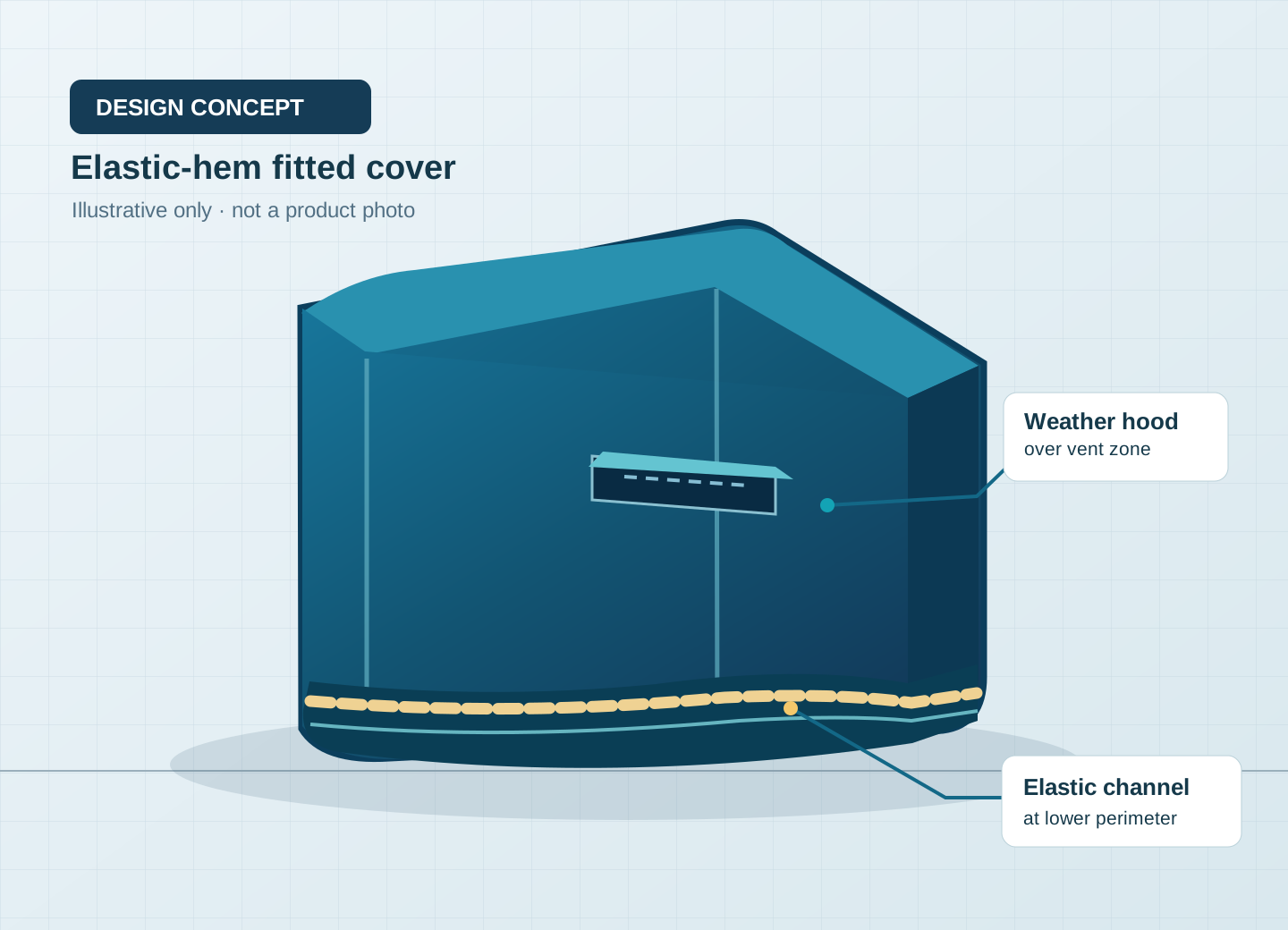
What is an elastic hem tarp cover?
Quick answer: An elastic hem tarp cover is a shaped protective fabric cover with elastic integrated into all or part of its lower perimeter. The elastic gathers excess material beneath a flange, housing or equipment edge to improve fit and convenience without relying on a rigid frame or manually tied cord.
The fabric forms the weather barrier; the hem channel and elastic manage the installation opening. These are different jobs. A waterproof coated sheet still needs sound seams and sensible water runoff. Elastic force, meanwhile, changes with installed stretch, repeated use, temperature and aging.
For repeat B2B programs, specify whether the product is a fitted five-sided cover, hood-shaped tarp, partial elastic skirt or a panel set supplied for local fabrication. A fabric-only order does not include a completed elastic-edge closure unless explicitly agreed.
When this closure makes sense
- Frequent hand installation and removal around repeatable equipment shapes.
- Stationary outdoor or indoor protection where a snug edge is preferred.
- OEM accessory covers with consistent model numbers and packaging.
Not the right default: vehicle or highway cargo securement, high-wind exposed covers without independently specified anchorage, or hot/running machinery.
Size the opening in two states: relaxed and installed
An elastic hem should pass over the equipment's widest installation route, then settle below the chosen retention edge. The critical dimension is not just the fabric's outer footprint—it is the opening that must stretch over protrusions during fitting and grip the lower profile at rest.
Measure the fitting path
Record the maximum width/depth or perimeter the lower opening must clear while pulling the cover on. Include handles, guards, knobs and projections, plus the removal direction.
Choose the resting hem line
Mark the lower edge location, ground clearance, areas where the hem can tuck under a flange, and any points where gathering would obstruct drains or airflow.
Approve the installed effort
Assess whether one operator can fit and remove the approved sample safely. Too much gathering can damage stitching or make the cover difficult to handle; too little can permit lifting or billowing.
Procurement convention: identify relaxed elastic length, safe fitting extension, hem opening dimensions, band width, band material and acceptance method separately. No universal “20% smaller” or fixed elastic stretch ratio is suitable for every product. Validate the actual geometry and sample before setting tolerances.
| Drawing field | Record in the specification | Why it matters |
|---|---|---|
| Equipment profile | W × D × H, corner radius, projections, photos or CAD | Controls cover shape and fitting path |
| Finished cover dimensions | Outer length, width, height, side drop, seam allowance / tolerance | Prevents confusion between cut size and installed size |
| Hem position | Distance below reference datum; access / drainage clearances | Sets the retention line and avoids interference |
| Elastic details | Band/cord form, relaxed loop length, casing width, insertion access | Supports fit checks and eventual replacement |
| Installation test | Fit over the widest point; release behavior; hand force and damage check | Approves a practical, repeatable opening range |
The measurement worksheet defines required information; it is not a published dimensional or elastic-force specification for an existing stock model.
Build the elastic perimeter for handling and repair
The hem is a maintenance component as well as a closure. Choose the route based on fit geometry, accessibility and the desired service life of the whole cover.
Continuous encased elastic
A protected band or cord runs inside a folded channel around the lower opening. It offers generally even gathering around a consistent shape. Confirm the splice, service access and risk of twisting or bunching at corners.
Segmented elastic sections
Elastic is installed only along selected sides while other sections remain stable. Useful when a cover needs a front access door, unobstructed vent, handle clearance or distinct corner geometry.
Hybrid hem plus independent straps
Elastic helps the cover fit during placement; separately specified straps or hardware can manage additional retention for stationary use. Do not treat the elastic itself as load-rated hardware.
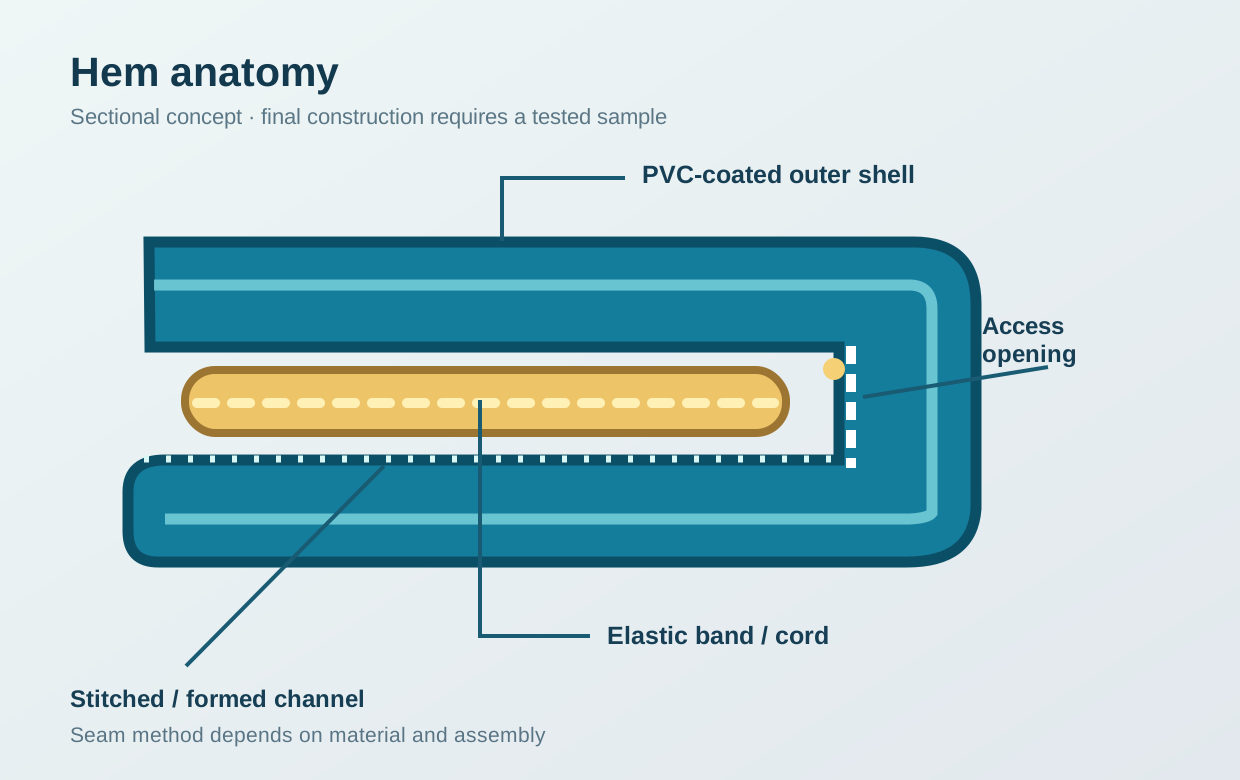
Replaceable elastic: preferred for service programs
A planned access slit or closable opening allows the old elastic to be withdrawn and a new band or cord fed through the casing. Record the replacement part dimension, join/splice detail and access location. A factory-sealed end without access cannot automatically be called field-replaceable.
Captive elastic: fewer openings, harder repair
Elastic secured within stitched channels may be simple to fabricate but often requires unpicking a section for replacement. Select this intentionally if the expected handling cycle, budget and maintenance route justify it.
Weather resistance includes the elastic—not only the PVC
Outdoor use exposes the coated shell and the elastic component to different aging mechanisms. UV, heat, cold, wet/dry cycling, cleaning chemicals, salt and cyclic extension can change elastic recovery, while abrasion and rubbing can damage the hem channel.
- Coated fabric: select weather-exposure and flexibility requirements for the proposed material grade; verify by its own data sheet or relevant test record.
- Elastic: agree on polymer/cord construction, covering braid, cycling protocol, aging conditions and acceptable loss of recovery as project-specific criteria.
- Interfaces: inspect corner wear, stitch and seam integrity, and whether pooled water can remain inside the casing.
- Replacement: define a visual/functional inspection interval in the operating instructions, not an unsupported fixed service-life promise.
Design warning: a UV-resistant fabric does not automatically mean the elastic is UV-resistant or that the finished cover has passed a weathering test.
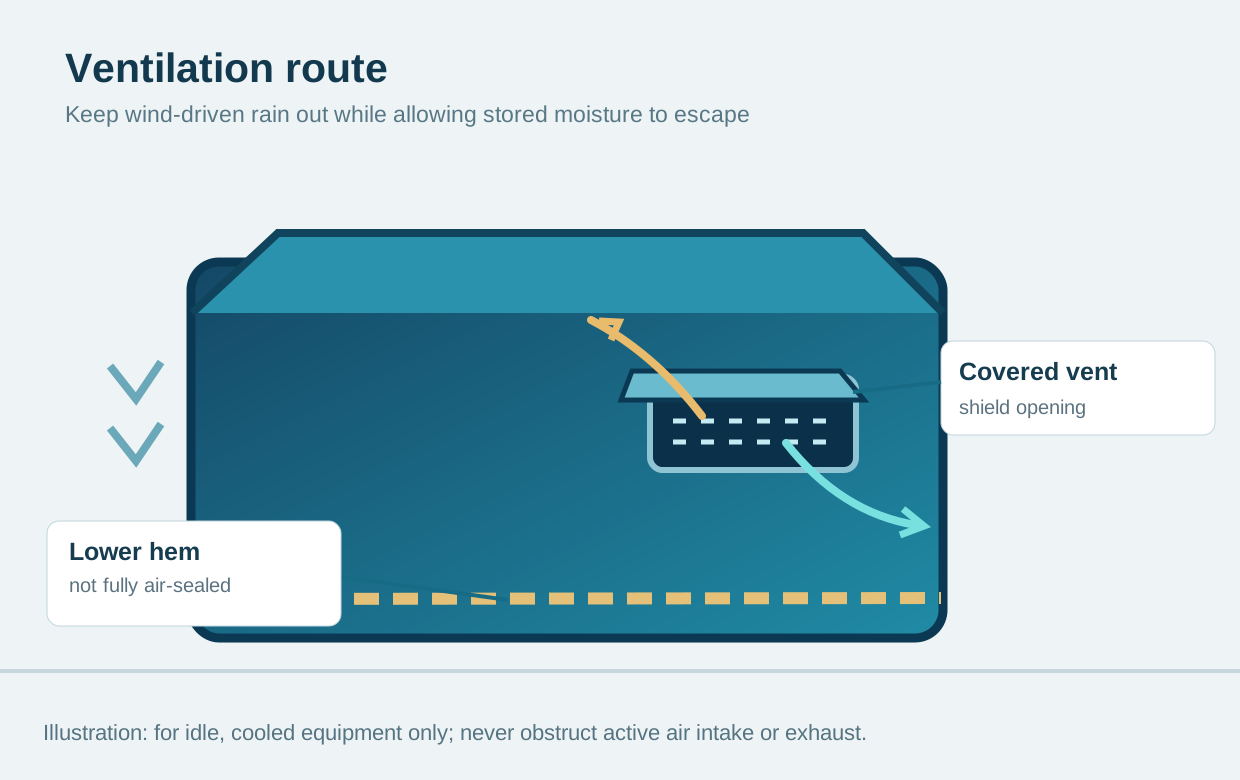
Keep stored equipment dry without trapping humidity
Solid PVC-coated covers can limit direct rain entry, but moisture can still come from damp equipment, ground vapor, condensation and sudden temperature changes. Consider a downward-facing covered vent, an appropriate lower air gap or breathable zones where the duty allows. Do not place vents where rain runoff will flow through them. The cover should be fitted to shut down, cooled, stationary equipment unless the equipment manufacturer expressly approves a specific operating-cover system; never block an intake, exhaust, safety label or hot surface.
Elastic hem vs drawstring vs fixed fastening
The best bottom-edge closure is the one that fits the installation routine and the expected environmental forces. “Snug” should not be confused with a certified attachment.
| Closure approach | Useful when | Primary limitation | Buyer should specify |
|---|---|---|---|
| Elastic hem | Fast slip-on/off fit on repeatable small or medium equipment profiles | Grip changes with temperature, extension and aging | Relaxed/installed opening, elastic access and cycle inspection |
| Drawstring / cinch hem | Operator-adjustable circumference across variable equipment sizes | Manual tightening, loose tails and knot/cleat management | Cord channel, locking point and safe tail management |
| Straps / grommets / D-rings | Defined anchor positions and controlled retention forces | Needs compatible anchors and reinforced load-transfer paths | Hardware position, load path, accessories and approved application |
| Hybrid configuration | Quick initial fit plus a separately designed stationary restraint system | More components and inspection items | Which part does positioning versus anchoring |
For additional perimeter reinforcement considerations, see tarp edge reinforcement design. Other closure types should be compared on installed duties, not just list price.
Where fitted elastic-bottom covers are practical
Workshop and service equipment
Dust and splash protection around tools, pumps, small processing machines and compact equipment while shut down. Include service panels when routine inspection is required.
Idle farm and yard equipment
Weather-resistant covers for parked seasonal equipment, implements and dealer inventory. Assess exposure, sharp edges, water runoff and lower vent clearance.
Model-specific accessory ranges
Repeated cover dimensions, identifiers, instructions, elastic spare parts, pack size and batch consistency for a defined series of equipment models.
For broader custom shapes, see custom machinery covers and farm equipment cover design.
Define the complete cover—not just the elastic length
Use these fields to develop a project specification and approve the sample. Numeric elasticity, retention-force, UV life, cold-flex limits and exact material weight must come from the chosen grade and validated construction.
| Specification field | Custom discussion direction | Acceptance evidence |
|---|---|---|
| Product type | Fitted elastic-hem tarp cover; partial or continuous gathering | Approved style drawing |
| Cover shell | PVC-coated polyester or application-suitable cover textile | Material code and verified data sheet |
| Finished geometry | W × D × H, projected parts, skirt drop, corner radius, hem location | Measured approved cover on reference unit |
| Elastic type | Webbing or cord; covered and compatible with the casing | Material identification and fit/recovery evaluation |
| Opening behavior | Relaxed / maximum installation opening and handling effort | Repeatable install/removal test method |
| Hem assembly | Continuous, segmented or hybrid; sewn/welded/combined as appropriate | Casing section drawing and sample inspection |
| Elastic replacement | Accessible / captive construction; spare elastic kit if specified | Replacement procedure demonstrated on sample |
| Ventilation | Protected vents, air clearance and runoff path as project requires | Machine compatibility and location review |
| Reinforcement | Wear patches, seam transitions, accessory mount areas | Visual/construction inspection criteria |
| Appearance and packing | Color, print, label, size ID and private-label carton | Approved artwork, sample and packing instruction |
These are configurable procurement fields, not claims that all constructions or performance options are in stock.
What DERFLEX can discuss
Coated fabric rolls for cover converters; cut or shaped panels; and drawing-based finished-cover/OEM programs. Specify elastic-in-casing, vent and spare-part requirements early so sampling can evaluate whether the requested fabrication route is practical.
Before you order
- Equipment model, measured profile and cover installation photographs
- Indoor/outdoor storage, weather conditions and handling frequency
- Sketch of the proposed hem position and pass-over obstruction
- Required access, vents and serviceable elastic details
- Order quantity, OEM branding, packaging and delivery market
Material and equipment-cover references
These are actual existing DERFLEX site images demonstrating coated fabric and general tarp-cover applications. They are not presented as proof that the pictured covers contain elastic hems.
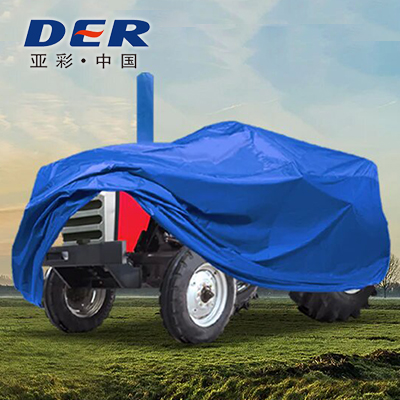
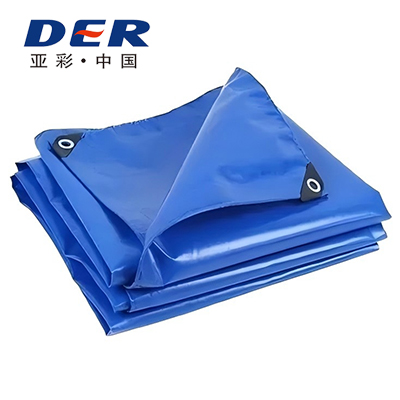
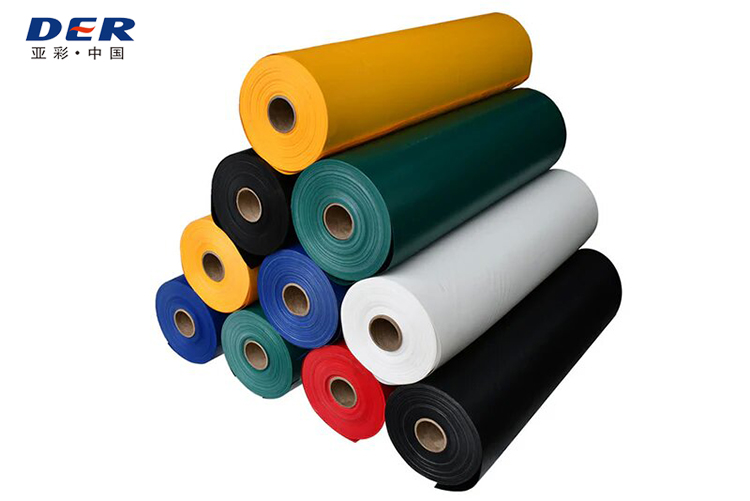
Original files shown at DERFLEX farm equipment covers and tarpaulin roll supply. Existing site JPGs require live site access; include copies in the ZIP only if rights and file access are confirmed.
How to validate a repeatable elastic-hem program
Define the object
Dimensions, photos, fitting path, vents, abrasion and environment.
Choose the casing
Continuous or partial elastic, access point, seam method and material.
Inspect installed fit
Pass-over effort, stationary seating, removal, weather entry and spare replacement.
Freeze the revision
Drawing code, approved fabric/elastic, tolerances, packing and quality checkpoints.
For broader OEM material, panel and tarp programs, explore DERFLEX custom tarps, equipment covers, and tarp manufacturing overview.
Elastic hem tarp cover questions
How tight should an elastic hem tarp cover be?
It should pass over the widest installation point without damaging the fabric or requiring unsafe force, then gather at the intended resting edge. Define relaxed and installed opening dimensions on the approved sample; do not apply a universal stretch percentage.
Can the elastic band be replaced without replacing the whole cover?
Yes, if a service-access casing is specified and validated. A fully captive or permanently enclosed elastic may require opening a seam. Confirm spare part size, access point and replacement procedure before bulk production.
Does an elastic hem hold an equipment cover in strong wind or during transport?
No rated holding capacity should be assumed. Elastic hems are for fitted positioning during appropriate stationary protection, not cargo securement or high-wind anchorage. Separate fastening and structural verification are required where applicable.
Can a waterproof PVC cover trap condensation?
Yes. A waterproof shell does not prevent vapor from entering from wet equipment, humid air or the ground. Design a suitable protected ventilation path and drainage clearance without blocking machinery intakes or exhausts.
What affects outdoor durability of the elastic and coated fabric?
UV, heat, cold, repeated stretching, moisture, abrasion, cleaning chemicals and exposure duration affect them differently. Request grade-specific fabric evidence and agree on an elastic-aging and recovery acceptance method for the intended duty.
What does DERFLEX need to quote a custom elastic-hem cover?
Send equipment photos or a drawing, W × D × H, the widest installation profile, the proposed lower hem line, storage environment, number of covers, ventilation and replacement requirements, preferred material, color and OEM packaging details.
Make the opening easy to fit—and practical to maintain.
Send a cover photo, model drawing or rough sketch. DERFLEX can review the coated fabric, elastic casing, service access, vents and sample-approval steps for your intended stationary-protection or OEM program.