Mil
One mil is 0.001 inch. Retail polyethylene tarps commonly use mil as the headline thickness value. A 16 mil tarp is 0.016 inch thick.



Match mil, millimeters and GSM to the actual load—not to a product label alone.
This guide helps distributors, tarp fabricators, construction suppliers, transport operators and industrial procurement teams choose a practical tarp structure by exposure time, wind, abrasion, handling frequency, finished size and attachment design. It also explains why two tarps with the same nominal thickness can perform very differently.
A reliable heavy duty tarp thickness guide must separate physical thickness from fabric weight. These values can be compared, but they should not be treated as automatic equivalents.
One mil is 0.001 inch. Retail polyethylene tarps commonly use mil as the headline thickness value. A 16 mil tarp is 0.016 inch thick.
Millimeters are widely used for PVC-coated and laminated technical fabrics. One millimeter equals about 39.37 mil, while 20 mil is about 0.51 mm.
Grams per square meter measures material mass, not thickness. It reflects the combined base fabric and coating weight and is useful for international B2B specification.
Vinyl and canvas tarp products are often sold by ounces per square yard. As a practical reference, 18 oz is about 610 GSM and 22 oz is about 746 GSM.
For many buyers, 14–20 mil is a useful heavy-duty reference range. The final choice should rise when the tarp faces long exposure, sharp cargo edges, frequent folding, high-speed airflow, dragging or high tie-down loads.
Easy to carry and economical, but generally not selected for repeated industrial handling or high wind.
Painting, indoor dust cover, short-duration weather shielding.
Suitable when exposure and handling are moderate and the tarp is not continuously dragged or tensioned.
Seasonal storage, moderate outdoor equipment, temporary jobsite cover.
A practical starting range for construction materials, machinery, outdoor stock and repeated commercial use.
Construction, equipment covers, agriculture and general transport protection.
Useful when a tarp must tolerate more abrasion, stronger attachment loads, longer outdoor use or frequent movement.
Truck and trailer covers, industrial equipment, large fabricated covers.
Often considered for high abrasion, long service targets or demanding transport programs, but heavier is not always easier to handle.
Fleet programs, mining, marine, semi-permanent covers and high-stress OEM tarps.
The following bands are practical sourcing directions for discussion. They are not direct conversions, because yarn, weave density, coating formulation and surface treatment change the final construction.
| Selection band | Approx. thickness direction | Common weight direction | Application profile | Buyer check |
|---|---|---|---|---|
| Flexible commercial | 0.35–0.50 mm | 350–550 GSM | Temporary covers, lightweight curtains, easy-fold applications and value-oriented product lines. | Confirm tear strength, UV exposure time and reinforcement before using on large covers. |
| General heavy-duty | 0.50–0.70 mm | 550–750 GSM | Construction covers, agricultural storage, equipment covers, general truck and trailer use. | Review denier, tensile/tear data, weld strength, grommet design and finished size. |
| Industrial heavy-duty | 0.70–0.90 mm | 750–1000 GSM | Repeated handling, higher abrasion, long outdoor exposure, large industrial covers and fleet programs. | Check cold flexibility, surface abrasion, seam method and handling weight. |
| High-stress custom | 0.90–1.20 mm | 1000–1200 GSM | Mining, marine, containment, semi-permanent protection and application-specific fabricated products. | Validate with a sample, physical data, attachment loads and fabrication trials. |
A thicker sheet can still fail early when the base fabric is weak, coating adhesion is poor, seams are under-designed or tie-down loads concentrate around a few eyelets. Heavy-duty performance is a system.
Weathering, cleanability, chemical contact, abrasion and visual finish.
Denier, weave density, yarn balance, tensile and tear behavior.
Hot-air or high-frequency welding, overlap width and panel direction.
Hems, ropes, webbing, eyelets, D-rings, straps and corner reinforcement.
Duration is only one factor. Movement, surface contact, wind pressure and attachment spacing can increase the required construction even when the tarp is used for a shorter time.
For lumber, scaffolding, temporary weather protection and exposed equipment, start by reviewing 14–20 mil or an application-matched PVC construction.
Highway airflow, cargo movement and repeated folding often justify 18–20 mil or heavier PVC/vinyl directions, depending on cargo and finished size.
Long-term covers need UV stability and drainage design as much as thickness. Condensation management and sharp projections should be addressed.
A practical tarp must balance strength with handling. Excessive weight can slow seasonal installation while insufficient reinforcement can tear in open fields.
Dragging, dust, aggregate and rough contact may move the project toward 20+ mil or a 750–1200 GSM PVC direction with reinforced high-wear zones.
Waterproofing alone is not enough. Salt, UV, wind and repeated wet/dry cycles should be considered with seam design and corrosion-resistant hardware.
Choose the closest application profile. The tool provides a starting band for discussion, not a final engineering approval.
Change any field to update the suggested direction.
A balanced direction for repeated commercial outdoor use.
Confirm base-fabric strength, UV direction, weld method, reinforced hems and tie-down spacing before the final quotation.
These issues often cause early failure even when the selected tarp appears thick enough on paper.
A heavy coating can hide a low-strength scrim. Ask for tensile and tear data, not thickness only.
Large gaps concentrate wind and tie-down loads, increasing the risk of hem or eyelet failure.
Steel corners and cargo projections can puncture a thick tarp unless wear pads or corner reinforcement are added.
Panel direction, overlap width and welding quality affect both waterproofing and load transfer.
A heavier tarp can become difficult to fold, install or remove, increasing labor and handling damage.
Without agreed tolerance, golden sample and inspection points, later batches may vary in feel, color or construction.
A complete inquiry makes thickness recommendations more accurate and helps suppliers quote comparable constructions.
Describe cargo, equipment, site, climate, chemicals, abrasion and expected exposure period.
Provide length, width, height, shape, overhang and whether the dimensions are cut size or finished size.
State preferred mil, mm, GSM, oz, denier or an existing sample. Suppliers can then suggest alternatives.
Include tensile, tear, adhesion, abrasion or hydrostatic requirements when the project has defined targets.
Specify hem type, webbing, rope, grommet material/spacing, D-rings, straps, pockets and corner patches.
Confirm UV, mildew, flame-retardant, cold-flex, anti-static, chemical or food-contact direction as applicable.
Send color reference, gloss/matte preference, logo artwork, label, carton mark and private-label requirements.
Provide roll or finished-tarp quantity, sample need, inspection plan, packing and target delivery schedule.
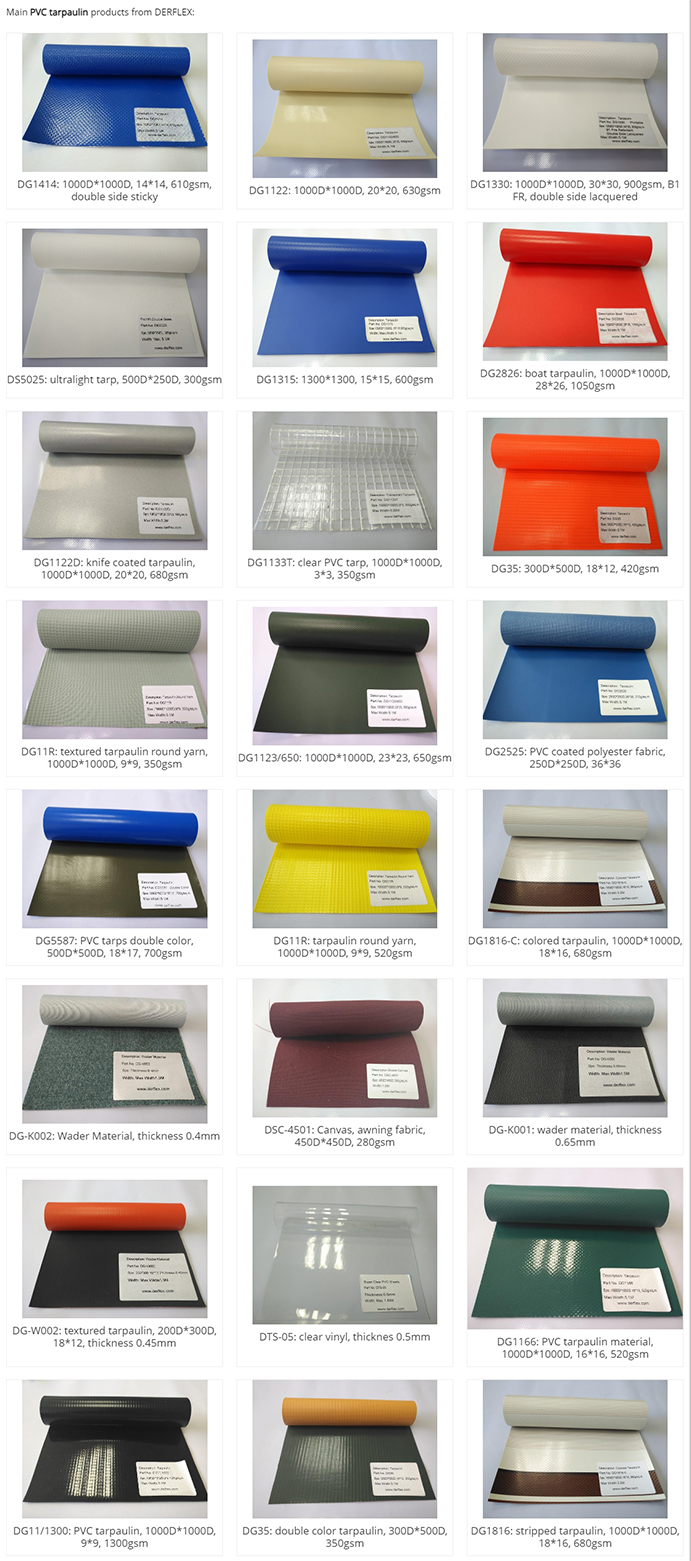
DERFLEX supplies PVC coated polyester tarpaulin materials and custom fabricated tarp programs for distributors, converters, construction buyers, transport applications and industrial projects. The selection process can cover roll goods, welded panels or finished tarps with application-specific reinforcement.
Use these six pages to compare materials, duty levels, waterproofing and abrasion requirements before preparing your RFQ.
Concise answers for buyers comparing mil, millimeters, GSM and material construction.
For many construction, equipment and commercial outdoor applications, 14–20 mil is a practical starting range. Truck, industrial, high-abrasion or long-term applications may require 20+ mil or a stronger PVC coated polyester structure selected by GSM, base fabric and reinforcement.
Some suppliers market 12 mil as heavy duty, while others treat it as medium or entry heavy duty. It can suit moderate outdoor work, but the full weave, coating, tear strength, UV treatment and edge design should be checked before industrial use.
Sixteen mil can be suitable for many jobsite and material-cover applications when the tarp has adequate tear strength, reinforced edges and attachment spacing. Sharp edges, high wind or long exposure may justify a heavier or more strongly reinforced construction.
Thickness describes the distance between the two surfaces of the material. GSM measures the mass of one square meter. The relationship varies with scrim, coating formulation and manufacturing method, so buyers should request both values rather than convert one to the other automatically.
No. Thickness may improve puncture and wear resistance, but service life also depends on base-fabric strength, UV stability, coating adhesion, seam quality, edge reinforcement, wind loading and correct installation. An over-heavy tarp can also be harder to handle and may suffer damage during installation.
Send the application, finished dimensions, quantity, expected service period, climate, abrasion level, preferred mil/mm/GSM, color, required treatment, edge design, grommet spacing, packaging and any existing sample or performance target.
Share your application, dimensions, handling conditions and target market. DERFLEX can discuss a practical PVC tarpaulin construction, reinforcement plan and sampling path for your project or product line.
A balanced direction for repeated commercial outdoor use.
Confirm base-fabric strength, UV direction, weld method, reinforced hems and tie-down spacing before the final quotation.
These issues often cause early failure even when the selected tarp appears thick enough on paper.
A heavy coating can hide a low-strength scrim. Ask for tensile and tear data, not thickness only.
Large gaps concentrate wind and tie-down loads, increasing the risk of hem or eyelet failure.
Steel corners and cargo projections can puncture a thick tarp unless wear pads or corner reinforcement are added.
Panel direction, overlap width and welding quality affect both waterproofing and load transfer.
A heavier tarp can become difficult to fold, install or remove, increasing labor and handling damage.
Without agreed tolerance, golden sample and inspection points, later batches may vary in feel, color or construction.
A complete inquiry makes thickness recommendations more accurate and helps suppliers quote comparable constructions.
Describe cargo, equipment, site, climate, chemicals, abrasion and expected exposure period.
Provide length, width, height, shape, overhang and whether the dimensions are cut size or finished size.
State preferred mil, mm, GSM, oz, denier or an existing sample. Suppliers can then suggest alternatives.
Include tensile, tear, adhesion, abrasion or hydrostatic requirements when the project has defined targets.
Specify hem type, webbing, rope, grommet material/spacing, D-rings, straps, pockets and corner patches.
Confirm UV, mildew, flame-retardant, cold-flex, anti-static, chemical or food-contact direction as applicable.
Send color reference, gloss/matte preference, logo artwork, label, carton mark and private-label requirements.
Provide roll or finished-tarp quantity, sample need, inspection plan, packing and target delivery schedule.
DERFLEX supplies PVC coated polyester tarpaulin materials and custom fabricated tarp programs for distributors, converters, construction buyers, transport applications and industrial projects. The selection process can cover roll goods, welded panels or finished tarps with application-specific reinforcement.
Use these six pages to compare materials, duty levels, waterproofing and abrasion requirements before preparing your RFQ.
Concise answers for buyers comparing mil, millimeters, GSM and material construction.
For many construction, equipment and commercial outdoor applications, 14–20 mil is a practical starting range. Truck, industrial, high-abrasion or long-term applications may require 20+ mil or a stronger PVC coated polyester structure selected by GSM, base fabric and reinforcement.
Some suppliers market 12 mil as heavy duty, while others treat it as medium or entry heavy duty. It can suit moderate outdoor work, but the full weave, coating, tear strength, UV treatment and edge design should be checked before industrial use.
Sixteen mil can be suitable for many jobsite and material-cover applications when the tarp has adequate tear strength, reinforced edges and attachment spacing. Sharp edges, high wind or long exposure may justify a heavier or more strongly reinforced construction.
Thickness describes the distance between the two surfaces of the material. GSM measures the mass of one square meter. The relationship varies with scrim, coating formulation and manufacturing method, so buyers should request both values rather than convert one to the other automatically.
No. Thickness may improve puncture and wear resistance, but service life also depends on base-fabric strength, UV stability, coating adhesion, seam quality, edge reinforcement, wind loading and correct installation. An over-heavy tarp can also be harder to handle and may suffer damage during installation.
Send the application, finished dimensions, quantity, expected service period, climate, abrasion level, preferred mil/mm/GSM, color, required treatment, edge design, grommet spacing, packaging and any existing sample or performance target.
Share your application, dimensions, handling conditions and target market. DERFLEX can discuss a practical PVC tarpaulin construction, reinforcement plan and sampling path for your project or product line.