
Outer Weather Membrane
Maintains the visible dome profile and is selected around UV exposure, weathering, wind and snow loads, surface durability and long-term outdoor appearance.



DERFLEX supplies inner gas holder membrane material for double-membrane biogas storage systems where the working layer must move with changing gas volume while maintaining a controlled gas barrier and dependable welded seams. Material structure can be matched to gas composition, pressure range, fabrication process and project service conditions.
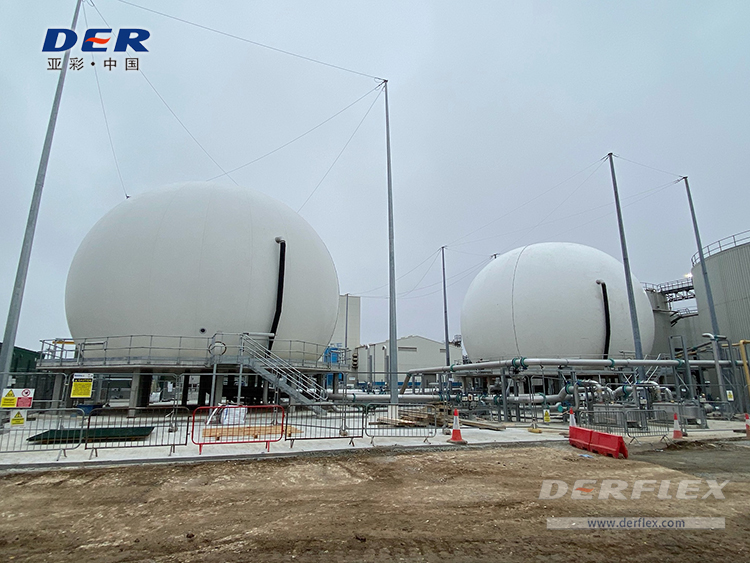
The outer shell and the inner working layer operate in different environments. The outer membrane faces sunlight, wind, rain, dirt and external loads. The inner layer works against stored biogas and the support-air pressure system. It flexes continuously, experiences pressure cycles, and relies on welded seams to keep the gas envelope intact.
For that reason, a project should not select the gas-tight inner membrane only by GSM, thickness or color. A more useful specification starts with gas permeability, chemical contact, mechanical movement, seam fabrication, dimensional behavior and the way the membrane connects to the gas holder's anchoring or bottom sealing system.
DERFLEX approaches the product as a technical coated-fabric component for gas-holder manufacturers, EPC contractors, membrane converters and replacement projects. The goal is to define a repeatable material specification that can be sampled, welded, inspected and reproduced for future systems.
Separating the functions early helps buyers avoid over-specifying one layer and under-specifying another.
Maintains the visible dome profile and is selected around UV exposure, weathering, wind and snow loads, surface durability and long-term outdoor appearance.
Forms the variable-volume biogas chamber. Its priorities are low gas permeability, chemical resistance, flexible cyclic movement, dimensional control and gas-tight welded fabrication.
Used in selected free-standing or dome configurations for base sealing and connection. It must match foundation interface, anchoring, gas tightness and mechanical loading.
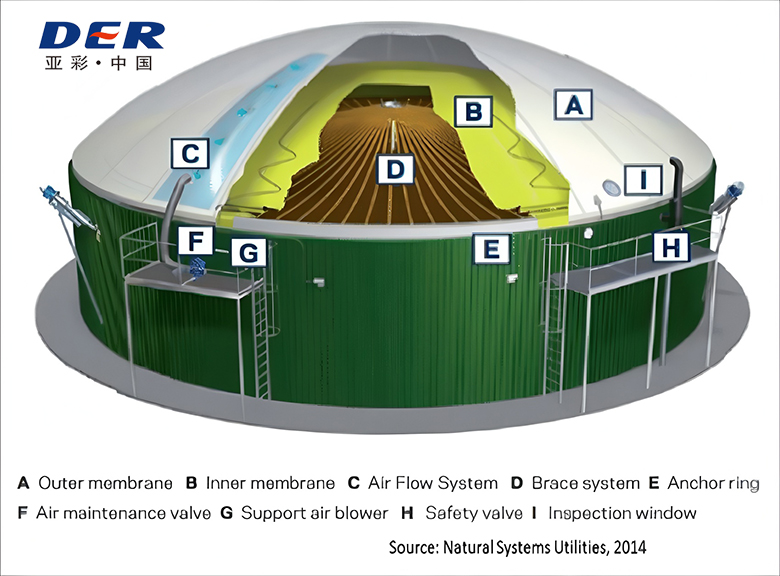 System diagram for membrane role identification. The inner membrane is the flexible gas-holding layer inside the air-supported outer shell.
A practical inner membrane structure combines a load-carrying textile reinforcement with coating layers that provide flexibility, weldability and gas-barrier performance. Exact construction depends on the project.
These are the factors that directly affect material selection, sample approval and fabrication performance.
Ask for a project-relevant gas permeability criterion and test method rather than relying on the general wording “airtight.” Gas composition, temperature and test conditions can affect the result.
Methane-rich biogas can also contain CO?, moisture, H?S and other process compounds. Chemical exposure and condensate conditions should be disclosed before the coating system is finalized.
The inner membrane repeatedly moves as storage volume changes. The material should retain useful flexibility without creating excessive stiffness, fold stress or unstable deformation under the project's operating conditions.
Gas storage performance depends on the fabricated membrane as a system. Material formulation, surface finish, seam overlap and welding parameters should be verified together through trial welds.
The textile reinforcement should match panel size, pressure, connection details and handling loads. Higher strength is useful only when it remains compatible with flexibility and fabrication requirements.
OEM gas-holder builders need stable coating, base fabric, width, color and welding behavior across repeat orders so fabrication settings and panel patterns do not have to be reinvented for each batch.
This framework is designed for RFQ and engineering review. Final numerical values and tolerances should be confirmed after project data and sample testing are agreed.
| Product role | Inner gas holder membrane / gas-contact working membrane for double-membrane biogas storage systems. |
|---|---|
| Base reinforcement | High-tenacity polyester woven fabric; yarn, weave density and strength direction can be customized by project. |
| Coating direction | PVC coated polyester is a common direction; PVC/PVDF or TPU-related structures can be discussed when project chemistry, durability or fabrication requirements justify them. |
| Gas barrier | Low-permeability structure to be specified by gas type, test method, temperature and acceptance criterion. |
| Chemical environment | Project review can include methane, CO?, H?S, moisture, condensate and other known process compounds. |
| Mechanical properties | Tensile strength, tear strength, elongation and dimensional stability are developed around holder geometry, panel design and operating pressure. |
| Fabric weight / thickness | Project-defined. Select according to membrane role, reinforcement, required strength, handling, flexibility and welding process rather than GSM alone. |
| Welding compatibility | HF/RF, hot-air or hot-wedge welding can be supported depending on material formulation and the fabricator's equipment. |
| Color & surface | Project color and finish can be discussed; functional gas-contact and welding requirements take priority over appearance for the inner layer. |
| Supply form | Roll goods, custom roll width, cut material or fabricated-panel direction subject to project agreement. |
| Optional requirements | Flame-retardant, anti-mildew, anti-wicking, low-temperature flexibility, labeling, batch identification and custom packaging where applicable. |
| Recommended RFQ inputs | Holder type, diameter, storage volume, working/design pressure, gas composition, H?S level if known, temperature, welding method, membrane geometry, quantity and required test criteria. |
A procurement specification becomes stronger when it is written around what could fail in service, not only around nominal material data.
Define permeability by test method and conditions so different samples can be compared consistently.
Share gas chemistry and condensate conditions instead of assuming all biogas environments are equivalent.
Balance reinforcement and coating build with the flexibility required by the holder's operating cycle.
Approve trial welds using the real fabrication process before bulk production whenever practical.
Testing should follow the purchase specification and applicable project standards. Depending on the application, a buyer's approval plan may include the following checks.
DERFLEX can support both standardized OEM programs and project-by-project material matching.
Replacement work should begin with the existing system data, not only the old membrane's color or thickness.
The same basic gas-contact function appears across several biogas and renewable-gas storage configurations.
Flexible gas storage above or beside digesters treating manure, crop residues and other agricultural feedstocks.
Inner gas membranes for digester-gas storage and pressure buffering before CHP, boilers, flares or upgrading equipment.
Gas holder systems serving industrial digesters where gas production can vary throughout the treatment cycle.
Inner working layer installed beneath the outer weather membrane on concrete, steel or other engineered tanks.
Gas-contact membrane inside slab-mounted or ground-mounted holders with a controlled support-air space.
Flexible low-pressure storage used as part of biogas handling before or around upgrading and downstream utilization.
DERFLEX's role is to support the coated-fabric layer: specification matching, sample development, weldability review and repeatable supply for companies that design or fabricate the complete gas-holder system.
Inner, outer and bottom membrane requirements can be treated separately so the gas-contact layer is not forced into a weather-membrane specification.
DERFLEX works across PVC coated fabric, PVDF-surface directions, TPU coated materials and industrial membrane applications.
Material selection can be discussed together with HF/RF, hot-air or wedge welding, roll width, panel processing and seam validation.
Color, coating, base fabric, width, labeling, packaging and inspection requirements can be standardized for recurring holder models and multi-project programs.
Six related pages provide adjacent material, system and application information without turning this page into a generic biogas membrane overview.
Buyer-focused answers for system builders, EPC contractors, wastewater projects and membrane fabricators.
The inner membrane forms the variable-volume gas chamber and is selected primarily for gas containment, chemical exposure, flexibility and welded seam performance. The outer membrane protects the system from weather and supports the external dome form, so UV resistance, weathering and external loads are more dominant considerations.
Reinforced PVC-coated polyester is a common material direction because it combines textile strength, flexibility and weldability. Other coating structures can be discussed when chemical exposure, permeability targets, temperature or fabrication requirements call for a different solution.
For procurement, it is better to define a gas permeability test method, gas type, temperature, units and acceptance criterion instead of relying only on terms such as airtight or gas-tight. The project engineer or system supplier should confirm the applicable requirement.
DERFLEX can review replacement material requirements based on the existing membrane specification or sample, holder geometry, working conditions, gas composition, connection details and welding process. Final compatibility should be verified through project review and sample approval.
Depending on the coating formula and fabrication design, high-frequency/radio-frequency welding, hot-air welding or hot-wedge welding may be considered. Trial welding with the fabricator's actual equipment is recommended before bulk production where practical.
Please send the gas-holder type, membrane position, diameter, storage volume, working/design pressure, gas composition, H?S level if known, temperature range, welding method, required test criteria, color, roll width, quantity and any available drawings or existing datasheet.
Send the operating data first. DERFLEX can then discuss a practical inner membrane direction for sample evaluation, welding trials and project quotation.
Gas-holder drawing, current membrane TDS, gas composition, pressure data, required permeability test, welding method and expected order quantity.
Request A Quote