Storefront advertising
Print-led promotions on glass where the outside graphic needs attention and some inward daylight and visibility remain useful. Assess glass size and visibility at night.



Printable perforated window vinyl for storefront graphics, architectural glazing and approved vehicle-window applications—sourced with the pattern, adhesive, liner and roll configuration your business actually needs.
As a perforated window vinyl manufacturer, DERFLEX supports print media distributors, sign converters and private-label buyers with white-printable / black-backed film, sample matching and bulk quotations.
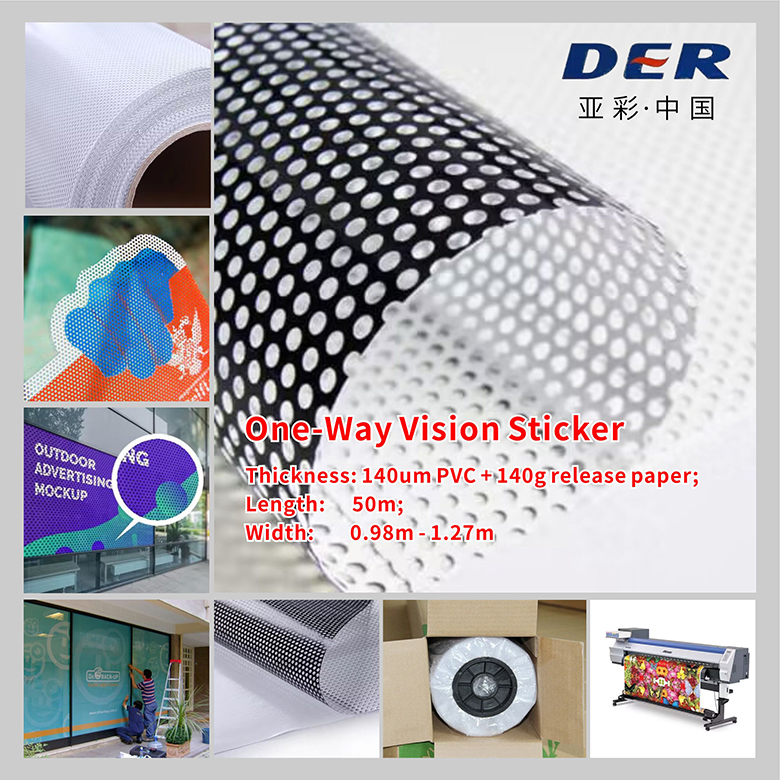
One way vision film is a printable, perforated adhesive vinyl with a white graphic-facing surface and a black reverse. Its tiny holes permit outward viewing from behind the window, while the printed surface is more visually prominent on the brighter side.
It is also called perforated window film, see-through vinyl or one-way vision window graphics film. The effect depends on hole coverage, the print image, viewing distance and—most importantly—the relative lighting on either side of the glass.
Unlike non-perforated printable self-adhesive vinyl, this material leaves an open route for light and visual detail through the printed surface. That trade-off is what buyers must specify.
For general signage, see DERFLEX's one way vision sticker overview. This page focuses on film specification and roll sourcing rather than finished graphic production.
The following separates a published DERFLEX product example from details that must be agreed for a new purchase order. A single reference grade must not be treated as the specification of the entire product family.
| Specification | DERFLEX reference / material principle | What to confirm before ordering |
|---|---|---|
| Construction | Perforated printable PVC window vinyl; white face and black viewing side | Face finish, black-layer consistency and finished application side |
| Open-area pattern | Published DERFLEX example: 60% printable / 40% open | Required balance of outward visibility, light transmission and graphic impact |
| Hole diameter | Published 60/40 DERFLEX example: approximately 1.5 mm holes | Hole size, spacing, pitch, pattern regularity and acceptance tolerance |
| Film caliper | Published DMT100 reference: 6 mil (approximately 152 μm) | Grade-specific nominal thickness; whether this excludes liner and adhesive |
| Adhesive | Acrylic-based removable adhesive listed on the DMT100 reference | Glass type, intended service duration, removal method, residue tolerance |
| Print compatibility | Eco-solvent ink is cited for the older DMT100 listing | Exact solvent / eco-solvent / UV / latex printer, ink and curing conditions; obtain a sample test |
| Liner and converting | Release liner supports handling and printing | Perforated versus solid liner, print feed, cutting system and lamination strategy |
| Supply format | Roll supply; different commercial formats may be discussed | Width, roll length, core size, roll winding, carton and pallet requirements |
| Custom & OEM | Project review for distributors and private-label programs | Target annual volume, label artwork, packaging, region and approvals |
Published item example: DERFLEX's perforated window vinyl specification page. 70/30 and 50/50 patterns below are industry selection examples, not a promise that every ratio is stocked by DERFLEX. Request current grade-specific datasheets and samples before purchase.
When the ratio is written print area / open area, the first number is the printed film and the second is the holes. More open area usually improves see-through viewing; more solid area provides more continuous space for graphics.
A higher printable-area share favors more continuous graphics, at the expense of see-through area. Useful for print-led campaigns where exterior legibility matters.
Industry comparison grade. Ask DERFLEX to confirm availability and test samples.DERFLEX has published a 60% printable / 40% open reference. It is a practical starting point for normal retail windows and promotional glass graphics.
Published 1.5 mm hole example; confirm the current product grade and tolerances.More open area can support sightlines and daylight where appropriate, but makes the printed image less visually dense. Actual visibility remains lighting-dependent.
Industry comparison grade. Vehicle-window use requires jurisdiction-specific approval.Pattern swatches are conceptual illustrations, not photographs or metrology measurements. Optical behavior should be approved on printed film mounted to actual project glass.
Perforation cannot guarantee one-direction privacy under every lighting condition. Verify the viewing effect in the actual building at both daytime and after dark.
Daylight can make the printed exterior more prominent while occupants inside view through the black-backed perforations.
After dark, illuminated interiors can become visible through the holes. Do not sell printable perforated vinyl as guaranteed 24-hour privacy film.
Visual panels illustrate lighting conditions rather than measured privacy or light-transmission values.
Print-led promotions on glass where the outside graphic needs attention and some inward daylight and visibility remain useful. Assess glass size and visibility at night.
Branding for glass facades and office fronts. Coordinate building policies, glass compatibility, access for installation and expected removal.
Advertising on permitted windows only. Verify local visibility rules, driver sightlines, glazing type and any applicable print-laminate combination before selection.
Bulk roll conversion and re-sale, where liner integrity, consistent hole pattern, printable width and repeat-order stability matter as much as appearance.
For non-perforated signage and broader product sourcing, compare DERFLEX's self-adhesive vinyl wholesale range; the right film may be opaque, clear or perforated depending on the viewing requirement.
Use the photos to understand the appearance of the two faces. Confirm actual hole diameter, print performance and adhesives with physical samples rather than judging a product solely from a screen image.


A film can look correct on a small sample and still cause production waste if the liner, drying profile or glass conditions are wrong.
Ask whether the selected liner is perforated or solid, and test feeding and vacuum hold-down on your exact printer. UV flatbeds and roll-fed systems can require different liner behavior.
Run a production sample with the actual solvent, eco-solvent, latex or UV process rather than assuming all grades are interchangeable. Check dot sharpness around holes, cure and blocking.
For wet exposure or intensive cleaning, evaluate a compatible optically clear overlaminate. It can reduce water or dirt accumulation in holes, but alters cost and can affect appearance and removability.
If you're building a larger supply portfolio, DERFLEX's wide-format digital printing materials hub covers complementary print media for sign distributors and print houses.
These are recommended buyer-agreed inspection checkpoints—not a claim that every DERFLEX grade is pre-certified or routinely tested to a specific standard. Include the agreed values in the purchase specification.
01 · Hole geometry: confirm diameter, pitch, open-area ratio, burrs and perforation consistency at roll beginning, middle and end.
02 · Film & color: inspect white-face uniformity, black backing, pinholes outside the designed perforations and nominal caliper.
03 · Print trials: approve ink anchorage, edge definition around holes, drying and feed stability on the actual device.
04 · Adhesion / removal: test initial tack, dwell and removal on the real glass type, including residue risk under expected temperatures.
05 · Roll presentation: check telescoping, wrinkles, crushed cores, liner release, damage and package identification.
06 · Installed performance: approve daytime/nighttime appearance, wet-weather visibility and glass cleaning procedure.
For repeat orders, retain a signed physical master sample, a grade-specific data sheet and one approved print/glass test panel. Agree acceptable variation before the first bulk shipment, not after the goods arrive.
| Common mistake | Commercial consequence | Better purchase decision |
|---|---|---|
| Ordering only by “one way vision film” | Unexpected difference in print density or interior visibility | Write the ratio explicitly as print area / open area and approve an installed sample. |
| Ignoring evening lighting | Interior privacy does not match expectations after dark | Test both lighting directions; combine with an alternative shade or blind where continuous privacy is required. |
| Assuming every film runs on every printer | Feed, liner, curing or image-quality failures | Match the liner and ink chemistry to printer make/model and production settings. |
| Assuming “removable” means residue-free | Glass cleaning cost or adhesive residue after extended dwell | Set a service period and test removal after representative aging and cleaning. |
| Specifying vehicle graphics without local checks | Compliance, visibility and installation risks | Obtain written local approval for the precise glazing location and applicable visibility requirements. |
| Skipping finished-roll inspection | Yield loss in large production batches | Agree edge, core, winding, tolerance and packaging checks with the supplier. |
For a broader explanation of opaque, transparent and perforated printable films, DERFLEX also provides a self-adhesive vinyl selection guide.
A usable specification shortens back-and-forth, reduces sampling mistakes and makes quotations comparable.
Storefront or vehicle; inside/outside mount; flat or curved glazing; climate; required service period.
70/30, 60/40 or 50/50 target; film thickness; white/black construction; adhesive; liner requirements.
Printer/ink process; material width; roll length; core; lamination; finishing and package configuration.
Sample request, initial quantity, repeat volume, destination, OEM label and mandatory local documentation.
MOQ, price, production lead time and available OEM configurations are quoted against the confirmed specification; they are not guaranteed by the general product description.
In signage applications, yes. Both commonly refer to printable, perforated PVC window film designed to show graphics on one side while permitting viewing through the holes from the other side. Confirm construction and mounting orientation because not every product sold as “one way” is the same type of film.
In the print-area/open-area convention used on this page, 60/40 means 60% solid printable material and 40% open perforations. Suppliers do not always write ratios in the same order, so state the convention on the RFQ and inspect a material sample.
It should not be relied on for constant night privacy. The typical effect depends on the brighter exterior and darker interior; when interior lights dominate after dark, the interior can become visible. Use blinds or a different privacy system when continuous privacy is required.
Many commercial film grades support one or more of these systems, but compatibility is grade-specific. Confirm the exact printer and ink, liner construction, cure settings and intended overlaminate through a sample production trial.
A compatible optically clear laminate can help reduce water and dirt collecting in perforations and protect the printed face. It is not automatically required or compatible with every application, particularly curved glass, so validate the film/laminate pair and installation conditions.
Standard white-front/black-back graphics films are generally intended for an exterior first-surface installation. Interior mounting requires a film and printing construction specifically designed for second-surface viewing. Do not assume a standard roll will work when applied inside.
Rules vary by jurisdiction and window position. Approval may depend on visibility, coverage, perforation pattern and approved substrates. Verify applicable regulations before specifying film for front, rear or side vehicle windows.
DERFLEX supports inquiries from distributors, converters and private-label buyers. Send the required film grade, hole pattern, adhesive, liner, roll dimensions, quantity, packaging and destination so availability, samples, MOQ and quotation can be confirmed for the project.
DERFLEX can review your perforation target, printable face, adhesive, liner, roll format and delivery requirements before proposing a quotation. Get the material decision right before scaling the print run.
Share your intended use, roll width × length, print process, required pattern, estimated order volume and destination.
Request A Quote ↗