

News
Industry News

Mining Ventilation Duct | Mine Vent Ducting | DERFLEX

Update:2026/8/14 16:29:05 Views:
Underground Air Route · Flexible Duct Systems

Mining Ventilation Duct for Underground Airflow Systems

Project-configured mining ventilation ducting for fresh-air forcing, extraction routes and changing underground work fronts.

DERFLEX supplies flexible mine ventilation duct sections and PVC-coated ducting materials with selectable diameter, section length, reinforcement, suspension and connection details. The specification is built around airflow direction, fan interface, route geometry and the mine's required test criteria rather than a generic duct description.

Product familyFlexible mine vent duct
Airflow dutyPositive / negative by structure
Core bodyPVC-coated technical textile
Supply modelFinished duct + material options
System definition

Mine vent ducting is part of the ventilation system—not an isolated fabric tube

A mining ventilation duct forms the temporary or semi-permanent air path between an auxiliary fan and the underground work zone. In advancing headings, crosscuts, shaft work and tunneling interfaces, the duct route must move air while fitting around equipment, rock surfaces, suspension points, bends and changing installation conditions.

This is why two products described only as “800 mm mining ventilation ducting” may behave differently in service. Airflow direction determines whether the duct must stay open by internal pressure or by structural reinforcement. Joint design influences installation time and leakage. Suspension geometry influences sagging and contact with the tunnel wall. The coated textile, seam, cuffs, reinforcement and fittings therefore need to be evaluated together.

Mining ventilation duct, mining ventilation ducting, mine ventilation duct and mine vent duct refer to the same buying category

Procurement teams use different terms across regions and companies, but the purchase decision usually comes back to the same questions: how air is moving, how far it must travel, what pressure the fan system produces, how much clearance is available, how sections connect and which safety or test requirements apply at the site.
Practical definition: a mine ventilation duct is a flexible air-conveyance assembly configured to deliver or extract air underground. The correct format is selected from pressure direction, fan duty, route geometry, installation constraints and the documented project requirement.
Three route architectures

Match the duct structure to pressure and clearance

A mine can use more than one duct architecture. Separate the air-supply route from extraction or localized suction, then select the flexible structure that supports the required pressure direction and underground envelope.

Positive pressure

Layflat air-forcing duct

A collapsible mining ventilation duct that inflates as the fan forces fresh air through the line. It is well suited to advancing headings where compact transport, storage and quick route extension matter.

  • Fresh-air supply toward active headings
  • Compact packaging compared with continuously reinforced hose
  • Project-selected rings, zippers, cuffs or other end connections
  • Single- or double-line suspension layouts
Negative or mixed duty

Spiral-reinforced mine duct

A flexible duct with continuous or distributed structural support that helps preserve the air passage when the system pulls air through the duct or when bends and equipment interfaces require shape retention.

  • Extraction and suction sections
  • Bend-heavy routes and portable fan connections
  • Helix, wear strip and cuff details by project
  • Positive-pressure use may also be possible when specified
Low clearance

Oval / low-headroom ducting

Where full round ducting competes with loaders, drilling rigs, conveyors, cable trays or utilities, a shaped profile can preserve more useful headroom while maintaining the planned air route.

  • Restricted tunnel and drift profiles
  • Custom suspension geometry
  • Transitions to round duct or fan interfaces
  • Project review based on equivalent airflow area and clearance
Engineering variables

Six details that change the operating result underground

Fabric weight is only one input. The complete mine ventilation duct route has to balance airflow, leakage control, geometry, mechanical wear, installation rhythm and the site's documented safety requirements.

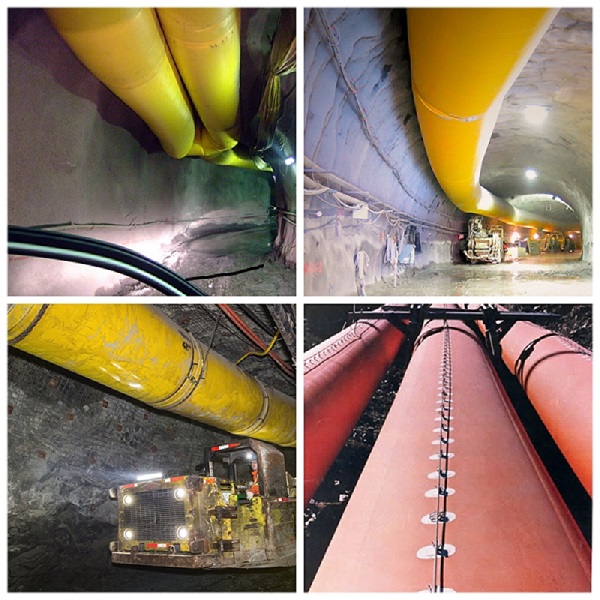
Mining ventilation ducting installed in underground mine routes
Underground installation reality Long suspended runs, wall contact, route changes, moving equipment and repeated extension can make connection and suspension details as important as the center section of the coated textile.
01 · Pressure direction

Forcing vs. suction

Layflat tubing depends on positive pressure to remain inflated; extraction duty normally needs structural support to resist collapse.

02 · Leakage control

Seams and joints

Weld quality, end cuffs and connection consistency influence how much of the fan's delivered air reaches the active work zone.

03 · Route geometry

Bends and clearance

Diameter, bend count, branch points, elevation changes and overhead conflicts affect pressure loss and installation practicality.

04 · Wear exposure

Rock and handling contact

Undersides, suspension zones, wire ends, cuffs and bend areas can require additional reinforcement or wear protection.

05 · Safety specification

FR / antistatic criteria

Flame and electrical-resistance requirements should be stated by standard, test method and acceptance limit before production.

06 · Installation rhythm

Section strategy

Section length, pack size, hanging interval and connection method affect how quickly the mine vent duct can advance with the work face.

Finished assembly

What is actually being specified in a mining ventilation duct?

A repeatable mining duct order should identify the complete assembly. This reduces ambiguity when the project needs replacement sections, phased deliveries or repeat orders months later.

A

Coated textile body

PVC-coated polyester technical textile selected around mechanical strength, weldability, airtightness, flexibility and the required surface or safety treatment.

B

Seam architecture

Fabricated seams should be consistent along the duct body and coordinated with the body construction, section length and expected pressure duty.

C

Suspension & reinforcement

Fins, eyelets, webbing, rings or helical wire are configured according to diameter, duct weight, route alignment and pressure direction.

D

End connections & fittings

Zipper, ring, cuff, clamp, hook-and-loop or custom interfaces can be matched to the fan, existing line, reducers, bends, branches and transition pieces.

RFQ specification range

Mining ventilation ducting specification fields

The ranges below are intended to structure an early technical discussion. Final dimensions, performance and documentation are confirmed on the approved product specification for the actual order.

Specification fieldDERFLEX project directionWhat the buyer should provide or confirm
Supply formatFinished flexible duct sections, accessories and/or PVC-coated ducting fabricState whether the order is ready-to-install ducting, material for local fabrication, or a mixed supply package.
Airflow dutyPositive-pressure supply, negative-pressure extraction, or separate sections for mixed systemsFan type, outlet diameter, airflow direction, available static pressure and operating mode.
Duct diameterApprox. 300–3000 mm reference project range for selected flexible configurationsRequired airflow, route length, pressure loss, fan curve and tunnel / mine clearance.
Section lengthProject-configured; short handling sections through long layflat runs can be discussedUnderground transport, hanging method, extension sequence, crew handling and replacement strategy.
Body constructionPVC-coated polyester technical textile with project-selected weight / reinforcementAbrasion exposure, environment, flexibility, weldability and required test criteria.
ReinforcementLayflat, ring-supported, continuous spiral wire or shaped low-headroom designPositive or negative pressure, bend radius, collapse resistance and handling constraints.
ConnectionsZipper, ring, cuff, clamp, hook-and-loop or custom interfacePhotos / dimensions of the fan outlet and existing duct connections are useful for replacements.
SuspensionSingle row, double row, reinforced fins, eyelets or custom layoutHanging line location, spacing, tunnel profile and expected duct movement.
Performance optionsFlame-retardant, antistatic, cold-weather, abrasion or visibility options by projectState the exact standard, test method, acceptance limit and requested certificate / report format.
Identification & packingSection marking, color, label, batch identification and export packing can be coordinatedMine inventory system, installation sequence, spare sections and destination logistics.
Technical notice: ventilation design, legal acceptance and safe operation depend on the complete system, including fans, duct route, installation, monitoring and local mine requirements. Final suitability should be reviewed by the responsible mine / ventilation engineer and the applicable authority or project team.
Procurement logic

Compare suppliers on the finished air route, not a one-line price

The most useful quotation is one that makes assumptions visible. Normalize the technical basis first so purchasing teams can compare like-for-like scope instead of comparing diameter and fabric weight alone.

Supplier qualification checklist

Use these points for new projects, replacement programs, fan packages and distributor sourcing.

1
Pressure duty is clearly definedThe supplier distinguishes forcing duct from suction / extraction duct instead of presenting one flexible tube as universal.
2
Interfaces are documentedConnection, cuff, zipper, ring, clamp and fan-adaptor dimensions are recorded for future compatibility.
3
Safety claims are tied to a test route“FR”, “antistatic” or “FRAS” is not treated as a universal label; the required method and limit are identified.
4
Wear zones are consideredSuspension, bends, floor / wall contact and repeated relocation are addressed in the construction or repair strategy.
5
Repeat orders can be reproducedApproved dimensions, material direction, fabrication details, labels and packing are captured as a reusable specification.
6
Accessories are coordinated with the main lineReducers, transitions, branches, bends, fan interfaces and spares use compatible connections and identification.
Where it is used

Mining ventilation duct applications

The same product family can support multiple underground operations, but the duct architecture should be matched to the exact airflow role and installation conditions of each route.

Hard-rock mine headings

Auxiliary fresh-air supply to development faces, drilling areas and moving work zones where the ventilation line advances with the heading.

Underground coal mine routes

Project-specified ventilation sections where flame and electrical-resistance requirements may need a documented test and approval pathway.

Shaft sinking & underground chambers

Flexible air delivery or extraction where vertical routing, temporary work zones and confined installation space influence section layout.

Mine rehabilitation & maintenance

Temporary ventilation for isolated work zones, equipment service, dust / fume control and changing underground access conditions.

Fan and equipment packages

Custom cuffs, adapters and reinforced flexible sections connecting auxiliary fans to temporary or semi-permanent duct routes.

Ore development crosscuts

Branching duct runs, transitions and extension sections where installation speed and interface repeatability matter.

Low-headroom drifts

Oval or shaped flexible ducting where overhead clearance must be preserved for vehicles, services and operating equipment.

Mine & tunnel crossover projects

Flexible duct formats that can be configured for mixed underground construction environments using a common procurement framework.

DERFLEX manufacturing support

From coated textile to repeatable mine duct specification

DERFLEX works across PVC-coated technical textiles and fabricated flexible products. For mining ventilation ducting, that allows the material body, welded fabrication, reinforcement, suspension, connection and optional fittings to be discussed within one project specification.

This approach is useful for mine operators, ventilation contractors, fan companies, EPC teams, distributors and local fabricators that need either finished duct sections, coated ducting material or a coordinated supply program for repeat orders.

Published DERFLEX company information describes a 60,000 m2 integrated production base, 450+ employees, 25+ senior engineers and service to customers in 120+ countries and regions. These figures describe company scale; actual duct capacity, lead time and testing scope are confirmed per inquiry.

60,000 m2Integrated production area
450+Employees
25+Senior engineers
120+Countries & regions served
Buyer questions

Mining ventilation duct FAQ

Answers are written for mine operators, ventilation engineers, contractors, fan suppliers, procurement teams and distributors evaluating flexible underground ducting.

What is a mining ventilation duct?

A mining ventilation duct is an air-conveyance tube used in underground mine ventilation to carry fresh air toward work areas or extract contaminated air from selected zones. Flexible versions are commonly made from reinforced coated technical textiles and can be supplied as layflat, ring-supported, spiral-reinforced or low-profile constructions depending on pressure direction and route constraints.

What is the difference between mining ventilation duct and mining ventilation ducting?

The terms are commonly used interchangeably. “Mining ventilation duct” often refers to an individual duct or product, while “mining ventilation ducting” can describe the overall duct product family or connected ventilation line. “Mine ventilation duct” and “mine vent duct” are also common buying terms for the same category.

Can the same mine vent duct be used for positive and negative pressure?

Not automatically. Layflat ducting is normally selected for positive-pressure air forcing because internal pressure inflates the tube. Negative-pressure or suction duty generally needs rings, a wire helix or another support structure to prevent collapse. A mine ventilation system can use different duct constructions in different sections.

How do I select the diameter of a mine ventilation duct?

Diameter should be reviewed against required airflow, target air velocity, fan curve, available static pressure, total route length, bend count, leakage allowance and underground clearance. A larger diameter can reduce friction for the same airflow but requires more installation space. The ventilation engineer should confirm the final system design.

What information does DERFLEX need for a mining ventilation duct quotation?

Provide fan outlet size, airflow direction, air volume or fan data, available static pressure, total duct run, preferred diameter, section length, bends and branches, connection method, suspension arrangement, required flame / antistatic test criteria, quantity and delivery plan. Photos and measurements are helpful for replacement sections.

Can DERFLEX supply flame-retardant and antistatic mining ventilation ducting?

DERFLEX can discuss flame-retardant and antistatic configurations by project. Buyers should state the exact standard, test method, resistance limit, reporting format and approval requirement. “FRAS” should not be treated as a universal certification because mine and jurisdiction requirements can differ.

Does DERFLEX supply complete duct sections or only PVC duct fabric?

Both routes can be discussed. DERFLEX can supply fabricated flexible duct sections with selected seams, suspension, reinforcement and end connections, and can also supply PVC-coated ducting material for customers that fabricate locally.

Which connection systems are available for mine ventilation ducting?

Project options can include zippers, steel rings, cuffs, clamps, hook-and-loop interfaces and custom connection geometry. The most appropriate option depends on air leakage expectations, installation speed, existing equipment interfaces, replacement compatibility and site handling practices.

Specify the air route before you price the duct.

Send DERFLEX your fan data, airflow direction, duct diameter, total route, connection details, suspension preference and required test criteria. We can review a project-configured mining ventilation ducting route and prepare a quotation based on the defined scope.

General product-selection information only. Mine ventilation design, duct suitability, safety compliance and legal acceptance must be confirmed for the specific project, operating conditions and jurisdiction.

Consulting Services
+86-021-54361792 / 54361798
Email
sales@derflex.com