
High Daylight Potential
Clear film grades can support bright interiors and visual openness. The final transmission and haze depend on grade, thickness, print coverage, layer count and the selected test method.



Project-oriented ETFE material supply for architects, membrane fabricators, facade contractors, skylight specialists and international buyers who need a clear specification before ordering film rolls.
DERFLEX supports the material stage of transparent building-envelope projects with thickness review, optical direction, printed shading discussion, roll configuration, samples, packing and export coordination. Final system performance remains subject to engineering design, fabrication, installation and applicable local requirements.
ETFE is the abbreviation for ethylene tetrafluoroethylene, a fluoropolymer that can be extruded into thin film or foil. In architecture, ETFE material is used as a transparent or translucent envelope skin for roofs, skylights, facades, canopies and air-supported cushion systems.
Unlike PVC-coated polyester or PTFE-coated fiberglass, architectural ETFE is normally not a woven fabric. Its performance is created by the relationship between the selected film, welded panel geometry, perimeter clamping, supporting structure, drainage, inflation equipment where applicable, and the engineer’s design assumptions.
A transparent or translucent skin with low envelope weight and flexible architectural form.
These DERFLEX site images illustrate the material’s typical visual role in curved roofs, transport canopies and illuminated envelope systems. The completed project depends on coordinated structural and system engineering.
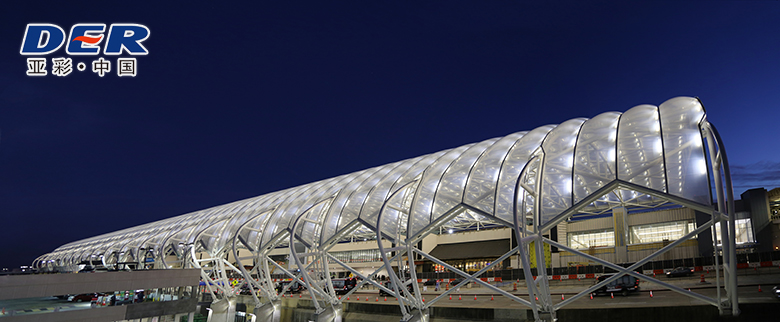
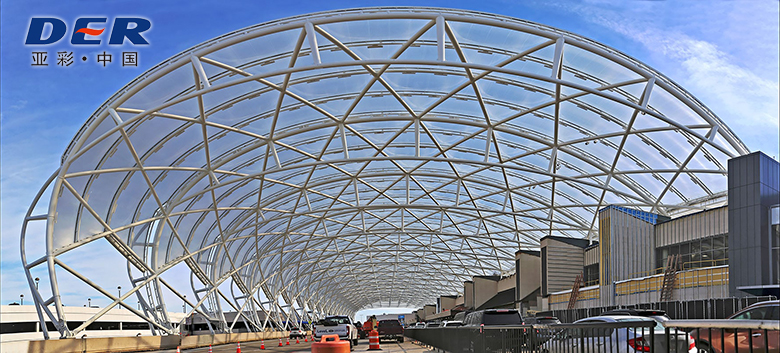
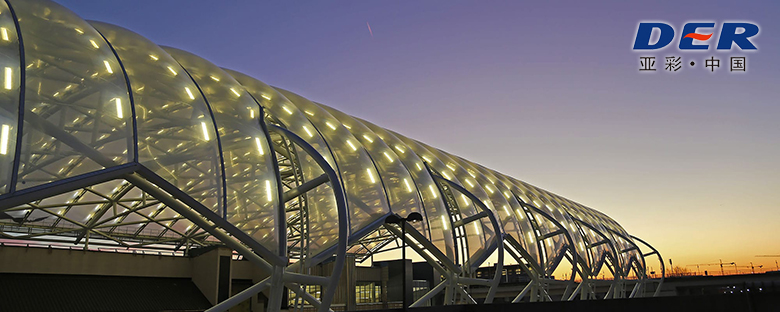
The decision is rarely based on one property. ETFE becomes compelling when optical performance, structural weight, envelope form, fabrication and project maintenance are evaluated together.
Clear film grades can support bright interiors and visual openness. The final transmission and haze depend on grade, thickness, print coverage, layer count and the selected test method.
Thin ETFE film can reduce dead load compared with rigid glazing concepts, which may help the design team explore lighter frames or larger spans when engineering conditions allow.
Tensioned skins and pneumatic cushions can follow curved, faceted and free-form surfaces, expanding the architectural options beyond standard flat panels.
Printed dots, frit patterns, tint directions and multi-layer cushion arrangements can be reviewed to influence glare, solar gain, diffusion and visual rhythm.
ETFE is selected for exterior use where ultraviolet exposure, rain, temperature variation and chemical resistance are important design considerations.
The smooth fluoropolymer surface tends to retain less dirt than many conventional surfaces. Actual cleaning intervals still depend on geometry, pollution, rainfall and access planning.
A useful specification begins with the building system. Thickness and roll width should be selected after the application, layer arrangement, visual target and fabrication process are understood.
For roofs, skylights and facades where maximum visual openness is a central design goal. Confirm optical values by the selected grade and thickness.
Dot, frit or project artwork can be reviewed for shading, glare management and architectural pattern. Approve artwork and physical samples before bulk production.
For pavilions, facades and illuminated skins requiring diffusion, colour direction or reduced transparency. Availability and tolerance are project dependent.
For two- or multi-layer pneumatic panels maintained by controlled air pressure. Layer-by-layer thickness, printing and monitoring must be coordinated with the system specialist.
The following framework helps architects, contractors and procurement teams structure an RFQ. It is not a substitute for structural calculations, mock-up approval, a final project datasheet or local-code review.
Panel stress, welding, print coverage, roll handling, cushion pressure, wind and snow actions, fixing details and the engineer’s approval all influence the final choice.
| Product Terminology | ETFE material, ETFE film, ETFE foil, architectural ETFE membrane or ETFE cushion film. Technical documents should identify the exact grade and intended building-envelope use. |
|---|---|
| Material Structure | Extruded ethylene tetrafluoroethylene fluoropolymer film. Architectural ETFE is normally not a woven reinforcement fabric. |
| Thickness Direction | 100 μm, 150 μm, 200 μm and 250 μm are common early-stage discussion points. Final thickness depends on panel dimensions, stress, printing, system type, fabrication and engineering approval. |
| Appearance Options | Clear, translucent, tinted or printed. Confirm reference sample, colour tolerance, haze, artwork, print coverage, registration and viewing conditions. |
| System Direction | Single-layer tensioned foil, cable-supported skin, framed facade film, two-layer cushion, three-layer cushion or project-specific multi-layer assembly. |
| Performance Focus | Visible-light transmission, haze, tensile and tear behaviour, welding compatibility, UV exposure, fire-test route, surface cleanliness and long-term appearance. |
| Roll Configuration | Width, length, core, edge protection, wrapping, labels and loading method should match the fabricator’s equipment and transport limitations. |
| Documentation | Discuss the required technical data, available test information, packing records, inspection scope and project documents before order approval. Availability depends on the selected material route. |
| Commercial Inputs | Quantity, sample requirement, printing scope, destination, delivery sequence, packing marks and requested inspection affect quotation and lead-time planning. |
| Final Confirmation | Approve the written specification, reference sample and agreed supply boundary with the project engineer, fabricator and relevant approval authority before construction use. |
ETFE is most suitable where daylight, reduced envelope mass and expressive building form are central to the concept. Each application needs project-specific structural, thermal, acoustic, fire and maintenance review.
Transparent or translucent coverage for venue concepts that need natural light and a visually light enclosure.
Terminal roofs, covered walkways and transport canopies requiring brightness, drainage and service access.
Light-filled interior streets, shopping centres, hotels and public spaces with transparent roof features.
Single-layer or cushion facades using clear, printed, tinted or illuminated material directions.
Plant-focused structures where daylight, solar management, ventilation and condensation must be coordinated.
Curved canopies, entrance features and renovation-sensitive roofs where reduced dead load may be valuable.
There is no universal “best” envelope material. The shortlist should follow the project’s priorities for transparency, structural load, acoustic behaviour, form, budget direction, fabrication and approval route.
DERFLEX focuses on making the material-supply stage clearer for international buyers. Complete system engineering, profiles, air equipment, structural analysis and installation should be confirmed according to the agreed project scope.
Review application, drawing stage, system, thickness direction, appearance, quantity, destination and requested documents.
Use an agreed physical or documented reference for transparency, colour, print, surface and handling expectations.
Match width, length, core and roll handling to the receiving company’s welding, nesting and panel-fabrication process.
Clarify tolerances, labels, packing, inspection points and the written specification before bulk production.
Discuss edge protection, moisture protection, loading, shipping marks and repeat-order records for staged delivery.
A complete brief makes it easier to compare like-for-like quotations and prevents film-only pricing from being confused with fabricated panels or complete building-envelope systems.
These six related pages connect material terminology with supplier evaluation, roof and facade planning, and cushion-system decisions.
Review common film formats, architectural uses and material performance directions.
Material Guide ETFE Membrane MaterialUnderstand film terminology, thickness options and lightweight envelope applications.
Supplier Evaluation ETFE Membrane SupplierSee purchasing guidance for roofs, facades, skylights and cushion systems.
System Planning ETFE Cushion SystemLearn how layer count, air pressure, printing and framing interact.
Roof Application ETFE Roof MembraneExplore material decisions for skylights, atriums, canopies and long-span roofs.
Facade Application ETFE Facade MembraneReview clear, printed and illuminated directions for lightweight building skins.
Clear answers for terminology, thickness, printing, comparison and quotation planning.
Architectural ETFE is normally an extruded fluoropolymer film or foil, not a woven fabric. “ETFE fabric” is a common market phrase, but the material structure differs from PVC-coated polyester and PTFE-coated fiberglass membranes.
Early discussions often include 100 μm, 150 μm, 200 μm and 250 μm. The correct selection depends on panel size, system type, stress calculation, wind and snow actions, print coverage, welding and the project engineer’s approval.
Yes. Dot, frit or project-specific patterns can be discussed. Print coverage and layer position influence daylight, solar transmission, glare and appearance, so artwork review and physical sample approval are recommended.
ETFE can be considered as a lightweight transparent alternative in many roofs, skylights and facades, but it does not reproduce every glass characteristic. Structural behaviour, acoustic targets, thermal design, fire strategy, maintenance, access and local codes must be compared at system level.
This page focuses on material selection, film rolls, printing direction, samples, packing and procurement support. Complete cushion engineering, aluminium framing, air-supply equipment, calculations and installation should be confirmed according to the agreed project scope and qualified specialist partners.
Send the application, drawing stage, system type, thickness direction, visual target, printing requirement, roll preference, quantity, destination, document needs and delivery schedule. Also clarify whether the request is for film rolls only or a wider fabricated/system scope.
Send DERFLEX your application, drawings, system concept, thickness direction, optical target, quantity, destination and required documents for a project-oriented material review.