News
Industry News

Roll-Up Patio Curtains: Vinyl, Bottom Bars & Mounting | DERFLEX

Update:2026/10/14 19:43:11 Views:
Skip to main content
Covered patios · Porches · Outdoor dining

Roll-Up Patio Curtains:Choosing Clear Vinyl, Bottom Bars and Mounting Details

A clear curtain should open smoothly, hang evenly and leave useful space when raised. Specify the vinyl, bottom bar, side closures and mounting system together—before the panels are cut.

For enclosure fabricators, installers, distributors and hospitality buyers, DERFLEX supplies clear PVC materials and reviews custom panel requirements. Send a bay drawing, operating preference and quantity to confirm the supply scope, sample and quotation.

Clear PVC roll sourcingCustom panel reviewOEM & bulk enquiries
Start with the material01 / Clear PVC
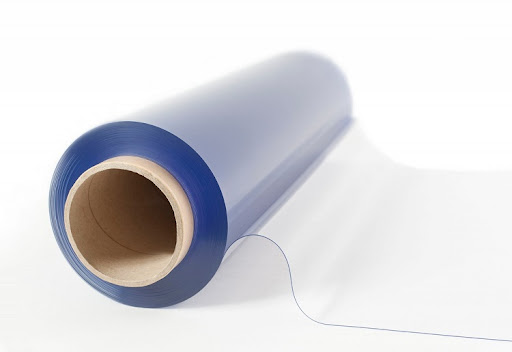
Roll of transparent flexible PVC film with a loose clear edge for curtain fabrication
DERFLEX clear PVC roll reference. A finished roll-up curtain adds compatible reinforcement, a bottom detail and a separately specified operating system.
The practical answer

What makes a roll-up patio curtain work?

Roll-up patio curtains are flexible outdoor panels that gather vertically to reopen a covered patio or porch. Choose clear vinyl for visibility, then match its thickness and finished panel weight to the lifting method. A compatible bottom bar helps the panel hang and roll evenly; reinforced edges, side restraints, structural fixings and roll clearance determine how the complete assembly operates.

01 / Define the movement

“Roll-up” can mean three different assemblies.

Approve a simple section drawing showing what rotates, what stays fixed and how the raised curtain is retained.

A / HAND ROLL

Roll from the bottom.
Hold with straps.

The operator rolls the panel around its lower bar, lifts the bundle and secures it near the header with dedicated retention straps.

Plan for: reachable retention points, manageable panel weight and enough support to keep the bundle level. Split a wide opening into practical bays where needed.

B / CORD & PULLEY

Lift the lower roll
with a cord system.

A coordinated pulley arrangement raises the roll from the bottom. The header attachment remains fixed while the rolled bundle travels upward.

Plan for: balanced lifting positions, compatible bottom bar, secure stowage and a cord arrangement approved for the location and users.

C / TOP ROLLER

Wind onto a tube
above the opening.

The panel winds onto a rotating top tube driven by a specified crank or motor. The lower rail remains at the free edge of the curtain.

Plan for: tube and bracket capacity, fabric attachment, guides, travel limits and access for maintenance. Confirm hardware compatibility with the system supplier.

Order boundary: film, fabricated panels and a complete roller system are different supply scopes. Ask DERFLEX to confirm what is included. Tracks, drives, structural anchors, local installation and system performance need their own written agreement.

Still comparing fixed, removable and zippered designs? Start with the broader clear vinyl patio curtain planning guide. For a general transparent cover rather than a rolling assembly, compare clear PVC tarp constructions.

02 / Match the film to the duty

How thick should clear vinyl be for a roll-up curtain?

Use nominal 20, 30 and 40 mil classes as comparison points, then test the selected film in the intended assembly. More thickness adds material to lift and wind; flexibility, cold behavior and surface quality also depend on the formulation.

Thickness conversions are exact unit conversions, not a DERFLEX stock list or a wind-performance rating. 1 mil = 0.0254 mm.
Nominal referenceWhen to evaluate itWhat to verify on a sample
20 mil0.508 mmA lighter comparison option for manageable hand-operated panels.Clarity, edge reinforcement, handling marks and the complete panel’s behavior when rolling and hanging.
30 mil0.762 mmA middle reference when more film body is wanted and the operating system can accommodate it.Finished assembly weight, roll diameter, winding effort and bending behavior at the intended operating temperature.
40 mil1.016 mmA heavier reference requiring closer review of the lift, bar and mounting arrangement.Actual gauge availability, tolerance, winding radius and bracket capacity. A 1.0 mm film is not exactly 40 mil.

Specify outdoor formulation separately.

State sun exposure, location, cleaning routine and the lowest temperature at which the curtain must be operated. Request grade-specific information rather than assuming that all clear PVC behaves the same. Explore DERFLEX super-clear PVC film options for the material discussion.

Approve clarity in the installed view.

Check a sample against a window, a darker interior and reflected daylight. Review waviness, tint, surface marks and seam placement. Clear flexible vinyl can reduce direct drafts and rain exposure; it does not provide the rigidity or insulation performance of a glazed wall.

03 / The lower edge matters

A bottom bar is a handling component. It is also part of the load.

For a bottom-up assembly, the bar forms the starting core of the roll. In a top-roller assembly, the lower rail helps the free edge hang. Select the bar against the actual mechanism, span and finished panel weight.

  • Choose stiffness and mass together.A bar that is easy to lift may still need a larger section to remain straight across the span. Added weight also increases operating effort and loads on the upper attachment.
  • Review corrosion and end details.Specify the bar material, finish and capped ends for the environment. Prevent exposed edges, burrs and projecting ends from rubbing the film or adjacent posts.
  • Define access and retention.A removable bar needs an accessible pocket opening and positive end retention. A permanently enclosed bar needs a fabrication and maintenance plan.
  • Check the deployed restraint separately.Gravity can help a panel hang, but a weighted hem alone does not establish wind capacity. Side closures, any lower restraints and structural attachments must be assessed as a complete system.
04 / Mount to a defined structure

Plan the header, sides and bottom as one assembly.

Mounting details must follow the chosen operating style. Identify the structural fixing surface, release points and raised bundle position before approving finished panel dimensions.

Bottom-up roll-up patio curtain mounting conceptA fixed reinforced header carries a clear curtain. Releasable side closures run down both posts. A lower bar starts the bottom-up roll. Retention straps hold the raised bundle near the header. Labels identify five interfaces requiring review. 1 / Fixed headerReinforced attachment2 / Side closuresRelease before rolling3 / Retention strapsCheck raised position4 / Bar + pocketCap, fit and secure5 / Floor gap & drainageCLEAR VINYL FIELDBottom-up concept · front elevation
Planning illustration for a bottom-up curtain, shown deployed. It is not a structural drawing. A top-roller system requires its own tube, bracket, guide and lower-rail layout.

Header: verify the load path.

Show whether the connection is on the face of a beam or beneath it. Confirm the backing material and the location of sound structural support. Decorative trim, cladding and a convenient screw position do not by themselves establish anchor capacity.

Sides: choose restraint and release.

Turn buttons, zippers, removable fixings and guided systems have different operating sequences. The panel must be released as required before it moves. Do not assume a plain zipper can run inside an unrelated roller guide.

Bottom: preserve drainage and passage.

Document the deployed gap and any seal or restraint. Check the floor slope across the whole opening. Keep the bar and straps out of access routes; a tight bottom seal must not obstruct drainage or cause the bar to drag.

Raised position: allow service access.

Check beams, gutters, lights, fans, door swings and cleaning access. Keep the bundle clear of abrasive surfaces and heat sources using the relevant equipment instructions. Cord controls require a location-appropriate safety arrangement.

Reinforced borders and pockets need compatible fabrication materials. Review the PVC coated fabric and tarpaulin range with the converter before fixing the seam construction.

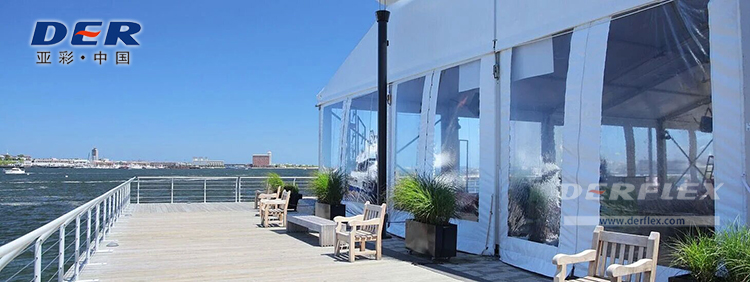
Clear flexible enclosure panels along a covered waterfront terrace with seating outside
DERFLEX transparent enclosure application reference. Use site photographs to identify posts, floor levels and obstructions; the pictured enclosure is not a verified roll-up hardware installation.
05 / Measure the installed condition

Opening size is only the starting measurement.

Submit dimensions for each bay independently. The finished curtain needs agreed allowances for the selected attachment, perimeter construction, operating movement and storage position.

Record thisHow to document itWhy it changes the order
Bay openingWidths at top, middle and bottom; heights at left, center and right. Include diagonals where the frame is irregular.Reveals taper, slope and out-of-square conditions that a single width × drop misses.
Mounting lineMark fixing surface, face or underside mount, edge offsets and structural backing.Separates clear opening dimensions from the curtain’s actual attachment position.
Rolled envelopeRequest the assembled roll or cassette dimensions, including hems, straps, rail and brackets.Sets the usable opening when raised. Film thickness alone cannot predict the complete bundle.
Side interfacesShow overlaps, zipper or guide positions, release direction and any projection from posts.Determines finished width, available viewing field and movement clearance.
Lower edgeRecord floor slope, deployed gap, drainage route and bar or rail dimensions.Avoids dragging, uneven closure and interference with pedestrian access.
Ask for one usable-clearance dimension: the distance from the lowest part of the fully raised assembly to the highest obstruction below it. Compare that measurement with the access you actually need.
06 / Make quotations comparable

What should the roll-up curtain specification include?

A useful enquiry describes both the material and its interfaces. DERFLEX can review the clear PVC material requirement; confirm panel conversion, hardware and installation responsibilities in the written offer.

Specification itemWhat to put on the enquiryApproval before production
Clear filmNominal gauge, acceptable tolerance, clear or tinted appearance, roll width and required outdoor grade.Physical sample, agreed data sheet and finish expectations. See transparent PVC roll supply for sourcing formats.
Operating methodHand roll / cord-assisted bottom roll / top-tube system; frequency of use and operator position.Assembly drawing, full panel weight and system-supplier acceptance.
Panel constructionFinished size, border material and color, clear-field layout, seams and attachment interfaces.Drawing showing tolerances, seam locations and reinforcement. Confirm usable film width for the selected grade.
Bar and pocketSection, length, finish, caps, pocket fit, insertion opening and end retention.Pocket sample made with the actual bar; agree whether the bar is supplied or sourced locally.
Project conditionsDestination, climate, exposure, operating temperature and any fire-performance requirement.Evidence for the exact quoted material and the relevant application; system requirements reviewed locally.
Commercial scopeBay count, total quantity, material rolls or finished panels, hardware inclusions, labels and packing.Written price basis, MOQ, sample plan, production lead time, shipping terms and destination.

MOQ, price and delivery depend on the grade, quantity and conversion scope. Request current confirmation rather than applying a generic number to every curtain project.

07 / Approve one complete bay

Check the first assembly before repeating it.

A clear-film swatch cannot confirm roll-up performance. For repeat panels or an OEM program, agree a first-article check using the intended bar, closures and operating method.

01 / FIT

Hang and align

Check finished dimensions, seams, bar level and fastener alignment without forcing the film into place.

02 / MOVE

Release and roll

Follow the approved sequence. Watch for skew, side binding, uneven lifting and contact with the posts.

03 / STOW

Retain and clear

Confirm secure raised retention, useful opening height and access to controls, straps and maintenance points.

04 / RETURN

Lower and inspect

Look for rubbing marks, bar migration and stressed pocket ends. Record any drawing change before repeat production.

Common ordering mistakes

  • Selecting a heavier film without checking lift effort and roll space.
  • Buying a bar before agreeing the finished pocket size.
  • Assuming side zippers can stay closed while every curtain type rolls.
  • Using opening dimensions as finished panel dimensions.
  • Treating a weighted hem as a complete wind-restraint system.

Daily use and care

  • Release the specified restraints before operating the curtain.
  • Rinse away grit and use the film supplier’s approved cleaning method.
  • Let the panel dry before extended rolled storage where practical.
  • Do not force cold, stiff or binding vinyl; follow grade-specific operating limits.
  • Follow the system supplier’s weather and stowage instructions before conditions deteriorate.
08 / Bring the material and drawing together

Discuss the clear field, border and supply format with DERFLEX.

A useful quote starts with an assembly sketch and the conditions in which it will operate.

For fabricators

Specify clear PVC rolls by gauge, width, appearance and formulation. Send the border material and processing method so sample compatibility can be assessed. Related clear PVC window film for fabricated enclosures is another material reference.

For project buyers

Provide the bay schedule, photographs and operating arrangement. Ask for a clear division between material, panel fabrication, hardware procurement and local installation.

For OEM & distributors

Align repeatable specifications, sample approval, panel identification and packing. Confirm the first order and repeat-order requirements together to reduce avoidable variations between shipments.

Questions buyers ask

Roll-up patio curtain FAQ

What is the difference between a bottom-up curtain and a top-roller curtain?

A bottom-up curtain rolls around its lower bar and the bundle is raised toward a fixed header. A top-roller curtain winds onto a rotating tube above the opening. They need different attachment, lifting and clearance details, so specify the assembly before ordering the panel.

Is 20 mil or 30 mil clear vinyl better for roll-up patio curtains?

Neither gauge is automatically better. Compare 20 mil (0.508 mm) and 30 mil (0.762 mm) against panel size, operating effort, formulation and the chosen hardware. Approve the film and a complete assembly sample, particularly when frequent rolling or cold-weather operation matters.

Do clear roll-up curtains need a bottom bar?

Many bottom-up designs use a lower bar as the rolling core and to help the panel hang evenly. Top-roller systems usually use a lower rail appropriate to that system. Confirm the bar section, weight, end treatment and pocket fit with the fabricator; a weighted edge alone does not establish wind capacity.

How much headroom should I leave above the opening?

There is no universal allowance. Obtain the complete raised envelope from the fabricator or roller-system supplier, including hems, rail, straps, brackets or cassette. Measure the usable opening below the lowest raised component and check nearby beams, doors, lights and other obstructions.

Can clear vinyl patio curtains be used in wind and cold weather?

Suitability depends on the specific film grade and complete installed system. Request grade-specific cold-operation information and the system supplier’s limits for the actual size and fixing layout. Do not transfer a wind or temperature claim from another product, or force a stiff panel to roll.

What does DERFLEX need to quote custom roll-up curtain materials or panels?

Send the bay sizes and photographs, operating style, nominal film thickness, location and exposure, border and pocket details, quantity and destination. State whether you need rolls, converted panels or hardware. DERFLEX will need to confirm the feasible supply scope, sample, MOQ, price and production timing for the enquiry.

DERFLEX / Clear PVC materials & custom project enquiriesRoll-up patio curtain specification guideBack to top ↑
Consulting Services
+86-021-54361792 / 54361798
Email
sales@derflex.com